
TL;DR:
- The iGaming industry is a multi-billion-dollar, highly regulated global market with regional differences. Key success factors include obtaining credible licensing, managing complex banking relationships, and focusing on player retention and responsible gambling. Navigating regulatory compliance and establishing multiple banking sources are crucial for sustainable growth.
The global iGaming market is not a niche corner of the internet. It is a multi-billion-pound industry valued at approximately $95–117 billion in 2025 and projected to exceed $130 billion by 2026. Yet many operators entering this space still underestimate the regulatory complexity, banking friction, and compliance demands that come with it. Whether you are launching your first platform or scaling an existing operation, understanding the full iGaming landscape is not optional. This guide breaks down what iGaming actually is, how the market is structured, and what you need to know to operate successfully in one of the world’s most tightly regulated and financially complex industries.
Key Takeaways
| Point | Details |
|---|---|
| iGaming definition | iGaming includes all real-money internet gaming activities like online casinos, sports betting, and eSports. |
| Global market dominance | Europe leads iGaming revenue while emerging markets are rapidly expanding. |
| Regulation is key | Proper licensing, AML/KYC, and compliance are essential for operator success. |
| Banking remains challenging | Operators must plan for account rejections and payment blocks with robust, compliant systems. |
| Growth strategies | Focusing on retention, responsible gambling, and strategic payment solutions drives future success. |
Defining iGaming: scope, activities, and industry players
iGaming refers to online gambling and betting activities conducted over the internet. The term covers a wide range of real-money wagering activities, all delivered through digital platforms and subject to regulatory oversight. If your business involves players staking real money online, you are operating in iGaming.
The main verticals within iGaming include:
| Vertical | Description |
|---|---|
| Online casinos | Slots, table games, and live dealer products |
| Sports betting | Pre-match and in-play wagering on sporting events |
| Online poker | Real-money card games against other players |
| Lotteries | Digital draws and instant-win games |
| Bingo | Online bingo rooms with real-money prizes |
| eSports betting | Wagering on competitive video gaming events |
Understanding who does what inside the ecosystem is just as important as knowing what the verticals are. Key players include iGaming operators, game providers, and platform developers, each with distinct responsibilities.
- Operators hold the licence, manage the player relationship, handle deposits and withdrawals, and carry the compliance burden.
- Game providers develop and supply the content, from slot titles to live casino studios.
- Platform developers build and maintain the technical infrastructure that powers the operator’s site or app.
For anyone seeking iGaming licensing essentials, understanding these roles is the foundation. Operators bear the greatest regulatory and financial risk, which is why banking and licensing decisions sit squarely on their shoulders.
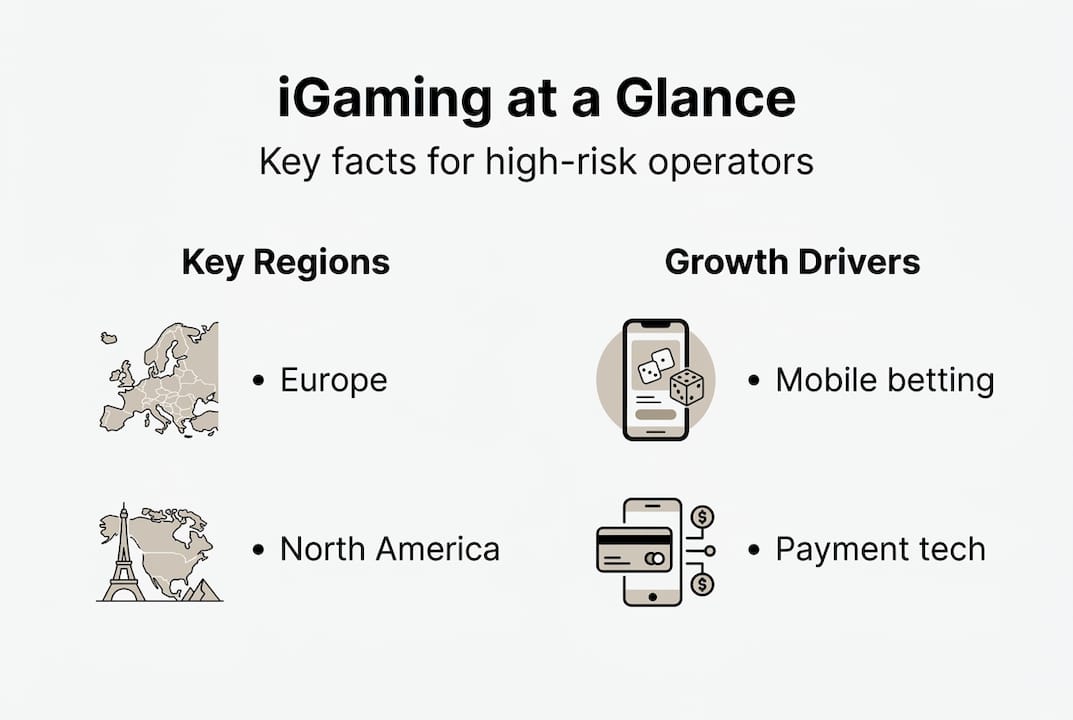
Regionally, Europe leads the global market, followed by North America and Latin America. The industry is not monolithic. Each region has its own regulatory framework, player behaviour patterns, and banking norms. Operators who treat iGaming as a single global market quickly discover that a one-size-fits-all approach rarely survives contact with local regulators.
Global iGaming market: scale, trends, and regions to watch
The numbers are hard to ignore. The iGaming market is projected to exceed $110–130 billion in 2026, with a compound annual growth rate that consistently outpaces most digital sectors. This is not speculative growth. It is driven by mobile penetration, regulatory liberalisation, and the mainstreaming of online betting across previously closed markets.
Here is how the major regions compare:
| Region | GGR share | Growth outlook |
|---|---|---|
| Europe | ~57% | Stable, regulation-driven |
| North America | ~18% | Rapid, post-legalisation |
| Latin America | ~10% | High growth, emerging |
| Asia-Pacific | ~10% | Fragmented, high potential |
| Rest of world | ~5% | Variable |
Europe commands approximately 57% of global iGaming market share, making it the dominant region by revenue and regulatory maturity.
What drives Europe’s dominance is not just population size. It is the presence of mature regulatory frameworks, high card payment penetration, and established operator brands. North America is growing fast following the liberalisation of sports betting across US states. Latin America is the region most operators are watching closely in 2026, with Brazil’s newly regulated market drawing significant operator interest.
Emerging trends reshaping the market include:
- Crypto gambling growing as a distinct vertical, particularly in markets with limited traditional banking access
- eSports betting attracting younger demographics who engage differently with traditional sportsbooks
- Increased M&A activity as larger operators acquire smaller platforms to gain market share quickly
- Regulation as a growth catalyst, where new licensing frameworks in previously grey markets unlock fresh revenue streams
For operators focused on iGaming payment processing profit, regional nuances matter enormously. Payment methods, currency preferences, and banking relationships differ sharply between Europe and LATAM, for example. Operators who build flexible payment infrastructure from day one are far better positioned to expand across borders.
Regulation, licensing, and compliance: navigating the essentials
Licensing is not just a legal formality. It is your access pass to banking, payment processing, and player trust. Without a credible licence, most banks will not touch you, and most serious payment service providers will not either.
Operators need compliant licences, with the Malta Gaming Authority (MGA) and UK Gambling Commission (UKGC) being the most preferred, alongside robust anti-money laundering and know-your-customer (AML/KYC) policies and responsible gambling measures. These are not optional extras. They are baseline requirements for operating legally and maintaining banking access.
The typical licensing process follows these steps:
- Select your target jurisdiction based on your market and banking needs
- Prepare corporate documentation, including ownership structure and source of funds
- Submit your technical and compliance documentation to the regulator
- Undergo fit-and-proper checks on directors and beneficial owners
- Receive conditional approval and complete technical certification
- Launch under supervision and maintain ongoing compliance reporting
Beyond the licence itself, compliance themes that operators must address include AML/KYC procedures, responsible gambling tools, verification of player origin (VoP), and payout source matching. VoP mismatches, where the source of a player’s deposit does not align with their withdrawal method, are one of the most common triggers for account freezes and payment blocks.
Pro Tip: Always ensure your payout sources match your player verification records. A player who deposits via card and withdraws to a different account is a red flag for both your payment provider and your bank. Catching this early prevents costly account suspensions.
For a deeper read on iGaming regulations explained, the regulatory landscape in 2026 is more complex than it was even two years ago, with new frameworks emerging in Brazil, the Netherlands, and several African markets.
Secure your iGaming growth: specialist banking and licensing support
If you are ready to face these challenges head-on, having the right specialist partner changes the outcome significantly. At BankMyCapital, we work directly with iGaming operators to secure banking relationships, get your iGaming licence in place, and build compliance-ready payment infrastructure. Our network of over 50 pre-vetted banking partners and EMIs means we can match your operation to the right financial institution from the outset, not after a string of rejections. Whether you need EU high-risk banking approval or secure payment processing tailored to iGaming, we handle the complexity so you can focus on growth.
Key regulatory frameworks: Comparing the major licensing options
Choosing a licence is one of the most consequential decisions an iGaming operator makes. It affects which markets you can serve, which banks will work with you, and how payment processors assess your risk profile. There is no universally correct answer, but there is a right answer for your specific business model, target markets, and risk appetite.

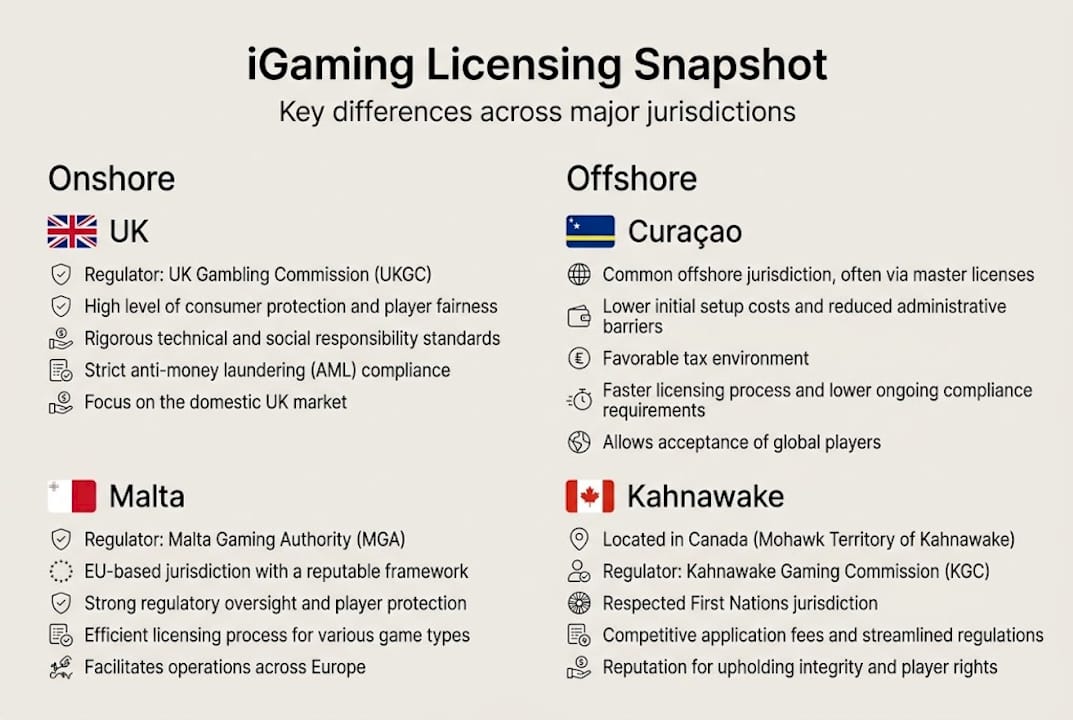
Onshore regulated markets such as the UK, Malta, Germany, Sweden, Denmark, Romania, and Ontario (Canada) require operators to meet demanding local standards. These licences signal credibility to players, banks, and payment providers. The UKGC licence is widely regarded as the gold standard globally, but it demands continuous compliance investment, mandatory player protection measures, and close regulatory scrutiny. Germany’s State Treaty on Gambling introduced strict advertising restrictions and monthly deposit limits of €1,000. Sweden’s Spelinspektionen requires a local presence and imposes stringent RG obligations. Ontario operates a regulated private market through iGaming Ontario, with its own compliance framework.
Offshore licensing regimes such as Curaçao, Kahnawake (Canada), Anjouan (Comoros), Nevis, and Liberia offer faster setup, lower costs, and fewer ongoing compliance demands. These are attractive to early-stage operators or those targeting markets without a local licensing requirement. However, premium licences like Malta’s provide EU market access and banking relationships that offshore alternatives simply cannot replicate. Anjouan licences can be obtained in weeks for a fraction of the cost of an MGA licence, but major payment processors and European banks routinely decline operators holding only offshore credentials.
Curaçao introduced stricter AML measures following its 2023 regulatory overhaul, requiring sub-licensees to transition to direct licences and meet enhanced due diligence standards. This has improved its standing somewhat, but many banks still categorise Curaçao-licensed operators as high-risk by default.
| Jurisdiction | Cost | Time to licence | EU market access | Banking ease | AML/RG standard |
|---|---|---|---|---|---|
| UKGC (UK) | Very high | 4-6 months | Yes (UK only) | Excellent | Very high |
| MGA (Malta) | High | 3-5 months | Yes (EU) | Good | High |
| Curaçao | Medium | 4-8 weeks | Limited | Moderate | Medium (post-reform) |
| Anjouan | Low | 2-4 weeks | No | Challenging | Low |
| Kahnawake | Medium | 2-3 months | Limited | Moderate | Medium |
Pro Tip: If your primary markets are EU-based, an MGA licence paired with a specialist banking partner will open far more payment processing doors than a cheaper offshore licence ever will. The short-term saving on licence fees can cost you multiples in lost revenue from declined transactions and restricted banking access. Explore bank account opening hurdles before committing to a jurisdiction.
For operators targeting emerging markets or running a lean initial operation, a crypto banking workflow for gaming can bridge the gap while a stronger licence is pursued.
Comparing major iGaming licence jurisdictions
With the main decision factors established, here is how the leading jurisdictions compare side by side. This is not a definitive ranking; it is a structured map to help you identify where your business fits.
| Jurisdiction | Approx. licence cost | Approval time | Tax on GGR | Reputation | Best for |
|---|---|---|---|---|---|
| UKGC (UK) | €500K to €1M+ | 6 to 12 months | 21 to 40% RGD | Excellent | UK-facing operators |
| MGA (Malta) | €25K to €35K | 4 to 6 months | 5% GGR | Very good | EU market access |
| Curaçao | €15K to €30K | 4 to 8 weeks | 2% net profit | Moderate | Speed, emerging markets |
| Gibraltar | €100K+ | 4 to 6 months | 1% GGR (capped) | Good | Premium brands |
| Isle of Man | €50K to €100K | 3 to 6 months | 0.1 to 1.5% GGR | Good | Crypto-friendly ops |
| Kahnawake | $25K to $50K CAD | 6 to 10 weeks | Low flat fee | Moderate | North American brands |
| Anjouan | €10K to €20K | 2 to 4 weeks | Minimal | Low to moderate | Lean startups |
| Tobique (New Brunswick) | Moderate | 8 to 12 weeks | Variable | Emerging | Canadian market |
| Romania (ONJN) | €100K+ | 6 to 9 months | 16 to 25% GGR | Regulated | Romanian players |
| Germany (GGL) | €100K+ | 6 to 12 months | 5.3% per bet (slots) | Regulated | German market |
85.7% of UKGC licensees achieved good compliance outcomes in 2025 to 2026 assessments, the highest rate among mature markets globally. That figure reflects genuine enforcement rigour, not just paperwork.
Curaçao is undergoing significant reform. The modernised Curaçao LOK framework is raising standards considerably in 2026, meaning the days of near-zero compliance are ending. Operators should factor this into cost projections. Explore your full range of iGaming licensing options before committing to any single path, and consider how offshore banking for iGaming integrates with your chosen jurisdiction.
Key jurisdiction-specific notes:
- Kahnawake: Issued by the Mohawk Territory in Canada since 1996; widely accepted in North America but less recognised in Europe.
- Anjouan: A low-cost option under the Comoros Islands framework; growing in popularity for lean operations but carries reputational risk with tier-one payment processors.
- Tobique: New Brunswick’s First Nations licence; emerging credibility, particularly for Canadian-facing operators.
- Romania and Germany: Both require local presence, high compliance investment, and significant tax commitments, but grant direct, legally protected access to those regulated player pools.
Why legal support is mission-critical in iGaming
Building an iGaming operation without embedded legal expertise is like constructing a casino without a fire safety plan. Everything looks fine until it is not, and by then the damage is severe. Legal support in this sector is not simply about reading regulations. It touches every layer of your business: how your licence application is structured, how your business plan is vetted by regulators, how player protections are documented, and how your compliance culture is communicated to banks and investors.
The numbers make this concrete. The MGA licensed 315 companies that collectively generated €84.1 million in revenue in 2024. That is a competitive, high-value market where the barrier to entry is deliberately high. Getting through that barrier without legal counsel is not just difficult; it is statistically unlikely.
Licensing pitfalls are where most operators first feel the pain. A Malta Gaming Authority application typically runs 6 to 12 months, involves technical audits, RNG certification, and ongoing quarterly reporting. Miss a step or submit incomplete documentation and the clock resets. In Sweden, operators have faced fines reaching SEK 28 million for compliance failures. The MGA itself issued €306,000 in fines across 25 cases in 2024 alone.
Proactive legal involvement reduces compliance failures by up to 40%. That is not a marginal gain; it is the difference between a business that scales and one that stalls.
Here is what competent legal support actually covers at the operational level:
- Structuring your licence application to meet jurisdiction-specific standards
- Reviewing your business plan for regulatory red flags before submission
- Drafting player protection policies that satisfy both regulators and auditors
- Establishing AML and KYC protocols that hold up under scrutiny
- Preparing your compliance documentation for bank and PSP onboarding
Pro Tip: Before you approach any regulator, have legal counsel review your corporate structure. Regulators scrutinise beneficial ownership closely, and structural issues are one of the most common reasons applications are delayed or rejected.
For operators ready to move forward, our iGaming licensing guide outlines the key steps and what to prepare before you begin.
Why iGaming regulations matter: The global compliance puzzle
Regulation in iGaming exists for three core reasons: preventing financial crime, protecting players, and securing tax revenue for governments. These goals sound straightforward, but the mechanics behind them create an intricate web of obligations that operators must navigate daily. Anti-money laundering (AML) rules require you to verify who your players are, monitor their transactions, and report suspicious activity. Responsible gambling (RG) obligations mean you must provide self-exclusion tools, deposit limits, and reality checks. Tax frameworks vary wildly, from flat gross gaming revenue levies to complex tiered structures.
The three most influential regulatory bodies globally are the UK Gambling Commission (UKGC), the Malta Gaming Authority (MGA), and the Curaçao Gaming Control Board. Each represents a distinct philosophy. The UKGC sets strict AML and RG standards, requiring robust customer due diligence (CDD), ongoing transaction monitoring, and mandatory reporting of suspicious activity. The MGA offers a credible EU-facing framework with comparable AML expectations. Curaçao, historically the most permissive of the three, has introduced meaningful reform in recent years, though its reputation with banks remains mixed.
Key compliance obligations that every operator must prioritise include:
- Customer due diligence (CDD): Verifying player identity at onboarding and throughout the relationship.
- Suspicious activity reports (SARs): Filing timely reports when transactions raise red flags.
- Responsible gambling tools: Self-exclusion registers, affordability checks, and intervention protocols.
- Source of funds checks: Demonstrating that large deposits originate from legitimate sources.
- Record-keeping: Maintaining transaction and identity records for regulatory inspection.
“Operators who treat AML and RG as tick-box exercises rather than operational culture tend to be the ones making headlines for the wrong reasons. Regulators are not just reading your policy documents — they are watching your data.”
Spain and the UK have both issued significant fines in recent years for failures in CDD and SAR reporting. These are not edge cases. They are the predictable outcome of under-investing in legal support for gaming compliance. Getting the foundations right is not optional — it is the price of operating in regulated markets.
Banking and payments: overcoming high-risk hurdles
Banking is where many iGaming businesses hit a wall. Traditional banks categorise iGaming under Merchant Category Code (MCC) 7995, which flags the business as high-risk. The result is routine rejection, unexpected account closures, and payment blocks that can halt operations overnight.
Banking remains the biggest challenge for iGaming operators despite the market’s maturity and multi-billion-pound scale.
The core pain points are predictable but still catch operators off guard. Rejected merchant accounts, sudden termination of banking relationships, delayed settlements, and high chargeback ratios all compound the operational risk. Crypto-specific operators face additional scrutiny under MiCA (Markets in Crypto-Assets regulation) and must register as Virtual Asset Service Providers (VASPs) in relevant jurisdictions.

High-risk operators must prioritise multi-bank redundancy, compliance-first payment service providers, and proactive risk management to maintain stable operations.
The banking must-haves for any serious iGaming operator include:
- Multiple banking relationships across at least two jurisdictions to avoid single points of failure
- Dedicated iGaming PSPs with direct experience handling MCC 7995 accounts
- Chargeback management protocols to keep ratios below the thresholds that trigger account reviews
- Segregated player funds accounts to satisfy regulatory requirements and build bank confidence
- Crypto payment rails as a supplementary channel, particularly for markets with limited card access
Pro Tip: When selecting a payment service provider, prioritise those with a proven track record in iGaming specifically, not just general high-risk processing. A PSP that handles adult entertainment or forex is not automatically equipped for the chargeback profile and regulatory demands of iGaming.
For practical guidance, our iGaming banking tips and payment processing best practices cover the operational detail that most operators only learn the hard way.
Strategic priorities: the operator’s playbook for growth in 2026 and beyond
The operators who are growing fastest in 2026 are not simply the ones with the biggest marketing budgets. They are the ones who have shifted their focus from customer acquisition cost (CAC) to lifetime value (LTV), building retention engines rather than just acquisition funnels.
Operators now emphasise retention-focused metrics, responsible gambling as a central KPI, and view Latin America as the leading emerging market opportunity. This is a meaningful shift from the growth-at-all-costs mindset that defined the sector five years ago.
AI-driven personalisation is central to this retention push. Platforms that use behavioural data to tailor bonus offers, game recommendations, and communication timing are seeing measurably higher player engagement. Responsible gambling is no longer just a compliance checkbox. Regulators in multiple jurisdictions now require operators to demonstrate active harm prevention, and players increasingly expect it.
Entering emerging markets like Brazil or Nigeria requires payment innovation as much as product adaptation. Local payment methods, currency support, and banking relationships in-country are often the deciding factor between a successful launch and an expensive failure.
The operator’s 2026 growth checklist:
- Implement AI-driven personalisation for retention and bonus optimisation
- Establish responsible gambling tools as a competitive differentiator, not just a compliance requirement
- Build payment infrastructure that supports local methods in target emerging markets
- Maintain at least two active banking relationships at all times
- Review your licensing structure annually as new jurisdictions open and existing ones tighten
- Invest in compliance technology to automate AML/KYC monitoring at scale
The tough truths few talk about in iGaming
Most guides on iGaming focus on the opportunity. We want to be honest about the grind. Even operators with strong licences, healthy player numbers, and solid compliance programmes routinely face rejected payments, unexpected bank requests for additional documentation, and payment processor reviews that freeze settlements for weeks.
Banking and payment flexibility is the true operational moat in this industry. A great product with unstable banking is a business under constant threat. We have seen operators with licences from respected jurisdictions lose banking access because their transaction patterns looked unusual to an automated risk system. No human reviewed it. The account was just closed.
Regulatory environments also change faster than most operators plan for. A jurisdiction that was straightforward two years ago may now require additional player verification layers, new reporting obligations, or revised responsible gambling tools. Static compliance playbooks become liabilities. The operators who survive long-term are those who plan for the worst-case banking disruption rather than optimising only for the best case.
For anyone navigating bank account opening in iGaming, the risk mindset is not pessimism. It is the most practical competitive advantage you can build.
Recommended
- iGaming regulations explained for international operators
- Essential iGaming banking tips for smooth operations
- iGaming payment processing: how it drives profit in 2026
- iGaming Licensing – Online Casino Licenses » Bank My Capital
Frequently asked questions
How does an online casino open a bank account?
An online casino opens a bank account by first holding a recognised gaming licence, then applying to banks or EMIs that explicitly serve licensed gambling operators. The licence is the single biggest approval factor: it proves player-fund segregation, responsible-gaming controls and AML compliance. Most high-street banks decline gambling outright, so licensed EMIs and gaming-friendly banks are the realistic route. Approval also depends on transaction volumes, the payment-method mix and the jurisdictions you serve. BankMyCapital pre-screens each iGaming case against gambling-friendly banking and EMI partners and submits only where approval is likely.
Which banks are gambling-friendly in 2026?
Truly gambling-friendly banking is concentrated in specialist EMIs and a small number of banks in jurisdictions that regulate remote gaming, rather than mainstream retail banks. The right partner depends on your licence, turnover and target markets. The table below compares the main iGaming licensing jurisdictions and how banks treat each.
| Jurisdiction | Regulator | Banking acceptance | Best for |
|---|---|---|---|
| Malta (MGA) | Malta Gaming Authority | High — strong EU banking access | EU-facing operators wanting credibility |
| UK (UKGC) | UK Gambling Commission | High but strict | UK market, high-trust brands |
| Curacao | Curacao Gaming Control Board | Moderate — EMIs over banks | Fast, cost-effective launch |
| Anjouan | Anjouan Gaming Board | Lower — EMI-dependent | Budget startups |
| Tobique / Kahnawake | First Nation commissions | Niche | Specific North American models |
Why do banks reject iGaming companies?
Banks reject iGaming companies mainly because of chargeback and fraud exposure, AML risk around player funds, reputational concerns, and uncertainty over which markets the operator serves. A weak or low-tier licence, unclear ownership, or no player-fund segregation almost guarantees rejection. The fix is a clean compliance file: a respected licence, segregated client accounts, documented KYC/AML procedures, and a clear explanation of geographic restrictions and expected volumes.
What payment methods can an online casino accept?
Licensed casinos typically accept card payments through a high-risk acquirer, alternative payment methods (open banking, e-wallets, vouchers), and increasingly crypto, with settlement handled by gaming-friendly PSPs. Your licence and banking setup determine which methods are realistically available, which is why payments, licensing and banking should be planned together rather than separately.
What types of businesses are considered iGaming?
Any business offering online gambling activities such as online casinos, sports betting, poker, lotteries, bingo, or eSports with real-money wagering qualifies as an iGaming business.
Why is iGaming classed as high-risk by banks?
Due to elevated chargeback rates, legal complexity, and regulatory variation across jurisdictions, banks view iGaming as high-risk and impose strict account conditions or refuse relationships outright.
Which licences are most recognised for iGaming operators?
The Malta Gaming Authority (MGA) and UK Gambling Commission (UKGC) are the most widely recognised, with MGA and UKGC licences opening the most banking and payment processing doors globally.
How big is the iGaming market in 2026?
The global iGaming market is projected to exceed $110–130 billion in 2026, with Europe accounting for the largest share and Latin America growing fastest.
What is the future outlook for high-risk iGaming operators?
Operators who prioritise retention metrics, robust compliance, and multi-bank redundancy will be best positioned as regulatory demands increase and new markets open.
