
TL;DR:
- Legal support is essential throughout all phases of iGaming licensing, compliance, and operations.
- Choosing the right jurisdiction and proactive legal planning improve speed and reduce regulatory risks.
- Embedding legal strategies enhances growth, operational resilience, and access to banking and payment solutions.
Most iGaming operators spend months perfecting their product, their payment stack, and their brand identity, then treat legal support as an afterthought. That is a costly miscalculation. The global iGaming market is valued at $101 billion in 2026, and regulators across the EU and offshore jurisdictions are tightening their grip on who gets to operate in it. Licensing delays, compliance failures, and regulatory fines are not abstract risks; they are the specific outcomes that end iGaming businesses before they reach profitability. This guide breaks down exactly where legal support earns its place, from jurisdiction selection through to audit readiness and long-term operational resilience.
Key Takeaways
| Point | Details |
|---|---|
| Legal is foundational | Legal support underpins every successful iGaming operation from licensing to compliance. |
| Jurisdiction choice matters | Legal guidance makes cross-border licensing and compliance more predictable and secure. |
| Compliance shields your business | Properly managed legal frameworks minimise fines and help attract partners and investors. |
| Proactive legal is strategic | Treat legal advisors as strategic partners, not just problem solvers, for lasting growth. |
Why legal support is mission-critical in iGaming
Building an iGaming operation without embedded legal expertise is like constructing a casino without a fire safety plan. Everything looks fine until it is not, and by then the damage is severe. Legal support in this sector is not simply about reading regulations. It touches every layer of your business: how your licence application is structured, how your business plan is vetted by regulators, how player protections are documented, and how your compliance culture is communicated to banks and investors.
The numbers make this concrete. The MGA licensed 315 companies that collectively generated €84.1 million in revenue in 2024. That is a competitive, high-value market where the barrier to entry is deliberately high. Getting through that barrier without legal counsel is not just difficult; it is statistically unlikely.
Licensing pitfalls are where most operators first feel the pain. A Malta Gaming Authority application typically runs 6 to 12 months, involves technical audits, RNG certification, and ongoing quarterly reporting. Miss a step or submit incomplete documentation and the clock resets. In Sweden, operators have faced fines reaching SEK 28 million for compliance failures. The MGA itself issued €306,000 in fines across 25 cases in 2024 alone.
Proactive legal involvement reduces compliance failures by up to 40%. That is not a marginal gain; it is the difference between a business that scales and one that stalls.
Here is what competent legal support actually covers at the operational level:
- Structuring your licence application to meet jurisdiction-specific standards
- Reviewing your business plan for regulatory red flags before submission
- Drafting player protection policies that satisfy both regulators and auditors
- Establishing AML and KYC protocols that hold up under scrutiny
- Preparing your compliance documentation for bank and PSP onboarding
Pro Tip: Before you approach any regulator, have legal counsel review your corporate structure. Regulators scrutinise beneficial ownership closely, and structural issues are one of the most common reasons applications are delayed or rejected.
For operators ready to move forward, our iGaming licensing guide outlines the key steps and what to prepare before you begin.
Navigating key EU and offshore jurisdictions
Choosing the right jurisdiction is one of the most consequential decisions you will make as an iGaming operator. It shapes your tax exposure, your player market access, your banking options, and the credibility of your brand. Legal advisors do not just explain the differences; they help you match your business model to the jurisdiction that gives you the best operational fit.

Here is a direct comparison of the four most commonly chosen licensing routes:
| Jurisdiction | Timeframe | Cost range | Key requirements | Market access |
|---|---|---|---|---|
| Malta (MGA) | 6 to 12 months | €25,000+ | AML, KYC, RNG, GDPR, fund segregation | EU-wide |
| Curaçao | 2 to 4 months | $15,000+ | Basic AML, operator compliance | Global |
| Isle of Man | 6 to 9 months | £35,000+ | Technical audit, player fund protection | UK, global |
| Gibraltar | 6 to 12 months | £100,000+ | Full regulatory audit, B2B/B2C split | UK, EU |
In EU jurisdictions like Malta, legal counsel assists with rigorous application processes, business plan reviews, ongoing reporting, and GDPR and AML standards. The process is demanding by design. Regulators want to see that you have the operational maturity to sustain compliance, not just pass a one-time check.
Here is the sequencing that experienced legal teams follow when guiding an operator through the licensing process:
- Corporate structure review and beneficial ownership mapping
- Jurisdiction selection based on target markets and operational model
- Pre-application consultation with the relevant regulator
- Preparation and submission of the full licence application
- Technical audit coordination and RNG certification
- Regulatory Q&A management during the review period
- Post-award compliance framework setup
Offshore jurisdictions like Curaçao offer faster timelines and lower entry costs, but they come with their own hidden risks. Banking access, payment processing, and player trust can all be harder to secure without the right legal groundwork. Explore the full picture in our guide to offshore iGaming options and why offshore jurisdiction selection matters more than most operators realise.
Meeting compliance: GDPR, AML, and player protection
Obtaining a licence is the beginning, not the finish line. Regulators expect continuous compliance, and the standards they apply evolve constantly. This is where many operators underestimate the ongoing cost of getting it wrong.
Legal counsel assists with GDPR, anti-money laundering protocols, and ongoing compliance including segregated player funds and RNG certification. These are not one-off tasks. They require living documentation, regular internal audits, and staff training that holds up when a regulator walks through the door.
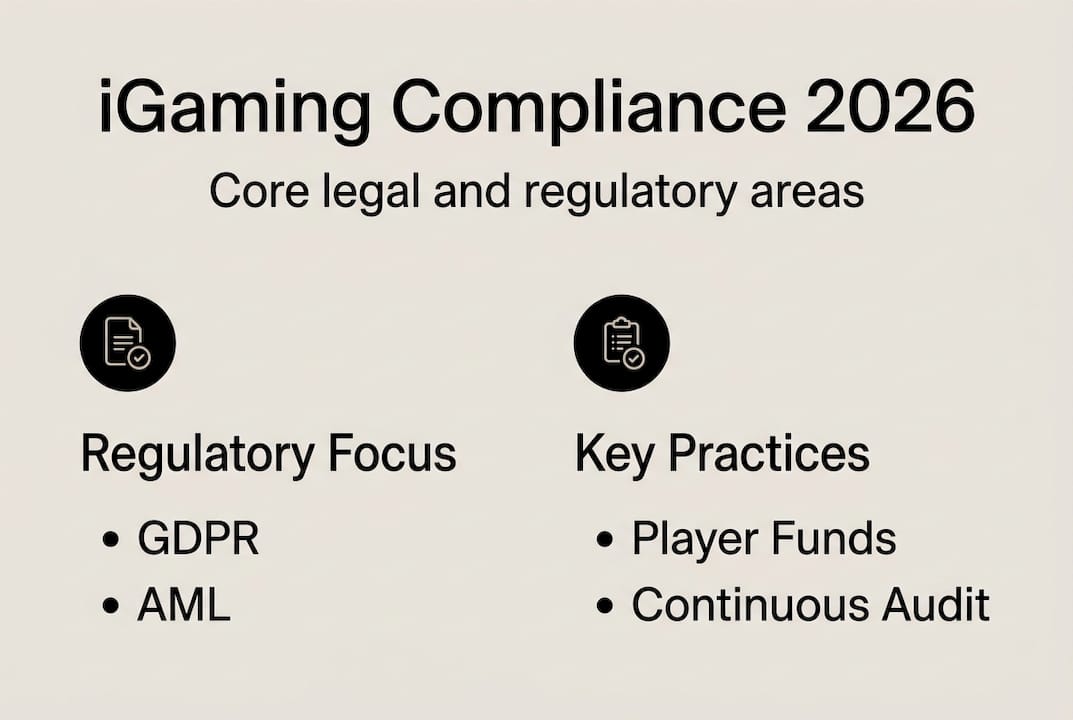
Here is what regulators typically examine during a compliance review:
| Compliance area | What regulators check | Consequence of failure |
|---|---|---|
| GDPR | Data processing agreements, consent records | Fines up to 4% of global turnover |
| AML | Transaction monitoring, suspicious activity reports | Licence suspension or revocation |
| KYC | Identity verification, source of funds | Regulatory censure, fines |
| Player fund segregation | Separate accounts, reconciliation records | Immediate enforcement action |
| RNG certification | Third-party audit certificates | Game suspension |
The MGA’s 2024 enforcement record, €306,000 across 25 cases, demonstrates that regulators are actively monitoring and acting. Sweden’s Spelinspektionen has been equally assertive, with multi-million krona fines issued for marketing violations and AML failures.
Key areas where legal support is non-negotiable:
- Drafting and maintaining your AML and KYC policy documentation
- Responding to player complaints in a regulator-compliant manner
- Preparing for annual audits with pre-audit internal reviews
- Keeping GDPR data processing records current and audit-ready
- Monitoring regulatory updates and translating them into operational changes
Pro Tip: Schedule a mock compliance inspection every six months. Have your legal team simulate the questions a regulator would ask. Gaps that feel minor in theory become critical liabilities in a real review. Operators who survive licence reviews treat preparation as a continuous process, not a pre-audit scramble.
For deeper guidance, our resources on compliance best practices and banking compliance strategies cover the operational detail that most operators miss.
Essential legal strategies for sustainable iGaming operations
The operators who build durable iGaming businesses do not wait for a regulatory letter before calling their lawyers. They build legal processes into their operational rhythm from day one. This shift from reactive to proactive is what separates businesses that scale from those that plateau.
Proactive legal involvement in audits and regulatory reviews can turn enforcement interactions into compliance-strengthening opportunities rather than crises. That reframe matters enormously. When a regulator sees an operator who has already identified and addressed a gap, the conversation changes.
Here is a practical legal launch checklist for iGaming operators:
- Appoint a dedicated legal adviser with iGaming sector experience before incorporation
- Complete a corporate structure review and beneficial ownership audit
- Select jurisdiction and obtain pre-application regulatory guidance
- Draft all core compliance policies: AML, KYC, responsible gambling, GDPR
- Establish a contract template library for affiliate, supplier, and player agreements
- Set up a regulatory monitoring process to track rule changes in your target markets
- Build a compliance calendar with quarterly internal reviews and annual external audits
Legal support also directly improves your relationships with banks, payment service providers, and investors. These parties run their own due diligence on your compliance posture. A well-documented legal framework signals operational maturity. It is often the deciding factor in whether a PSP or bank approves your application or declines it.
Pro Tip: When approaching a bank or PSP, present your compliance documentation proactively. Do not wait to be asked. Operators who arrive with a prepared compliance pack close onboarding processes significantly faster than those who respond to requests reactively.
For operators at the banking stage, our guide to bank account setup for iGaming covers what financial institutions actually want to see before they say yes.
Why legal support is your iGaming growth multiplier — what most guides miss
Most commentary on iGaming legal support frames it as a cost centre. A necessary expense. Something you manage rather than leverage. We disagree, and the evidence from operators who build lasting businesses backs that view.
Legal support, when embedded early and treated as a strategic function, compresses your time to market. It removes the back-and-forth with regulators that adds months to licensing timelines. It makes your compliance documentation a sales asset with banks and investors, not just a regulatory obligation. It gives you the confidence to enter new markets because you have a framework that adapts rather than one that breaks.
The operators who struggle are almost always those who treated legal as a final step rather than a foundation. They built their product, found their players, then discovered that their corporate structure was wrong, their AML policy was insufficient, or their banking options were closed because their compliance posture was weak.
In a high-risk sector, your legal framework is genuinely your most valuable operational asset. It determines who will bank you, who will process your payments, and which markets you can enter. View our real licensing case studies to see how operators with strong legal foundations move faster and face fewer obstacles than those who retrofit compliance after launch.
How Bank My Capital supports your iGaming legal needs
At BankMyCapital, we work exclusively with high-risk operators who need more than generic advice. Our team supports iGaming businesses from jurisdiction selection through to banking and payment processing, with an 87% approval rate across our network of over 50 pre-vetted banking partners and EMIs. Whether you are pursuing an iGaming licensing solution in Malta or exploring offshore routes, we handle the complexity so you can focus on building your operation. Our licensing advisory services cover the full process, from pre-application structuring to post-award compliance setup, with typical onboarding completed in 2 to 3 weeks.
Frequently asked questions
How long does it take to obtain an iGaming licence in the EU?
It typically takes 6 to 12 months to secure an iGaming licence in the EU, especially in jurisdictions like Malta, due to detailed application and compliance reviews.
What are the main compliance risks for iGaming operators?
Top compliance risks include failing GDPR or AML checks, improper player fund segregation, and missing technical audit requirements. In 2024, 25 MGA cases resulted in €306,000 in fines, illustrating how quickly exposure accumulates.
How does legal support help prevent regulatory fines?
Legal experts set up and monitor robust compliance systems, reducing failure rates by up to 40%, helping operators avoid the audit outcomes that most commonly lead to enforcement action.
Is legal support required for offshore iGaming licences?
While not always legally mandated, strong legal counsel is crucial to avoid hidden pitfalls, meet local requirements, and secure payment processing. Jurisdictional requirements vary significantly, and gaps are rarely obvious without specialist guidance.
Recommended
- Best 8 Offshore Bank Accounts for iGaming 2026
- Why offshore jurisdictions matter for high-risk businesses in 2026
- Bank Account Opening for iGaming and Online Casino » Bank My Capital
- iGaming Licensing – Online Casino Licenses » Bank My Capital
- Financial compliance trends: Key strategies for 2026
- Legal industry outsourcing trends: optimize service delivery in 2026
