
Running a crypto exchange, gambling platform, forex education site, or adult subscription business means dealing with multiple currencies daily—and in 2026, that complexity demands a structured banking strategy or you’ll face rejection, account closures, and lost revenue. Most EMIs and traditional banks won’t touch high-risk companies handling multiple currencies simultaneously, but those who understand how to structure their flows correctly still get approved and stay open.
What Is a Multi-Currency Business Account?
A multi-currency business account allows your company to receive, send, and hold money in multiple currencies—EUR, USD, GBP, and others—often within a single banking relationship or across a coordinated structure of accounts.
Unlike a basic EUR IBAN that converts everything through expensive correspondent banks, a true multi-currency setup lets you:
- Receive client payments in their local currency without forced conversion
- Settle supplier invoices and PSP commissions in their preferred currency
- Hold multiple currency balances simultaneously
- Reduce foreign exchange (FX) exposure and eliminate unnecessary conversion spreads
- Isolate crypto flows from fiat operations if required by compliance
The key distinction is that not all multi-currency accounts are equivalent. An EMI offering EUR + optional USD differs fundamentally from an offshore bank providing SWIFT access to multiple major currencies.
Types of Multi-Currency Accounts
| Account Type | What You Get | Best For |
|---|---|---|
| EMI (Europe) | EUR + optional USD/GBP via partner bank | Daily operations, SEPA settlements, card issuing |
| Offshore Bank | USD, GBP, EUR with full SWIFT support | Treasury, PSP settlements, crypto-friendly operations |
| Traditional EU Bank | EUR primary + limited FX capability | Credibility, licensing base, investor relations |
| Crypto PSP / OTC Desk | Crypto to EUR/USD/GBP with KYT integration | Stablecoin off-ramps, crypto-to-fiat conversion |
| Hybrid Structure | Multiple EMIs + offshore account + OTC partner | Complete flexibility across all currency pairs |
Why High-Risk Companies Can’t Survive on One Currency
If your business operates internationally, serves clients across multiple regions, or touches crypto and alternative payment channels, a single EUR IBAN becomes a liability—not an asset.
Here’s the operational reality:
Client payments arrive in multiple currencies. Your Latin American clients pay in USD, your UK affiliate partners in GBP, and your EU base in EUR. Forcing every incoming payment through a single EUR account means paying FX conversion spreads on every transaction—typically 1.5–3% per conversion.
Suppliers and PSPs settle in different currencies. If you outsource compliance to a US vendor, they invoice in USD. If your primary payment facilitator is in London, they settle in GBP. If you use a Maltese gaming licence, many suppliers operate in EUR. A single-currency account forces you to convert outbound payments repeatedly.
Reliance on a single EMI is a closure risk. EMIs fail or de-risk high-risk verticals without warning. During 2023–2024, dozens of gambling and crypto-friendly EMIs shut down their high-risk desks. If your entire operation depends on one provider and they close, your cash flow stops.
Margin erosion from forced conversion. On a £2 million monthly operation across three currencies, unnecessary FX conversion costs £30,000–60,000 per month. Over 12 months, that’s £360,000–720,000 in lost profit.
Some offshore PSPs and suppliers only settle in USD. If your primary revenue comes from US-based clients or you use a US offshore payment processor, they won’t send you EUR—they send USD. Without a USD receiving account, you either accept a conversion loss or you’re stuck.
Multi-currency access provides operational resilience, protects margin, and ensures you’re not dependent on a single provider’s risk appetite.
The Core Challenges: Why Banks Say No
The barriers to multi-currency access for high-risk companies are steep and specific. Understanding them is the first step to overcoming them.
Challenge 1: Limited EMI Capability
Most European EMIs offer a single EUR IBAN, sometimes with optional sub-accounts in USD or GBP via a partner bank. This is not true multi-currency—it’s EUR with a thin layer of FX access, and it’s slow, expensive, and easily revoked if the partner bank de-risks.
Challenge 2: USD Access Is Restricted Due to De-risking
Correspondent banking relationships between European and US banks have contracted dramatically. Banks are unwilling to serve high-risk merchants because of FATF compliance requirements and potential SAR (Suspicious Activity Report) filing obligations.
For a gaming or crypto business, accessing USD through a traditional European bank is now nearly impossible. Even offshore banks face restrictions when moving large USD volumes.
Challenge 3: GBP Access Is Increasingly Local-Only
Post-Brexit, UK EMIs face pressure from regulators and their acquiring banks. Many have withdrawn GBP access to non-UK entities or require UK local presence (entity + director + address).
Challenge 4: Crypto Exposure Flags You Immediately
Declare that your business touches crypto, and most banks and EMIs will either reject you outright or demand such stringent controls that your operation becomes unworkable.
KYT (Know Your Transaction) and wallet AML screening tools help, but they’re table stakes—not silver bullets. Banks assume crypto = money laundering until you prove otherwise.
Challenge 5: High-Volume FX Activity Looks Suspicious
If you’re moving large volumes between currencies without clear documentation, compliance teams assume you’re hiding something. A £10 million monthly FX operation with no documented business rationale will be flagged and likely closed.
The Solution: Structured, Documented, Transparent Flows
To secure multi-currency accounts that actually work, you must:
- Structure entities and flows by currency. Each major currency should have a documented business function.
- Declare crypto exposure upfront. Don’t hide it; explain it with KYT tools and audit trails.
- Separate client intake from treasury functions. Use different accounts for different purposes.
- Work with providers who actually accept high-risk clients. Cold applications fail; introductions from vetted channels succeed.
EMI vs Offshore Bank vs Traditional Bank: A Direct Comparison
| Feature | EMI (EU) | Offshore Bank | Traditional EU Bank |
|---|---|---|---|
| EUR access (SEPA) | ✅ Yes | ❌ Usually not | ✅ Yes |
| USD access (SWIFT) | ⚠️ Sometimes (via partner) | ✅ Yes | ✅ Rare (low-risk only) |
| GBP support | ⚠️ Sometimes | ✅ Yes | ✅ Sometimes |
| Crypto onboarding tolerance | ✅ Moderate | ✅ High | ❌ No |
| Gaming/adult tolerance | ✅ Moderate–High | ✅ High | ❌ Very low |
| Speed of onboarding | ✅ 7–21 days | ⚠️ 2–8 weeks | ❌ 1–3 months+ |
| Annual compliance burden | ✅ Low | ⚠️ Medium | ⚠️ High |
| Ideal use case | Operations, SEPA, card issuing | Treasury, settlement, crypto | Licensing base, credibility |
Strategic approach: Use EMIs for daily operational flows (client intake, SEPA settlements), offshore banks for treasury and holdover funds, and EU banks for credibility if you can secure them.
Top Jurisdictions for High-Risk Multi-Currency Accounts
Not all jurisdictions are equal. Some actively support high-risk businesses; others are hostile.
Lithuania
Why it works: Fast onboarding EMIs with explicit crypto tolerance. Many Lithuanian EMIs will onboard gaming and crypto businesses within 2–3 weeks.
Currencies supported: EUR primary, some USD via partner.
Best for: EU-focused operations, SEPA + card issuing.
Malta
Why it works: The Malta Gaming Authority (MGA) licence is globally recognised. Malta’s banking sector is accustomed to gaming, and EMIs here have proven crypto tolerance.
Currencies supported: EUR, USD.
Best for: Licensed gaming operators, B2B gaming services.
Czech Republic
Why it works: Large PSP ecosystem with multiple competing EMIs. Faster onboarding than Western Europe, crypto-tolerant compliance teams.
Currencies supported: EUR, GBP, some USD.
Best for: Multi-currency EU operations, PSP integrations.
Belize
Why it works: Offshore USD accounts with moderate crypto tolerance. Faster approvals than traditional banks, but with higher due diligence expectations.
Currencies supported: USD, USDT, EUR.
Best for: Treasury holdings, PSP fallback, crypto off-ramp partners.
Switzerland
Why it works: Private banks and OTC desks actively serve crypto businesses. SWIFT access is straightforward, and CHF provides additional diversification.
Currencies supported: EUR, CHF, USD, crypto.
Best for: Crypto off-ramps, high-value treasury, investor-facing operations.
UAE (ADGM, DMCC)
Why it works: Explicitly pro-crypto jurisdiction. Banks and OTC desks designed for crypto-to-fiat conversions.
Currencies supported: AED, USD, crypto.
Best for: Crypto businesses, OTC ramps, Middle Eastern client bases.
Building a Setup That Won’t Get Flagged or Shut Down
To secure multi-currency accounts that actually persist, your setup must be transparent, logically structured, and defensible to compliance teams.
The Four Principles
Principle 1: Transparency
Declare everything upfront. If your business touches crypto, gaming, FX, or adult content, tell every provider before they ask. Hiding it and getting caught means immediate closure.
Principle 2: Logical Segmentation
Each currency should have a documented business function. EUR for EU client intake, USD for PSP settlements, GBP for UK affiliate campaigns. Don’t mix purposes; don’t shuffle money between accounts without clear rationale.
Principle 3: Risk-Based Isolation
If crypto is higher-risk than fiat, put it in a separate account or with a separate provider. If gaming is higher-risk than forex education, isolate those flows. This reduces the likelihood that one flagged transaction shuts down your entire operation.
Principle 4: Vetted Introductions
Never cold-apply to a bank or EMI as a high-risk business. Work with introducers—accountants, legal firms, or specialists—who have existing relationships and can vouch for you.
Sample Multi-Currency Structure
| Component | Currency | Business Function | Provider Type |
|---|---|---|---|
| Client Intake EMI | EUR | SEPA payments from EU clients | Lithuanian or Czech EMI |
| Treasury Account | USD | PSP settlements, holdover, FX buffer | Offshore bank (Belize/Mauritius) |
| Secondary EU EMI | GBP | UK affiliate campaigns, UK client payments | Czech or UK EMI |
| Crypto Ramp | USDT → USD/EUR | Stablecoin to fiat off-ramp | Swiss or UAE OTC desk |
| Holding Account | EUR, CHF | Investor funds, security deposits, long-term holdings | Swiss private bank |
Each account is declared to the provider, has clear documentation, and serves a specific purpose that compliance teams can understand and justify.
Real Case Study: Crypto + FX Business with 5 Currency Channels
Company Profile: Crypto margin trading education platform + B2B forex brokerage referral network. Monthly revenue: £3.2 million across crypto (35%), EU affiliate referrals (40%), and direct FX education sales (25%).
Entity Structure:
- Cyprus OpCo (operations) with BVI HoldCo (holding company)
- Two UBOs from EU, both fully vetted and KYC’d
- Licensed OTC partner in Switzerland for crypto off-ramp
Multi-Currency Setup:
- Czech EMI (Primary): EUR account for SEPA intake, card issuing, EU client settlements. Volume: £1.3M/month.
- Offshore Bank (Belize): USD operations account for PSP settlements and FX commission payouts. Volume: £900K/month.
- Swiss OTC Desk: Crypto off-ramp facility. Stablecoin inflows converted to EUR/USD. Volume: £800K/month (crypto).
- UK EMI: GBP account for UK affiliate partner campaigns and UK client payments. Volume: £200K/month.
- Swiss Private Bank: Treasury holding account in EUR and CHF for investor funds and operational reserves. Volume: £1.5M+ (holding).
Compliance Infrastructure:
- Chainalysis KYT wallet screening on all incoming crypto
- Full AML documentation and policies
- Entity structure diagram provided at onboarding
- Transaction forecasts by currency and business line
- Monthly compliance reporting to each provider
Timeline:
- Month 1: Entity setup, documentation prep, introduction to Czech EMI
- Week 2–3: Czech EMI approval, account opening
- Week 4–6: Offshore bank KYC and approval
- Week 7–8: Swiss OTC desk integration
- Week 9–10: UK EMI approval
- Week 11–12: Swiss private bank integration
- Total: 45 days from first application to fully operational.
Result: ✅ Five-currency setup live and tested with small transactions
✅ No provider overlap in functions—each knows its role
✅ Zero compliance hiccups post-launch
✅ Margin protected: eliminated £40K/month in unnecessary FX conversions
Lesson: Structure is a compliance category. When you segment flows logically and document each one, banks say yes.
Essential Documents for Multi-Currency Onboarding
Banks and EMIs want evidence that you’ve thought through your operation. Missing documents = rejection.
| Document | Required For | What to Include |
|---|---|---|
| Company incorporation docs | All accounts (EMI, bank, offshore) | Articles of association, cert. of incorporation, shareholder registry |
| UBO verification + proof of address | KYC for each provider | Passport/ID, utility bill, signed UBO declaration (within 3 months) |
| Flow-of-funds map by currency | EMI, PSP, and offshore onboarding | Diagram showing where each currency comes from, where it goes, volumes, frequency |
| Business model summary (plain language) | All applications | 1–2 page overview: what you do, who your clients are, revenue sources, why you need each currency |
| KYT/AML policies | Crypto or FX flows | If crypto-exposed: KYT screening tool, wallet audit process, SAR filing procedure |
| Transaction forecast (by currency) | Must align with business description | Monthly volumes for each currency, projected growth, breakdown by client type |
| Website, platform demo, or screenshots | EMI & bank compliance approval | Working product, live merchant portal, or demo environment showing your actual operation |
| Sample contracts or invoices | PSP and offshore bank validation | Customer agreements, supplier invoices, PSP settlement statements (redacted) |
| Regulatory filings or licence documents | If applicable | MGA gaming licence, FCA authorisation, or other relevant approvals |
Pro tip: Include a one-page cover letter explaining your structure. Which currency flows through which account? Why? Compliance teams review dozens of applications weekly; clear communication gets fast approvals.
Compliance Tools That Matter: KYT, AML, and Traceability
Banks don’t just want to see your structure; they want proof that you monitor it.
Essential Tools
Chainalysis, Elliptic, or Crystal Wallet risk scoring and transaction screening. Required for any crypto inflow.
SumSub or IdentityMind Creator and KYC verification for your own clients. Shows you’re screening your client base, not just accepting anyone.
Notabene Travel Rule implementation for crypto. If you’re moving stablecoins across borders, Travel Rule compliance is non-negotiable post-2025.
PSP dashboards Screenshots from your acquiring bank or payment facilitator showing transaction volumes, chargeback rates, and settlement frequency. Proves your claims align with documented activity.
Xero, QuickBooks, or similar Accounting integration. Banks want to see that your claimed business volumes actually match your profit-and-loss statement.
The Proof Points Compliance Teams Want
✅ Wallet audit trail: Where did this crypto come from? When did it arrive? Which client sent it?
✅ KYT screening results: This wallet has a 2% risk score (low). This one has 87% (high)—we rejected the transaction.
✅ Client documentation: Here’s the KYC form for the client who sent this payment. Here’s our screening result.
✅ Settlement proof: Our PSP settled this transaction on 15 March. Here’s the bank statement confirmation.
✅ Accounting trail: This matches our monthly revenue forecast. Here’s the corresponding P&L entry.
Bottom line: If your flows touch crypto or gaming, traceability is non-negotiable. Banks will ask for it; you must be able to provide it.
Step 2: Evaluate Experience, Track Record, and Banking Network
A consultant’s value is determined entirely by two things — the quality of their institutional relationships and the depth of their sector-specific experience. Everything else is secondary.
Start by verifying sector experience directly. Ask for anonymised case studies of businesses in your industry that they have successfully onboarded. Ask which jurisdictions they work in regularly and which institutions they have placed clients with in the last six months. A consultant who cannot answer these questions with specifics either lacks the experience or is concealing a poor track record.
Network depth matters as much as experience. A strong consultant maintains active relationships with tier-1 banks, EU EMIs, licensed payment processors, and offshore institutions across multiple jurisdictions. This network allows them to match your business to institutions that are actively onboarding your sector right now — not institutions that theoretically could, but ones that currently will. Without this network, a consultant is guessing on your behalf and wasting your time and money in the process.
Verify their industry presence independently. Reputable consultants are known and accessible within the industry — present at major sector conferences, referenced by other operators, and findable through channels beyond their own website.
- Sector experience: Confirm they have placed businesses in your specific industry, not just adjacent ones.
- Institutional relationships: Verify they maintain active connections with multiple institution types across jurisdictions.
- References: Request contact with other businesses they have successfully onboarded, not just written testimonials.
- Industry presence: Confirm they are known and accessible within your sector’s professional community.
- Timeline transparency: Ask for realistic expected timelines based on your specific sector and jurisdiction.
| Evaluation Factor | What to Ask | Green Flag |
|---|---|---|
| Sector experience | Which industries have you placed in the last 12 months? | Immediate, specific answer with examples |
| Network breadth | Which institution types do you work with regularly? | EMIs, tier-1 banks, offshore, PSPs named specifically |
| Industry presence | Where can I find you in the industry? | Named conferences, references from known operators |
| References | Can I speak with a current client in my sector? | Yes, provided promptly |
A consultant who cannot demonstrate active institutional relationships in your sector is not a consultant — they are an intermediary with a website.
Pro tip: Search for your consultant’s name or company at major industry conferences including ICE, SBC Summit, Sigma World, TES, and IFX Expo. A genuine sector specialist will have a visible presence at these events. Absence from the industry circuit is a significant warning sign worth investigating before you commit.
Step 4: Identify Red Flags Before You Commit
The bank account consultancy space attracts operators who understand that high-risk businesses are desperate enough for banking solutions to pay significant fees for poor service or outright fraud. Knowing the warning signs before you engage protects your finances and your institutional reputation.
The most dangerous red flag is guaranteed approvals. No legitimate consultant can guarantee that any bank will approve any application. Banks make independent compliance decisions and reserve the right to reject any business regardless of how the application is presented. A consultant who promises guaranteed results either does not understand how banking works or is lying to secure your fees.
Large upfront payments without clear scope definition are equally concerning. Professional consultants define their services, deliverables, and fee structure in writing before requesting payment. Vague agreements with significant upfront fees and no defined process are a strong indicator of fraudulent intent. Legitimate consultants are also transparent about what they cannot do — specifically, they will never claim to be a bank or financial institution themselves, as this crosses into regulatory territory that carries serious legal consequences.
- Guaranteed approvals: No legitimate consultant can promise approval from any institution. Walk away immediately.
- Vague credentials: Refusal to provide references, case studies, or evidence of institutional relationships indicates a lack of genuine track record.
- Large undefined upfront fees: Legitimate consultants define scope and deliverables before requesting significant payment.
- Claims of being a bank: Any consultant claiming to provide banking services directly rather than through licensed third parties is misrepresenting their regulatory status.
- Pressure tactics: Urgency pressure to commit before you have verified credentials is a manipulation technique, not a genuine service constraint.
| Red Flag | What It Signals | Recommended Action |
|---|---|---|
| Guaranteed approvals | Fraud or fundamental misunderstanding of banking | Disengage immediately |
| No verifiable references | Lack of genuine track record | Request references before proceeding |
| Large upfront payment, vague scope | Potential fraud or poor service | Require written scope definition before payment |
| Claims to be a bank | Regulatory misrepresentation | Verify regulatory status independently |
Shortcuts in consultant selection do not save time — they guarantee you will repeat the entire process after the damage is done.
Pro tip: Before paying any fee, search your consultant’s company name alongside terms like “scam,” “review,” and “complaint” across industry forums and review platforms. Also verify their company registration in their declared jurisdiction. Legitimate consultants are registered businesses with verifiable credentials — not anonymous operators with contact forms.
What global business banking actually means
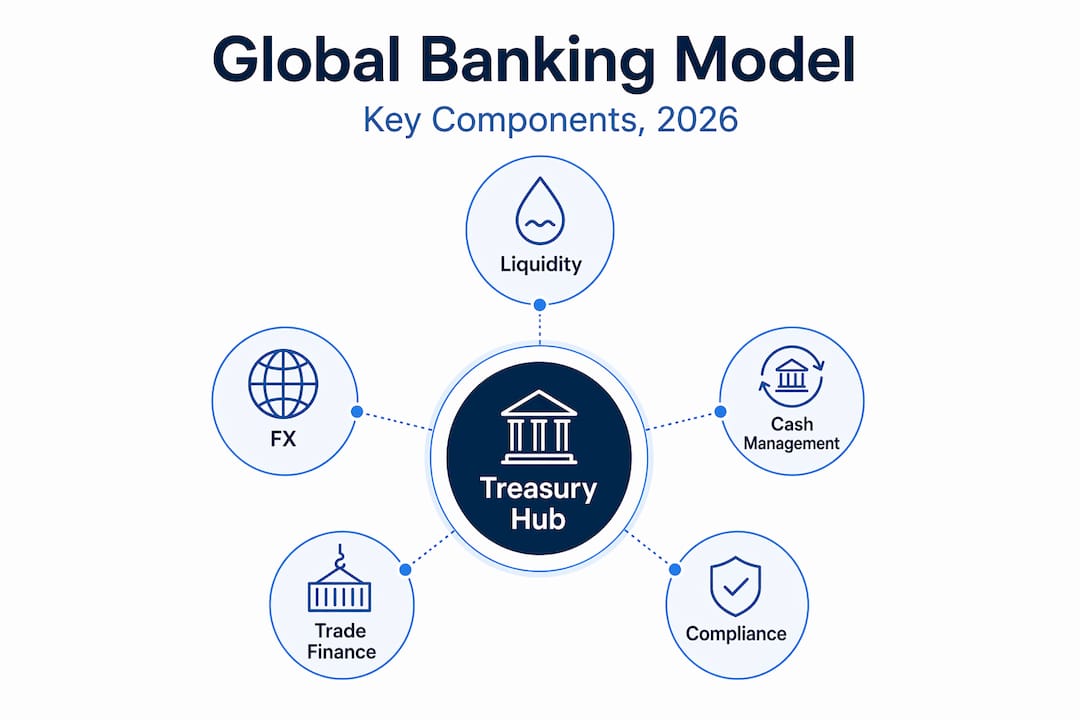
The phrase “global business banking” gets used loosely, so it helps to be precise. Global banking centralises visibility and control to reduce complexity as firms add accounts, products, banks, and countries. That is the operational definition. It is not a product. It is a framework through which a company manages its entire financial infrastructure across borders.
Seen this way, the core components become clear. Corporate banking services include liquidity management, foreign exchange, payments, trade finance, and lending. Each of these functions individually, but their value multiplies when they are managed through a single, coherent structure rather than fragmented across a dozen local banking relationships.
The practical mechanism that many larger corporates use is the hub-and-spoke treasury model. A central treasury hub, typically in a low-tax, well-regulated jurisdiction, manages group-wide cash and FX exposure. Local spokes handle day-to-day transactional banking in each country. This structure reduces operational overhead and closes the control gaps that disconnected local bank relationships routinely create.
For executives managing international operations, the fragmentation problem is the one that tends to cause the most damage. When your payments team in Singapore, your accounts receivable function in Germany, and your treasury in London are each working through different banks with no shared visibility, you cannot optimise liquidity, you cannot price FX risk accurately, and you cannot see your true cash position on any given day.
Pro Tip: Before engaging any global banking provider, map every existing banking relationship across all jurisdictions and identify where data and cash are siloed. That exercise alone will show you where centralisation will generate the fastest return.
The fragmentation trap is also where many mid-sized companies get stuck. They are too large to manage internationally with a single domestic bank, but they have not yet invested in the treasury infrastructure that a properly structured global model requires.
Key Selection Criteria for Banking Partners in High-Risk Sectors
Approval rates stand as the single most critical factor when evaluating potential banking partners. Bank Account Opening for iGaming and Online Casino data shows that acceptance rates over 70% are essential to reduce rejection risk, while onboarding speed targets of 2-3 weeks prove critical for operational agility. Traditional banks routinely reject 7 out of 10 high-risk applications, wasting months of your time.

Fast onboarding directly impacts your ability to launch operations and capture market opportunities. Every week spent in banking limbo costs revenue and competitive positioning. Specialized partners understand your sector’s unique needs and streamline verification processes accordingly.
Compliance and legal support separate amateur facilitators from professional banking consultancies. You need partners who navigate complex AML and KYC requirements daily, not generalists learning on your dime. The right partner provides ongoing regulatory guidance beyond initial account opening.
Geographic jurisdiction shapes everything from reporting obligations to acceptance likelihood. EU jurisdictions offer stronger regulatory frameworks but demand more extensive documentation. Offshore alternatives may onboard faster but require careful evaluation of reputational risks.
Critical selection factors include:
- Proven track record in your specific sector (crypto, iGaming, forex)
- Network of pre-vetted banking relationships exceeding 50 partners
- Transparent fee structures with no hidden charges
- Ongoing compliance monitoring and regulatory updates
- Infrastructure compatibility with your payment processing needs
Pro Tip: Before committing to any banking partner, request case studies from businesses in your exact sector. Generic high-risk experience doesn’t translate to crypto or iGaming expertise. Verify their claimed acceptance rates with verifiable client references.
How BankMyCapital Helps You Secure Multi-Currency Accounts
BankMyCapital doesn’t open accounts or hold client funds. But we do everything else to ensure you get approved and stay open.
1. Structure Design
We assess your current operation and design a multi-currency setup aligned with your actual needs—not a one-size-fits-all template.
What we do:
- Map your client flows, revenue sources, and jurisdictions
- Identify which currencies matter for your business
- Recommend how to segment risk (crypto, gaming, FX, adult)
- Propose a tiered structure: primary EMI, secondary EMI, offshore account, and crypto partner if needed
- Model the cost/benefit of each configuration
Outcome: A clear, defensible structure that compliance teams understand and approve.
2. Document Preparation
Missing or poorly organised documents kill applications. We ensure every document is complete, accurate, and structured for maximum impact.
What we do:
- Help you draft a bank-compliant business summary in plain language
- Build a visual flow chart showing currency routes and business functions
- Organise and label all KYC, KYT, and compliance documentation
- Ensure signatures, dates, and notarisation are correct
- Translate documents into English if required
Outcome: A submission package that gets approved faster.
3. Introductions to Providers
We have direct relationships with EMIs, offshore banks, and OTC desks that actively onboard high-risk clients. We don’t just pass your name along; we vouch for you.
What we do:
- Match your business to providers based on currency needs, industry tolerance, and volume
- Warm-introduce you to the right compliance contact
- Support your due diligence calls with technical answers
- Follow up post-approval to ensure smooth integration
- Assist with account testing and PSP integration
Outcome: Higher approval rates, faster timelines, and better terms.
4. Risk Advisory
After you launch, we help you stay open.
What we do:
- Monitor your setup for emerging risks
- Advise when to move flows between accounts or add new providers
- Help isolate flagged transactions before they trigger account review
- Support compliance refreshes and annual certifications
- Identify de-risking threats early and develop contingency plans
Outcome: Multi-currency accounts that last—not closures that blindside you.
Next Steps
A single-currency, single-provider operation is a liability in 2026. If you operate in crypto, gambling, forex, or adult content—you need multiple currencies, multiple providers, and a documented structure that withstands compliance scrutiny.
Your roadmap:
✅ Assess your current flows by currency and identify gaps
✅ Design a multi-currency structure aligned with your business
✅ Prepare documentation (flow chart, business summary, KYC/KYT evidence)
✅ Identify and approach providers with warm introductions
✅ Launch, test with small transactions, then scale
✅ Monitor for de-risking threats and maintain relationships
BankMyCapital can guide you through every step. From structure design to provider introductions to ongoing risk management, we help high-risk businesses secure the banking relationships they need to operate at scale.
Contact BankMyCapital for a confidential strategy session. We’ll assess your operation, recommend a structure, and introduce you to the right EMI, offshore bank, or OTC desk to support your multi-currency flows—legally, compliantly, and reliably.
Frequently asked questions
Q: Can I Get EUR, USD, and GBP in One Account?
Rarely. Most EMIs offer EUR + one optional FX currency (usually USD or GBP). True tri-currency access requires multiple accounts or providers.
Practical approach: Use a Czech or Lithuanian EMI for EUR + one FX currency, then add an offshore bank for the third. This gives you full three-currency coverage with just two accounts.
Q: Is USD Access Still Possible in 2026 for Crypto and Gambling Companies?
Yes, but with limitations. Traditional European banks will not provide direct USD access to high-risk merchants due to correspondent bank de-risking and FATF compliance concerns.
Where to get it: Offshore banks (Belize, Mauritius, Seychelles) still provide USD access. Some EMIs in Lithuania and Malta can route USD via partner banks, though this is slower and more expensive than direct access.
Timeline: 2–4 weeks from application to first USD transfer.
Q: Do I Need a Licence for This Kind of Multi-Currency Structure?
Only for regulated activities. If you’re offering payment services, forex brokerage, or gaming, you need a relevant licence (MGA, FCA, UKGC, KGC, etc.).
If you’re a platform, content creator, or consultant, you don’t need a licence—but you do need documentation proving how your business makes money and why you need multiple currencies. Clear structure and documented flow replace licence requirements.
Q: Can I Hold Crypto and Fiat in the Same EMI?
Some EMIs allow it, but it’s operationally risky. If one flow gets flagged (e.g., a sanctioned wallet), the entire account—including all your fiat—can be frozen.
Better approach: Use a separate crypto account (with an OTC desk or crypto-native provider) and keep fiat in a traditional EMI. Cost of segregation: minimal. Cost of losing your entire operation: everything.
Q: How Fast Can a Multi-Currency Structure Be Set Up?
With full documentation and warm introductions:
- EMI: 7–14 days
- Offshore bank: 10–30 days (depends on jurisdiction and KYC depth)
- Crypto off-ramp/OTC desk: 7–14 days
- Entire structure operational: 3–6 weeks
Without introductions and with incomplete documents: 2–4 months (or rejection).
Q: What Happens if One of My Providers De-risks?
This is why you build redundancy. If your primary EUR EMI closes your account, you shift flows to your secondary EMI. If your offshore bank tightens crypto controls, you already have an OTC partner.
Contingency planning: Each major currency and business function should have a backup provider identified before you need it.
