
TL;DR:
- Crypto payment integration allows online platforms to accept digital currencies at checkout, reducing chargeback risk and expanding global reach. Successful setup requires verified merchant accounts, secure API handling, server-side payment confirmation, and clear treasury policies to ensure reliable transactions. Testing scenarios like successful payments, timeouts, and underpayments are crucial for a dependable implementation.
Crypto payment integration is the process of configuring your online platform to accept cryptocurrency transactions at checkout, from API connection through to order fulfilment. Done correctly, it reduces chargeback risk, accelerates settlement, and opens your store to a global customer base that prefers on-chain payments. The process involves KYC verification, API key management, webhook handling, and treasury policy decisions. This guide covers every stage of the crypto payment setup process, from prerequisites to live testing, so you can go live with confidence.
What are the prerequisites for crypto payment integration step by step?
Before writing a single line of code, you need three things in place: a verified merchant account, a clear list of accepted assets, and secured API credentials. Skipping any of these creates compliance gaps that will cost you later.
Merchant account and KYC verification
The KYC and business verification process for crypto payment processors typically takes 1–5 business days, with ownership documentation required for any individual holding 25% or more equity. That threshold mirrors standard AML (Anti-Money Laundering) regulations across EU and offshore jurisdictions. Prepare your certificate of incorporation, proof of address, and a shareholder register before you apply. Delays almost always come from incomplete documentation, not the processor’s review queue.
Choosing which cryptocurrencies to accept
Offering more than 5–8 cryptocurrencies at checkout reduces conversion rates due to analysis paralysis. Start with BTC, ETH, USDC, and USDT. These four assets cover the widest customer base and carry the deepest liquidity, which matters when you convert to fiat. You can expand the list once your integration is stable and your treasury policy is documented.
Integration approach: plugins, SDKs, and REST APIs
| Approach | Complexity | Control | Best for |
|---|---|---|---|
| CMS plugin | Low | Low | Non-technical merchants on WooCommerce or Shopify |
| SDK | Medium | Medium | Developers wanting pre-built UI components |
| REST API | High | Full | Custom platforms requiring complete control |
Store your API keys in environment variables, never in source control. A leaked key is an open door to fraudulent payment creation. Rotate credentials immediately if a repository is ever made public, even briefly.
Pro Tip: Generate separate API keys for your staging and production environments. This prevents a misconfigured test call from touching live funds.
How to implement the technical steps for cryptocurrency payments?
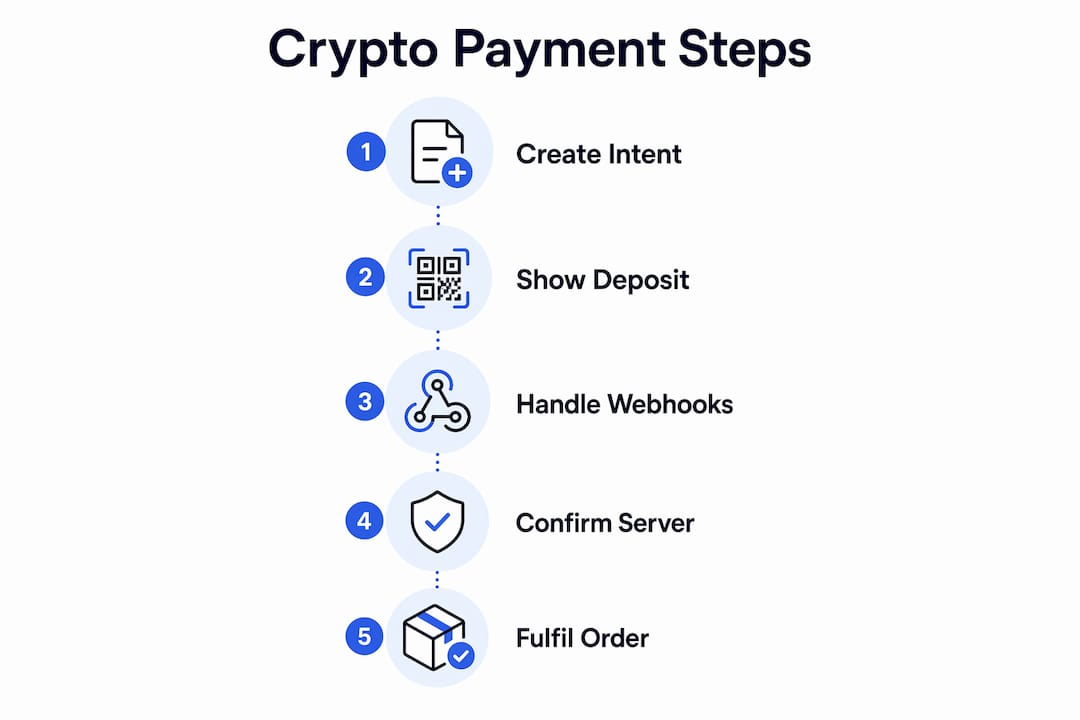
The technical integration follows a clear sequence. Each step builds on the last, and skipping one creates security or reconciliation problems downstream.
Step 1: Create a payment intent
Send a POST request to your gateway’s payment intent endpoint. Include the order amount in fiat, the accepted currency list, and a unique order ID. The gateway returns a payment object containing a deposit address and an expiry timestamp. Store the payment object ID in your database immediately. You will need it for every subsequent status check.

Step 2: Present the deposit address
Display the deposit address to your customer alongside a QR code. Most gateways provide a hosted payment page that handles this automatically. If you are building a custom UI, render both the address string and the QR code. Customers using mobile wallets almost always scan rather than type. A missing QR code measurably increases drop-off at this stage.
Step 3: Handle webhook callbacks
Webhooks are asynchronous and may fire multiple times or fail intermittently. Use idempotency keys on every webhook handler so that duplicate events do not trigger duplicate order updates. Verify each incoming webhook using HMAC signature validation before processing its payload. Reject any request that fails signature verification outright.
Step 4: Confirm payment server-side
Never trust the webhook payload alone for order fulfilment. After receiving a webhook with a confirmed status, make a separate GET request to the payment status endpoint and compare the result. This server-side confirmation prevents race conditions and replay attacks. Only mark an order as paid after both the webhook and the GET request agree on a confirmed status.
Step 5: Fulfil the order
Merchants should only fulfil orders after the gateway confirms the required number of blockchain confirmations. The exact confirmation count varies by network: Bitcoin typically requires three to six confirmations, while Ethereum-based tokens often require twelve to thirty. Crypto transactions are visible on-chain immediately but remain pending until the gateway signals confirmed status. Acting on a pending status exposes you to double-spend risk.
Pro Tip: Log every payment event with its raw payload, timestamp, and your server’s response code. This audit trail is invaluable during disputes and reconciliation.
What testing procedures ensure a reliable crypto payment setup?
Testing is where most integrations fail. Developers test the happy path and skip the edge cases that cause real-world failures.
The three scenarios you must test
Sandbox testing must cover at least three scenarios: a successful payment, a payment timeout (the customer abandons the session), and an underpayment (the customer sends less than the required amount). Each scenario exercises a different branch of your order state machine. Missing any one of them means deploying untested code to production.
| Test scenario | Expected gateway status | Required system response |
|---|---|---|
| Successful payment | confirmed | Mark order paid, trigger fulfilment |
| Payment timeout | expired | Cancel order, release reserved stock |
| Underpayment | underpaid | Hold order, notify customer to top up |
Use your gateway’s dashboard to trigger test webhook events manually. Most enterprise-grade gateways provide a webhook simulator that lets you fire any status transition on demand. This is faster than waiting for real blockchain events and lets you test retry logic directly.
Common mistakes in testing
The most frequent mistake is skipping idempotency checks entirely. Developers assume webhooks arrive once and in order. They do not. A payment confirmed event can arrive twice if the gateway retries a failed delivery. Without idempotency keys, your system will mark the order paid twice and potentially fulfil it twice.
The second common mistake is trusting the webhook payload status field without a server-side verification call. A malicious actor can craft a fake webhook with a confirmed status. HMAC signature validation stops this, but only if you implement it before checking the payload.
Pro Tip: After sandbox testing passes, run a live micro-transaction of the smallest denomination your gateway supports. This verifies the end-to-end flow including real blockchain confirmations, real webhook delivery, and your production database writes.
How should you manage settlement, treasury, and pricing display?
Technical integration is only half the work. How you handle money after it arrives determines your accounting accuracy, tax compliance, and customer experience.
Settlement and auto-conversion
Industry best practice is to auto-convert 100% of incoming crypto to fiat upon receipt, unless you have a documented treasury strategy. Auto-conversion eliminates volatility risk and simplifies your accounting. If you choose to hold crypto, you need a formal treasury policy that addresses price risk, custody security, and how unrealised gains are reported. Most merchants, particularly those new to crypto, are better served by full auto-conversion.
Pricing display and exchange rate locking
Display fiat-equivalent pricing clearly at checkout and lock the exchange rate for a short window of 10–15 minutes. This protects both you and your customer from price swings during the payment session. If the rate expires before the customer pays, refresh it and notify them. Never display only a crypto amount without the fiat equivalent. Customers need to know what they are spending in their local currency.
Recommended pricing and denomination practices
- Display prices in fiat (GBP, EUR, USD) as the primary figure, with the crypto equivalent shown beneath.
- Lock exchange rates for 10–15 minutes per session and display a countdown timer.
- Accept stablecoins (USDC, USDT) as a priority option to reduce volatility exposure for both parties.
- Store payment chain IDs and network identifiers in your database as mandatory fields to avoid reconciliation errors across multiple blockchains.
- Define your refund policy before going live. Crypto refunds require a new outbound transaction rather than a reversal, so your support team needs a clear process for handling them.
The checkout UI deserves the same attention as the technical stack. A confusing payment screen increases drop-off even when the underlying integration is flawless. Show the deposit address, the QR code, the fiat equivalent, and the countdown timer on a single screen. Remove every element that does not directly help the customer complete the payment.
Bankmycapital: crypto infrastructure for high-risk businesses
Crypto payment integration is technically achievable for any developer, but the compliance layer is where high-risk businesses consistently run into problems. KYC rejections, banking refusals, and treasury policy gaps are not technical failures. They are structural ones. Bankmycapital specialises in resolving exactly these issues, with a network of over 50 pre-vetted banking partners and an 87% approval rate for high-risk onboarding. If you need a compliant crypto banking infrastructure built around your specific jurisdiction and risk profile, Bankmycapital provides the full setup, from KYC facilitation through to payment processing solutions tailored for crypto, iGaming, forex, and adult entertainment sectors.
Key takeaways
Successful cryptocurrency payment integration requires verified accounts, secure API handling, server-side payment confirmation, and a documented treasury policy before going live.
| Point | Details |
|---|---|
| Verify before you build | Complete KYC and merchant account setup first; verification takes 1–5 business days. |
| Limit your asset list | Start with BTC, ETH, USDC, and USDT to maximise conversion and minimise confusion. |
| Confirm payments server-side | Always make a GET request after a webhook to prevent double-spend and replay attacks. |
| Test three scenarios minimum | Cover successful payment, timeout, and underpayment before deploying to production. |
| Lock exchange rates at checkout | Apply a 10–15 minute rate lock and display fiat equivalents to protect both parties. |
FAQ
What is crypto payment integration?
Crypto payment integration is the process of connecting your online platform to a cryptocurrency payment gateway so customers can pay with digital assets at checkout. It involves API configuration, webhook handling, and order state management.
How long does KYC verification take for crypto payment processors?
KYC verification for crypto payment processors typically takes 1–5 business days. Having your incorporation documents and shareholder register ready before applying reduces delays significantly.
How do I prevent double-spend attacks in my integration?
Only fulfil orders after the gateway confirms the required number of blockchain confirmations. Always perform a server-side GET request to verify payment status independently of the webhook payload.
Should I hold crypto or convert it to fiat immediately?
The industry standard is 100% auto-conversion to fiat unless you have a documented treasury strategy. Holding crypto introduces price risk and accounting complexity that most merchants are not equipped to manage.
How do crypto refunds work?
Crypto refunds require a new outbound transaction rather than a reversal. Define your refund policy before going live and train your support team to initiate outbound payments when a refund is approved.
