
Opening a bank account for high-risk businesses remains one of the most challenging barriers for entrepreneurs in crypto, iGaming, and adult entertainment sectors. Over 70% of these businesses face rejection or sudden closures from traditional financial institutions. This guide provides a strategic roadmap to navigate enhanced due diligence requirements, select appropriate banking partners, and secure long-term banking relationships despite the obstacles inherent to high-risk classifications.
Key takeaways
| Point | Details |
|---|---|
| Preparation is critical | High-risk banking requires specialised documentation, compliance frameworks, and sector-specific licenses before applying. |
| Partner selection matters | Choosing banks or EMIs experienced with your sector dramatically improves approval success rates. |
| Common mistakes are avoidable | Poor documentation quality, business model mismatches, and ignoring jurisdictional regulations cause most rejections. |
| Realistic timelines apply | Onboarding typically takes 2-6 weeks with approval rates reaching up to 87% through specialist networks. |
| Ongoing compliance is essential | Maintaining banking relationships requires continuous monitoring, transparency, and proactive regulatory adaptation. |
Understanding high risk business bank accounts
High-risk businesses include sectors like cryptocurrency, iGaming, adult entertainment, forex trading, and pharmaceutical e-commerce. Banks classify these industries as high-risk due to elevated exposure to money laundering concerns, significant chargeback rates, and complex regulatory landscapes. This classification triggers enhanced due diligence protocols that scrutinise transaction patterns, customer profiles, and operational models far more rigorously than standard business accounts.
Financial institutions apply these heightened standards because regulatory authorities hold them accountable for preventing financial crime. Over 70% of high-risk companies experience account rejections or unexpected closures, creating operational disruptions that threaten business continuity. Understanding what is high risk banking helps entrepreneurs anticipate these challenges and prepare accordingly.
The impact extends beyond mere inconvenience. High-risk status affects available services, transaction limits, reserve requirements, and fee structures. Banks often impose monthly maintenance fees, minimum balance thresholds, and rolling reserves to mitigate perceived risks. Some institutions refuse services entirely, forcing businesses towards alternative solutions.
Key factors driving high-risk classification include:
- Industry sector reputation and regulatory scrutiny levels
- Historical chargeback rates and fraud exposure in the sector
- Cross-border transaction complexity and sanctions screening requirements
- Difficulty verifying customer identities and beneficial ownership structures
- Potential for reputational damage to the financial institution
“Banks view high-risk businesses through a compliance lens first, commercial opportunity second. Your application must address their risk concerns directly and comprehensively.”
Exploring high-risk business banking challenges reveals patterns that prepared entrepreneurs can address proactively. The enhanced scrutiny, whilst burdensome, exists to protect the financial system. Businesses that demonstrate robust compliance frameworks, transparent operations, and clear transaction models significantly improve their acceptance prospects.
Prerequisites: what you need before applying
Successful high-risk banking applications begin long before submission. Preparation quality directly correlates with approval likelihood. Banks assess whether your business demonstrates operational maturity, regulatory awareness, and genuine commitment to compliance standards.
Corporate registration documents must align perfectly with your actual business activities. Discrepancies between incorporation papers, website content, and declared transaction models trigger immediate red flags. Your business structure should match the jurisdictions where you operate, with appropriate licenses secured in advance. Enhanced due diligence requirements demand documentation far beyond standard corporate filings.
Financial statements provide evidence of business viability and transaction legitimacy. Banks require detailed profit and loss accounts, balance sheets, and cash flow projections covering at least 12 months. If your business is newly established, prepare pro forma financials based on realistic market research and sector benchmarks. Inconsistent or overly optimistic projections damage credibility.

Comprehensive AML and KYC policies demonstrate your commitment to preventing financial crime. These documents should detail customer onboarding procedures, transaction monitoring systems, suspicious activity reporting protocols, and staff training programmes. Generic templates copied from internet sources fail scrutiny. Your policies must reflect actual operational practices and sector-specific risks.
Transaction models and customer profiles address the bank’s core concerns about your business. Prepare detailed descriptions of typical transaction sizes, frequencies, geographic sources, and customer demographics. Include information about payment methods, refund rates, and chargeback management procedures. The more transparency you provide, the less uncertainty banks face during assessment.
Essential documentation checklist:
- Certified corporate registration and shareholding structure
- Valid business licenses relevant to your specific sector
- Audited financial statements or detailed pro forma projections
- Comprehensive AML/CTF compliance manual
- Detailed KYC procedures with sample customer verification workflows
- Transaction model documentation with volume and value projections
- Website screenshots and marketing materials demonstrating legitimate operations
- Beneficial ownership declarations with supporting identity documents
- Professional references from legal advisers or compliance consultants
Consulting compliance experts before application submission identifies gaps that would otherwise cause rejection. Professional review ensures your documentation package meets sector-specific expectations and addresses common pitfall areas. Gathering comprehensive high risk bank account documents takes time but dramatically improves outcomes.
Step-by-step process to open a high risk bank account
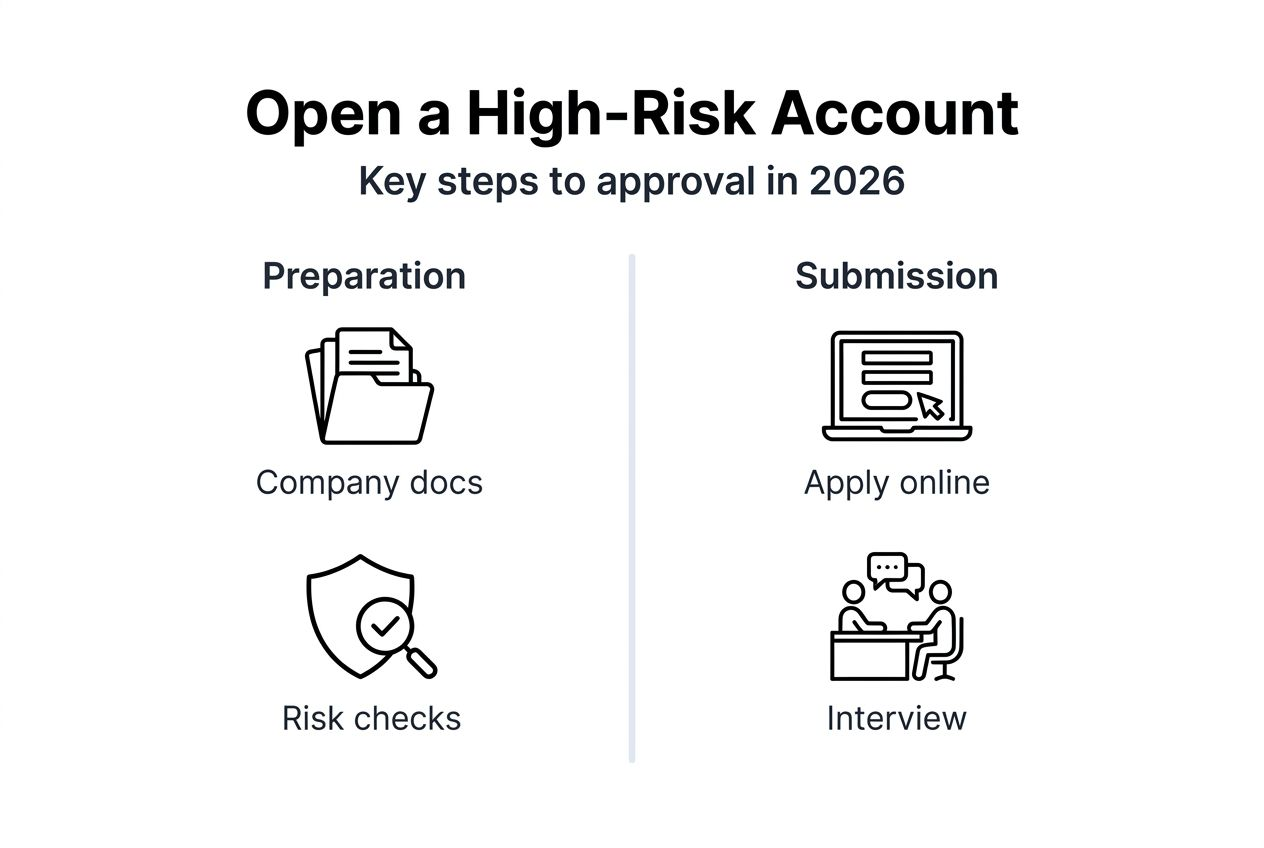
Opening a high-risk business bank account requires methodical execution across multiple stages. Each phase builds on the previous, creating a cumulative case for approval.
-
Identify suitable banking partners. Research banks and EMIs with proven track records serving your specific sector. Shortlist institutions that explicitly welcome high-risk businesses rather than those merely tolerating them. Check whether they operate in jurisdictions aligned with your business structure and regulatory needs.
-
Prepare tailored documentation. Customise your compliance materials to address the specific concerns of your target banks. Generic submissions signal lack of seriousness. Your documentation should directly answer questions about transaction legitimacy, customer risk profiles, and operational controls relevant to your sector.
-
Engage compliance expertise. Professional advisers familiar with high-risk banking review your package before submission. They identify weaknesses, suggest improvements, and ensure completeness. This step prevents the costly cycle of rejection, revision, and resubmission that extends timelines unnecessarily.
-
Submit complete applications. Lodge applications only when documentation is genuinely ready. Incomplete submissions create negative first impressions that are difficult to overcome. Include cover letters that proactively address common concerns and highlight your compliance strengths.
-
Respond promptly to queries. Onboarding typically takes 2-6 weeks but delays often stem from slow responses to bank requests. Allocate dedicated resources to handle additional information requests immediately. Demonstrate reliability through communication responsiveness.
-
Review contract terms carefully. Once approved, scrutinise account agreements thoroughly. Pay particular attention to reserve requirements, transaction limits, prohibited activities, monthly fees, and termination clauses. Negotiate terms where possible, especially regarding reserve percentages and monitoring thresholds.
-
Complete enhanced due diligence. Cooperate fully with additional verification stages the bank requires. This may include video calls with compliance officers, site visits, or supplementary documentation requests. Transparency throughout this phase builds trust for the long-term relationship.
Pro Tip: Maintain detailed records of all communications with banking partners. Document verbal conversations in writing through follow-up emails. This creates an audit trail that protects both parties and demonstrates your professional approach to compliance obligations.
Following structured guidance on how to open bank account high risk business reduces uncertainty and positions your application competitively. The high-risk onboarding process rewards preparation, transparency, and patience.
Common mistakes and how to avoid them
Even well-intentioned entrepreneurs sabotage their banking applications through preventable errors. Understanding these pitfalls helps you avoid costly rejections.
Incomplete or generic documentation causes the majority of failures. Banks receive numerous high-risk applications and immediately filter out those lacking specificity or professionalism. Using template compliance manuals without customisation signals inexperience. Your materials must reflect genuine understanding of your operational risks and demonstrate implemented controls addressing those specific concerns.
Business model mismatches between declared activities and actual transactions trigger account closures even after initial approval. If you describe your business as software services but process payments resembling gambling transactions, banks terminate relationships immediately. Accuracy and honesty in application materials prevent this catastrophic outcome.
Ignoring jurisdictional regulations creates compliance gaps that banks cannot overlook. Operating without proper licenses in markets where you serve customers demonstrates regulatory negligence. Banks assume liability when facilitating unlicensed activities, so they reject applications showing jurisdictional non-compliance.
Lack of ongoing compliance monitoring risks sudden account termination. Opening an account represents the beginning, not the end, of your compliance obligations. Businesses that fail to maintain updated policies, conduct regular audits, or adapt to regulatory changes lose banking relationships unexpectedly.
Failing to engage expert advisers increases both rejection rates and timeline extensions. Professional guidance identifies issues before they become problems. The cost of expert consultation pales compared to operational disruption from banking access loss.
Top mistakes causing rejection:
- Submitting incomplete documentation packages without thorough review
- Using generic compliance templates that ignore sector-specific risks
- Misrepresenting business models or transaction characteristics
- Operating without appropriate licenses in relevant jurisdictions
- Neglecting ongoing compliance obligations after account approval
Pro Tip: Schedule expert consultation during business planning stages, not after rejection. Early involvement prevents structural issues that are expensive or impossible to correct later. Understanding how to avoid high risk banking mistakes protects your business continuity and reputation.
Common refusal reasons include unclear transaction models, mismatched website content, inadequate due diligence, and high-risk jurisdiction exposure. Each factor is preventable through proper preparation.
Expected outcomes: timelines, approval rates and costs
Understanding realistic expectations prevents frustration and enables proper business planning. High-risk banking differs significantly from standard business accounts in timing, success rates, and financial commitments.
Typical onboarding takes 2-6 weeks depending on documentation quality and institutional procedures. Complex business models or multi-jurisdictional operations extend timelines. Well-prepared applications with expert support can achieve faster approvals, whilst incomplete submissions face indefinite delays or outright rejection.
Approval success rates reach up to 87% when businesses engage specialist networks and compliance advisers. Working with experienced professionals improves documentation thoroughness and partner selection accuracy. Self-directed applications face significantly lower success rates due to knowledge gaps and strategic missteps.
Fee structures for high-risk accounts exceed standard business banking costs substantially. Monthly maintenance fees range from €200 to €1,500 depending on transaction volumes and services required. Many institutions impose minimum balance requirements between €10,000 and €50,000. Rolling reserve requirements can reach 10-20% of monthly transaction volumes, creating significant working capital implications.
Ongoing enhanced due diligence incurs additional costs beyond initial setup. Annual compliance reviews, transaction monitoring systems, and regulatory reporting obligations add operational expenses. Budget for professional advisory retainers to maintain compliance standards and address regulatory changes proactively.
| Aspect | Typical Range | Notes |
|---|---|---|
| Onboarding timeline | 2-6 weeks | Faster with expert support and complete documentation |
| Approval success rate | 60-87% | Higher rates through specialist networks and proper preparation |
| Monthly maintenance fees | €200-€1,500 | Varies by transaction volume and service complexity |
| Minimum balance requirements | €10,000-€50,000 | Institution and risk profile dependent |
| Rolling reserve percentage | 10-20% | Impacts working capital significantly |
| Initial setup costs | €2,000-€10,000 | Includes legal, compliance, and advisory fees |
Planning for high risk bank account opening requires realistic financial projections that incorporate these elevated costs. The investment protects business operations and enables growth that would be impossible without banking access. Understanding high-risk approval timelines helps coordinate business launches and operational planning effectively.
Alternative banking solutions and jurisdictions
High-risk businesses benefit from exploring multiple banking avenues beyond traditional institutions. Each option presents distinct advantages and trade-offs requiring careful evaluation.
Electronic Money Institutions provide faster onboarding and greater sector acceptance than traditional banks. EMIs often specialise in specific high-risk industries, developing expertise that translates to streamlined processes. However, they typically charge higher transaction fees and offer more limited service ranges. EMI accounts may lack certain features like business loans or merchant cash advances available through traditional banks.
Traditional banks offer greater institutional trust and typically broader service portfolios. Their established reputations benefit businesses requiring credibility with partners and customers. However, traditional banks impose stricter entry requirements, conduct more extensive due diligence, and maintain conservative risk appetites. Approval processes are longer and success rates lower compared to specialist EMIs.
EU jurisdictions provide regulatory clarity and reputational advantages. Banking relationships within the European Union benefit from harmonised regulations and established legal frameworks. EU banks offer stronger consumer protections and institutional stability. However, they enforce rigorous compliance standards and typically charge premium fees for high-risk accounts.
Offshore banks present privacy advantages and potentially easier acceptance for certain business models. Alternative banking jurisdictions like Belize, Seychelles, or Vanuatu may accommodate businesses that EU institutions reject. However, offshore banking introduces increased compliance complexity, potential reputational concerns, and complications with payment processors or business partners preferring mainstream banking relationships.
| Banking Option | Trust Level | Entry Requirements | Fee Structure | Onboarding Speed |
|---|---|---|---|---|
| Traditional Banks | High | Very strict | Moderate to high | Slow (4-8 weeks) |
| EMIs | Moderate | Moderate | High | Fast (2-4 weeks) |
| EU Banks | High | Strict | High | Moderate (3-6 weeks) |
| Offshore Banks | Variable | Less strict | Moderate | Fast (2-3 weeks) |
Selecting appropriate banking solutions requires matching institutional characteristics with business needs, risk tolerance, and operational requirements. Understanding offshore banking explained high risk contexts helps evaluate whether international solutions suit your situation.
Maintaining banking relationships and compliance post-approval
Securing account approval represents only the beginning of your banking relationship. Long-term success requires continuous attention to compliance obligations and relationship management.
Conduct regular compliance audits to identify potential issues before banks discover them. Schedule quarterly internal reviews covering transaction patterns, customer risk profiles, and policy adherence. Update documentation proactively as regulations evolve or business models expand. Banks appreciate partners who demonstrate ongoing commitment to compliance rather than treating it as a one-time requirement.
Manage chargebacks aggressively through robust customer service and clear refund policies. High chargeback rates trigger bank concerns about fraud exposure and operational quality. Implement effective dispute resolution procedures, maintain detailed transaction records, and respond to customer complaints promptly. Reducing chargeback rates below industry averages demonstrates operational excellence.
Maintain transparent, timely communication with banking partners. Inform them of significant business changes before they occur, not after. Material changes like new product launches, geographic expansions, or ownership alterations may require approval or updated due diligence. Surprising your bank with unexpected transaction pattern changes risks account suspension.
Utilise professional advisory services to navigate regulatory evolution. Financial regulations affecting high-risk industries change frequently. Expert advisers monitor developments and guide necessary adjustments to your compliance frameworks. This proactive approach prevents violations that could terminate banking relationships.
Essential post-approval maintenance activities:
- Quarterly compliance audits reviewing policies, procedures, and controls
- Monthly transaction monitoring for anomalies requiring investigation
- Annual policy updates reflecting regulatory changes and business evolution
- Regular communication with bank relationship managers about business performance
- Ongoing staff training covering AML, KYC, and sector-specific compliance requirements
- Chargeback management programmes with clear escalation procedures
- Documentation systems maintaining complete audit trails for all transactions
Pro Tip: Establish automated monitoring systems that flag unusual transaction patterns, customer behaviours, or regulatory deadlines. Technology-enabled compliance reduces human error and demonstrates sophistication to banking partners. Learning how to pass bank compliance for high risk business accounts protects your operations.
Failing to align operations with banking expectations leads to repeated closures and operational disruptions. The effort invested in maintaining compliance with banks pays dividends through stable, long-term banking relationships supporting business growth.
Find high risk banking solutions tailored to your business
Navigating high-risk banking complexities requires specialised expertise and established relationships that most entrepreneurs lack. BankMyCapital connects high-risk businesses with pre-vetted banking partners experienced in crypto, iGaming, adult entertainment, and forex sectors. Our network of over 50 EU and offshore institutions enables targeted matching between business requirements and institutional capabilities.
Access our comprehensive high risk business banking checklist success guide to ensure your documentation meets institutional expectations before submission. Professional support addressing specific compliance gaps dramatically improves approval likelihood whilst reducing timeline uncertainty. Understanding precisely how to pass bank compliance for a high risk business account transforms banking access from obstacle to operational foundation. Our consultancy approach combines legal expertise, regulatory knowledge, and banking relationships to deliver solutions when conventional approaches fail.
FAQ
What documents are essential for opening a high-risk business bank account?
Corporate registrations, regulatory licences specific to your sector, comprehensive AML/KYC policies, audited financial statements, and detailed transaction models form the core requirements. Banks also require beneficial ownership declarations, website documentation, and professional references demonstrating operational legitimacy. Gathering complete high risk bank account documents before application prevents delays and improves approval chances significantly.
How long does it take to open a high-risk business bank account?
Typical onboarding ranges between two and six weeks depending on documentation quality, business complexity, and institutional procedures. Well-prepared applications with expert support can achieve faster approvals, whilst incomplete submissions face indefinite delays. Understanding realistic high risk bank account opening timeline expectations helps coordinate business planning and operational readiness effectively.
Can I open a high-risk business bank account without offshore structures?
Whilst offshore accounts provide alternatives, many EU-based banks and EMIs welcome high-risk businesses when compliance frameworks are robust. Proper documentation, transparent operations, and appropriate licensing enable onshore banking access without offshore complexity. Understanding high risk banking without offshore structures reveals viable pathways for businesses preferring EU jurisdiction relationships.
What are the main reasons for high-risk account application rejections?
Incomplete or generic documentation, mismatches between declared business models and actual transaction patterns, inadequate enhanced due diligence, and improper management of high-risk jurisdiction exposure cause most rejections. Banks also refuse applications lacking appropriate licenses or demonstrating poor understanding of sector-specific compliance requirements. Learning common reasons for rejection enables proactive correction before submission.
