
High-risk banking isn’t impossible, it just requires the right partners. Traditional banks reject over 60% of high-risk applications, yet specialised consultancies achieve 87% approval rates by connecting crypto, iGaming, and forex businesses with vetted banking partners. This guide explains how high-risk banking works, why traditional banks refuse these sectors, and how you can secure compliant banking solutions in the EU and offshore jurisdictions.
Key takeaways
| Point | Details |
|---|---|
| High-risk classification | Crypto, iGaming, and forex face elevated fraud risk, chargeback rates exceeding industry norms, and stringent regulatory scrutiny. |
| Traditional bank barriers | Mainstream banks reject high-risk businesses due to compliance costs, reputational exposure, and complex AML requirements. |
| Specialised consultancy value | Expert consultancies improve approval rates to 87% through pre-vetted banking networks and accelerated 2-3 week onboarding. |
| Jurisdictional strategy | Choosing between EU compliance-heavy environments and flexible offshore jurisdictions optimises banking access and operational costs. |
| Integrated solutions | Bundled compliance, licensing, and payment processing services reduce gaps and ensure continuous banking stability. |
Understanding high-risk banking: definition and industry scope
High-risk banking refers to specialised financial services for industries with elevated fraud, chargeback, and regulatory risks, including crypto, iGaming, and forex sectors. These businesses face unique challenges because traditional banks view them as liabilities rather than opportunities. Understanding this classification helps you approach the right banking partners from the start.
Three sectors dominate high-risk categorisation: cryptocurrency exchanges and wallets, online gaming and betting platforms, and forex trading operations. Banks classify these industries as high risk due to higher-than-average chargeback rates, often exceeding 1% of total transactions compared to 0.5% for standard retail. Regulatory scrutiny compounds this challenge, with Anti-Money Laundering directives requiring extensive due diligence and ongoing monitoring that many traditional banks find costly to implement.
Several factors influence how banks assess risk profiles. Transaction volume volatility makes revenue forecasting difficult, whilst cross-border operations introduce multiple jurisdictional compliance requirements. Customer identity verification becomes complex when dealing with digital-first businesses, and the potential for fraud or sanctions violations creates reputational exposure banks want to avoid. Following a structured banking checklist significantly improves your chances of approval.
Key risk factors banks evaluate include:
- Transaction dispute frequency and resolution rates
- Customer onboarding processes and KYC compliance strength
- Business model scalability and revenue stability
- Licensing status and regulatory compliance history
- Management team experience in high-risk sectors
- Geographic customer distribution and sanctions risk exposure
Understanding why banks systematically reject EU high-risk businesses helps you prepare stronger applications and target appropriate banking partners.
Challenges faced by high-risk businesses in traditional banking
High-risk businesses encounter rejection rates exceeding 80% when approaching mainstream banks. This staggering statistic reflects institutional risk aversion rather than individual business merit. Even profitable, compliant operations struggle to secure basic banking services through traditional channels.

Banks refuse high-risk accounts for three primary reasons. First, fraud risk assessment models automatically flag crypto, iGaming, and forex businesses as high probability for financial crime, regardless of actual compliance records. Second, implementing adequate compliance monitoring systems costs banks more than the account fees justify, making high-risk clients economically unviable. Third, chargeback exposure threatens bank relationships with payment networks, as excessive disputes can result in penalties or service termination.
Operational disruptions from banking denials create cascading business problems. Without stable banking, you cannot process customer payments reliably, maintain float for operational expenses, or access credit facilities for growth. Payment processing interruptions damage customer trust and revenue continuity. Limited banking options force businesses into higher-fee arrangements or jurisdictional compromises that increase complexity.
Statistic spotlight: Traditional banks reject over 80% of crypto, iGaming, and forex applications, whilst specialised consultancies achieve 87% approval rates through targeted partner matching.
Banking access directly impacts growth trajectory and competitive positioning. Companies stuck with unsuitable banking partners face:
- Unpredictable account closures disrupting operations
- Higher transaction fees reducing profit margins
- Limited payment method options losing customer conversions
- Inability to scale operations without banking infrastructure
- Compliance gaps from inadequate banking partner expertise
Knowing how to properly open a high-risk business account prevents these operational bottlenecks and positions your business for sustainable growth.
Regulatory challenges in the EU affecting high-risk banking
European Union regulatory frameworks create significant compliance obligations for high-risk sectors. The Fifth and Sixth Anti-Money Laundering Directives impose stringent customer due diligence, beneficial ownership transparency, and suspicious activity reporting requirements. These regulations demand substantial investment in compliance infrastructure that many businesses struggle to maintain.
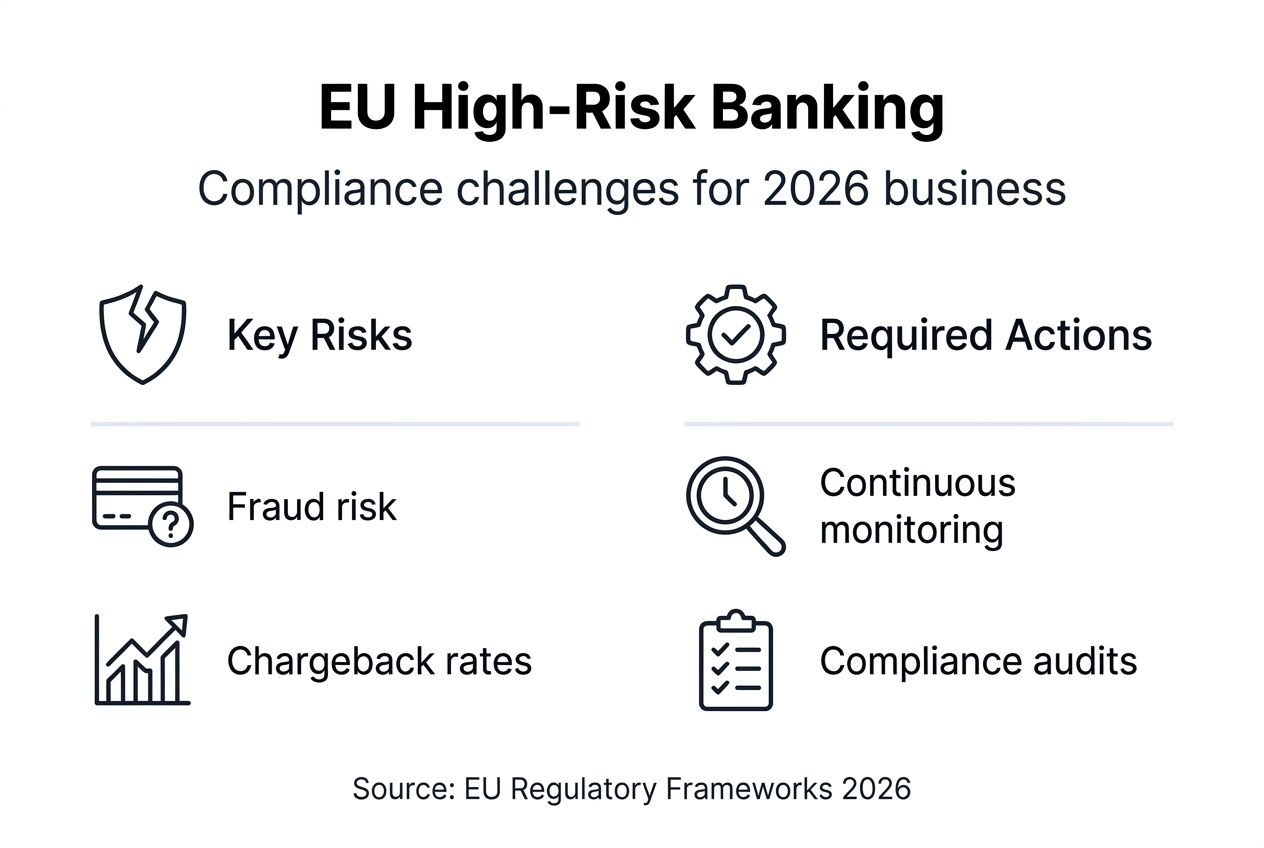
EU banking regulations for high-risk sectors require continuous monitoring of customer transactions, regular compliance audits, and immediate reporting of suspicious patterns. Crypto businesses must maintain detailed blockchain transaction records, whilst iGaming operators need robust age verification and responsible gambling controls. Forex platforms face additional scrutiny around leverage limits and investor protection measures.
Compliance costs scale dramatically with regulatory complexity. Small to medium high-risk businesses typically spend £50,000 to £150,000 annually on compliance staff, systems, and legal advice. Licensing requirements vary by jurisdiction and business model, with some requiring multiple licences across different EU member states to operate legally. This fragmented regulatory landscape makes pan-European operations prohibitively expensive for many businesses.
| Sector | Primary EU Regulation | Key Compliance Requirements | Typical Annual Cost |
|---|---|---|---|
| Crypto | MiCA, 5AMLD, 6AMLD | Transaction monitoring, wallet verification, travel rule | £80,000-£200,000 |
| iGaming | Gambling Act, AML Directives | Player verification, responsible gambling, advertising restrictions | £60,000-£150,000 |
| Forex | MiFID II, EMIR | Trade reporting, client categorisation, leverage limits | £70,000-£180,000 |
Regulatory barriers compound banking access difficulties in three ways:
- Banks require proof of full regulatory compliance before account opening
- Ongoing compliance monitoring adds operational costs banks pass to clients
- Regulatory changes force frequent policy updates and additional documentation
- Cross-border operations multiply compliance requirements across jurisdictions
- Licensing delays prevent businesses from demonstrating operational legitimacy
Effective banking compliance strategies for high-risk businesses address these challenges through proactive regulatory engagement and robust internal controls.
Role of specialised consultancies in high-risk banking
Specialised consultancies transform banking access for high-risk businesses by bridging the gap between business needs and banking requirements. These firms maintain relationships with over 50 pre-vetted banks and Electronic Money Institutions that actively serve high-risk sectors. Rather than approaching banks blindly, consultancies match your specific business profile with banking partners suited to your risk profile and operational needs.
Approval rates demonstrate consultancy value clearly. Whilst traditional banks reject 80% of high-risk applications, consultancy-supported applications achieve 87% approval rates with 2-3 week onboarding compared to 8-12 weeks for direct applications. This dramatic improvement stems from three factors: pre-screened banking partners familiar with high-risk sectors, expert application preparation meeting specific bank requirements, and ongoing relationship management smoothing approval processes.
Consultancies provide continuous compliance support beyond initial account opening. They monitor regulatory changes affecting your sector, advise on policy updates, and facilitate communication with banking partners when issues arise. This ongoing relationship prevents account closures and maintains banking stability as your business scales.
| Approach | Average Approval Rate | Typical Onboarding Time | Ongoing Support | Cost Structure |
|---|---|---|---|---|
| Direct bank application | 15-20% | 8-12 weeks | None | Application fees only |
| Consultancy-assisted | 87% | 2-3 weeks | Continuous compliance advice | Success-based fees |
| Multiple direct attempts | 25-35% | 16+ weeks | None | Multiple application fees |
Pro Tip: Engage specialised consultancies before your first banking application. Early involvement prevents application rejections that create negative records and reduces overall time to banking access by 60-70%.
Successful consultancies offer several distinct advantages:
- Access to banks actively seeking high-risk clients
- Expert documentation preparation meeting specific bank criteria
- Regulatory compliance guidance reducing rejection risk
- Jurisdictional strategy optimising banking access and costs
- Ongoing banking relationship management preventing disruptions
Understanding how to pass bank compliance requirements positions your application for success regardless of approach.
Common misconceptions about high-risk banking
Several myths prevent high-risk businesses from pursuing appropriate banking solutions. The most damaging misconception suggests that all banks treat high-risk businesses identically. In reality, specialist banks and EMIs actively compete for high-risk clients, offering tailored services traditional banks cannot match. These institutions build their business models around serving sectors others reject.
Another widespread belief claims high-risk banking simply costs more without additional value. Whilst fees typically run higher than standard business banking, specialised high-risk banking provides critical services standard banks lack: dedicated compliance teams understanding sector-specific regulations, flexible risk assessment frameworks accommodating business model nuances, and relationship managers experienced in high-risk operations. These services justify premium pricing by preventing costly operational disruptions.
Many business owners assume offshore banking equals unregulated or illegal operations. Modern offshore banking jurisdictions maintain robust regulatory frameworks often exceeding EU standards in specific areas. Legitimate offshore banking provides regulatory flexibility and cost advantages whilst maintaining full compliance with international standards. The key lies in choosing reputable jurisdictions and transparent service providers.
Common pitfalls when seeking high-risk banking include:
- Applying to multiple banks simultaneously without strategy
- Providing incomplete compliance documentation
- Failing to demonstrate robust AML and KYC procedures
- Underestimating regulatory compliance requirements
- Choosing banking partners unfamiliar with your sector
- Neglecting ongoing compliance obligations after account opening
Avoiding these common high-risk banking mistakes significantly improves your approval odds and operational stability.
Regulatory strategies and jurisdiction selection
Strategic jurisdiction selection optimises both regulatory compliance and banking access for high-risk businesses. The choice between EU and offshore jurisdictions involves balancing regulatory complexity against operational flexibility, cost considerations against market access, and compliance burden against banking partner availability.
Offshore jurisdictions offer several advantages for high-risk operations. Licensing processes typically complete faster, often within 3-6 months compared to 9-18 months in many EU states. Regulatory frameworks provide clearer guidelines for emerging sectors like crypto, where EU regulations remain fragmented across member states. Ongoing compliance costs run 30-50% lower in established offshore centres whilst maintaining international credibility.
EU jurisdictions provide different strategic benefits. Operating within the EU grants automatic access to the Single Market, simplified cross-border transactions with EU customers, and enhanced credibility with European banking partners. Despite higher compliance costs, EU licensing creates competitive advantages in customer acquisition and partnership development within European markets.
| Factor | EU Jurisdiction | Offshore Jurisdiction | Hybrid Model |
|---|---|---|---|
| Licensing timeframe | 9-18 months | 3-6 months | 6-12 months |
| Annual compliance cost | £70,000-£200,000 | £30,000-£100,000 | £50,000-£150,000 |
| Market access | EU Single Market | Global, limited EU | EU + Global |
| Banking partner availability | Moderate | High | High |
| Regulatory clarity | Fragmented | Established | Structured |
Hybrid operational models combine EU and offshore advantages effectively. Common structures include offshore holding companies with EU operating subsidiaries, offshore licensing with EU payment processing arrangements, or EU customer-facing operations with offshore back-office functions. These models optimise tax efficiency, regulatory burden, and banking access simultaneously.
Key considerations when selecting jurisdictions include:
- Target customer geographic distribution and preferences
- Regulatory compliance capabilities and budget
- Banking partner requirements and preferences
- Tax implications of different structures
- Long-term scalability and market expansion plans
- Reputational considerations within your target market
Exploring offshore banking solutions for high-risk businesses reveals strategic opportunities many overlook. Understanding the practical differences between offshore and onshore accounts enables informed decisions matching your business needs.
Comprehensive services in high-risk banking
Integrated service packages streamline high-risk banking by combining compliance support, licensing assistance, and operational infrastructure. Rather than coordinating multiple service providers independently, comprehensive solutions reduce complexity and eliminate gaps between services. This bundled approach accelerates time-to-market whilst ensuring all elements work together cohesively.
Combined compliance and licensing services address the chicken-and-egg problem many high-risk businesses face: banks require licensing proof whilst licensing authorities demand banking evidence. Integrated providers coordinate these requirements simultaneously, presenting cohesive applications to both banking partners and regulators. This parallel processing reduces total setup time by 40-60% compared to sequential approaches.
Crypto infrastructure represents a critical component for digital asset businesses. Specialised banking partners provide dedicated crypto rails, multi-currency wallets, and blockchain integration capabilities standard banks cannot offer. These technical capabilities enable seamless customer onboarding, automated compliance monitoring, and efficient treasury management for crypto operations.
Integrated service benefits include:
- Faster overall implementation with coordinated timelines
- Reduced compliance gaps from unified strategy
- Single point of contact simplifying management
- Cost efficiencies through bundled service pricing
- Ongoing support maintaining banking stability
- Scalable infrastructure growing with your business
Pro Tip: Choose service providers offering end-to-end solutions including banking, licensing, compliance, and payment processing. Fragmented services create coordination gaps that delay launches and increase risk of compliance failures.
Comprehensive solutions typically encompass banking relationship management, regulatory licensing support, AML and KYC compliance systems, payment processing infrastructure, and ongoing regulatory monitoring. This holistic approach ensures every operational element aligns with banking requirements and regulatory expectations.
Exploring complete banking and financial solutions designed specifically for high-risk businesses reveals operational advantages. Specialised crypto infrastructure solutions provide technical capabilities essential for digital asset operations.
Conclusion: navigating high-risk banking successfully
Securing reliable banking for high-risk businesses requires strategic planning, specialist partnerships, and proactive compliance management. Traditional banking rejection rates exceeding 80% reflect institutional limitations rather than business viability. Specialised consultancies bridge this gap through pre-vetted banking networks and expert application support.
Successful high-risk banking strategies combine several elements:
- Early engagement with specialised consultancies before first applications
- Strategic jurisdiction selection balancing compliance and operational needs
- Robust compliance infrastructure demonstrating regulatory commitment
- Ongoing relationship management maintaining banking stability
- Integrated service solutions eliminating operational gaps
The regulatory landscape continues evolving, making adaptability essential. Businesses thriving in high-risk sectors maintain proactive compliance postures, regularly review jurisdictional advantages, and cultivate strong banking relationships through transparent operations. Your banking infrastructure directly impacts growth potential, making strategic banking selection a competitive advantage rather than operational necessity.
Approach high-risk banking as a strategic business decision requiring expert guidance. The right banking partners provide more than transaction processing; they offer compliance expertise, regulatory navigation, and operational stability enabling sustainable growth. Starting with proper foundations prevents costly disruptions and positions your business for long-term success.
Bank My Capital: your partner for high-risk business banking
Bank My Capital specialises in securing banking access for crypto, iGaming, forex, and other high-risk businesses operating in EU and offshore jurisdictions. Our network of over 50 pre-vetted banking partners and EMIs enables 87% approval rates with accelerated onboarding typically completing within 2-3 weeks.
We provide comprehensive support throughout your banking journey, from initial strategy through ongoing compliance management. Our team guides jurisdiction selection, prepares robust applications meeting specific bank requirements, and maintains relationships ensuring banking stability as you scale. Whether you need EU market access or offshore flexibility, we match your business profile with optimal banking partners.
Our integrated approach combines banking access with licensing support, compliance guidance, and payment infrastructure. This eliminates coordination gaps whilst accelerating your time-to-market. Following our proven high-risk banking checklist and compliance strategies positions your application for success.
Contact Bank My Capital today to discuss your specific banking requirements and discover tailored solutions designed for your high-risk business operations.
FAQ
What types of businesses are considered high risk for banking?
Crypto exchanges, iGaming platforms, forex brokers, adult entertainment, and online gambling operations face high-risk classification. Banks categorise these sectors as high risk due to elevated chargeback rates exceeding 1%, complex regulatory requirements, and increased fraud potential. Payment processing disputes, customer identity verification challenges, and cross-border compliance obligations further contribute to this designation.
Why do traditional banks often reject high-risk business accounts?
Traditional banks reject high-risk businesses to minimise financial exposure, reputational risk, and compliance costs. Implementing adequate monitoring systems for high-risk accounts costs more than account fees justify economically. Banks also face potential penalties from payment networks if chargeback rates exceed acceptable thresholds, making high-risk clients institutionally unviable regardless of individual business merit.
How can specialised consultancies help secure high-risk banking?
Consultancies connect businesses with specialist banks and EMIs maintaining risk frameworks designed for high-risk sectors. They provide expert compliance guidance, prepare documentation meeting specific bank criteria, and manage ongoing relationships preventing account disruptions. Their 87% approval rates and 2-3 week onboarding demonstrate superior outcomes through strategic partner matching and application expertise.
What are the advantages of choosing offshore jurisdictions for high-risk banking?
Offshore jurisdictions offer faster licensing processes completing within 3-6 months, clearer regulatory frameworks for emerging sectors, and 30-50% lower ongoing compliance costs. They enable flexible operational structures combining global market access with reduced regulatory burden. Hybrid models leverage offshore advantages whilst maintaining EU market access through strategic structuring.
