
Over 60% of high-risk businesses applying for EU banking face rejection, yet specialised consultancy networks achieve 87% approval rates for the same sectors. This dramatic reversal challenges the widespread belief that crypto, iGaming, and forex operations cannot secure compliant European banking relationships. This guide reveals the compliance frameworks, partner ecosystems, and practical steps enabling high-risk online businesses to establish reliable financial operations across EU jurisdictions.
Key takeaways
| Point | Details |
|---|---|
| Rejection rates exceed 60% | High-risk sectors face systematic banking refusal due to AML and regulatory concerns |
| Expert networks boost approvals to 87% | Pre-vetted banking partners and tailored compliance support dramatically improve outcomes |
| EU compliance demands sector knowledge | AML/KYC requirements vary significantly across crypto, iGaming, and forex operations |
| Secure onboarding completes in 2-3 weeks | Encrypted processes and prepared documentation enable rapid account activation |
| Common myths limit viable opportunities | Understanding regulatory realities reveals accessible banking pathways |
Understanding banking challenges for high-risk B2B sectors in the EU
High-risk sectors encompass crypto exchanges, iGaming platforms, forex brokerages, and adult entertainment services. These industries encounter systematic barriers when seeking banking relationships across European Union jurisdictions. High rejection rates exceed 60% for high-risk sectors due to heightened AML and regulatory concerns from traditional financial institutions.
EU banking regulations for these sectors intensified throughout 2025 and 2026, particularly following revised Anti-Money Laundering Directives. Traditional banks perceive elevated operational risks from industries handling cross-border payments, cryptocurrency transactions, or gambling-related funds. This regulatory scrutiny translates directly into declined applications, frozen accounts, or abrupt relationship terminations that disrupt critical business operations.
Multiple jurisdictional complexities compound these challenges. A crypto platform licensed in Malta faces different compliance obligations than one operating from Estonia, whilst both must satisfy EU-wide AML frameworks. Common barriers include:
- Insufficient understanding of sector-specific KYC requirements by generalist banks
- Multi-jurisdictional licensing confusion between home and host country obligations
- Perceived reputational risk from associating with high-risk industries
- Inadequate compliance infrastructure to monitor complex transaction patterns
- Limited banking partner networks willing to service these sectors
Without reliable banking access, high-risk businesses cannot process customer payments, pay suppliers, manage payroll, or maintain operational liquidity. This creates existential threats requiring urgent resolution through specialised solutions.
Available banking solutions and partner ecosystem
Electronic Money Institutions (EMIs) and specialised traditional banks now offer viable alternatives to conventional banking rejection. EMIs operate under EU e-money regulations, providing payment accounts and transaction processing without full banking licences. Whilst they impose transaction limits and cannot offer lending, EMIs frequently accept clients that traditional banks refuse.
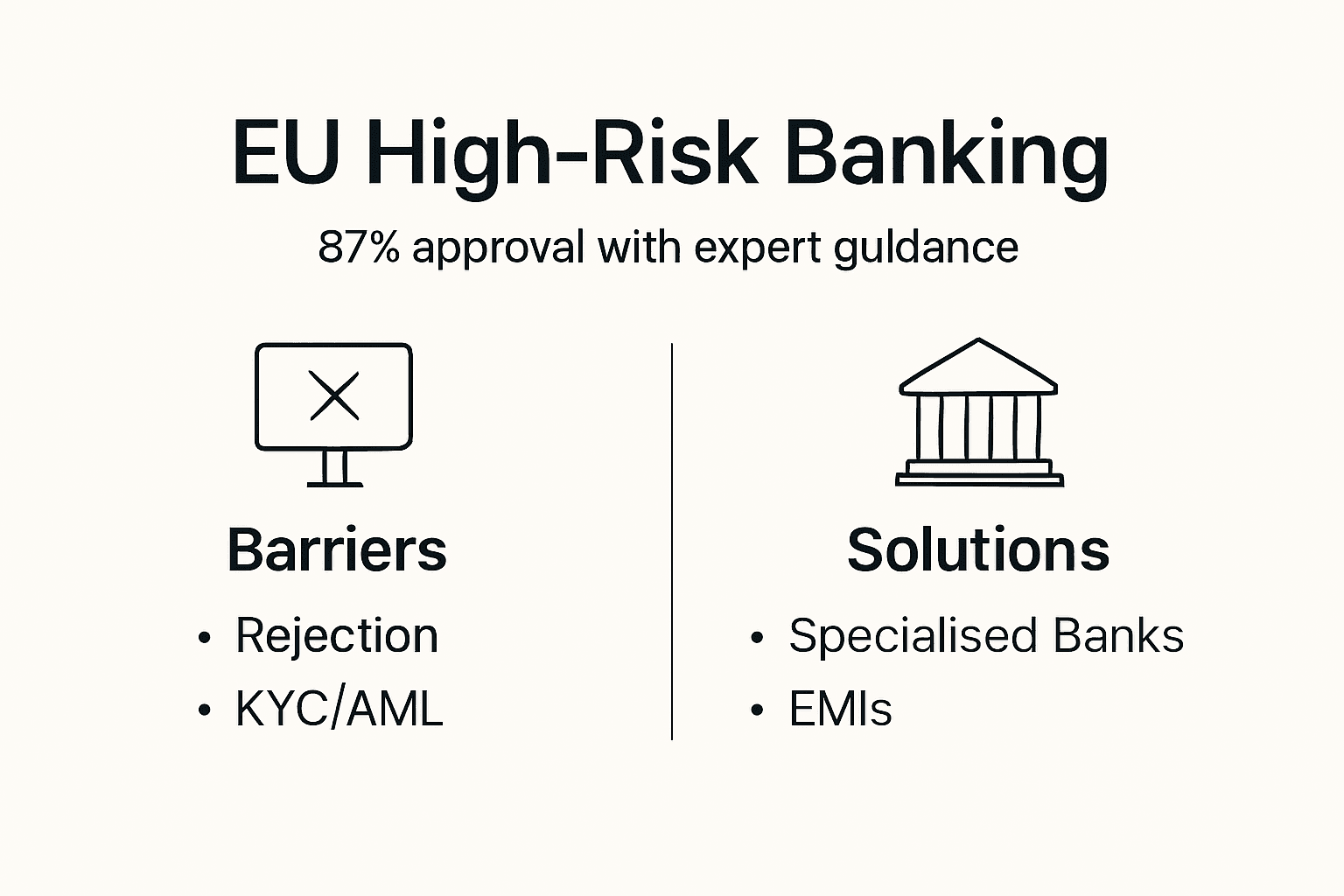
Specialised consultancy networks pre-vet relationships with over 50 banking partners and EMIs across EU and offshore jurisdictions. These networks understand which institutions accept specific high-risk sectors, match client compliance profiles with appropriate partners, and facilitate introductions that bypass initial screening rejections. Networks with 50+ pre-vetted banking partners boost approval rates to 87% for high-risk businesses.
Key services include:
- Multilingual compliance documentation preparation tailored to target bank requirements
- Jurisdiction selection based on licensing frameworks and regulatory compatibility
- Customised onboarding workflows integrating AML/KYC protocols
- Payment processing solutions connecting merchant accounts with banking infrastructure
- Ongoing relationship management and regulatory liaison
| Partner Type | Typical Services | Best For | Approval Timeline |
|---|---|---|---|
| Traditional EU banks | Full banking, lending, treasury | Established businesses with strong compliance | 4-8 weeks |
| Licensed EMIs | Payment accounts, SEPA transfers | Startups, crypto platforms | 2-4 weeks |
| Offshore banks | Multi-currency, privacy, flexibility | Complex structures, global operations | 3-6 weeks |
| Specialist fintech | Crypto banking, DeFi integration | Blockchain-native businesses | 2-3 weeks |
Pro Tip: Select banking partners that demonstrate active experience in your specific sector rather than generic high-risk acceptance, ensuring they understand your compliance obligations and transaction patterns.
Compliance and legal frameworks for high-risk banking
EU compliance for high-risk banking centres on Anti-Money Laundering Directives (AMLD5 and AMLD6), Know Your Customer protocols, and sector-specific licensing requirements. Crypto businesses must satisfy Markets in Crypto-Assets Regulation (MiCA) obligations, whilst iGaming platforms require gambling licences from recognised jurisdictions like Malta, Curaçao, or Gibraltar. Forex brokers need MiFID II authorisation or equivalent regulatory oversight.

Jurisdiction selection profoundly impacts banking accessibility. Estonia offers straightforward crypto licensing through its Financial Intelligence Unit, attracting blockchain startups seeking EU banking regulations compliance. Malta provides comprehensive iGaming frameworks with established banking relationships. Lithuania and Cyprus balance regulatory rigour with practical high-risk sector acceptance.
Key compliance elements include:
- Customer Due Diligence (CDD) processes documenting beneficial ownership and fund sources
- Enhanced Due Diligence (EDD) for politically exposed persons or high-value transactions
- Transaction monitoring systems detecting suspicious patterns
- Sanctions screening against EU and international watchlists
- Regular compliance audits and reporting to regulatory authorities
Continuous legal support proves essential beyond initial onboarding. Regulatory requirements evolve rapidly, particularly in crypto and iGaming sectors. Professional advisors monitor legislative changes, update compliance procedures, and liaise with banking partners when new obligations emerge. Integrated crypto infrastructure demands specialised AML/KYC adherence connecting blockchain transparency with traditional banking compliance safeguards.
Onboarding processes and operational efficiency
Streamlined onboarding workflows compress traditional 8-12 week banking timelines into 2-3 week activations. This efficiency stems from prepared documentation, pre-vetted partner relationships, and encrypted submission processes protecting sensitive business information.
Typical high-risk bank onboarding follows these steps:
- Initial assessment evaluating business model, transaction volumes, and compliance readiness
- Banking partner selection matching sector requirements with institutional acceptance criteria
- Documentation preparation including incorporation papers, licensing certificates, and compliance policies
- Secure submission using Swiss-grade encryption protecting confidential financial data
- Bank review and clarification requests managed by consultancy intermediaries
- Account activation with integrated payment processing and compliance monitoring
Swiss-grade encryption employs AES-256 protocols ensuring submitted documents remain confidential during transmission and storage. This addresses legitimate privacy concerns from high-risk businesses sharing sensitive operational details, competitive information, and ownership structures.
Compliance integration during onboarding establishes sustainable banking relationships rather than accounts vulnerable to immediate termination. Banks receive properly formatted AML policies, transaction monitoring procedures, and risk assessment frameworks demonstrating professional operations. This groundwork prevents the common scenario where accounts open successfully but close within months due to compliance deficiencies.
Pro Tip: Prepare complete documentation packages before initiating applications, including updated compliance manuals, transaction flow diagrams, and source of funds evidence, reducing approval timelines by 40-50%.
Common misconceptions and realities in high-risk banking
Widespread myths about banking accessibility for high-risk sectors discourage businesses from pursuing viable solutions. Understanding factual realities based on current data empowers informed decision-making.
Myth: High-risk businesses cannot secure traditional EU banking relationships. Reality: Many high-risk businesses achieve 87% approval rates with expert help, debunking the myth of universal rejection. Appropriate compliance preparation, jurisdiction selection, and partner matching enable access to legitimate banking infrastructure.
Myth: All banks treat high-risk sectors identically. Reality: Institutional risk appetites vary dramatically. Certain EMIs specialise exclusively in crypto platforms, whilst specific traditional banks accept iGaming with proper licensing. Partner selection determines outcomes more than sector classification.
Myth: Offshore banking remains the only option for high-risk operations. Reality: EU-based solutions offer superior regulatory clarity, SEPA payment access, and reduced compliance complexity compared to many offshore jurisdictions. Businesses prioritising European customer bases benefit from EU banking infrastructure.
Myth: Compliance obligations prove impossible for small high-risk businesses. Reality: Tailored compliance frameworks scale appropriately to business size and transaction volumes. Startups implement proportionate AML procedures satisfying banking requirements without enterprise-level resources.
Misunderstanding these realities leads businesses to abandon banking applications prematurely or pursue suboptimal offshore arrangements. Expert guidance reveals that crypto business banking integration within EU frameworks proves entirely achievable with proper preparation.
“The perception that high-risk sectors face universal banking rejection stems from businesses approaching inappropriate institutions without compliance preparation. Strategic partner selection and professional documentation support transform outcomes dramatically.”
Practical steps to secure and maintain banking relationships
Securing sustainable banking relationships requires systematic preparation and ongoing compliance management. Follow these sequential steps:
-
Assess your business risk profile accurately. Document your sector classification, transaction types, customer demographics, and jurisdictional exposure. Understand which specific risk factors banks evaluate for your industry.
-
Select appropriate jurisdictions based on licensing requirements and banking accessibility. Research whether your sector finds better acceptance in Estonia, Malta, Lithuania, or Cyprus. Align incorporation location with banking target institutions.
-
Engage specialised banking consultancy with proven high-risk sector experience. Verify their network includes institutions actively servicing your industry. Request case studies demonstrating successful placements for similar businesses.
-
Prepare comprehensive compliance documentation before applications. Develop AML policies, KYC procedures, transaction monitoring protocols, and risk assessment frameworks. Gather incorporation certificates, licensing approvals, and beneficial ownership declarations.
-
Complete secure onboarding through encrypted channels protecting confidential information. Submit complete documentation packages reducing clarification delays. Respond promptly to bank queries with detailed evidence.
-
Implement ongoing compliance monitoring maintaining relationship health. Conduct regular internal audits, update policies reflecting regulatory changes, and maintain transparent communication with banking partners about business developments.
Common failure points include incomplete documentation, mismatched bank selection, inadequate compliance infrastructure, and poor ongoing relationship management. Businesses applying to institutions incompatible with their sector waste months pursuing guaranteed rejections. Those securing accounts without proper compliance face swift terminations.
Avoid these pitfalls by:
- Researching institutional risk appetites before applications
- Investing in professional compliance development rather than minimal documentation
- Maintaining transparent communication about business model changes
- Regularly updating banks on licensing renewals and regulatory compliance
Consult detailed bank rejection reasons to understand specific deficiencies causing application failures. Reference comprehensive onboarding guides providing step-by-step workflows for different high-risk sectors.
Discover expert banking support for high-risk businesses
Navigating high-risk banking complexities demands specialised expertise combining regulatory knowledge, institutional relationships, and compliance experience. Professional consultancy services eliminate trial-and-error approaches that waste time and damage banking prospects through multiple rejections.
BankMyCapital’s specialised network connects high-risk businesses with pre-vetted banking partners across EU and offshore jurisdictions, achieving 87% approval rates through tailored compliance support and strategic partner matching. Services encompass complete onboarding assistance, jurisdiction selection, licensing liaison, and ongoing relationship management.
Explore the high-risk business banking checklist identifying essential preparation steps before applications. Learn strategies for passing bank compliance requirements specific to crypto, iGaming, and forex sectors. Discover comprehensive banking and financial solutions designed for complex high-risk operations requiring sophisticated compliance frameworks and multi-jurisdictional support.
Frequently asked questions about banking solutions for high-risk EU sectors
What is considered a high-risk business in the EU?
High-risk businesses include crypto exchanges, iGaming platforms, forex brokers, adult entertainment services, and certain fintech operations. Banks classify these sectors as elevated risk due to regulatory scrutiny, cross-border transaction complexity, and AML concerns.
How long does onboarding usually take for high-risk accounts?
Typical onboarding completes within 2-3 weeks when working with specialised consultancies and pre-vetted banking partners. Traditional bank applications without expert support may extend to 8-12 weeks or face rejection, whilst EMIs often process applications more rapidly.
Can crypto businesses integrate traditional EU banking?
Yes, crypto businesses achieve traditional EU banking relationships through proper licensing, robust AML/KYC procedures, and appropriate jurisdiction selection. MiCA compliance, transaction monitoring systems, and transparent business models satisfy banking requirements for legitimate cryptocurrency operations.
What are key compliance steps to maintain banking relationships?
Maintain updated AML policies, conduct regular internal audits, respond promptly to bank information requests, report significant business changes transparently, and implement continuous transaction monitoring. Regular compliance reviews and professional legal support prevent relationship deterioration.
Are offshore banking options better than EU banks for high-risk sectors?
Offshore banking offers privacy and regulatory flexibility but EU banks provide superior SEPA access, customer confidence, and regulatory clarity for European operations. The optimal choice depends on customer location, business model, and specific compliance requirements rather than universal superiority of either option.
