
TL;DR:
- Banking approval in Cyprus depends on full risk profile assessment, not just licensing.
- Operators must demonstrate strong compliance, transparency, local substance, and well-prepared documentation.
- Building long-term governance and proactive compliance strategies increases success in opening accounts.
Getting a gaming licence in Cyprus is a genuine achievement, but it does not open the doors to banking the way many operators expect. Banking challenges persist because banks assess your full risk profile, from transaction volumes and cross-border flows to governance and Anti-Money Laundering controls, long before they consider your licence status. The result is that well-licensed operators find themselves rejected or ignored by banks that should, in theory, welcome their regulated business. This guide cuts through the confusion, explaining why iGaming banking in Cyprus is so complex, what banks actually demand, and how to position your operation for approval.
Key Takeaways
| Point | Details |
|---|---|
| Licensing is not enough | Cyprus banks demand strong governance, compliance, and local substance in addition to iGaming licences. |
| Compliance is critical | Robust AML policies and transparent operations are essential for successful banking applications. |
| Varied banking options | Operators can choose from onshore, offshore, e-money, and crypto solutions, each with their own pros and cons. |
| Preparation boosts success | Thorough groundwork and best-practice documentation raise your approval odds and long-term bankability. |
Why banking is the biggest challenge for iGaming in Cyprus
With the ongoing struggles clear, it is vital to understand what makes banking solutions especially complex for iGaming operators in Cyprus.
Cyprus has built a reputation as a serious hub for online gaming businesses. The Cyprus Gaming and Casino Supervision Commission issues licences that are respected across Europe, and the island offers a favourable tax environment, a skilled multilingual workforce, and proximity to major financial centres. Yet despite all of this, banking remains the hardest challenge that operators face, often requiring months of back-and-forth before a single account is opened.
“A licence tells a bank that you are permitted to operate. It does not tell a bank that you are safe to bank. Those are two very different conversations.”
The core issue is that banks apply their own internal risk appetite on top of regulatory requirements. iGaming sits in a category that triggers enhanced due diligence automatically. Banks worry about money laundering, problem gambling-related fraud, chargebacks, and reputational exposure. A licence addresses none of these concerns directly.
When evaluating an application for opening business bank accounts, compliance teams look at several factors that go well beyond documentation:
- Transaction volumes and geography: High volumes and payments flowing through multiple jurisdictions raise red flags immediately.
- UBO transparency: Banks want clear, unambiguous ownership structures. Layered holding companies invite suspicion.
- AML programme quality: A policy document is not enough. Banks want to see a functioning compliance programme with named officers and audit trails.
- Local substance: Physical presence, local staff, and real operational activity matter to Cypriot banks more than many operators realise.
- Reputation of associated parties: If your payment processor or affiliate network has a poor track record, that affects your application.
Cyprus is indeed becoming a hub for high-risk fintech and iGaming precisely because of its expert ecosystem. But that ecosystem also means local banks are well-educated about the risks. Proactive governance is the price of entry. Operators who treat compliance as a box-ticking exercise consistently fail at the iGaming bank account opening stage.
Compliance and AML essentials: what Cyprus banks expect
Now that the risks and scrutiny are clear, let us break down exactly what banks look for in iGaming applicants wishing to do business in Cyprus.
Cyprus banks operate under EU Anti-Money Laundering directives, currently the sixth AML directive, and apply these standards rigorously to high-risk sectors. To open a high-risk bank account in Cyprus, your documentation needs to be thorough and consistent across every document submitted.
Comparison of AML standards: Cyprus vs. selected EU jurisdictions
| Requirement | Cyprus | Malta | Estonia |
|---|---|---|---|
| Enhanced due diligence for iGaming | Mandatory | Mandatory | Mandatory |
| Local substance requirement | High | Medium | Low |
| UBO disclosure threshold | 10% | 25% | 25% |
| On-site compliance officer | Expected | Recommended | Optional |
| Processing history required | 6 to 12 months | 3 to 6 months | 3 months |
Cyprus sits at the stricter end of the EU spectrum for substance and compliance officer requirements. This is not a disadvantage if you are prepared, but it catches underprepared operators off guard regularly.
Here is a practical step-by-step checklist to maximise your approval odds:
- Appoint a qualified AML compliance officer with a demonstrable track record.
- Draft an AML policy that reflects your actual business model, including specific risks from cross-border payments and player geographies.
- Compile certified copies of all UBO documentation, going back through every layer of ownership.
- Prepare a business plan that includes projected transaction volumes, revenue forecasts, and an explanation of your player acquisition strategy.
- Gather at least six months of processing history from existing payment providers.
- Document your local substance clearly: office lease, employee contracts, and organisational charts.
- Review your application for consistency before submission, as contradictions between documents are a common rejection trigger.
Pro Tip: Before approaching any bank, run a mock due diligence review on your own documents. Pretend you are the bank’s compliance officer and ask whether you would approve this application. This exercise alone identifies most weaknesses before they cost you time and money.
The risks of avoiding common banking mistakes are well documented. Operators who skip the self-audit step submit incomplete or contradictory applications and wonder why they receive rejections with no explanation.
Banks assess the full risk profile including volumes, cross-border flows, and governance structure. Matching your submission to this exact framework is the most reliable path forward.
Banking solutions available to iGaming operators in Cyprus
With compliance needs in mind, choosing the most suitable banking avenues is the next step.

Not every iGaming operator in Cyprus needs the same banking solution. Your player base, transaction volumes, and growth plans all determine which combination of accounts and payment infrastructure makes sense. The good news is that Cyprus is a recognised hub with a growing network of financial institutions that understand the sector, so your options are broader than in many other jurisdictions.
Comparison of banking solution types for iGaming operators
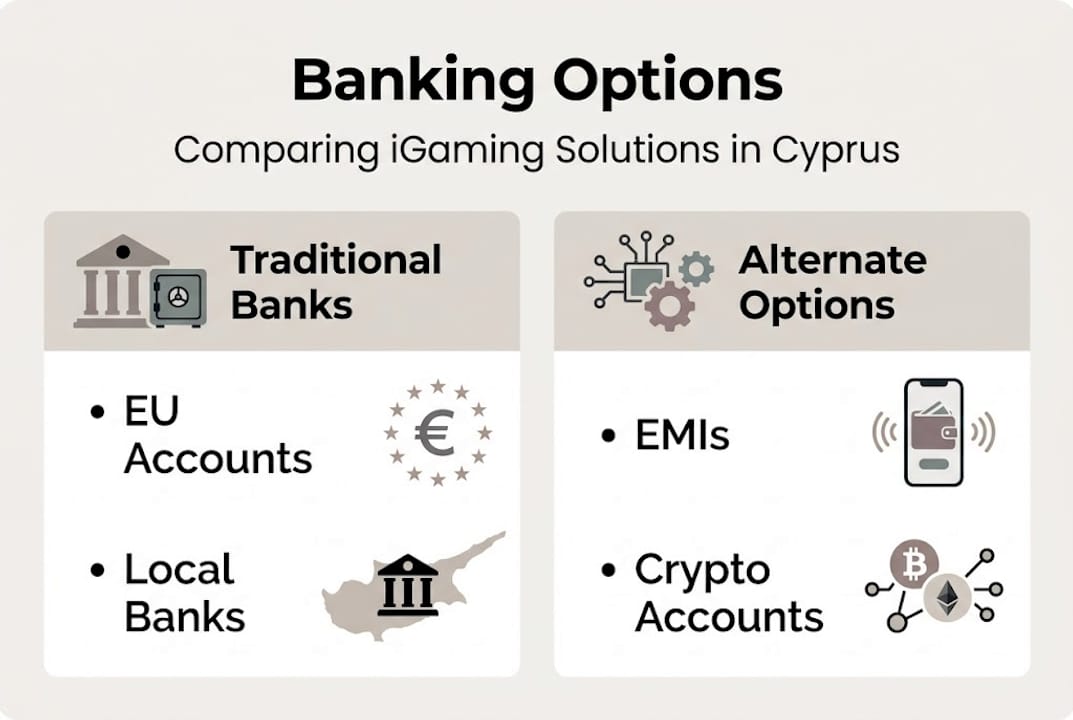
| Solution type | Speed of opening | Compliance burden | Best suited for |
|---|---|---|---|
| Cypriot local bank | Slow (3 to 6 months) | Very high | Established operators with substance |
| EU e-money institution | Medium (4 to 8 weeks) | Medium | Growth-stage operators |
| Offshore bank account | Fast (2 to 4 weeks) | Variable | Operators needing quick runway |
| Crypto banking solution | Fast (1 to 3 weeks) | Medium to high | Tech-forward operators |
The key points for each option:
- Local Cyprus banks: Offer the strongest credibility with regulators and enterprise clients. The trade-off is the highest compliance bar and longest onboarding timelines. Best for operators with established local substance.
- EU e-money institutions (EMIs): A practical middle ground. Many EMIs have built specific iGaming onboarding programmes and can process multi-currency transactions efficiently. Read more in our iGaming banking tips resource.
- Offshore accounts: Offshore bank account options can provide fast liquidity and operational flexibility. The risk is reputational; some payment partners and licensing authorities view offshore accounts with suspicion.
- Crypto banking: A growing category. The crypto banking workflow for iGaming allows operators to hold and settle in digital assets, reducing reliance on traditional banking rails. This is particularly useful for operators with high cross-border transaction volumes.
The smartest operators do not choose just one solution. They build a layered structure: a local or EU account for regulated payments, an EMI for day-to-day operations, and a crypto solution for cross-border settlements. This approach balances compliance, speed, and cost while reducing single-point-of-failure risk.
How to boost your banking application success
After choosing the banking route, it is critical to prepare thoroughly before submitting your application.
Even experienced operators are surprised by how often strong businesses receive rejections simply because of avoidable presentation issues. Banks do not always explain their decisions. That means your first submission must be close to perfect.
Here is a numbered action plan that reflects what banks assess when reviewing the full risk profile of volumes, cross-border flows, reputation, and governance:
- Restructure your corporate governance before applying. If your ownership structure is difficult to explain clearly in a two-page diagram, simplify it first.
- Commission a professional AML gap analysis. An external expert reviewing your programme adds credibility and often identifies weaknesses your internal team has missed.
- Prepare a tailored business plan for each bank. A generic document signals that you have not done your homework. Reference the bank’s own stated risk appetite where possible.
- Model your transaction flows in advance. Banks want to know exactly where money is coming from and where it is going. A cash flow narrative that accounts for player deposits, withdrawals, chargebacks, and operator revenue is highly persuasive.
- Document your substance proactively. Do not wait for the bank to ask. Include office lease agreements, staffing records, and evidence of day-to-day operational activity in Cyprus.
- Address cross-border risk head-on. If you accept players from multiple jurisdictions, explain your geo-blocking controls and know-your-customer processes for each region.
Pro Tip: Use your account opening checklist as a living document throughout the preparation process, updating it as you gather documents and resolve gaps. Presenting a self-certified checklist alongside your application demonstrates the kind of proactive compliance culture banks actually want to see.
Remember that approval is not the end goal. Banks reassess high-risk clients regularly. Maintaining strong substance, active AML monitoring, and clean transaction records keeps your account secure long after opening.
A reality check: what most iGaming operators get wrong about banking in Cyprus
Bridging the journey from practical tips to big-picture strategy calls for a candid perspective on the realities of iGaming banking.
Most iGaming operators who struggle with banking in Cyprus share one fundamental misunderstanding: they believe their licence is doing more work than it actually is. They invest heavily in obtaining the licence and very little in building the compliance infrastructure that banks actually evaluate. The result is predictable.
The operators who succeed treat compliance as a competitive advantage, not an overhead cost. They invest in a genuinely capable AML officer, build transparent governance structures, and maintain local substance that would hold up to scrutiny at any point during the relationship. These are not expensive investments relative to the cost of repeated banking rejections.
Cyprus is genuinely becoming a high-risk fintech hub, but the operators who benefit from that ecosystem are those who proactively match the bankability standards banks set. There is no shortcut here. Transparency and governance are the actual product you are selling to a bank when you apply for an account.
Our experience working with opening bank accounts as an iGaming operator confirms one consistent lesson: operators who build for the long term get banked. Those who build to pass inspection rarely do.
Unlock high-risk banking success with the right partner
Turning expertise into results is easier when you have proven resources and partners. Navigating Cyprus iGaming banking without specialist support is genuinely risky. A single rejected application leaves a record that follows your entity for years. At BankMyCapital, we work with a network of over 50 pre-vetted banking partners and EMIs, and we bring an 87% approval rate to every engagement because we prepare clients to meet what banks actually demand. Whether you need guidance on your banking rejection risks or want a structured approach via a high-risk business banking checklist, we provide the compliance frameworks, jurisdiction expertise, and banking introductions that turn rejections into approvals. Our typical onboarding takes two to three weeks, not months.
Frequently asked questions
Why do Cyprus banks reject iGaming applications even if I’m licensed?
Banks go far beyond licensing, evaluating your full risk profile including AML controls, governance, and transaction volumes to protect against financial crime and reputational exposure.
What documentation do I need for iGaming banking in Cyprus?
Typical requirements include proof of licence, a detailed business plan, robust AML policies, full due diligence on directors, and evidence of local substance. Banks assess volumes and cross-border flows as part of the same review.
Are offshore or crypto bank accounts viable for Cyprus iGaming firms?
Both offer real solutions for certain operator profiles, but proactive governance and careful vetting are essential to avoid compliance gaps and reputational risk.
How can I improve my banking application’s chances in Cyprus?
Prepare with transparent, consistent documentation, a simplified corporate structure, and a proactive compliance programme that addresses the specific risks your business model presents to a bank’s due diligence team.
