
High-risk businesses repeat predictable mistakes damaging banking access permanently. Learn what to avoid, why banks reject applications containing these errors, and how to preserve banking viability long-term.
Key takeaways
| Mistake | Why Banks Reject It |
|---|---|
| Application cycling and rapid re-application | Multiple rapid applications signal desperation; banks track application patterns and interpret cycling as fundamental unsuitability |
| Incomplete or disorganised documentation | Missing documents cause 60% of rejections; disorganised submissions appear unprofessional and suggest poor operational discipline |
| Operational misrepresentation and false claims | False licensing claims, revenue misstatement, and hidden regulatory proceedings trigger immediate disqualification and reputation damage |
| Beneficial ownership obfuscation | Unclear ownership structures trigger AML concerns; transparent beneficial ownership documentation is mandatory for approval |
| Relationship neglect and ignored communication | Banks interpret lack of communication as compliance indifference; high-risk sectors demand higher communication standards |
| Inadequate compliance frameworks | Informal AML/KYC procedures and vague fraud prevention appear as insufficient controls; institutional-grade compliance infrastructure is mandatory |
| Unclear transaction flows and customer documentation | Vague transaction flows trigger suspicion about money laundering; specificity in customer sourcing and fund flows demonstrates operational transparency |
| Excessive banking partner switching | Frequent account changes appear as attempt to evade regulatory scrutiny; sequential switching raises red flags about compliance evasion |
Pro Tip: Banking rejection is often preventable. Most rejections stem from operational mistakes rather than sector risk. Engage specialist consultants before applications to identify potential mistakes, structure operations compliantly, and position applications transparently.
Mistake 1: Application cycling and rapid re-application
Application cycling—submitting multiple applications to same or different banks in rapid succession after rejections—damages banking reputation irreparably. Banks track application patterns through industry databases. Multiple rapid applications signal desperation and appear as shotgun approach to securing banking despite institutional unsuitability.
Banking rejection consequences extend beyond individual application failure. Rejected applications create records in banking industry databases accessible by other banks. Subsequent applications trigger additional scrutiny due to prior rejections. Multiple rejections within short timeframe establish patterns banks interpret as fundamental unsuitability rather than documentation gaps or timing misalignment.
Correct approach involves learning from individual rejections before reapplication. Why did banks reject initial applications? Documentation gaps? Compliance concerns? Operational misalignment? Understanding rejection causes enables adjustment before subsequent applications. Rushing to reapply without addressing rejection causes repeats mistakes, triggering additional rejections and deepening banking reputation damage.
Timing between applications matters significantly. Reasonable reapplication timeline involves 3-6 months between applications to same banks (if reapplying after addressing feedback) or to different banking partners after rejection. Shorter timeframes appear as application cycling; longer timeframes suggest thoughtful remediation and renewed application.
Mistake 2: Incomplete or disorganised documentation
Incomplete documentation causes 60% of high-risk banking rejections. Missing documents trigger automatic rejection regardless of business legitimacy. Yet most high-risk businesses submit applications hurriedly without verifying documentation completeness.
Common documentation omissions include: missing beneficial ownership identification, incomplete source of funds documentation, lack of sector-specific licensing documentation, and missing operational procedure documentation. Each omission independently causes rejections; applications with multiple documentation gaps face compounding rejection likelihood.
Disorganised documentation appears unprofessional even if complete. Submissions consisting of loose documents with unclear relevance trigger reviewer skepticism about operational maturity. Banks equate documentation organisation with operational discipline—disorganised submissions suggest disorganised operations.
Prevention involves creating documentation checklists specific to target bank requirements. Different banks maintain different documentation standards; understanding specific bank requirements prevents submitting unnecessary documentation (appearing as information overload) or missing required documentation. Specialist consultants maintain knowledge of bank-specific requirements enabling checklist customisation.
Documentation verification before submission prevents rejections due to documentation issues. Review every document on required checklist; verify document currency (recent dates); confirm authenticity (originals or certified copies); organise documents logically; create index enabling reviewers to locate specific documents. This verification step prevents rejections due to documentation issues.
Mistake 3: Operational misrepresentation and false claims
Mischaracterising business operations or regulatory status destroys banking relationships immediately. Examples include: claiming regulatory licensing you don’t possess, misrepresenting customer demographics, mischaracterising transaction volumes, or concealing regulatory proceedings. Banks discover these misrepresentations during due diligence, triggering immediate rejection and damage to reputation.
False licensing claims represent particularly damaging misrepresentation. Crypto businesses claiming VASP licenses when they lack licensing, iGaming operators claiming gaming licenses they don’t possess, Forex brokers claiming investment provider authorization they lack—these misrepresentations trigger immediate disqualification. Banks verify regulatory claims easily; false claims destroy credibility instantly.
Revenue misrepresentation similarly damages applications. Overstating transaction volumes, mischaracterising revenue sources, or hiding significant customer concentrations all constitute misrepresentation discovered during banking due diligence. Once discovered, these misrepresentations trigger rejection and reputation damage affecting future applications.
Regulatory proceedings misrepresentation proves particularly damaging. Failing to disclose regulatory investigations, compliance violations, or account closures at other institutions appears as deliberate concealment. Banks discovering omitted regulatory matters reject applications and report omissions to regulatory authorities.
Prevention involves honest representation of operational status. If regulatory licensing is aspirational (in progress) rather than completed, disclose this status clearly. If revenue is projected rather than historical, present projections with clear assumptions. If regulatory matters are pending, disclose these matters transparently. Transparency prevents discovered misrepresentation; honesty builds banking trust.
Mistake 4: Beneficial ownership obfuscation and unclear structures
Beneficial ownership obfuscation—hiding true business ownership through complex structures or unclear documentation—triggers regulatory rejection. High-risk banking explicitly requires transparent beneficial ownership identification. Unclear ownership appears as deliberate concealment triggering AML concerns.
Complex ownership structures aren’t inherently problematic. Parent companies owning subsidiaries owning operating companies can work if beneficial ownership is clearly documented through entire chain. The problem arises when ownership structures appear designed to obscure ultimate beneficial owners rather than serving legitimate operational purposes.
Red flags that trigger ownership scrutiny include: ownership chains with unclear ultimate beneficial owners, owner identification missing personal details, beneficial owner identity information that doesn’t match identification documents, and owner addresses that don’t match registered addresses. These red flags appear as ownership obfuscation regardless of actual intent.
Prevention involves transparent ownership documentation. Clearly identify all beneficial owners (25%+ ownership), provide personal identification for all owners, document ownership percentages and roles clearly, and explain ownership structure rationale. This transparency prevents misinterpretation of complex structures as obfuscation.
Mistake 5: Neglected relationship management and ignored communication
Secured banking relationships require ongoing management. Banks expect proactive communication about material business changes, regulatory developments affecting operations, and compliance procedure updates. Neglected relationships deteriorate over time—bankers interpret lack of communication as lack of attention to compliance or operational deterioration.
Common relationship neglect examples include: failing to respond to banking partner inquiries, ignoring compliance questionnaires, missing reporting deadlines, and failing to update documentation when regulatory requirements change. These communication failures trigger account scrutiny and closure.
Banking relationships in high-risk sectors demand higher communication standards than mainstream banking. Banks expect periodic (monthly or quarterly) contact, transparent reporting on operational metrics, and immediate notification of material changes. Businesses providing regular communication face lower scrutiny; businesses with sporadic contact face higher account closure risk.
Pro Tip: Establish communication schedule with banking partners. Monthly transaction reporting, quarterly compliance updates, and immediate notification of material changes should be standard practice. Proactive relationship management prevents account closures resulting from neglect.
Mistake 6: Unrealistic compliance frameworks and insufficient controls
Banking applications with inadequate compliance frameworks trigger immediate rejection. Banks require institutional-grade anti-money laundering and know-your-customer procedures. Applications describing compliance informally (“we verify customers informally”) or vaguely (“we address compliance”) trigger skepticism about genuine compliance capability.
Insufficient AML/KYC procedures appear in applications describing verification as “asking customers their age” or “checking ID visually”. Banks require documented procedures: document verification (ID scanning), sanctions screening (OFAC list comparison), beneficial ownership verification for customer companies, transaction monitoring systems, and suspicious activity reporting procedures. Informal procedures suggest insufficient compliance controls.
Insufficient fraud prevention frameworks trigger rejection similarly. Applications lacking fraud detection systems, chargebacks management procedures, or transaction monitoring capability appear as operations accepting fraud exposure. Banks require documented fraud prevention demonstrating proactive fraud prevention rather than accepting fraud as business cost.
Prevention involves implementing institutional-grade compliance infrastructure matching or exceeding banking standards. Specific procedures documentation demonstrates compliance commitment. Technology system descriptions (transaction monitoring software, sanctions screening platforms, fraud detection systems) demonstrate operational sophistication exceeding informal approaches.
Mistake 7: Unclear transaction flows and customer source documentation
Banks require understanding how money flows through your operations. Unclear transaction flows trigger suspicion about potential money laundering. Applications must clearly explain: where customer funds originate, how customers access your services, what services you provide, where customer money goes after deposit, and what controls prevent misuse of banking infrastructure.
Vague transaction documentation appears as attempted obfuscation. Applications should describe: customer acquisition channels (marketing, referrals, partnerships), customer verification procedures, transaction types and volumes, customer fund holding periods, fund withdrawal procedures, and regulatory compliance for each transaction type. This specificity demonstrates operational transparency.
Customer concentration documentation prevents misinterpretation of unusual patterns. If 80% of customers originate from single geographic region, document why (regulatory concentration, market presence, customer demographics). If customer transaction sizes appear unusual, explain patterns. This documentation prevents banking partner suspicion about unusual patterns.
Mistake 8: Changing banking partners excessively and switching rapidly
Excessive banking partner changes appear as attempt to evade regulatory scrutiny. Banks interpret frequent account switching as sign that operators are hiding from banking oversight. Multiple consecutive account changes raise red flags about compliance issues or regulatory evasion.
Strategic banking diversification differs from problematic account cycling. Maintaining multiple accounts simultaneously demonstrates resilience planning. Switching from one bank to another sequential to investigation or compliance problem appears as evasion. This distinction matters—simultaneous multi-account strategy appears responsible; sequential account switching appears evasive.
Prevention involves multi-account strategy from inception. Rather than switching partners reactively, establish multiple accounts during normal operations demonstrating deliberate redundancy rather than reactive evasion.
Troubleshooting rejection and what to do next
Even with careful preparation, setbacks happen. Here is how to recover and get back on track without damaging your prospects further.
The first thing to understand is that a rejection is not necessarily final. Many institutions issue initial declines because of incomplete information rather than a fundamental policy objection to your business. The distinction matters enormously because it determines your next move.
Common reasons rejections happen at each stage
- Pre-screening rejection: Industry category policy or jurisdiction of incorporation. Solution: target institutions with a known appetite for your sector.
- Document review rejection: Missing, outdated, or inconsistent documentation. Solution: conduct a full audit of your file before resubmitting.
- Compliance review rejection: Gaps in your AML policy or unclear UBO structure. Solution: engage a compliance specialist to rebuild your policy documents.
- Final review rejection: Reputational concerns, adverse media, or issues with your source of wealth. Solution: obtain a legal opinion or independent compliance review and address findings formally.
“Banks are not obligated to tell you exactly why they declined your application. But you are absolutely entitled to ask, and a clear, polite enquiry often produces useful detail that makes your next application stronger.”
Alternatives when traditional banking fails
If traditional EU banks are not viable right now, you have real options. EU high-risk banking approval through specialist channels is one route, but there are others worth considering alongside it:
- EMIs (Electronic Money Institutions): Regulated under the EU’s EMD2 directive, EMIs like those authorised in Lithuania or the Netherlands can provide IBANs, payment processing, and multi-currency accounts with far shorter onboarding timelines.
- Offshore banking: Jurisdictions including the Seychelles, Mauritius, and Saint Vincent offer corporate banking to high-risk sectors, though you need robust correspondent banking arrangements to move funds internationally.
- Crypto treasury solutions: Stablecoin-based treasury management is now a viable operational tool for businesses that transact globally, reducing reliance on traditional fiat infrastructure.
- Payment processor accounts: High-risk merchant accounts through specialist acquirers allow you to process card payments even without a full corporate bank account.
The EBA and FATF proportionality principles actually support the use of these alternatives as part of a risk-based financial ecosystem. They are not workarounds. They are legitimate components of a well-structured high-risk business banking strategy.
To future-proof your banking relationships once you have established them, maintain detailed transaction records, update your compliance policy annually, and inform your banking partners proactively of any significant changes to your business model, ownership, or jurisdiction. Surprises kill banking relationships faster than almost anything else.
Why banks reject high-risk businesses
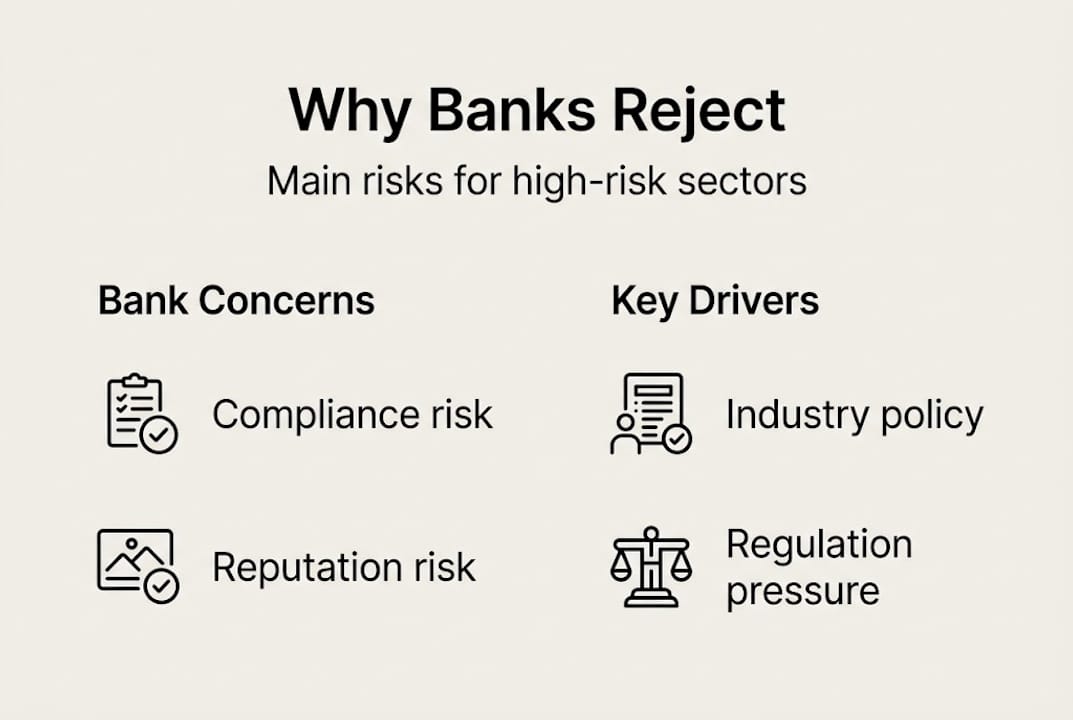
Bank rejection is not random. It follows a pattern driven by regulatory pressure, internal risk models, and reputational concerns. Understanding this pattern gives you a real advantage when you approach any institution.
The single biggest driver is de-risking. This is the practice of banks simply cutting off entire industry categories rather than managing individual client risk. It is cheaper and easier for a compliance department to say “no crypto” than to assess each crypto business on its merits. The result is that entire sectors lose access to banking infrastructure, regardless of how well-run individual businesses are.
Regulators are a key factor here. The EBA and FATF risk-based approach to anti-money laundering and counter-terrorism financing requires banks to apply enhanced due diligence to higher-risk clients. While the guidance actually calls for proportionate measures rather than blanket exclusions, many banks interpret it conservatively and apply outright bans. This misapplication of the rules is costing legitimate businesses their livelihoods.
Which sectors are most affected
Some industries face far greater scrutiny than others. Common banking rejection risks apply across the following categories:
- Crypto and digital asset businesses, including exchanges, custodians, and token issuers
- iGaming operators, whether licensed in Malta, Gibraltar, or elsewhere
- Forex and CFD brokers, particularly those with offshore regulatory licences
- Adult entertainment platforms and content creators
- Payment processors and money service businesses
- Nutraceuticals and supplements with subscription billing models
- Travel agencies and ticketing businesses with high chargeback exposure
The regional picture matters too. In the UK, account closures for high-risk sectors have surged sharply, driven by FCA pressure and correspondent banking risk. European Union banks operating under EBA supervision face similar pressures, though certain jurisdictions such as Lithuania, Malta, and the Netherlands maintain more pragmatic attitudes towards regulated high-risk operators. Offshore financial centres, including jurisdictions like the Cayman Islands, Seychelles, and Vanuatu, often offer more flexibility, but carry their own correspondent banking risks.
Key reasons banks decline applications
| Rejection reason | How it affects you | Typical sectors |
|---|---|---|
| Industry category policy | Automatic decline without review | Crypto, adult, iGaming |
| Unclear source of funds | AML red flag, triggers EDD | All high-risk |
| Offshore ownership structure | Perceived opacity | Forex, iGaming |
| High chargeback history | Operational risk concern | eCommerce, travel |
| Missing or weak compliance policy | Regulatory liability | All sectors |
| Unregulated business model | Reputational risk | Crypto, adult |
Understanding which specific reason is likely to apply to your business lets you address it directly, rather than submitting a generic application and hoping for the best.
Alternative Financial Solutions for High-Risk Businesses
Crypto payment gateways offer operational resilience when traditional banking proves difficult. They lower chargeback risks through irreversible transactions and speed up settlement times from days to minutes.
Benefits of crypto payment solutions:
- Near-zero chargeback risk compared to card payments
- Faster settlement reducing cash flow gaps
- Lower processing fees than traditional merchant accounts
- Global reach without currency conversion complications
- Reduced dependency on single banking relationships
Limitations require careful consideration. Regulatory challenges persist as jurisdictions implement varying crypto frameworks. Price volatility can erode margins if you do not convert immediately to stablecoins or fiat. Limited universal acceptance means many customers still prefer traditional payment methods.
Best practice combines crypto payments with compliant bank accounts. This hybrid approach provides payment diversity, operational backup, and customer choice. iGaming platforms increasingly use this model to mitigate banking risks while maintaining broad payment acceptance.
Real-world application shows effectiveness. A mid-sized iGaming operator might process 60% of deposits through crypto gateways while maintaining EUR and GBP bank accounts for withdrawals and operational expenses. This structure reduces bank exposure while preserving essential fiat services.
Crypto infrastructure should complement, not replace, your banking strategy. You still need bank accounts for regulatory compliance, payroll, supplier payments, and customer trust. Pure crypto operations face licensing obstacles and limit your addressable market.
Explore crypto payment gateways to understand how integrating these solutions within your broader financial architecture reduces vulnerability to banking access challenges.
Step-by-step: how to approach banks and alternatives
Once your documents are ready, you can move on to the engagement process. This is where strategy matters as much as paperwork.
Most high-risk businesses make the same mistake: they apply to a list of banks based on name recognition, get rejected, and then try the next one on the list. This scattergun approach does not work. Every rejection is visible in certain banking intelligence networks, and repeated rejections can make you harder to bank over time.
The right process for securing a banking relationship
- Research receptive institutions before approaching any of them. Not every bank accepts every sector. Specialist EMIs and fintech banks in Lithuania, Estonia, and Malta are often more open to regulated high-risk clients. Research their current onboarding policies before submitting a file.
- Prepare a tailored cover letter. Your cover letter should directly address the risk factors your business carries and explain, clearly and factually, how you mitigate them. Do not hide risk. Banks know it exists. Demonstrate that you manage it professionally.
- Request a pre-application call with the compliance team. Many institutions will allow a brief introductory call before you submit formally. Use this to gauge appetite and to establish a personal point of contact within their compliance function.
- Submit a complete, well-organised file. Documents should be clearly labelled, in the correct format, certified where required, and translated if needed. A disorganised file is a red flag.
- Follow up systematically but not aggressively. A polite follow-up every five to seven business days is appropriate. Chasing daily signals desperation and creates friction with compliance teams who are already under pressure.
- Have alternative solutions lined up in parallel. You should never rely on a single banking application. Opening a high-risk bank account often requires working multiple channels simultaneously, including EMIs, offshore banks, and payment processors.
- Engage a specialist where needed. Institutions that regularly onboard high-risk clients often have pre-existing relationships with specialist consultants. An introduction through a trusted intermediary can dramatically accelerate your application.
Pro Tip: When engaging banking compliance guidance professionals or specialist advisers, make sure they have actual relationships with the institutions they propose, not just theoretical knowledge of the landscape. Ask for named contacts and past case types.
It is also worth acknowledging that high-risk businesses face banking difficulties at a far higher rate than mainstream sectors, which makes pre-qualification from specialist networks significantly more valuable than cold applications.
Mitigating Bank Rejection Risk with Compliance Best Practices
Preparing complete KYC/AML documentation before application submission dramatically improves outcomes. Banks appreciate organized, comprehensive packages that demonstrate your understanding of compliance obligations.
Structured KYC approaches can increase approval rates up to 87% in specialized banking contexts. This statistic reflects how proper preparation signals professionalism and reduces bank workload during due diligence.
Maintain transparent governance and transaction monitoring records that demonstrate ongoing compliance commitment. Banks want evidence of internal controls, not just initial documentation. Your systems should capture and flag suspicious patterns automatically.
Steps to build compliant KYC/AML processes:
- Document beneficial ownership with certified corporate structure charts and shareholder registers
- Prepare source of funds documentation tracing capital origins through audited statements
- Implement transaction monitoring systems with clear threshold alerts and investigation protocols
- Establish customer due diligence procedures matching FATF recommendations for your risk level
- Create compliance manuals detailing policies, procedures, and staff responsibilities
- Schedule regular external audits validating control effectiveness and regulatory adherence
- Maintain ongoing training programs ensuring staff understand current AML/CFT obligations
Adopt enhanced due diligence measures tailored to your sector and jurisdiction. Generic compliance programs fail because they do not address specific risks banks identify in crypto, iGaming, or forex operations.
Your documentation package should include:
- Detailed business plan explaining revenue models and customer segments
- Licensing documentation from relevant authorities
- Compliance policies covering AML, KYC, data protection, and fraud prevention
- Transaction monitoring reports demonstrating system effectiveness
- Internal audit findings and remediation actions
- Risk assessments identifying and mitigating sector-specific threats
Pro Tip: Engage compliance consultants experienced with high-risk EU banking to optimize success. They understand bank expectations and can identify documentation gaps before submission, saving months of application delays.
Review the high-risk bank account documents guide and high-risk bank onboarding guide to understand how structured KYC effectiveness translates into banking access.
How BankMyCapital helps high-risk businesses avoid permanent mistakes
Navigating the complexities of high-risk banking and compliance demands specialised expertise and established banking relationships. BankMyCapital is a high-risk consultancy boutique facilitating crypto, iGaming, adult entertainment, forex, and related sectors in establishing banking relationships within the European Union and offshore jurisdictions. Our tailored approach addresses the unique challenges faced by high-risk businesses, from preventing application mistakes to implementing robust compliance frameworks.
We offer comprehensive support designed to prevent costly banking mistakes:
- Pre-application assessment: We identify potential mistakes in your operational approach before banking applications, suggesting adjustments preventing rejection triggers.
- Documentation preparation: We prepare documentation preventing common omissions and ensuring bank-specific requirements are satisfied completely.
- Operational positioning: We position applications transparently, preventing misrepresentation concerns and beneficial ownership ambiguity.
- Relationship management: We establish communication procedures preventing account closures from neglect and ensuring ongoing banking stability.
- Banking partner connection: We connect you with pre-vetted banking partners experienced in high-risk sectors, achieving strong approval rates and efficient onboarding.
Our transparent, security-focused approach protects your sensitive information throughout engagement. We provide ongoing support as regulations evolve, helping you maintain banking relationships in a dynamic regulatory environment.
Recommended
- Bank Account Pre-Approval Strategy for High-Risk Companies
- High-Risk Business Bank Account Documents Checklist
- Banking Compliance Best Practices for High-Risk Accounts
- Top Banks Onboarding High-Risk Clients
Frequently asked questions
How long should I wait between banking applications after rejection?
Wait 3-6 months before reapplying to same bank (if addressing feedback) or different banking partners (after rejection). Shorter timeframes appear as application cycling damaging reputation. Use waiting period to address rejection causes before reapplication.
Can I reapply to banks that rejected me previously?
Only after addressing reasons for previous rejection. If rejection resulted from documentation gaps, address gaps thoroughly before reapplication. If rejection reflected fundamental business model concerns, reapplication likely fails unless business model changes substantially. Consult specialists about whether reapplication makes strategic sense.
What should I do if I made misrepresentations in previous banking applications?
Disclose corrections to banking partners proactively rather than allowing discovery during audits. Transparency about previous misstatements (even if unintentional) prevents regulatory consequences and preserves future banking access. Hiding discovered misrepresentations triggers serious regulatory consequences.
How frequently should I communicate with banking partners?
Establish monthly or quarterly communication rhythm. Monthly reporting of transaction activity, quarterly compliance updates, and immediate notification of material changes represent standard practice. Regular communication normalises ongoing relationship management preventing account closure from neglect.
What if a bank closes my account—should I immediately seek replacement?
Not immediately. Understand account closure reasons first. If closure resulted from compliance violations, address violations before seeking replacement accounts (hasty replacement appears as evasion). If closure resulted from policy changes, seek replacement accounts strategically rather than rushing into unsuitable relationships.
