
TL;DR:
- Payment processing is a critical operational decision that impacts regulation, player trust, and revenue.
- Regulatory compliance, fraud prevention, and continuous monitoring are essential for long-term success in igaming payments.
- Choosing adaptable, multi-currency, and crypto-friendly solutions with expert support enhances scalability and resilience.
Payment processing is frequently dismissed as a back-office function, a technical necessity that simply moves money from A to B. That assumption costs igaming operators dearly. In reality, your payment infrastructure is the single most consequential operational decision you will make, shaping regulatory standing, player loyalty, and ultimately your bottom line. Payment processing is mission-critical for igaming platforms navigating banking risk and regulatory hurdles. This guide cuts through the noise and gives you a clear, practical framework for understanding, selecting, and optimising payment solutions that genuinely support long-term growth.
Key Takeaways
| Point | Details |
|---|---|
| Payment processing is strategic | It drives regulatory compliance, player trust, and profitability in igaming. |
| Compliance is essential | Robust payment solutions minimise legal and financial risks for operators. |
| Player confidence matters | Seamless payments directly impact retention and platform reputation. |
| Future-proof solutions increase resilience | Adopting modern systems helps igaming operators adapt to changing technologies and risks. |
Understanding payment processing in igaming
Payment processing, in the igaming context, refers to the complete chain of systems and relationships that authorise, settle, and reconcile financial transactions between players and your platform. It is not simply a payment gateway bolted onto your site. It is an ecosystem involving acquiring banks, payment service providers (PSPs), card networks, fraud detection layers, and currency conversion engines, all working in sequence every time a player deposits or withdraws.
Payment processing underpins igaming platforms’ ability to securely accept and remit funds globally, which is why disruption at any point in this chain has immediate revenue consequences. A failed withdrawal at 11pm on a Friday is not an IT problem. It is a player retention crisis.
So why do igaming operators fall into the high-risk category that banks and processors find uncomfortable? Several factors combine:
- Regulatory complexity: Licences vary by jurisdiction, and not all are recognised equally by financial institutions.
- Chargeback exposure: Gambling transactions carry elevated dispute rates compared with standard e-commerce.
- Reputational risk: Banks are cautious about association with gambling brands, particularly in markets with ambiguous legal status.
- Cross-border volume: High international transaction volumes trigger enhanced due diligence requirements.
- Player anonymity concerns: AML obligations are harder to satisfy when player identity verification is incomplete.
Understanding the igaming regulatory overview helps clarify why these factors collectively push operators into a category where standard merchant accounts are routinely declined.
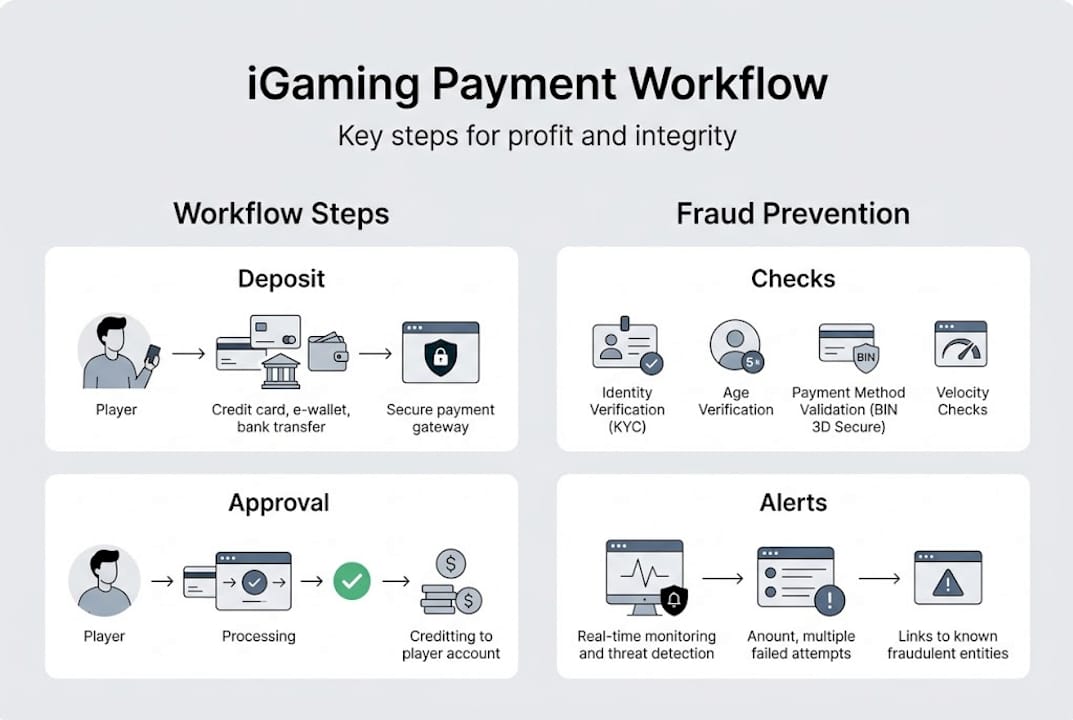
The typical payment workflow involves a player initiating a deposit, the PSP routing the request to the acquiring bank, the card network (Visa, Mastercard, or a local alternative) authorising the transaction, and funds settling into your merchant account, usually within one to three business days. Withdrawals follow a reverse path, often with additional compliance checks. Each handoff is a potential point of failure, delay, or regulatory scrutiny.
| Stakeholder | Role in payment chain | Key concern |
|---|---|---|
| Acquiring bank | Holds merchant account, settles funds | Regulatory exposure, chargeback ratios |
| PSP / gateway | Routes and processes transactions | Uptime, fraud detection, coverage |
| Card networks | Authorise card payments | Compliance with network rules |
| Compliance layer | AML, KYC, sanctions screening | Regulatory liability |
| Player | Initiates deposit or withdrawal | Speed, security, choice of method |
Grasping this structure is essential before you evaluate any vendor or negotiate any contract.
Navigating banking regulations and compliance
Compliance is where most igaming operators encounter their first serious payment problem. The regulatory landscape is not static, and what was acceptable practice two years ago may now trigger account termination.
Core frameworks you must satisfy include Anti-Money Laundering (AML) obligations, which require transaction monitoring and suspicious activity reporting. Know Your Customer (KYC) protocols mandate identity verification before players can deposit or withdraw above defined thresholds. Payment Card Industry Data Security Standard (PCI DSS) governs how card data is stored and transmitted. Failure on any of these fronts is not a minor administrative issue.
Non-compliance leads to lost banking relationships and blocked access to financial networks, which can effectively halt operations overnight.
Regional approaches differ significantly, and choosing the right jurisdiction for your payment infrastructure is a strategic decision, not a formality:
| Region | Regulatory body | Approach | Practical impact |
|---|---|---|---|
| European Union | EBA, national regulators | Strict AML directives, GDPR | Higher compliance cost, greater banking access |
| United Kingdom | FCA, UKGC | Robust consumer protection rules | Demanding but prestigious licence |
| Malta (MGA) | MGA | EU-aligned, igaming-specific | Widely accepted by EU banks |
| Offshore (e.g. Curaçao) | Local authority | Lighter touch regulation | Faster setup, limited banking options |
Seeking regulatory guidance for igaming early in your setup process prevents costly restructuring later. Operators who treat compliance as an afterthought consistently face higher processing fees, restricted banking relationships, and elevated chargeback liability.
Practical compliance steps that protect your payment operations include:
- Implementing real-time transaction monitoring tools that flag unusual activity automatically.
- Maintaining thorough KYC documentation with regular refresh cycles for high-value players.
- Conducting periodic audits of your PSP’s own compliance posture, not just your own.
- Establishing clear escalation procedures for suspicious transaction reports.
- Following payment best practices to reduce chargeback ratios below the 1% threshold most acquirers enforce.
The operators who thrive long-term are those who treat compliance as a competitive advantage rather than a burden. A clean compliance record opens doors to better banking terms, lower processing rates, and access to premium payment methods that less compliant competitors simply cannot offer.

How payment processing impacts player confidence and financial integrity
Here is a figure worth keeping in mind: platforms with transparent, efficient payment processing see measurably higher customer retention rates and lower chargeback risk. Players who experience smooth, predictable transactions are significantly less likely to dispute charges or abandon your platform.
The connection between payment experience and player trust operates on a straightforward psychological principle. When a player deposits instantly and withdraws within hours, they feel in control. When withdrawals are delayed, queried, or rejected without clear communication, trust collapses rapidly and rarely recovers.
Building payment-driven player confidence involves several interconnected steps:
- Offer diverse payment methods. Local payment options, e-wallets, bank transfers, and crypto alternatives reduce friction for international players and signal that you understand their preferences.
- Communicate processing times clearly. Ambiguity about withdrawal timelines is one of the most common triggers for chargebacks and player complaints.
- Invest in fraud prevention technology. Machine learning fraud detection reduces false declines, which frustrate legitimate players, while catching genuine fraud before it escalates.
- Maintain bank account pre-approval processes that ensure your merchant accounts remain active and adequately funded to handle withdrawal peaks.
- Monitor chargeback ratios weekly. Catching a rising ratio early allows intervention before your acquirer places your account under review or terminates it.
Pro Tip: Set up automated alerts for any single payment method that drops below a 95% success rate. A silent decline spike can cost you thousands in lost deposits before your team notices manually.
Financial integrity extends beyond the player relationship. Robust payment systems provide the transaction data granularity that your finance team needs for accurate revenue recognition, tax reporting, and cash flow forecasting. Operators using secure EU banking strategies consistently report cleaner audit trails and fewer regulatory queries, because their payment data is structured, accessible, and reconcilable.
Fraud prevention via advanced payment technology is not optional at scale. Velocity checks, device fingerprinting, behavioural analytics, and 3D Secure authentication together form a layered defence that protects both your revenue and your players.
Choosing future-proof payment solutions for igaming success
Selecting a payment solution is not a one-time procurement decision. It is an ongoing strategic relationship that must evolve as your player base grows, your licensing portfolio expands, and the regulatory environment shifts.
Reliable payment solutions ensure continuous operations, support multi-currency processing, and integrate crypto payment capabilities that are increasingly central to igaming growth in 2026. Operators who locked into single-currency, single-method solutions three years ago are now scrambling to retrofit flexibility into architectures that were never designed for it.
Key features to prioritise when evaluating payment systems:
- Multi-currency settlement across at least 20 major currencies, with competitive FX rates and minimal conversion delays.
- Crypto integration covering Bitcoin, Ethereum, and stablecoins, with compliance-grade wallet screening built in.
- Redundant processing routes so that if one acquirer goes offline, transactions automatically reroute without player-facing disruption.
- Granular reporting dashboards that give your finance and compliance teams real-time visibility into transaction status, decline reasons, and chargeback trends.
- API-first architecture that allows rapid integration with new payment methods without full platform rebuilds.
- Dedicated igaming support from your PSP, not generic merchant services teams who do not understand the regulatory nuances of your sector.
Exploring crypto payment innovations is particularly relevant for operators targeting younger demographics or markets where traditional banking penetration is low. Crypto deposits settle faster, carry lower chargeback risk, and attract a player segment that actively prefers pseudonymous transactions.
Pro Tip: Before signing any PSP contract, request a live demonstration of their decline recovery workflow. How a provider handles a failed transaction tells you far more about their operational quality than any sales presentation.
Common implementation pitfalls include underestimating integration timelines, failing to test withdrawal flows under peak load conditions, and neglecting to negotiate reserve release schedules before going live. Understanding the process of opening igaming bank accounts with specialist partners rather than generic commercial banks dramatically reduces the risk of account freezes during your growth phase.
Our perspective: what most guides miss about igaming payment processing
Most guides treat payment processing as a setup challenge. Get the right PSP, tick the compliance boxes, go live. What years of consulting igaming operators have shown us is that the real challenge is continuous adaptability, and that is where most operators fall short.
Regulation does not stand still. The EU’s AML directives tighten regularly, card network rules shift, and banking partners reassess their risk appetite without warning. Operators who built perfectly compliant setups in 2023 have faced unexpected account reviews in 2026 simply because their banking partner changed its internal risk policy.
Vendor relationships matter as much as technology. A PSP with strong igaming sector relationships will advocate for your account when your acquirer raises concerns. A generic provider will simply terminate you. This distinction is rarely visible in a features comparison table.
Silent risks are the most dangerous. Gradual chargeback ratio creep, a payment method quietly declining more frequently, a banking partner slowly reducing your processing limits — these do not trigger alarms until they become crises. Continuous monitoring, not annual reviews, is what separates operators who scale from those who stall. Exploring offshore banking for igaming as a complementary strategy adds resilience that purely onshore setups cannot provide.
Maximise your igaming payment performance with expert solutions
If this guide has clarified one thing, it is that igaming payment processing rewards operators who take a structured, expert-led approach rather than piecing together solutions reactively. At BankMyCapital, our payment processing options are built specifically for high-risk operators who need reliable banking relationships, multi-currency capability, and compliance support that keeps pace with regulatory change. We work with over 50 pre-vetted banking partners and EMIs, achieving an 87% approval rate with onboarding typically completed within two to three weeks. Whether you need to review your current setup against high-risk best practices or build a complete payment infrastructure from scratch, our team provides the tailored guidance that generic consultancies simply cannot match. Explore our solutions for high-risk industries and request a consultation today.
Frequently asked questions
What makes igaming a high-risk industry for banks?
Banks identify igaming as high risk owing to regulatory scrutiny, elevated fraud exposure, and reputational concerns, making standard merchant accounts difficult to obtain and maintain.
How does payment processing affect player retention?
Transparent payments increase customer retention by ensuring quick, reliable deposits and withdrawals that build trust and reduce the likelihood of players disputing transactions or switching to competitors.
What payment solutions work best for international igaming operators?
Multi-currency systems and integrated crypto processing are ideal, as multi-currency and crypto integration provides the flexibility and security that global player bases require.
Can non-compliance with payment regulations shut down an igaming business?
Yes, absolutely. Non-compliance leads to lost banking relationships and network bans, which can freeze accounts and halt operations with very little warning.
