
TL;DR:
- Choosing the right licensing jurisdiction significantly impacts banking access, compliance costs, and market reach.
- Strict compliance with AML, responsible gambling, and record-keeping is essential to avoid hefty fines.
- Navigating grey markets requires thorough legal, financial, and enforcement risk assessments for successful entry.
Most operators entering the global iGaming market assume that grabbing a licence from a well-known jurisdiction is enough to stay compliant. It rarely is. The regulatory landscape spans dozens of frameworks, from tightly controlled onshore markets in Europe to flexible offshore regimes in the Caribbean and Indian Ocean, and the gap between them is wider than most business plans account for. Fines for non-compliance can reach hundreds of millions of euros in the EU alone. Understanding how these frameworks differ, and why your licence choice shapes everything from banking access to player trust, is the foundation of any serious international iGaming strategy.
Key Takeaways
| Point | Details |
|---|---|
| Know your jurisdictions | Choosing the right licence can unlock or block access to banking, payments, and market growth. |
| Compliance is critical | Lapses in AML, KYC, or RG will cost heavily in fines and business reputation. |
| No shortcuts in grey zones | Grey markets demand rigorous due diligence and real-time legal awareness to avoid nasty surprises. |
| Balance rules and reach | Overly strict compliance can backfire, so tailor your approach for effective channeling and long-term stability. |
Why iGaming regulations matter: The global compliance puzzle
Regulation in iGaming exists for three core reasons: preventing financial crime, protecting players, and securing tax revenue for governments. These goals sound straightforward, but the mechanics behind them create an intricate web of obligations that operators must navigate daily. Anti-money laundering (AML) rules require you to verify who your players are, monitor their transactions, and report suspicious activity. Responsible gambling (RG) obligations mean you must provide self-exclusion tools, deposit limits, and reality checks. Tax frameworks vary wildly, from flat gross gaming revenue levies to complex tiered structures.
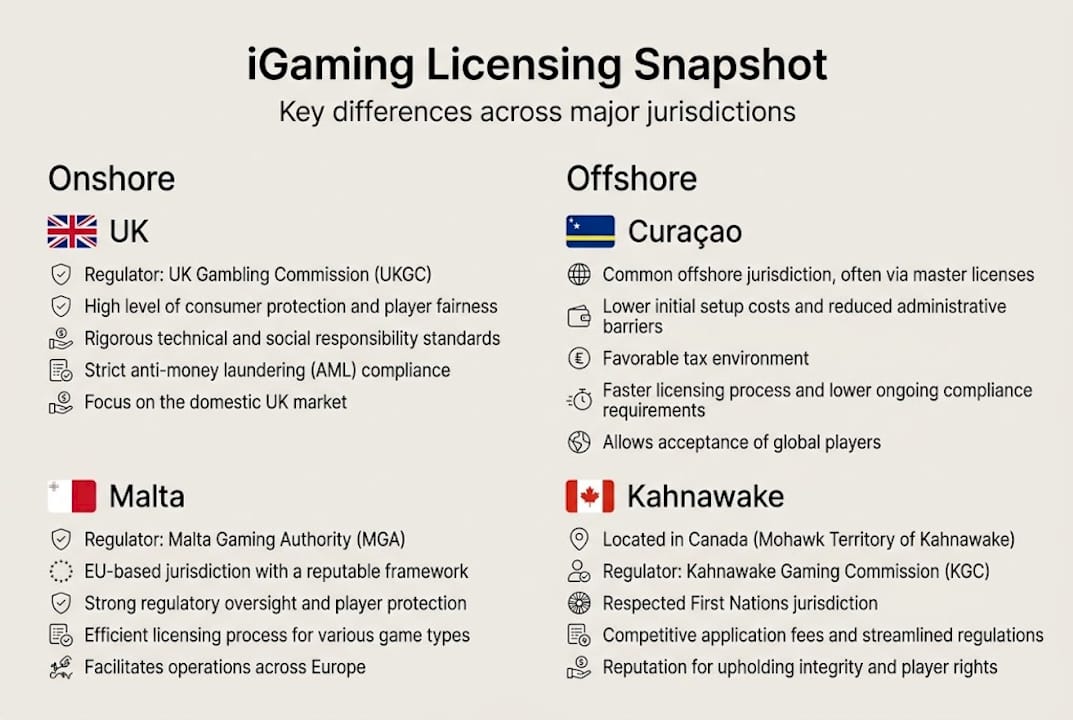
The three most influential regulatory bodies globally are the UK Gambling Commission (UKGC), the Malta Gaming Authority (MGA), and the Curaçao Gaming Control Board. Each represents a distinct philosophy. The UKGC sets strict AML and RG standards, requiring robust customer due diligence (CDD), ongoing transaction monitoring, and mandatory reporting of suspicious activity. The MGA offers a credible EU-facing framework with comparable AML expectations. Curaçao, historically the most permissive of the three, has introduced meaningful reform in recent years, though its reputation with banks remains mixed.
Key compliance obligations that every operator must prioritise include:
- Customer due diligence (CDD): Verifying player identity at onboarding and throughout the relationship.
- Suspicious activity reports (SARs): Filing timely reports when transactions raise red flags.
- Responsible gambling tools: Self-exclusion registers, affordability checks, and intervention protocols.
- Source of funds checks: Demonstrating that large deposits originate from legitimate sources.
- Record-keeping: Maintaining transaction and identity records for regulatory inspection.
“Operators who treat AML and RG as tick-box exercises rather than operational culture tend to be the ones making headlines for the wrong reasons. Regulators are not just reading your policy documents — they are watching your data.”
Spain and the UK have both issued significant fines in recent years for failures in CDD and SAR reporting. These are not edge cases. They are the predictable outcome of under-investing in legal support for gaming compliance. Getting the foundations right is not optional — it is the price of operating in regulated markets.
Key regulatory frameworks: Comparing the major licensing options
Choosing a licence is one of the most consequential decisions an iGaming operator makes. It affects which markets you can serve, which banks will work with you, and how payment processors assess your risk profile. There is no universally correct answer, but there is a right answer for your specific business model, target markets, and risk appetite.

Onshore regulated markets such as the UK, Malta, Germany, Sweden, Denmark, Romania, and Ontario (Canada) require operators to meet demanding local standards. These licences signal credibility to players, banks, and payment providers. The UKGC licence is widely regarded as the gold standard globally, but it demands continuous compliance investment, mandatory player protection measures, and close regulatory scrutiny. Germany’s State Treaty on Gambling introduced strict advertising restrictions and monthly deposit limits of €1,000. Sweden’s Spelinspektionen requires a local presence and imposes stringent RG obligations. Ontario operates a regulated private market through iGaming Ontario, with its own compliance framework.
Offshore licensing regimes such as Curaçao, Kahnawake (Canada), Anjouan (Comoros), Nevis, and Liberia offer faster setup, lower costs, and fewer ongoing compliance demands. These are attractive to early-stage operators or those targeting markets without a local licensing requirement. However, premium licences like Malta’s provide EU market access and banking relationships that offshore alternatives simply cannot replicate. Anjouan licences can be obtained in weeks for a fraction of the cost of an MGA licence, but major payment processors and European banks routinely decline operators holding only offshore credentials.
Curaçao introduced stricter AML measures following its 2023 regulatory overhaul, requiring sub-licensees to transition to direct licences and meet enhanced due diligence standards. This has improved its standing somewhat, but many banks still categorise Curaçao-licensed operators as high-risk by default.
| Jurisdiction | Cost | Time to licence | EU market access | Banking ease | AML/RG standard |
|---|---|---|---|---|---|
| UKGC (UK) | Very high | 4-6 months | Yes (UK only) | Excellent | Very high |
| MGA (Malta) | High | 3-5 months | Yes (EU) | Good | High |
| Curaçao | Medium | 4-8 weeks | Limited | Moderate | Medium (post-reform) |
| Anjouan | Low | 2-4 weeks | No | Challenging | Low |
| Kahnawake | Medium | 2-3 months | Limited | Moderate | Medium |
Pro Tip: If your primary markets are EU-based, an MGA licence paired with a specialist banking partner will open far more payment processing doors than a cheaper offshore licence ever will. The short-term saving on licence fees can cost you multiples in lost revenue from declined transactions and restricted banking access. Explore bank account opening hurdles before committing to a jurisdiction.
For operators targeting emerging markets or running a lean initial operation, a crypto banking workflow for gaming can bridge the gap while a stronger licence is pursued.
Compliance realities: Penalties, enforcement, and common pitfalls
The gap between knowing the rules and actually implementing them at scale is where most operators run into trouble. Compliance failures are rarely the result of deliberate wrongdoing. They typically stem from under-resourced compliance teams, outdated onboarding processes, or technology that cannot keep pace with regulatory change.
Spain issued fines exceeding €398M between 2019 and 2024, with the UK recording multiple individual cases exceeding £1M. The most common triggers are inadequate CDD at onboarding, delayed SAR filing, and gaps in responsible gambling tooling. These are not obscure technical failures — they are the basics.
| Jurisdiction | Notable fine | Primary failure |
|---|---|---|
| Spain | €398M (2019-2024) | Advertising and CDD failures |
| United Kingdom | £17M (bet365, 2023) | Social responsibility and AML |
| Sweden | SEK 100M+ (multiple) | RG tool deficiencies |
| Netherlands | €400K+ (multiple) | Unlicensed activity |
To avoid joining this list, operators should build compliance into operations from day one rather than retrofitting it later. The essential mitigation steps are:
- Implement robust CDD at onboarding: Use automated identity verification tools that check documents, sanctions lists, and politically exposed persons (PEP) databases in real time.
- Establish a SAR filing protocol: Designate a Money Laundering Reporting Officer (MLRO) and set clear internal thresholds for escalation and reporting.
- Deploy comprehensive RG tools: Self-exclusion, deposit limits, session timers, and affordability checks must be live before you accept your first player.
- Train staff regularly: Compliance is not a one-time induction. Quarterly training updates aligned with regulatory changes are the minimum acceptable standard.
- Audit your processes externally: Independent compliance audits identify blind spots that internal teams often miss.
Even minor compliance missteps can trigger banking partner reviews. Banks categorise iGaming as high-risk by default, and a regulatory warning or fine gives them grounds to exit the relationship immediately. Exploring EU AML strategies and diversifying your offshore bank choices reduces the operational risk of losing a single banking partner.
Navigating regulatory grey areas and edge cases
Not every market fits neatly into the onshore or offshore category. Grey markets — jurisdictions where online gambling is neither explicitly licensed nor explicitly prohibited — represent both opportunity and significant risk. Operators entering these markets without thorough due diligence are essentially gambling on enforcement patterns remaining stable, which they rarely do.
The United States is the most prominent example of regulatory complexity. Individual states regulate gambling independently. Nevada has among the strictest suitability standards in the world, requiring extensive background checks and financial disclosures. New Jersey operates a robust regulated online market. Meanwhile, the sweeps casino model has proliferated across states where real-money gambling remains unlicensed, operating through a legal workaround involving virtual currencies. Operators must assess local suitability standards carefully before entering any US market, as the legal ground shifts frequently.
South Africa presents a different challenge. Online casino gambling is technically illegal under the National Gambling Act, yet enforcement is inconsistent and a significant grey market exists. Operators serving South African players from offshore licences face the risk of sudden enforcement action or payment processing disruption without warning.
Before entering any ambiguous jurisdiction, work through this checklist:
- Legal opinion from local counsel: Not a generic overview, but a specific written opinion on your proposed business model.
- Payment processing viability: Confirm that processors will support transactions from that market before committing operational resources.
- Banking stability assessment: Understand whether your existing banking partners will tolerate exposure to that jurisdiction.
- Regulatory monitoring plan: Assign responsibility for tracking legislative and enforcement developments on a monthly basis.
- Exit strategy: Define in advance the triggers that would cause you to withdraw from the market and how you would handle player funds.
Pro Tip: Grey market entry is not inherently reckless, but it requires the same level of due diligence as a regulated market launch, plus a contingency plan. Understanding offshore jurisdiction strategies and offshore banking explained gives you the structural knowledge to assess these risks properly.
The real balancing act: How effective regulation builds lasting success
Here is an uncomfortable truth that most compliance consultants will not tell you: chasing the strictest licence does not automatically make you a better operator. It can actually harm your business if the compliance burden outpaces your revenue base or if the regulatory framework misaligns with your target market.
The Netherlands is a clear example. When the Dutch market regulated in 2021, it introduced some of the most restrictive responsible gambling measures in Europe, including mandatory affordability checks and aggressive advertising bans. The result was that a significant portion of Dutch players migrated to unlicensed offshore sites, weakening both consumer protection and the regulated market’s viability. Overly strict controls can drive users offshore, undermining the very goals regulation is meant to achieve.
The operators who build lasting competitive advantage are those who treat compliance as a strategic asset rather than a cost centre. A robust licensing foundation signals to banks, payment processors, and players that you are a serious, stable business. But the licence is only the beginning. The real work is building operational systems that sustain compliance at scale, adapting quickly when rules change, and maintaining banking relationships that can withstand regulatory scrutiny. Smart compliance is not about being the most restricted operator in the room. It is about being the most resilient.
Next steps: Position your iGaming business for regulatory success
Navigating global iGaming regulations requires more than reading the rules — it requires knowing which jurisdiction fits your business model, which banks will actually support your operations, and how to build compliance systems that hold up under scrutiny. At BankMyCapital, we work exclusively with high-risk operators to solve exactly these problems. Whether you need guidance on iGaming licensing solutions or want to understand and reduce your banking rejection risks, our network of over 50 pre-vetted banking partners and our in-house compliance specialists are ready to move quickly. Most clients are onboarded within two to three weeks.
Frequently asked questions
Which licence offers the best mix of access and compliance for new iGaming operators?
The Malta MGA licence provides strong EU market access and genuine regulatory credibility, though it comes with higher costs and more demanding compliance requirements than offshore alternatives such as Curaçao or Anjouan.
What are the most common reasons iGaming operators are fined?
The most frequent causes are inadequate customer due diligence at onboarding, delayed suspicious activity report filing, and insufficient responsible gambling tools such as self-exclusion and deposit limits.
Is launching in regulatory grey markets worth the risk?
Grey market entry can be viable, but it demands thorough local legal advice, payment processing confirmation, and an active monitoring plan, as suitability standards and enforcement can shift with little notice.
How can regulatory overreach affect legitimate iGaming businesses?
When rules become too restrictive, players often migrate to unlicensed offshore sites, which weakens regulated markets and reduces the consumer protections that regulation was designed to deliver in the first place.
