
TL;DR:
- Low risk industries for banks feature stable, recurring revenue, low default rates, and strong debt coverage ratios, making them highly attractive for lending. Healthcare, professional services, insurance, essential retail, and waste management qualify due to predictable cash flows and high entry barriers, resulting in favorable loan terms. Accurate classification codes and demonstrated financial stability are essential for businesses to access these benefits and secure better banking relationships.
Low risk industries for banks are defined as sectors with stable, recurring revenue, low default rates, and predictable repayment capacity that make them highly favourable for commercial lending. In formal credit assessment, these sectors are often called “preferred credit categories” or “investment-grade industries” by underwriters. Understanding which sectors qualify, and why, gives business owners a direct advantage when approaching lenders for accounts, credit facilities, or long-term financial partnerships. This guide covers the financial characteristics, classification codes, and sector examples that determine low-risk status, alongside a practical comparison with moderate and high-risk categories.
Key takeaways
Low risk industries for banks are defined by stable cash flows, low default rates, and strong DSCR metrics, not by sector name alone.
| Point | Details |
|---|---|
| DSCR is the primary metric | Banks require a minimum DSCR of 1.25x; falling below 1.15x triggers structural adjustments or rejection. |
| Healthcare and professional services lead | SBA default rates below 2% make dental, legal, and accounting firms the most favoured sectors. |
| NAICS and SIC codes shape initial risk ratings | Misclassification places businesses in higher-risk buckets before financials are reviewed. |
| Basel III amplifies sector risk costs | High-risk sector loans require banks to hold more regulatory capital, raising borrowing costs directly. |
| Client concentration undermines low-risk status | Even in preferred sectors, heavy reliance on a single client increases perceived risk for lenders. |
What makes an industry low risk for banks?
Banks assess industry risk through a combination of financial metrics, operational characteristics, and regulatory context. Stable, recurring revenue and contract-based customer relationships are the two attributes lenders weight most heavily. Both reduce cash flow volatility, which is the primary driver of loan default.
Key financial characteristics lenders look for
The following attributes consistently appear in sectors that receive favourable credit assessments:
- Stable cash flow patterns. Subscription models, retainer agreements, and government contracts all produce predictable monthly income. Lenders can model repayment with confidence.
- High barriers to entry. Sectors requiring professional licences, such as healthcare or legal services, face less competitive disruption. That stability translates directly into lower default risk.
- Strong Debt Service Coverage Ratio (DSCR). Banks prefer a minimum DSCR of 1.25x to confirm that operating income comfortably covers loan repayments. A DSCR below 1.15x typically triggers structural adjustments or outright rejection.
- Low client concentration. Even within secure banking sectors, a business that derives 70% of revenue from a single client carries elevated risk. Lenders examine the top five customers and the durability of those contracts in detail.
- Low operating cost volatility. Sectors with predictable cost structures, such as professional services firms, present fewer earnings surprises that could impair repayment.
Low risk lending is as much about business economics as it is about the industry label itself. Recession-resistant revenues and licensing barriers matter more to an underwriter than a favourable sector name on a credit application.
Pro Tip: When approaching a bank, present a 24-month cash flow schedule alongside your top five client contracts. This directly addresses the two metrics underwriters scrutinise first: revenue predictability and concentration risk.
Which industries have low risk for banks?
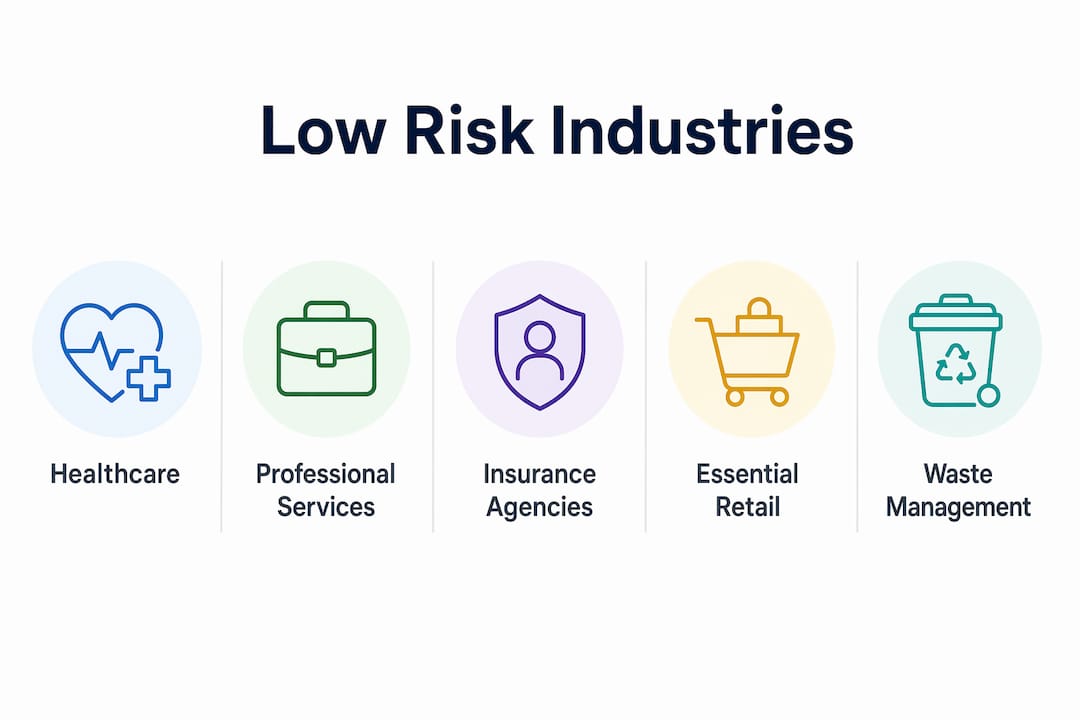
Healthcare and professional services consistently produce SBA loan default rates below 2%, placing them at the top of every lender’s preferred sector list. That figure is not incidental. It reflects structural features that make these businesses reliably solvent across economic cycles.

Healthcare sub-sectors
Dental practices, veterinary clinics, optometry offices, and home health agencies all share the same core advantage: demand is non-discretionary. Patients do not defer essential medical care during recessions the way they defer luxury purchases. This produces the steady cash flow patterns that banks prize in stable industries for lenders.
Professional services
Accounting firms, law practices, engineering consultancies, and management consulting firms operate on retainer or project-contract models. Revenue is booked in advance, client relationships are long-term, and switching costs are high. These factors combine to produce consistently low defaults well below consumer-facing sectors.
Insurance agencies
Insurance agencies are considered low default businesses because of recurring commission income and stable client retention. Their lower operational overhead and predictable revenue multiples make them straightforward to underwrite.
Essential retail
Supermarkets and pharmacies are regarded as low risk because consumer demand remains steady during economic downturns. Essential retail exhibits strong cash flow performance compared to discretionary retail segments, which can see revenue fall sharply in a recession.
Waste management and environmental services
Waste management and environmental remediation firms operate under long-term municipal or corporate contracts. Revenue is contractually locked in for years at a time. That contract durability is precisely what lenders mean when they describe a sector as a low risk lending market.
| Industry | Typical Default Rate | Primary Risk Advantage |
|---|---|---|
| Dental and veterinary practices | Below 2% | Non-discretionary demand, licensed operators |
| Accounting and legal services | Below 2% | Retainer contracts, high client retention |
| Insurance agencies | Very low | Recurring commission income, low overhead |
| Supermarkets and pharmacies | Low | Recession-resistant consumer demand |
| Waste management | Low | Long-term municipal contracts |
How do NAICS and SIC codes affect bank risk assessment?
NAICS and SIC codes are the primary classification tools banks and automated underwriting systems use to assign an initial risk rating to a business. The code you carry determines which risk bucket you land in before a single financial document is reviewed. That initial placement shapes the entire credit conversation.
Why misclassification is a silent funding risk
A mismatch between your business activity and your industry code can place you in a higher-risk bucket within automated underwriting systems, even if your actual financials are strong. A software development firm that carries a general “technology services” code may be grouped with higher-volatility tech businesses rather than with stable professional services firms. The financial metrics are identical, but the risk rating differs.
The consequences are concrete:
- Higher interest rates applied at the outset of underwriting
- Requests for additional collateral not required of correctly classified peers
- Outright rejection by lenders whose mandates exclude certain risk categories
- Longer due diligence timelines as underwriters attempt to reconcile code and financials
Verifying that your NAICS or SIC code accurately reflects your primary revenue-generating activity is a prerequisite for accessing favourable banking terms. This is not a bureaucratic detail. It is a direct input into the capital cost your business pays.
Pro Tip: Cross-reference your NAICS code against the Census Bureau’s official NAICS manual and confirm it matches your largest revenue stream, not your founding business description. Many businesses evolve but never update their code, and that gap costs them at the underwriting stage.
Low, moderate, and high risk: what bank risk frameworks reveal
Banks do not operate on gut instinct when categorising industry risk. They apply formal frameworks. The CAMELS rating system, used by credit unions and referenced by the NCUA, evaluates six components: capital adequacy, asset quality, management, earnings, liquidity, and sensitivity to market risk. Asset quality and earnings stability are the two components most directly influenced by industry sector.
Under Basel III, risk weights assigned to credit exposures are based on sector and counterparty ratings, not just historical default data. This means a bank lending to a business in a high-risk sector must hold more regulatory capital against that loan. That capital cost is passed directly to the borrower in the form of higher rates or tighter terms.
Atradius, one of the world’s largest trade credit insurers, publishes sector-level credit outlooks that illustrate how granular this analysis becomes. In Q1 2026, Atradius rated 555 sector-market combinations for credit risk, with 149 rated low risk and 194 rated high risk. The remaining combinations fell into moderate risk. That distribution shows that even within a single industry, geography and market conditions shift the risk rating substantially.
The table below contrasts the three risk categories across the metrics that matter most to lenders.
| Risk Category | Typical DSCR Threshold | Funding Conditions | Example Sectors |
|---|---|---|---|
| Low risk | 1.25x and above | Competitive rates, minimal collateral | Healthcare, legal, accounting, essential retail |
| Moderate risk | 1.15x–1.25x | Standard rates, moderate collateral | General manufacturing, hospitality, logistics |
| High risk | Below 1.15x or variable | Elevated rates, heavy collateral or rejection | Crypto, iGaming, adult entertainment, forex |
Understanding where your sector sits within this framework is not just useful for securing credit. It determines the structural terms of every banking relationship you pursue. Businesses operating in high-risk sectors face a fundamentally different underwriting environment, one where standard bank channels frequently result in rejection regardless of individual financial performance.
Presenting sector-specific credit narratives that combine market outlooks with execution metrics is a more effective approach than relying on a generic low-risk claim. A dental practice that can demonstrate 36 months of stable revenue, a DSCR of 1.4x, and a diversified patient base will secure better terms than one that simply states it operates in healthcare.
How Bankmycapital supports stable banking partnerships
Whether your business operates in a preferred credit category or a more complex sector, securing the right banking relationship requires more than a strong balance sheet. Bankmycapital works with businesses across industries to structure compliant, stable banking arrangements that match their operational profile. For businesses seeking to open accounts without local entity requirements, the business bank account guide outlines how to access EU and offshore banking through a network of over 50 pre-vetted partners. Bankmycapital’s team handles jurisdiction selection, compliance documentation, and regulatory liaising, reducing the time from application to account activation to 2–3 weeks. If your sector sits outside the preferred categories, understanding the high-risk business loan framework is the right starting point before approaching any lender.
Recommended
- How to Open a Business Bank Account for High-Risk Industries in 2025
- Top Banks Still Onboarding High Risk Clients in 2026
- Legal support for high-risk sectors: 2026 guide
- Banking trends in 2026: Strategies for high-risk sectors
Frequently asked questions
What industries are considered low risk by banks?
Healthcare sub-sectors, professional services such as accounting and legal firms, insurance agencies, essential retail, and waste management are consistently rated as low risk. These sectors share stable cash flows, low default rates, and contract-based revenue models.
What DSCR do banks require for low risk lending?
Banks typically require a minimum DSCR of 1.25x for preferred lending terms. A DSCR below 1.15x usually triggers requests for additional collateral or structural changes to the loan.
How do NAICS codes affect my banking application?
Your NAICS or SIC code determines your initial risk bucket in automated underwriting systems. A misclassified code can place your business in a higher-risk category even if your financials are strong, resulting in higher rates or rejection.
Can a business in a low risk sector still be rejected by banks?
Yes. High client concentration, a DSCR below threshold, or weak earnings history can override a favourable sector classification. Banks assess the individual business, not just the industry label.
What is the difference between low risk and high risk industries for banks?
Low risk industries exhibit stable, recurring revenues and default rates below 2%, while high risk sectors such as crypto, iGaming, and forex show volatile cash flows and face elevated regulatory scrutiny. Under Basel III, banks must hold more capital against high-risk sector loans, which raises borrowing costs for those businesses.
