
High-risk crypto and iGaming businesses face intensified regulatory scrutiny and banking rejections in 2026, making offshore crypto banking essential yet complex. Strategic jurisdiction selection, meticulous compliance documentation, and professional facilitation determine whether applications succeed or stall. This guide walks you through selecting compliant jurisdictions, preparing comprehensive KYC documentation, navigating onboarding procedures, and maintaining long-term account stability to secure reliable offshore banking access.
Key takeaways
| Point | Details |
|---|---|
| Jurisdiction selection matters | Choosing crypto-friendly jurisdictions like Malta, Cayman Islands, or Singapore with clear regulations minimises compliance hurdles. |
| Documentation thoroughness | Complete KYC, source-of-wealth narratives, and corporate documents prevent 60% of application failures. |
| Professional facilitation accelerates approval | Specialised consultants reduce average onboarding from months to 14-21 days through pre-vetted banking networks. |
| Ongoing compliance sustains access | Regular transaction activity, proactive disclosure updates, and timely KYC refreshes prevent account freezing. |
Introduction to offshore crypto banking for high-risk businesses
Offshore crypto banking refers to establishing banking relationships outside your primary operating jurisdiction, specifically designed to accommodate cryptocurrency transactions and high-risk business models. For crypto exchanges, iGaming platforms, and similar ventures, traditional banking channels increasingly reject applications due to perceived regulatory and reputational risks.
In 2026, regulatory frameworks have tightened globally. Financial institutions face mounting pressure to demonstrate robust anti-money laundering controls and transaction monitoring capabilities. This environment creates operational bottlenecks for legitimate high-risk businesses seeking offshore banking solutions.
Key challenges include:
- Account application rejections exceeding 70% for crypto businesses approaching mainstream banks
- Sudden account freezes triggered by large crypto-related transactions lacking proper documentation
- Extended onboarding timelines stretching 3-6 months without specialised guidance
- Jurisdictional mismatches between corporate structure and banking location causing compliance gaps
Jurisdictions with clear crypto regulations like Malta, Cayman Islands, and Singapore reduce operational hurdles significantly. Success requires understanding which jurisdictions align with your business model, preparing comprehensive compliance documentation, and engaging experienced facilitators who navigate complex regulatory landscapes efficiently.
Prerequisites and necessary documentation for offshore crypto banking
Banks demand extensive verification before approving offshore crypto accounts. Documentation quality directly impacts approval speed and success rates.
Core KYC requirements include valid passports for all directors and ultimate beneficial owners, current proof of address documents dated within 90 days, detailed business descriptions explaining revenue models and target markets, and complete corporate formation documents. Your submission must demonstrate transparent ownership structures and legitimate business operations.
Offshore bank accounts require extensive documentation including passport copies, proof of address, source of wealth narratives, incorporation certificates, UBO declarations, financial statements, and business descriptions. Missing any component triggers delays or outright rejection.
Source-of-wealth documentation deserves particular attention. Banks scrutinise how you accumulated capital and generated ongoing revenue. Provide:
- Tax returns covering the past 2-3 years showing declared crypto income
- Blockchain transaction records demonstrating trading history and wallet balances
- Corporate financial statements audited by recognised accounting firms
- Detailed narratives explaining wealth accumulation, investment strategies, and business growth trajectories
- Supporting evidence like sale agreements, inheritance documentation, or previous business exit records
Anti-money laundering compliance extends beyond initial onboarding. Banks assess your ongoing compliance capability through policies addressing transaction monitoring, customer due diligence for your own clients, and reporting suspicious activities. Demonstrating robust internal controls significantly improves approval odds.
Accuracy matters more than speed. Inconsistent information between documents, unexplained gaps in employment history, or vague business descriptions raise immediate red flags. Review every document thoroughly before submission, ensuring dates align, entity names match precisely, and narratives tell coherent stories.
Selecting the optimal jurisdiction for offshore crypto banking
Jurisdiction selection determines regulatory burden, banking accessibility, and long-term operational stability. Not all offshore locations welcome crypto businesses equally.
Top-tier crypto-friendly jurisdictions in 2026 share common characteristics: transparent regulatory frameworks specifically addressing digital assets, established banking infrastructure comfortable with crypto clients, Financial Action Task Force compliance demonstrating international legitimacy, and political stability ensuring predictable operating environments.
Selecting jurisdictions with FATF compliance like Malta, Cayman Islands, and Singapore reduces compliance risk substantially. Compare leading options:
| Jurisdiction | Crypto Regulations | Banking Access | FATF Status | Key Advantages |
|---|---|---|---|---|
| Malta | Comprehensive DLT framework | Excellent for EU access | Compliant | VFA licensing, EU banking integration, established fintech ecosystem |
| Cayman Islands | Principles-based approach | Strong private banking | Compliant | No corporate tax, confidentiality protections, sophisticated legal infrastructure |
| Singapore | Clear licensing pathways | Premium banking options | Compliant | Political stability, regional hub status, rigorous compliance standards |
| Switzerland | Evolving crypto framework | Selective acceptance | Compliant | Banking privacy traditions, crypto valley ecosystem, premium service quality |
Malta excels for businesses requiring EU market access and licensing credibility. The Virtual Financial Assets framework provides clear compliance pathways, whilst Maltese banks increasingly accommodate crypto clients meeting stringent standards.
Cayman Islands attracts larger operations prioritising tax efficiency and confidentiality. Banking relationships require substantial minimum deposits, typically starting at $100,000, but offer sophisticated wealth management and multi-currency capabilities.
Singapore balances regulatory clarity with premium banking access. The Monetary Authority of Singapore enforces strict compliance, filtering out marginal operators whilst welcoming well-capitalised, professionally managed crypto businesses.

Evaluate jurisdictions against your specific needs: transaction volumes, currency requirements, regulatory compliance capabilities, and growth plans. Misaligned jurisdiction choices create expensive restructuring requirements later.
Step-by-step onboarding process with offshore banks
Successful offshore crypto banking setup follows a structured sequence. Skipping steps or rushing documentation preparation guarantees delays.
-
Conduct comprehensive risk assessment. Evaluate your business model, transaction patterns, target markets, and compliance gaps honestly. Banks perform identical assessments, so understanding weaknesses beforehand allows proactive mitigation.
-
Engage specialised facilitators early. Professional consultants maintain relationships with crypto-friendly banks, understand current acceptance criteria, and navigate application processes efficiently. Average setup timelines of 14-21 days become achievable through experienced facilitation.
-
Assemble complete documentation packages. Gather all KYC documents, corporate records, financial statements, and source-of-wealth evidence before approaching banks. Incomplete submissions trigger immediate rejections.
-
Submit applications through proper channels. Facilitators present applications directly to relationship managers, bypassing generic inquiry forms that disappear into compliance queues. Personal advocacy significantly improves consideration quality.
-
Respond promptly to verification requests. Banks issue clarification requests during due diligence. Delayed responses suggest operational disorganisation or evasiveness, both fatal to applications.
-
Complete enhanced due diligence procedures. Expect video verification calls, additional documentation requests, and detailed questionnaires about business operations. Transparency and preparedness demonstrate professionalism.
-
Activate accounts with initial deposits. Approved accounts require minimum opening deposits, typically $25,000 to $100,000 depending on jurisdiction and bank tier. Fund transfers trigger final compliance checks before full activation.
Pro Tip: Maintain parallel relationships with multiple banking partners. Relying on single accounts creates vulnerability when banks suddenly change risk appetites or exit crypto sectors. Diversification across 2-3 jurisdictions provides operational resilience.
Timelines vary based on documentation quality and bank workload. Well-prepared applications with professional facilitation achieve account activation within 2-3 weeks. Self-directed applications frequently extend to 3-6 months, assuming eventual approval.
Understand that banks can reject applications at any stage. Rejection reasons often remain vague due to confidentiality policies. Working with experienced consultants who receive feedback directly from banking partners enables strategic adjustments for subsequent applications to alternative institutions.
Common mistakes and how to avoid them
Application failures cluster around predictable patterns. Understanding common pitfalls enables proactive avoidance.
Incomplete KYC documentation causes 60% of failures. Missing apostilles on corporate documents, expired identity proofs, or unsigned bank references trigger automatic rejections. Create comprehensive checklists mapping every required document against specific bank requirements before submission.
Under-disclosure of crypto income and wealth sources destroys credibility instantly. Banks cross-reference submitted information against blockchain analytics, public records, and international databases. Discrepancies between declared wealth and observable transaction volumes raise immediate suspicion. Provide complete, accurate disclosures even when exposing tax liabilities or complicated acquisition histories.
Vague business narratives fail to satisfy compliance officers evaluating risk profiles. Generic descriptions like “cryptocurrency trading platform” provide insufficient detail for proper risk assessment. Specify:
- Exact services offered and revenue generation mechanisms
- Target customer demographics and geographic markets
- Transaction volume projections and seasonal patterns
- Regulatory licences held or applications pending
- Compliance controls and monitoring capabilities implemented
Ignoring post-onboarding KYC refresh requests precipitates account freezing. Banks periodically update customer files, typically annually for high-risk accounts. Treating these requests casually or delaying responses beyond stated deadlines signals non-cooperation. Prioritise compliance inquiries above routine business operations.
Pro Tip: Document every bank interaction meticulously. Maintain organised files containing submission dates, correspondence records, and verbal conversation summaries. When facing account reviews or disputes, comprehensive documentation demonstrates professionalism and supports your position effectively.
Mismatched entity structures create regulatory complications. Establishing accounts under personal names when operating corporate crypto businesses, or vice versa, confuses beneficial ownership verification and tax reporting obligations. Ensure corporate structures align perfectly with intended banking relationships and operational models.
Maintaining compliance and account stability post-onboarding
Securing offshore crypto banking access represents only the beginning. Long-term stability requires ongoing diligence and proactive relationship management.
Maintain minimum transaction activity preventing dormancy classifications. Banks flag accounts with insufficient quarterly activity as potential money laundering risks or administrative burdens. Execute at least one legitimate business transaction monthly, even during slower periods.
Proactively disclose material business changes before banks discover them independently. Ownership transfers, significant transaction volume increases, new business lines, or regulatory licence acquisitions all warrant immediate notification. Banks appreciate transparency and view unreported changes as potential red flags during periodic reviews.
Key stability practices include:
- Responding to compliance requests within 48 hours maximum
- Updating beneficial ownership information immediately upon changes
- Providing advance notice of large or unusual transactions
- Maintaining consistent transaction patterns aligned with stated business activities
- Renewing identity documents and corporate registrations before expiration
- Conducting annual compliance reviews demonstrating ongoing AML policy effectiveness
Transaction monitoring extends beyond banking relationships to your own business operations. Implement robust internal controls screening customers, monitoring transaction patterns for suspicious activities, and maintaining detailed audit trails. Banks increasingly request evidence of your compliance capabilities during account reviews.
Build genuine relationships with banking officers assigned to your account. Personal familiarity creates goodwill during inevitable compliance questions or unusual transaction inquiries. Schedule periodic check-in calls discussing business developments, industry trends, and regulatory changes affecting your sector.
Anticipate regulatory evolution. Crypto regulations continue developing rapidly across jurisdictions. Stay informed about pending legislation, new reporting requirements, and shifting bank risk appetites. Proactive adaptation to regulatory changes demonstrates sophistication and reduces friction during compliance assessments.
Expected costs, timelines, and success metrics
Understanding financial commitments and realistic timelines prevents budget surprises and sets appropriate expectations.
Professional facilitation fees typically range £4,000 to £12,000 depending on jurisdictional complexity and support scope. Premium services including ongoing compliance support, multiple jurisdiction applications, and regulatory licensing assistance command higher fees but deliver proportionally better outcomes.
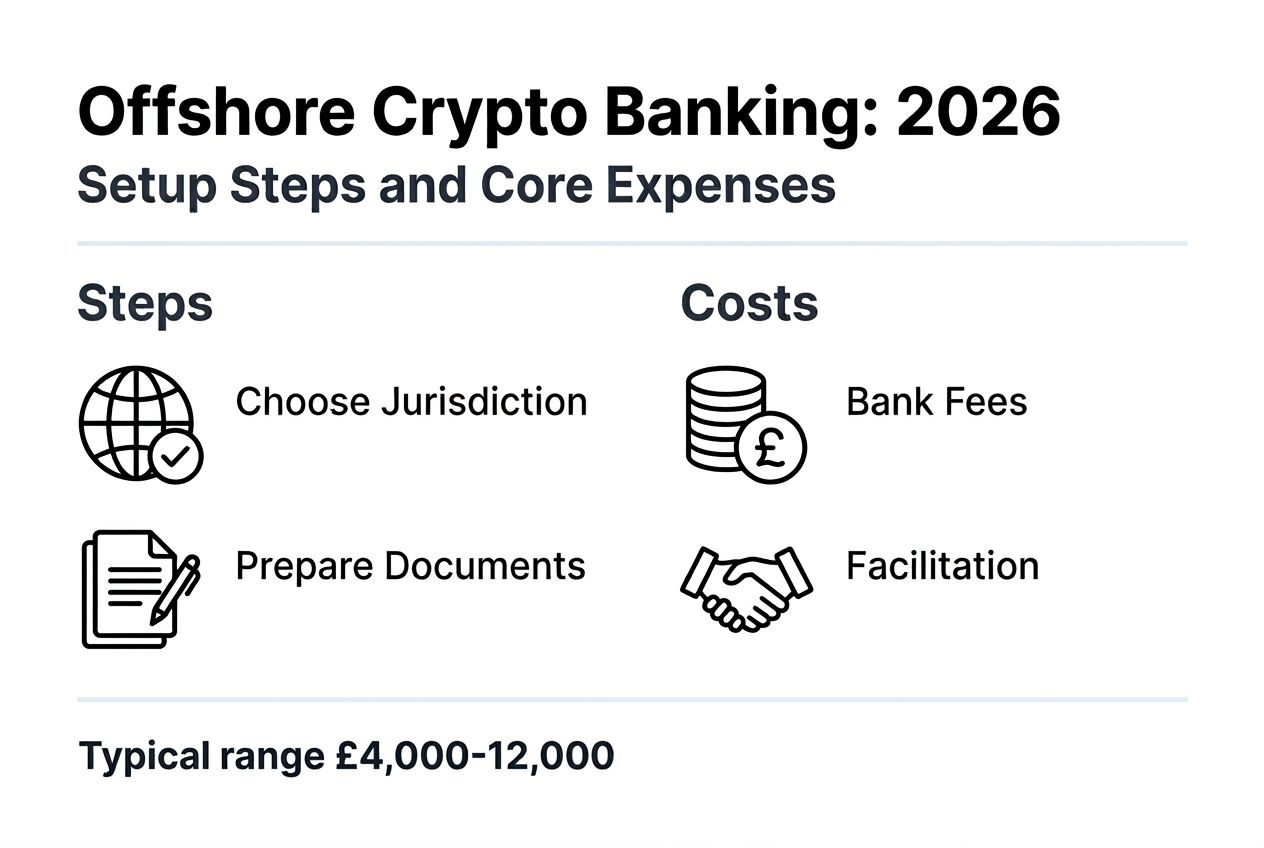
| Cost Component | Typical Range | Notes |
|---|---|---|
| Consultancy fees | £4,000 – £12,000 | Varies by jurisdiction and service scope |
| Corporate formation | £1,500 – £5,000 | Includes registered agent, directors if needed |
| Legal documentation | £2,000 – £8,000 | Contracts, policies, compliance frameworks |
| Initial bank deposits | £20,000 – £100,000 | Minimum opening balances, jurisdiction dependent |
| Annual maintenance | £3,000 – £15,000 | Registered agent, compliance updates, renewals |
Average onboarding timelines of 2-3 weeks assume complete documentation preparation and experienced facilitation. Self-directed applications frequently extend to 12-16 weeks, with success rates below 30% for first-time applicants lacking specialised knowledge.
Success metrics worth tracking include:
- Application-to-approval conversion rates measuring documentation quality and jurisdictional fit
- Time from submission to account activation indicating process efficiency
- Account longevity without compliance incidents demonstrating stability
- Transaction processing speed and limits meeting operational requirements
- Banking relationship continuity across annual reviews and policy changes
Rejection patterns provide learning opportunities. Common decline reasons include insufficient capitalisation, unclear business models, adverse media coverage, or jurisdictional mismatches. Analysing rejection feedback enables strategic pivots toward more receptive banking partners or structural improvements addressing identified weaknesses.
Budget conservatively for extended timelines and potential multiple application cycles. First-time offshore banking setups rarely proceed flawlessly. Allocating buffer time and contingency funding prevents operational disruptions when applications require additional documentation or face unexpected delays.
Why choose BankMyCapital for offshore crypto banking support
Navigating offshore crypto banking complexities demands specialised expertise and established banking relationships. BankMyCapital maintains pre-vetted partnerships with over 50 crypto-friendly banks and EMIs across optimal jurisdictions, achieving 87% approval rates through strategic application positioning.
Our consultants understand evolving regulatory requirements, prepare comprehensive documentation packages meeting stringent compliance standards, and advocate directly with banking relationship managers. We accelerate timelines from months to weeks whilst ensuring structural resilience across multiple banking relationships.
Whether launching new crypto ventures or restructuring existing operations facing banking challenges, our team provides end-to-end support from jurisdiction selection through ongoing compliance management. Access our comprehensive onboarding resources and specialist guidance ensuring your offshore banking foundations support sustainable growth.
Frequently asked questions
What documentation is absolutely required to open an offshore crypto bank account?
You need valid passports for all beneficial owners, proof of address dated within 90 days, complete source-of-wealth narratives with supporting evidence, incorporation certificates, articles of association, UBO declarations, and detailed business descriptions. Financial statements covering 2-3 years and transaction history documentation strengthen applications significantly.
How long does it typically take to set up an offshore crypto bank account in 2026?
With professional facilitation and complete documentation, expect 14 to 21 days from application to account activation. Self-directed applications typically require 12 to 16 weeks, assuming eventual approval. Timeline variations depend on jurisdiction complexity, bank workload, and documentation quality.
What are the most common reasons offshore crypto bank accounts get rejected or frozen?
Incomplete KYC documentation accounts for approximately 60% of rejections. Under-disclosed source-of-wealth information, vague business narratives lacking operational specifics, and inconsistent information across submitted documents trigger immediate declines. Post-approval, ignoring KYC refresh requests or exhibiting transaction patterns inconsistent with stated business activities cause account freezing.
How can businesses maintain account stability after opening offshore crypto bank accounts?
Maintain minimum quarterly transaction activity preventing dormancy flags. Proactively disclose material business changes including ownership transfers, volume increases, or new service lines before banks discover them independently. Respond to all compliance inquiries within 48 hours and conduct annual internal compliance reviews demonstrating ongoing AML policy effectiveness.
