
Many business owners mistakenly believe crypto-friendly banks overlook anti-money laundering rules. In reality, crypto-friendly banks conduct enhanced due diligence covering 100% of crypto transactions compared to 20-30% in traditional banking. This guide explains what crypto-friendly banking means and how it benefits high-risk crypto businesses in the EU.
Key takeaways
| Point | Details |
|---|---|
| Crypto-friendly banking definition | Banking services designed for crypto businesses with tailored compliance frameworks, risk management, and infrastructure integration supporting digital asset operations. |
| EU regulatory impact | AMLD5, AMLD6, and MiCA regulations require enhanced AML/KYC compliance, increasing costs and complexity for banks serving crypto clients. |
| Traditional bank challenges | High rejection rates (70%) for crypto accounts driven by reputational risk concerns and strict compliance requirements. |
| Operational differences | Crypto-friendly banks use dynamic risk scoring, enhanced due diligence, and integrated payment infrastructure versus rigid traditional bank policies. |
| Practical approval steps | Engage specialised consultancies, prepare enhanced KYC documentation, choose optimal jurisdictions, and implement ongoing compliance monitoring. |
Introduction to crypto-friendly banking
Crypto-friendly banking represents a specialised financial service category designed explicitly for businesses operating in the digital asset economy. These banks understand blockchain technology, accept the inherent risks of crypto operations, and build compliance frameworks around those realities. Unlike traditional banks that treat crypto as a blanket risk category, crypto-friendly institutions assess each business individually.
The fundamental difference lies in risk management philosophy. Traditional banks often reject crypto clients outright to avoid regulatory scrutiny and reputational damage. Crypto-friendly banks instead invest in sophisticated compliance infrastructure that allows them to accept and monitor crypto businesses safely. They recognise that not all crypto operations carry equal risk.
High-risk crypto businesses in the EU face particular banking challenges. Regulatory complexity, cross-border operations, and evolving compliance requirements create barriers that standard banks cannot accommodate. Crypto-friendly banks bridge this gap by offering services that align with both business needs and regulatory expectations.
Crypto-friendly banking integrates tailored compliance frameworks, advanced risk management, and specialised partnerships across three core pillars:
- Compliance architecture built specifically for crypto transaction monitoring and reporting
- Risk management systems using real-time blockchain analysis and dynamic scoring models
- Strategic partnerships with payment processors, liquidity providers, and regulatory advisers
These elements combine to create banking relationships that support business growth whilst maintaining full regulatory compliance. For EU crypto businesses, this means accessing reliable banking services without constant account closure threats or arbitrary transaction limits. The result is financial stability that enables long-term planning and scalability.
Regulatory landscape for crypto banking in the EU
The EU has established a comprehensive regulatory framework governing crypto banking operations. Three key regulations shape how banks must approach crypto clients: AMLD5 (Fifth Anti-Money Laundering Directive), AMLD6 (Sixth Anti-Money Laundering Directive), and MiCA (Markets in Crypto-Assets Regulation). Each adds layers of compliance requirements that banks must implement.
EU AMLD5, AMLD6, and MiCA regulations create specific obligations for financial institutions serving crypto businesses. AMLD5 requires enhanced customer due diligence for virtual asset service providers. AMLD6 expands criminal liability for AML violations and harmonises penalties across member states. MiCA introduces licensing requirements and operational standards for crypto asset services.
Compliance costs for banks serving crypto clients increase substantially under these frameworks. Implementing blockchain monitoring systems, training compliance staff, and conducting enhanced due diligence requires significant investment. Traditional banks typically calculate these costs exceed the revenue potential from crypto clients, leading to widespread rejection.
Crypto-friendly banks make different calculations. They view compliance infrastructure as core business investment rather than overhead. By specialising in crypto banking, they achieve economies of scale that traditional banks cannot match. The same compliance systems serve hundreds of crypto clients, distributing costs across a larger base.
These regulations continue evolving as regulators respond to market developments. MiCA implementation phases extend through 2026, with ongoing refinements expected. Banks serving crypto businesses must maintain adaptive compliance programmes that adjust to regulatory changes. This dynamic environment favours specialised institutions over traditional banks attempting crypto services as side offerings.
Challenges faced by high-risk crypto businesses in banking
Traditional banks reject approximately 70% of crypto-related business accounts during onboarding in Europe. This rejection rate creates severe operational challenges for legitimate crypto businesses seeking banking services. Even businesses with strong compliance records and transparent operations face systematic rejection.
Reputational risk drives much of this rejection behaviour. Traditional banks fear regulatory scrutiny, negative media coverage, and shareholder backlash associated with crypto clients. Many institutions implement blanket policies excluding all crypto-related businesses regardless of individual risk profiles. This approach protects the bank’s reputation but leaves viable businesses without banking access.
Compliance requirements create additional hurdles beyond initial rejection. Banks that do accept crypto clients often impose extraordinary documentation demands, prolonged due diligence periods, and restrictive transaction monitoring. The onboarding process can stretch six months or longer, during which businesses cannot operate normally. Many businesses give up or seek alternative jurisdictions.
“The banks reject 70% of crypto business accounts statistic represents not just rejections but business failures, delayed launches, and entrepreneurs forced to relocate operations outside the EU.”
Operational difficulties extend beyond onboarding. Crypto businesses with accounts face sudden closures, arbitrary transaction limits, and frozen funds. Banks often provide minimal explanation, citing internal risk policies. These disruptions damage client relationships, interrupt cash flow, and create legal liabilities for businesses unable to meet payment obligations.
Case studies on banking challenges reveal common patterns. Businesses spend months assembling documentation, pass initial screenings, then face last-minute rejections. Others maintain accounts briefly before unexpected closure. The unpredictability makes long-term business planning nearly impossible. These systematic barriers explain why crypto businesses increasingly seek specialised banking providers.
How crypto-friendly banks operate differently
Crypto-friendly banks implement enhanced KYC and AML processes specifically designed for digital asset risks. Standard banking due diligence often misses crypto-specific red flags whilst flagging legitimate crypto activity as suspicious. Specialised banks understand blockchain transaction patterns, can distinguish between high-risk and low-risk crypto activities, and apply appropriate monitoring.

Crypto-friendly banks use enhanced KYC/AML tailored to crypto and dynamic risk scoring models that assess clients across multiple dimensions. Rather than binary accept/reject decisions, these models assign risk scores considering business model, transaction patterns, jurisdictions, and compliance history. Scores update continuously as new data emerges, allowing banks to maintain relationships whilst monitoring risk evolution.
Infrastructure integration sets crypto-friendly banks apart operationally. They offer native support for crypto payment processing, fiat-to-crypto conversions, and multi-currency accounts. This infrastructure eliminates the friction businesses face when traditional banks treat crypto transactions as anomalies requiring manual review. Automated processing reduces costs and enables real-time operations.
Consultancy-supported onboarding improves acceptance rates dramatically. Banking solutions tailored for high-risk crypto businesses include pre-application consultation, documentation preparation, and relationship management. Consultancies with established banking partnerships guide businesses through requirements, increasing first-time approval probability.
Key operational differences include:
- Real-time blockchain monitoring integrated into transaction surveillance systems
- Compliance staff trained specifically in crypto risk indicators and regulatory requirements
- Technology partnerships with blockchain analytics firms providing enhanced due diligence data
- Flexible account structures accommodating crypto business operational needs
Pro Tip: Engage specialist banks with established crypto frameworks early in your business planning. Their experience accelerates approvals and reduces compliance costs compared to educating traditional banks about your business model.
Common misconceptions about crypto-friendly banking
Misconception 1: Crypto-friendly banks ignore AML and KYC regulations. Reality proves the opposite. These banks implement some of the strictest due diligence processes in financial services. Enhanced KYC for crypto clients often exceeds requirements for traditional business banking. The difference lies in how these banks apply compliance frameworks, using crypto-specific risk indicators rather than treating all crypto activity as equally risky.
Misconception 2: All crypto businesses face rejection regardless of banking provider. Strategic risk acceptance distinguishes crypto-friendly banks. They reject businesses presenting genuine risks like unclear ownership structures, jurisdictions with weak AML enforcement, or business models facilitating illicit activity. However, they accept businesses with transparent operations, strong compliance programmes, and legitimate use cases that traditional banks reject categorically.
Misconception 3: Crypto-friendly banking bypasses EU regulations. Full regulatory compliance forms the foundation of legitimate crypto banking. These banks operate under identical licensing requirements as traditional banks. They simply choose to build the compliance infrastructure necessary for serving crypto clients rather than excluding the sector entirely. Their regulatory obligations match or exceed those of traditional banks.
The distinction between accepting risk and ignoring compliance often confuses observers. Crypto-friendly banks accept the risk that crypto businesses present higher compliance costs and regulatory scrutiny. They mitigate this risk through enhanced monitoring, not by lowering standards. The economic model works because specialisation reduces per-client compliance costs.
- Risk acceptance frameworks balance business viability with regulatory compliance through tiered monitoring based on actual risk levels
- Compliance investment in crypto-specific tools and expertise enables profitable service delivery where traditional banks see only costs
- Regulatory engagement involves proactive dialogue with supervisors, demonstrating compliance capability rather than avoiding oversight
- Client selection criteria focus on transparency, compliance capability, and business legitimacy rather than categorical industry exclusion
Practical steps to secure crypto-friendly banking
- Identify crypto-friendly banks with proven experience serving your business category and jurisdiction. Research their compliance frameworks, acceptance rates, and client testimonials. Verify they hold appropriate banking licences and maintain good regulatory standing. Not all institutions claiming crypto-friendly services deliver genuine expertise.
- Engage specialised consultancies with pre-vetted banking partnerships. Consultancies reduce banking rejection rates from 70% to under 15% by leveraging pre-approved partnerships. They understand bank requirements, prepare applications correctly, and manage relationships throughout onboarding. Their involvement signals serious compliance intent to banks.
- Choose jurisdictions optimal for your business model and regulatory requirements. Some EU member states offer more developed crypto banking infrastructure and clearer regulatory guidance. Jurisdiction selection affects licensing requirements, tax obligations, and banking accessibility. Consider where your clients are located and which jurisdictions your business operations require.
- Prepare detailed enhanced KYC documentation exceeding standard banking requirements. Expect to provide business plans, compliance manuals, source of funds documentation, beneficial ownership details, and transaction forecasts. Transparency accelerates approval. Incomplete or unclear documentation triggers rejection or prolonged due diligence.
- Implement ongoing compliance monitoring and adapt to regulatory changes proactively. Banking relationships require continuous compliance demonstration, not just initial approval. Establish internal controls, conduct regular audits, and maintain open communication with your banking provider about business changes or unusual transactions.
Pro Tip: Early consultancy engagement, ideally before business formation, optimises jurisdiction selection and structures operations for banking approval from the start. Retrofitting compliance after rejection costs significantly more than building it correctly initially.
Crypto business banking approval success requires understanding that specialised banks evaluate businesses holistically. They consider your compliance programme, business model sustainability, management experience, and regulatory engagement. Present your business as a long-term partner committed to compliance, not just seeking transactional banking services. Business bank account opening guidance provides additional detail on documentation and process requirements.
Comparison of crypto-friendly vs. traditional banks
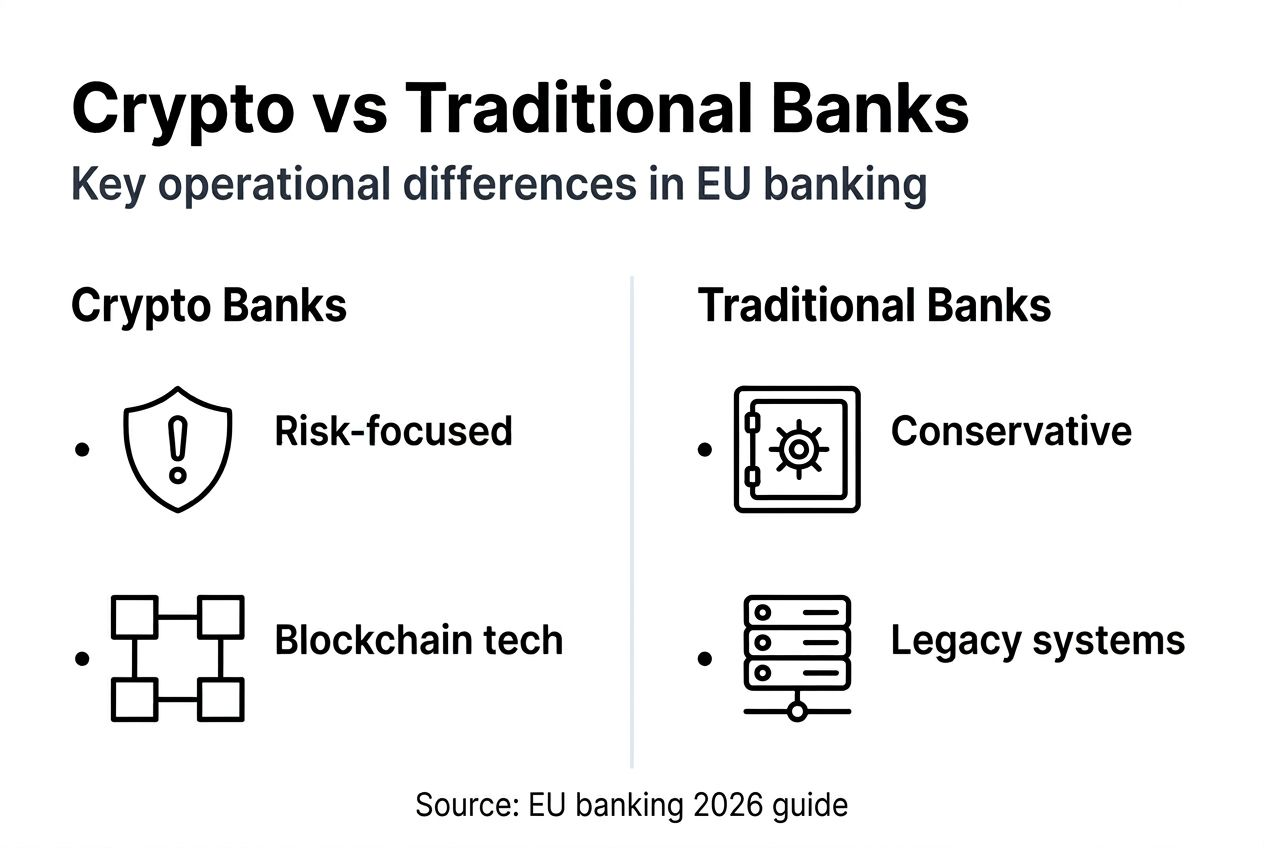
Comparison of crypto-friendly and traditional banking reveals fundamental operational and philosophical differences affecting high-risk EU crypto businesses.
| Feature | Crypto-Friendly Banks | Traditional Banks |
|---|---|---|
| Risk Appetite | Strategic acceptance using dynamic risk scoring across multiple dimensions | Categorical rejection or extremely limited acceptance with restrictive terms |
| Acceptance Rate | 70-87% for compliant crypto businesses with proper documentation | 20-30% with prolonged due diligence periods and frequent mid-process rejections |
| Compliance Process | Enhanced crypto-specific KYC/AML with blockchain monitoring and real-time risk assessment | Standard due diligence applied rigidly, often missing crypto-specific risk factors |
| Onboarding Speed | 2-4 weeks with consultancy support and pre-vetted partnerships | 6-12 months with uncertain outcomes and frequent documentation re-requests |
| Payment Infrastructure | Integrated crypto payment processing, multi-currency support, and fiat conversion services | Limited or no crypto infrastructure, manual review of crypto-related transactions |
| Transaction Monitoring | Automated blockchain analysis with crypto-specific risk indicators and pattern recognition | Generic transaction monitoring flagging legitimate crypto activity as suspicious |
| Compliance Cost | Distributed across specialised client base with economies of scale | High per-client cost viewed as unprofitable, leading to service avoidance |
| Regulatory Engagement | Proactive dialogue with supervisors, demonstrating crypto compliance capability | Defensive posture avoiding regulatory scrutiny through client exclusion |
| Relationship Stability | Long-term partnerships with transparent communication about risk management | Frequent account closures, arbitrary limits, and sudden relationship termination |
| Consultancy Support | Often integrated or partnered, providing guided onboarding and compliance assistance | Absent, requiring businesses to navigate complex requirements independently |
These differences create dramatically different experiences for crypto businesses. Traditional banks treat crypto clients as problems to be managed or avoided. Crypto-friendly banks view them as core customers deserving specialised service. The infrastructure, expertise, and risk management philosophy align with crypto business realities rather than forcing them into unsuitable traditional banking frameworks.
Summary and next steps
Crypto-friendly banking provides high-risk EU businesses with reliable financial services that traditional banks typically refuse. The key benefits include access to banking infrastructure designed for crypto operations, compliance frameworks that satisfy regulatory requirements without creating operational barriers, and relationships based on understanding rather than fear of the crypto sector.
Starting this process requires understanding your banking needs clearly. Assess your transaction volumes, jurisdictions, compliance capabilities, and growth plans. This information helps identify appropriate banking providers and structure applications for success. Preparation significantly improves approval probability.
Upcoming regulatory trends in EU crypto banking:
- MiCA implementation phases requiring updated compliance programmes through 2026 and beyond
- Increased regulatory scrutiny of DeFi services and novel crypto business models
- Enhanced reporting requirements for cross-border crypto transactions
- Growing emphasis on consumer protection and operational resilience standards
Engaging crypto-friendly banks or specialised consultancies early prevents costly missteps. Many businesses waste months pursuing unsuitable banking relationships or structuring operations poorly for banking approval. Professional guidance accelerates the process and improves outcomes. The investment in proper setup pays dividends through stable banking relationships supporting business growth.
Better business scalability emerges from banking stability. When you know your accounts will remain open and transactions will process reliably, you can focus on growing your business rather than constantly managing banking crises. This stability attracts investors, enables client commitments, and supports long-term strategic planning that unstable banking relationships make impossible.
How do crypto businesses get an IBAN?
Crypto businesses obtain a dedicated IBAN through an Electronic Money Institution (EMI) that serves digital-asset companies, which is usually faster and more accessible than a traditional bank account. A crypto-friendly EMI IBAN supports SEPA and often SWIFT, lets you receive and send fiat against crypto activity, and integrates with on/off-ramp providers. It is the most common first banking rail for crypto startups before a full bank relationship.
| Option | Speed | Best for |
|---|---|---|
| Crypto-friendly EMI (IBAN) | Fast (days–weeks) | Startups, on/off-ramp, SEPA |
| Specialist crypto bank | Slower | Larger firms, custody, lending |
| Offshore crypto bank/EMI | Varies | Non-EU structures, flexibility |
Explore crypto-friendly banking solutions with BankMyCapital
Securing compliant crypto banking in the EU requires expertise that BankMyCapital has developed through years serving high-risk industries. Our specialised consultancy connects crypto businesses with appropriate banking partners across the EU and offshore jurisdictions. We understand the regulatory landscape, bank requirements, and business challenges you face.
Our crypto banking setup service includes jurisdiction analysis, documentation preparation, partner selection, and application management. We maintain relationships with over 50 pre-vetted banking partners and EMIs specialising in crypto services. This network access dramatically improves approval probability.
Our track record speaks clearly: banking solutions with 87% approval rates for EU high-risk firms compared to industry averages below 30%. We achieve these results through thorough preparation, strategic partner matching, and ongoing relationship management. Our clients secure banking that supports their growth rather than constraining it.
Contact BankMyCapital today to start your compliant banking journey. We provide transparent consultation about your banking prospects, required steps, and realistic timelines. Our approach combines regulatory knowledge, banking relationships, and practical experience solving complex banking challenges for crypto businesses throughout the EU.
Recommended
- Crypto Business Banking: 87% Approval & EU Compliance 2026
- Crypto Corporate Bank Account Opening
- How High-Risk Companies Opened Bank Accounts in the EU in 2025
- How to Choose Best Offshore Banks for Crypto & Gambling in 2025
Frequently asked questions
What is crypto-friendly banking?
Crypto-friendly banking refers to financial services specifically designed for businesses operating in the digital asset economy. These banks implement compliance frameworks, risk management systems, and payment infrastructure tailored to crypto operations. Unlike traditional banks that often reject crypto clients categorically, crypto-friendly institutions assess each business individually using dynamic risk scoring and blockchain monitoring.
Why is crypto-friendly banking critical for high-risk crypto businesses in the EU?
Traditional banks reject approximately 70% of crypto business applications in Europe, creating severe operational barriers for legitimate businesses. Crypto-friendly banks provide access to essential financial services whilst maintaining full regulatory compliance. Without specialised banking, crypto businesses struggle to process payments, manage funds, and maintain client relationships. The banking stability these institutions provide enables long-term planning and business growth.
How does crypto-friendly banking differ from traditional banking?
The fundamental difference lies in risk management philosophy and infrastructure. Crypto-friendly banks invest in blockchain monitoring systems, crypto-specific compliance training, and payment infrastructure supporting digital assets. They accept that serving crypto clients requires enhanced due diligence and higher compliance costs. Traditional banks view these costs as prohibitive and exclude crypto businesses entirely or impose unsustainable restrictions.
What compliance frameworks do crypto-friendly banks use?
Crypto-friendly banks operate under EU regulations including AMLD5, AMLD6, and MiCA. They implement enhanced KYC and AML processes specifically designed for crypto risks, using blockchain analysis tools and real-time transaction monitoring. Compliance programmes include source of funds verification, beneficial ownership identification, ongoing client risk assessment, and suspicious activity reporting. These frameworks often exceed requirements for traditional business banking.
How do I start the banking approval process?
Begin by engaging specialised consultancies with established banking partnerships who can assess your business structure, compliance readiness, and banking prospects. Prepare comprehensive documentation including business plans, compliance manuals, and beneficial ownership details. Choose jurisdictions aligned with your business model and target markets. Professional guidance significantly improves approval probability and reduces time to account opening from months to weeks.
Which banks are crypto-friendly in Europe?
Crypto-friendly banking in Europe is concentrated in specialist EMIs and a handful of banks that have built AML and transaction-monitoring systems for digital-asset flows, rather than mainstream retail banks. The right partner depends on whether you need fiat on/off-ramps, on-chain settlement, or both, and on your regulatory standing (a MiCA registration or VASP/CASP licence materially improves acceptance). BankMyCapital matches exchanges, VASPs and blockchain firms to partners that accept crypto businesses and prepares the application so compliance teams can approve it quickly.
Can a crypto company open a corporate bank account?
Yes — but only with banks and EMIs set up for digital-asset risk. Most conventional banks avoid crypto because of AML exposure and unclear fund flows, so the realistic options are crypto-friendly EMIs and specialist banks. Approval hinges on proving regulatory standing (increasingly a MiCA/CASP licence in the EU), robust KYC and transaction monitoring, and clear proof of the source of crypto funds.
