
TL;DR:
- Rushing high-risk banking onboarding increases the chances of future account closures and regulatory issues.
- Human oversight is essential for assessing complex structures and compliance credibility beyond automation.
- Successful onboarding requires thorough preparation, targeted partner selection, and proactive compliance documentation.
Faster onboarding sounds like a win. But for crypto, iGaming, and forex businesses, rushing through banking setup is one of the costliest mistakes you can make. Many operators assume that a slick digital application and a few uploaded documents will land them a functioning account within days. The reality is far messier. Banks face mounting regulatory pressure, and high-risk sectors draw the heaviest scrutiny. Automation and human oversight must work together because purely automated processes risk treating complex compliance situations too superficially, leaving your application vulnerable to rejection or later account termination.
Key Takeaways
| Point | Details |
|---|---|
| Onboarding is not one-size-fits-all | High-risk businesses need robust, tailored onboarding to meet compliance demands and minimise risk. |
| Human review remains essential | Automation alone cannot address the nuanced risks of crypto, iGaming, and forex sectors. |
| Consistency beats speed | Stable, thorough processes outpace fast but superficial approaches for approvals. |
| Preparation is power | Being organised with compliance documentation and process knowledge improves success. |
Understanding the banking onboarding process
Onboarding in banking refers to the full process a financial institution uses to verify, assess, and approve a new client before granting account access. For standard low-risk businesses, this might involve a few identity checks and a short waiting period. For high-risk businesses, it is an entirely different exercise, one that can take weeks and requires layers of documentation, risk assessments, and regulatory sign-off.
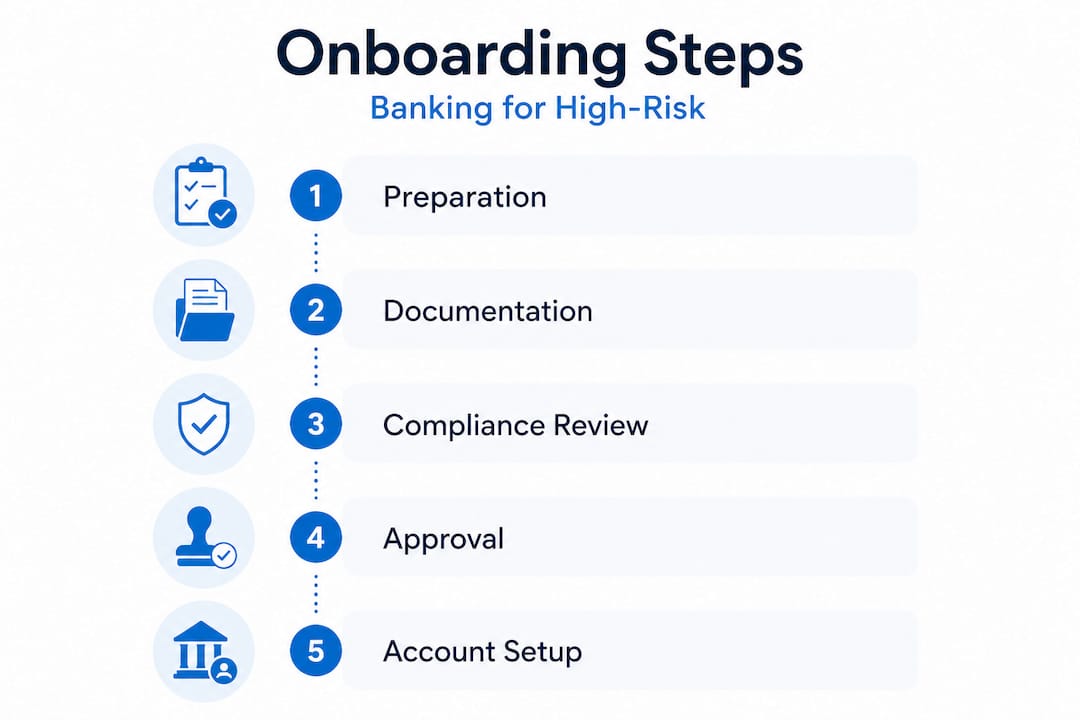
The core stages look like this:
- Initial application: You submit your business profile, ownership structure, and intended account use. This is the bank’s first impression of your operation.
- KYC (Know Your Customer) review: The bank verifies the identities of directors, shareholders, and Ultimate Beneficial Owners (UBOs). For complex corporate structures common in crypto and iGaming, this stage alone can take considerable time.
- Risk classification: The compliance team assigns your business a risk rating. High-risk designations trigger Enhanced Due Diligence (EDD), a deeper investigation into your business activities, transaction volumes, and jurisdictional exposure.
- Account approval and agreement: Once the compliance team is satisfied, account terms are agreed and the account is activated.
Crypto exchanges, iGaming platforms, and forex brokers consistently face longer review timelines because their business models carry higher inherent risks: regulatory ambiguity, cross-border transactions, large cash flows, and exposure to sanctioned jurisdictions. Our high-risk bank onboarding guide covers the full landscape in practical detail.
The temptation to seek “fast-track” onboarding is understandable, but the evidence is clear. Speed-chasing over consistent processes weakens due diligence and produces worse outcomes in the long run. A rushed process might get you to an open account faster, but it increases the probability of future account closures, compliance flags, and regulatory penalties once the bank revisits your file.
| Factor | Fast-track onboarding | Robust onboarding |
|---|---|---|
| Timeline | 3 to 7 days | 2 to 6 weeks |
| Document depth | Minimal | Comprehensive |
| EDD applied | Rarely | Always for high-risk |
| Approval durability | Low | High |
| Rejection risk | High | Significantly lower |
The step-by-step banking setup we recommend starts with preparation, not speed. Knowing what each stage requires before you submit your application dramatically reduces back-and-forth delays.
Compliance essentials: what banks look for
Knowing the road map, next you will need to navigate the toughest part: compliance and regulatory scrutiny.
Banks do not simply verify that your business exists. They are evaluating whether your operation poses a financial crime risk, whether your ownership structure is transparent, and whether your transaction flows make sense for your stated business purpose. For high-risk sectors, this scrutiny is significantly elevated.
Here are the key compliance elements banks assess:
- KYC documentation: Identity verification for all directors, shareholders holding more than 10 to 25 per cent of the business, and UBOs. This includes certified copies of passports, proof of address, and, in many cases, source of wealth declarations.
- EDD documentation: For high-risk applicants, banks go further. They examine your source of funds in detail, require evidence of regulatory licences, and may request audited financial statements or third-party compliance reports.
- Business activity evidence: You need to demonstrate what your business actually does. Transaction samples, client contracts, website screenshots, and payment processing history all contribute to this picture.
- AML and compliance policies: Banks want to see that your internal Anti-Money Laundering framework is credible. A professionally drafted AML policy tailored to your sector carries significant weight.
- Jurisdiction and licensing disclosure: Where you are licensed, where your customers are based, and where your transactions flow all affect risk classification.
Automation and digital tools can efficiently handle basic identity verification and document collection, but human oversight becomes essential when assessing complex corporate structures or evaluating the credibility of a crypto exchange’s compliance framework. Automated systems simply cannot make nuanced judgements about context.

Common pitfalls include submitting incomplete UBO chains, providing business descriptions that are vague or inconsistent with your licence category, and underestimating the importance of AML documentation. Our bank account opening checklist details every document you should prepare before a single submission is made.
Pro Tip: Prepare a concise, clearly written business overview document of no more than two pages that explains your business model, your customer base, your compliance structure, and your expected transaction volumes. Compliance officers are busy. A clear summary that pre-empts their key questions can meaningfully accelerate review. This document is separate from your formal application pack and acts as a narrative guide through your business.
Understanding how to pass bank compliance requires more than ticking boxes. It requires anticipating what a cautious compliance officer will worry about and addressing those concerns before they ask.
Balancing speed and compliance: the automation dilemma
Having covered compliance, it is crucial to address a modern reality: the push toward automation, and its mixed impact on onboarding success.
Digital onboarding tools have genuinely transformed banking for mainstream businesses. Optical character recognition, automated KYC platforms, and real-time sanctions screening have compressed timelines that once took weeks into processes that take hours. This is impressive technology. But for high-risk businesses, it creates a specific and underappreciated danger.
“The banks that prioritise speed above all else often struggle to maintain consistency in their due diligence. Consistent, thorough processes outperform speed-focused ones when measured over time.” This is the core finding from research on banking consistency, and it directly challenges the assumption that faster always means better.
Where automation helps:
- Rapid document collection and initial verification
- Sanctions and PEP (Politically Exposed Person) screening at scale
- Standardised risk scoring for straightforward applicants
- Reducing manual workload on routine compliance tasks
Where automation creates risk for high-risk businesses:
- Automated systems apply rigid rules that flag high-risk sectors by default, often without nuance
- Complex ownership structures involving multiple jurisdictions confuse automated parsing tools
- Automated risk scores cannot evaluate the credibility of your compliance team or the quality of your AML policies
- EDD requires human judgement that no algorithm currently replicates reliably
Consider a real scenario. A crypto exchange operating under a reputable EU licence submits its application through a fully automated onboarding portal. The automated system flags the application based on the sector classification alone and rejects it before a human ever reviews it. Meanwhile, a less well-regulated operation operating in a grey-market jurisdiction submits a simpler business profile that passes the automated screening. The first business was more compliant. The automated system simply could not see that.
Pro Tip: When approaching a new banking partner, ask directly whether their compliance review for high-risk accounts involves a dedicated human reviewer at the EDD stage. If the answer is no, or vague, treat that as a meaningful red flag. A bank that relies exclusively on automation for your sector’s due diligence is a bank whose relationship with you will be fragile.
Avoiding the pitfalls of purely automated processes is one of the most important aspects of our high-risk banking mistakes guide, which covers scenarios exactly like the one above in practical detail.
Making onboarding work for your high-risk business
With an understanding of automation’s limits, let us focus on how you can proactively succeed at onboarding for your high-risk business.
Success in high-risk banking onboarding is not accidental. It is the result of deliberate preparation, the right partner selection, and a considered approach to how you present your business. Here is a practical framework:
- Audit your documentation before you approach any bank. Gather every document that a compliance team might request: UBO chain diagrams, certified identity documents, audited accounts, your AML policy, your licence certificates, and transaction history. Treat this as building a compliance dossier, not collecting paperwork.
- Research and pre-qualify your banking partners. Not every bank serves every high-risk category. Approaching a bank that has never onboarded a crypto exchange wastes your time and creates a rejection on your record. Target institutions with a demonstrable track record in your specific sector and jurisdiction.
- Present your business proactively. Do not wait for the compliance team to ask questions. Submit a structured business overview that explains your model, your regulatory status, your customer base, and your risk controls. Banks respond well to applicants who demonstrate compliance maturity.
- Maintain the relationship post-onboarding. Account closures often occur not at onboarding but months later when transaction patterns diverge from what was disclosed. Update your bank proactively when your business model, ownership structure, or transaction volumes change significantly. Silence breeds suspicion.
- Work with specialists who understand your sector. The evidence on consistent onboarding processes shows that businesses working with experienced advisors achieve better and more durable outcomes than those relying on speed-focused generic platforms.
Our high-risk EU case studies show clearly how preparation and partner selection separate successful onboardings from rejected applications. The patterns are consistent: the businesses that succeed invest time upfront in compliance preparation and choose banking partners carefully.
Pro Tip: Never submit simultaneous applications to multiple banks without a strategy. If one application is rejected, other banks may discover this through screening tools, and multiple recent rejections significantly weaken your position. Sequence your applications and use each one as a learning exercise.
For a broader view of the regulatory landscape, our EU high-risk approval guide provides jurisdiction-specific guidance that covers the key differences between EU and offshore banking options.
Why thoughtful onboarding beats automation for high-risk businesses
Let us step back and challenge the received wisdom on onboarding for high-risk sectors.
The industry conversation around onboarding is dominated by a single metric: speed. Banks market frictionless onboarding. Fintech platforms advertise accounts in minutes. And high-risk business owners, frustrated by years of rejections and delays, are naturally attracted to anything that promises to cut through the bureaucracy.
Here is the uncomfortable truth: most high-risk banking rejections are not caused by slow processes. They are caused by shallow ones.
When we review cases where businesses have faced account closures or compliance failures after onboarding, the pattern is remarkably consistent. The business used a fast-track or automated process. The initial compliance review was superficial. Months later, when the bank’s risk team re-examines the file or notices transaction patterns that were not anticipated, the account is flagged or closed. The damage at that point is significant: frozen funds, disrupted operations, and a rejection on record that makes future applications harder.
Research confirming that speed-focused processes underperform is not a criticism of technology. It is a criticism of the assumption that speed and compliance are equivalent goals. They are not. For high-risk businesses, compliance is the goal. Speed is a secondary benefit when done properly.
Human insight matters in ways that are difficult to quantify but easy to observe. An experienced compliance consultant looking at your application can identify structural weaknesses before submission. They can recognise which elements of your business model will concern a bank’s risk committee and address them proactively. They can navigate the informal dynamics of banking relationships that no algorithm captures.
The businesses that achieve the most durable banking relationships are those that invest in the process rather than those that rush through it. A two-week thoughtful onboarding that produces a stable, long-term banking relationship is worth infinitely more than a three-day automated process that results in account closure six months later.
Accelerate and secure your onboarding with Bank My Capital
If you want to apply these best practices with expert help, here is how Bank My Capital can assist.
At Bank My Capital, we specialise exclusively in high-risk business banking across crypto, iGaming, forex, and related sectors. Our network of over 50 pre-vetted banking partners and EMIs means we match your specific business profile to the right institution from the outset, eliminating the wasted applications and damaging rejections that come from generic approaches. Our 87% approval rate and typical onboarding timeline of two to three weeks reflect a process built on thorough preparation, not speed for its own sake. If you are concerned about the risks that come with navigating this landscape alone, our banking rejection risks guide is the right place to start understanding what is at stake and how to protect your business.
Frequently asked questions
Why is onboarding more complex for high-risk industries?
High-risk sectors face stricter KYC and EDD requirements, meaning compliance reviews are far more thorough and time-consuming than those applied to standard businesses, requiring additional documentation and deeper scrutiny of ownership and transaction flows.
Can automation speed up compliance without increasing risk?
Automation helps with routine tasks, but for high-risk onboarding, human review remains essential to identify complex risks that automated systems routinely miss, particularly during the EDD stage.
What documents do banks typically require for onboarding?
Banks generally request certified identity documents, a full UBO chain, proof of business activity, AML policies, and licence certificates. The KYC and EDD requirements for high-risk sectors extend well beyond basic identity verification.
Do faster onboarding methods lead to better approval rates?
No. Speed-focused approaches consistently underperform compared to thorough, consistent compliance-led processes, particularly for high-risk businesses where shallow due diligence leads to later account closures rather than lasting approval.
