
TL;DR:
- High-risk businesses face complex onboarding due to regulatory scrutiny, transaction patterns, and beneficial ownership transparency.
- Preparation involves assembling a comprehensive compliance toolkit, including UBO documentation, operating licenses, and source of funds evidence.
- Ongoing compliance and proactive relationship management are essential to maintain banking access and avoid disqualification.
Step-by-step banking setup for high-risk businesses
Securing a business bank account should be straightforward. For crypto exchanges, iGaming operators, and forex firms, it rarely is. Compliance officers raise flags, onboarding stalls for weeks, and some applications never receive a response at all. The frustration is real, but it is largely avoidable. What separates high-risk businesses that get banked quickly from those that spend months in limbo is not luck. It is preparation, sequencing, and a clear understanding of what banks and regulators actually require. This guide walks you through every stage, from initial document assembly through to live account activation and ongoing compliance maintenance.
Key takeaways
| Point | Details |
|---|---|
| Know your risks | Understanding why your business is viewed as high-risk helps you address bank and regulator concerns from the outset. |
| Prepare documents thoroughly | Gather all required ownership, compliance, and risk information before starting your application to avoid costly delays. |
| Follow a proven sequence | A clear step-by-step approach increases your chances of getting approval and prevents unnecessary friction. |
| Maintain ongoing compliance | Regular reviews and updates are essential to keep your banking relationships secure and prevent sudden closures. |
| Treat setup as ongoing | Design your banking setup as a workflow, not a one-off task, to stay agile and attractive to banks. |
Understanding the high-risk banking challenge
Before you submit a single form, it pays to understand exactly why banks treat your sector differently. What defines high-risk banking is not arbitrary. It reflects a combination of factors: elevated transaction volumes, cross-border payment flows, evolving regulatory frameworks, and higher statistical rates of fraud or money laundering exposure.
For banks, onboarding a crypto, iGaming, or forex client introduces complexity that a standard retail or e-commerce client simply does not carry. Regulators expect financial institutions to apply enhanced scrutiny from day one, and that scrutiny does not end at account opening. High-risk banking in the EU is governed by a combination of EU Anti-Money Laundering Directives, national transpositions, and sector-specific rules that create a layered compliance environment.
Here is a summary of common friction points that derail high-risk onboarding:
- Incomplete UBO disclosure: Banks reject or pause applications when beneficial ownership chains are unclear or documents are missing.
- Unverified source of funds: Without clear evidence of where capital originates, compliance teams will not proceed.
- Lack of a valid operating licence: Operating in iGaming or forex without a recognised licence is an immediate blocker.
- Unusual transaction patterns: High-velocity or geographically diverse transactions raise automated flags without explanatory context.
- Missing corporate structure charts: Banks need to visualise the ownership chain, especially for multi-entity setups.
As the UK Gambling Commission guidance notes, high-risk sectors face bank onboarding friction due to changing customers and transaction patterns, with regulators expecting ongoing monitoring as standard practice. This is not a one-time box-ticking exercise.
“The real cost of poor preparation is not just a rejected application. It is months of lost revenue, compliance exposure, and reputational risk with the banking partners you need most.”
| Friction point | Frequency | Typical delay caused |
|---|---|---|
| Incomplete UBO documentation | Very common | 2 to 6 weeks |
| Missing source of funds evidence | Common | 3 to 8 weeks |
| No valid operating licence | Sector-dependent | Full rejection |
| Complex multi-jurisdiction structure | Common | 4 to 10 weeks |
| Unresolved PEP or sanctions flag | Less common | Full review, variable |
The costly reality is that unprepared businesses face full rejection, not just delays. Once rejected, many banks share information across their compliance networks. A rejection today can quietly close doors tomorrow.
With an understanding of what is at stake, it is crucial to clarify exactly what tools, data, and documents you will need before starting the banking application.
Preparing your compliance and onboarding toolkit
Think of your compliance toolkit as the foundation of your banking relationship. Get it wrong and the entire structure becomes unstable. Get it right and you transform a painful process into a manageable one.

The most critical component is beneficial ownership documentation. UBO information is a recurring gating point for banking onboarding, and banks are required to collect, verify, and update it throughout the life of the relationship. Every individual who owns or controls 25% or more of the business must be disclosed with full identification, address verification, and source of wealth evidence.
Here is a breakdown of what your toolkit must contain, with differences between EU and offshore requirements:
| Document | EU bank requirement | Offshore bank requirement |
|---|---|---|
| UBO/beneficial ownership disclosure | Mandatory, notarised in some cases | Mandatory, apostille may be needed |
| Source of funds and source of wealth | Detailed, with supporting evidence | Required, less prescriptive |
| Company structure chart | Multi-level, with percentages | Standard, one to two levels |
| Operating licence | Required for iGaming, forex, VASP | Required or regional equivalent |
| Travel Rule compliance data | Required for crypto/VASPs under MiCA | Required for qualifying jurisdictions |
| Financial statements | Last two to three years | Last one to two years |
For crypto businesses specifically, setting up crypto banking involves an additional layer: Travel Rule compliance. This requires that originator and beneficiary data accompany qualifying virtual asset transfers. Without a functioning system to capture and transmit this data, your application will stall at the compliance review stage.
For iGaming and forex firms, the focus shifts to licence documentation, player fund segregation evidence, and AML policy frameworks. Banks want to see that your internal controls are mature, not aspirational.
Here is a practical checklist for assembling your toolkit:
- Certified copies of all director and shareholder passports
- Proof of address for all UBOs (utility bills or bank statements, dated within three months)
- Certificate of incorporation and memorandum and articles of association
- Operating licence from recognised regulatory authority
- Two to three years of audited financial statements
- AML and KYC policy documentation
- Source of funds declaration with supporting transactional evidence
- Company ownership structure chart with percentage breakdowns
- Travel Rule compliance framework (for VASPs and crypto operators)
Pro Tip: Centralise all documentation in a secure digital vault with version control. This allows you to update individual documents without rebuilding the entire pack, and you can share access with banks or compliance teams instantly. This single step removes one of the most common onboarding delays: chasing documents that are out of date.
Understanding banking compliance requirements at this stage prevents surprises further down the line. Once you have your toolkit ready, follow the precise steps below to complete your banking setup efficiently and compliantly.
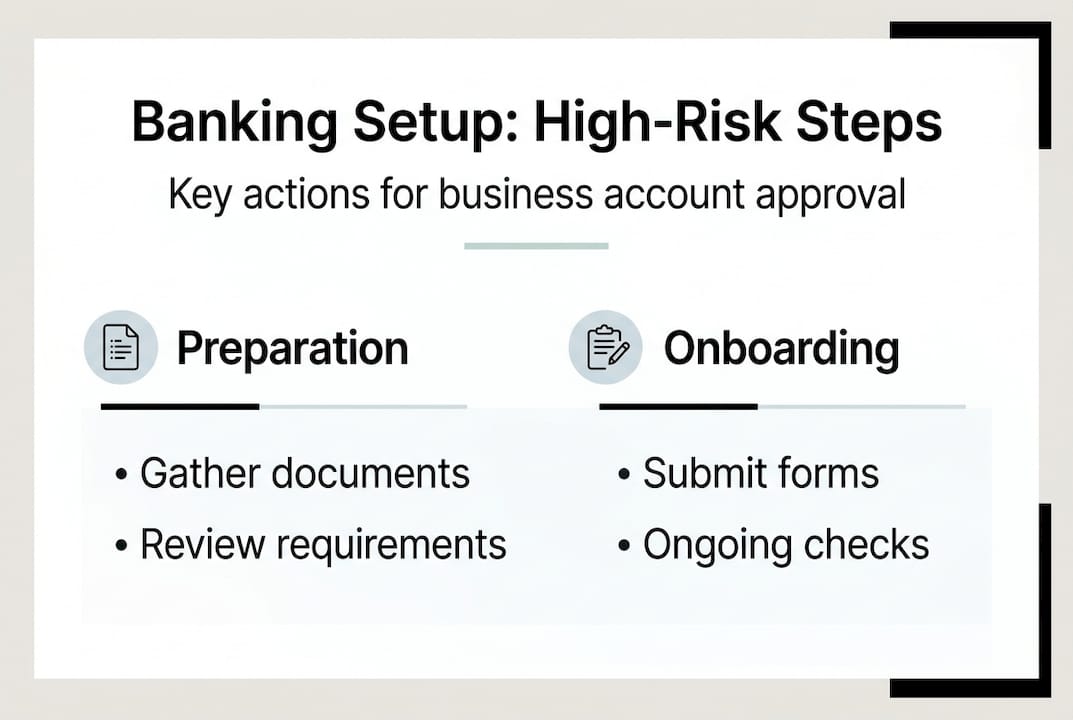
Step-by-step guide to banking setup
Now that your documentation is assembled, the sequencing of your application matters as much as its content. Submitting in the wrong order or missing context at a critical stage creates unnecessary back-and-forth that stretches timelines significantly.
For VASPs and crypto-style models, a robust bank onboarding sequence must include customer due diligence, sanctions and PEP screening, and Travel Rule data-handling expectations. This is the global standard, not a suggestion.
- Submit your application with full UBO and director details. Do not submit a partial application hoping to follow up. Banks that receive incomplete initial submissions often deprioritise them. Include your corporate structure chart, operating licence, and AML policy at this first stage.
- Undergo customer due diligence (CDD), sanctions screening, and PEP checks. The bank will run your directors, shareholders, and UBOs through international sanctions lists and politically exposed person (PEP) registers. If any individual is flagged, do not panic. Prepare an explanation in advance. A PEP flag does not automatically mean rejection, but unexplained flags do.
- Provide Travel Rule data if you are operating as a VASP or crypto business. Your crypto compliance checklist should confirm which transfers require originator and beneficiary data to accompany them. Banks will want to see that your technical infrastructure supports this before activating your account.
- Await the compliance review, respond to clarification requests promptly, and activate your account. This stage is where many applications slow down unnecessarily. Banks issue requests for additional information (RFIs) during review. Respond within 48 hours where possible. Delays here are interpreted as disorganisation or, worse, reluctance to cooperate.
For iGaming firms, Step 2 often includes a review of your player fund arrangements and segregation practices. For forex businesses, expect scrutiny of your regulatory status, leverage offerings, and client categorisation procedures.
Statistic: Across high-risk sectors, businesses that submitted complete, well-structured applications experienced 87% approval rates compared to significantly lower rates for incomplete or reactive submissions.
Pro Tip: Before submitting, conduct a structured internal risk assessment. Map every director and UBO against sanctions lists yourself. Identify any jurisdiction connections that could trigger enhanced due diligence (EDD). Address these proactively in a cover letter accompanying your application. Banks respond very differently to surprises they discover versus risks you have already explained and mitigated.
For businesses needing SEPA accounts for high-risk operations within the EU, the same steps apply, with an additional layer of documentation confirming your EU nexus, such as a registered EU entity or licensed EU operation.
After executing the setup steps, it is not set and forget. High-risk firms must maintain and monitor their banking posture for ongoing compliance.
Ongoing monitoring and compliance maintenance
Getting approved is a milestone, not a finish line. Banks are required to perform ongoing monitoring of high-risk accounts, and they expect you to cooperate actively with that process. Failing to maintain your compliance posture is the most common reason high-risk businesses lose banking access after successfully obtaining it.
As the UK Gambling Commission’s EDD guidance confirms, enhanced due diligence and enhanced ongoing monitoring for high-risk sectors includes source of funds and wealth checks, review of complex transactions, and periodic updates of beneficial owner data. Your bank will conduct these reviews whether you are prepared for them or not.
Here are the key triggers that will prompt your bank to re-assess your account:
- Change of ownership or new UBOs added
- Large, unusual, or geographically anomalous transactions
- Expiry or change of your operating licence
- Adverse media coverage referencing your business or key personnel
- New product lines or business activities not disclosed at onboarding
- Requests from regulators or law enforcement linked to your sector
“Banks do not close accounts without reason, but they do close them without warning if ongoing monitoring raises unresolved questions. Proactive communication is your most effective safeguard.”
Actionable strategies for maintaining compliance between formal reviews:
- Keep all UBO documentation current and re-certify annually
- Maintain a transaction monitoring log that you can produce on request
- Update your AML and KYC policies whenever regulations or business activities change
- Notify your bank proactively of material changes before they appear in monitoring data
- Store all compliance correspondence in your digital vault for audit trails
| Compliance event | Recommended action | Timing |
|---|---|---|
| Change of director or UBO | Submit updated ID and ownership chart | Within 5 business days |
| Large transaction above threshold | Prepare source of funds explanation | Before or at time of transaction |
| Licence renewal or change | Send updated licence copy immediately | On receipt |
| Adverse media mention | Draft factual response and brief your bank | Within 48 hours |
| Scheduled compliance review | Prepare full document refresh | Two weeks in advance |
For practical guidance on avoiding account closure, the EU banking approval tips we share reflect lessons learned across dozens of high-risk onboarding engagements. The pattern is consistent: businesses that treat compliance as a live function retain banking access. Those that treat it as a setup task lose it.
Pro Tip: Schedule formal internal compliance reviews twice yearly, aligned with your bank’s typical review cycle. Use these sessions to update documentation, re-screen directors and UBOs, and review any transaction patterns that could raise questions. This places you permanently ahead of your bank’s monitoring curve.
You have now learned best practices to get started and stay compliant. Next, we share a hard-won perspective on what truly smooths the path for high-risk business banking.
Rethinking banking setup: treat it as a workflow, not a checklist
Most high-risk business owners approach banking setup as a one-time project. They gather documents, submit an application, get approved, and consider the task complete. This is precisely the wrong mental model, and it explains why so many businesses lose banking access within 18 months of obtaining it.
The more effective approach is to treat banking setup as a continuous, risk-aligned workflow with three recurring phases: pre-onboarding preparation, live account monitoring, and rapid-response updating. When you build internal processes around these phases, rather than scrambling reactively, you become the type of client that compliance-driven banks want to retain.
Multi-jurisdiction banking adds further complexity to this picture, but the workflow principle scales. Digital systems that allow instant document updates, structured risk assessments, and live compliance tracking are far more resilient than static PDF folders. Regulators change requirements. Banks update their internal risk appetites. A workflow built for flexibility adapts. A checklist does not.
The other shift worth making is cultural. Banks are not adversaries. Their compliance teams are under significant regulatory pressure, and they respond very well to clients who engage proactively, provide clear answers, and demonstrate genuine commitment to transparency. Build that relationship deliberately, and your banking setup becomes a competitive advantage rather than a recurring headache.
Accelerate your high-risk banking setup with expert support
Navigating the complexity of high-risk banking does not have to be a solo effort. At BankMyCapital, we work with crypto, iGaming, and forex businesses to streamline every stage of the process, from assembling your compliance toolkit to managing bank communications and responding to enhanced due diligence requests. Our network of over 50 pre-vetted banking partners means your application reaches institutions already experienced with your sector. Use our banking checklist for success to identify gaps before submission, and review our guidance on banking rejection risks to protect your approval odds. Explore our full range of banking solutions for high-risk businesses and take the first step towards compliant, stable banking access.
Recommended
- 6 Step High-Risk Business Banking Checklist for Success
- High Risk Business Bank Account Documents Guide
- How to Pass Bank Compliance for a High-Risk Business Account
- How to Open High-Risk Business Bank Account | 2026 %
Frequently asked questions
What documents do banks need for a crypto, iGaming, or forex company?
Banks require detailed UBO disclosure, source of funds and wealth documentation, valid operating licences, and, for crypto businesses, Travel Rule compliance data covering originator and beneficiary information for qualifying transfers.
What is the Travel Rule, and who must comply?
The Travel Rule requires VASPs and certain high-risk businesses to transmit originator and beneficiary information alongside qualifying virtual asset transfers, as confirmed by FATF guidance for VASPs. Compliance is mandatory in most major jurisdictions and is increasingly enforced under frameworks such as MiCA.
How often should compliance reviews be conducted?
High-risk firms should conduct internal compliance and documentation reviews at least twice per year, or immediately following any material change such as new ownership, licence updates, or significant shifts in transaction volumes.
What triggers enhanced due diligence for high-risk entities?
Large, complex, or unusual transactions, along with clients or counterparties linked to high-risk jurisdictions, are among the most common triggers, as outlined in UK Gambling Commission EDD guidance. Changes in business ownership or adverse media can also prompt a full enhanced due diligence review.
Can offshore companies get EU banking?
Offshore high-risk companies can obtain EU banking, but they must demonstrate strong compliance frameworks, transparent beneficial ownership, and ideally a registered EU-based entity or licence to satisfy the transparency requirements that EU banks apply to offshore structures.
