
If you operate in crypto, iGaming, adult entertainment, or forex, you already know traditional banking rarely welcomes you with open arms. What many founders fail to realise is that multi-jurisdiction banking is not a luxury, it is a necessity for survival in these industries. The fragmented regulatory landscape, conflicting sanctions regimes, and constant compliance alerts mean relying on a single banking relationship is a recipe for operational paralysis. This guide unpacks what multi-jurisdiction banking truly entails, the compliance maze you must navigate, which jurisdictions offer the best opportunities, and practical steps to establish resilient banking relationships that keep your business running smoothly across borders.
Key Takeaways
| Point | Details |
|---|---|
| Definition and importance | Multi jurisdiction banking involves maintaining accounts in multiple countries to enable cross border payments and resilience against regulatory shifts. |
| Regulatory challenges | High risk sectors face fragmented AML, KYC, sanctions and data sovereignty rules across jurisdictions, raising compliance costs. |
| Best jurisdictions and solutions | EU and offshore options with SEPA and SWIFT, plus electronic money institutions, can provide redundancy and faster onboarding. |
| Practical steps and strategies | Prepare a comprehensive documentation package before approaching banks, including corporate structure charts, ultimate beneficial owner declarations, detailed business model explanations, fund flow diagrams, and AML policies. |
Understanding multi-jurisdiction banking for high-risk sectors
Multi-jurisdiction banking means maintaining accounts in multiple countries, typically combining EU and offshore jurisdictions, to handle cross-border transactions with flexibility and redundancy. For high-risk sectors like crypto, iGaming, adult entertainment, and forex, this approach is not optional. Multi-jurisdiction banking involves accounts in EU and offshore jurisdictions with SEPA, SWIFT, and multi-currency support, with average onboarding taking 2-3 weeks when pre-approval is secured. You are not just opening accounts, you are building a resilient financial infrastructure that can withstand regulatory shifts, banking partner exits, and payment processor restrictions.

The core components include multi-currency IBANs that allow you to receive and send payments in euros, dollars, pounds, and other currencies without costly conversions. Electronic Money Institutions and Payment Service Providers augment traditional banking by offering faster onboarding, greater risk tolerance, and specialised payment rails for high-risk transactions. Specialist banks that focus on types of banking solutions high risk businesses need understand your sector’s unique challenges and structure their compliance frameworks accordingly.
Onboarding timelines vary dramatically based on preparation. High-risk industries require specialist banking and face longer onboarding due to compliance demands, but businesses that arrive with comprehensive documentation, clear fund flow explanations, and pre-vetted compliance frameworks can compress this to 2-3 weeks. The difference between a smooth onboarding and a six-month ordeal lies in preparation.
SEPA accounts for high-risk industries provide critical infrastructure for European operations, enabling instant and low-cost euro transfers across the Single Euro Payments Area. Combining SEPA-enabled accounts with SWIFT-capable offshore accounts creates redundancy, ensuring you maintain payment capabilities even if one banking partner restricts services or exits your sector.
Pro Tip: Prepare your compliance documentation package before approaching any banking partner. Include corporate structure charts, ultimate beneficial owner declarations, detailed business model explanations, fund flow diagrams, and AML policies. Banks evaluate readiness as much as risk, and arriving prepared signals professionalism that accelerates approval.
Navigating compliance and regulatory challenges across jurisdictions
The regulatory landscape for multi-jurisdiction banking resembles a minefield where rules change constantly and often conflict. Compliance requires navigating fragmented regulations such as AML, KYC, sanctions, and data sovereignty laws, with compliance costs representing 15-25% of operational expenses for high-risk businesses. You are not just following one rulebook, you are harmonising requirements across multiple jurisdictions that rarely coordinate their approaches.
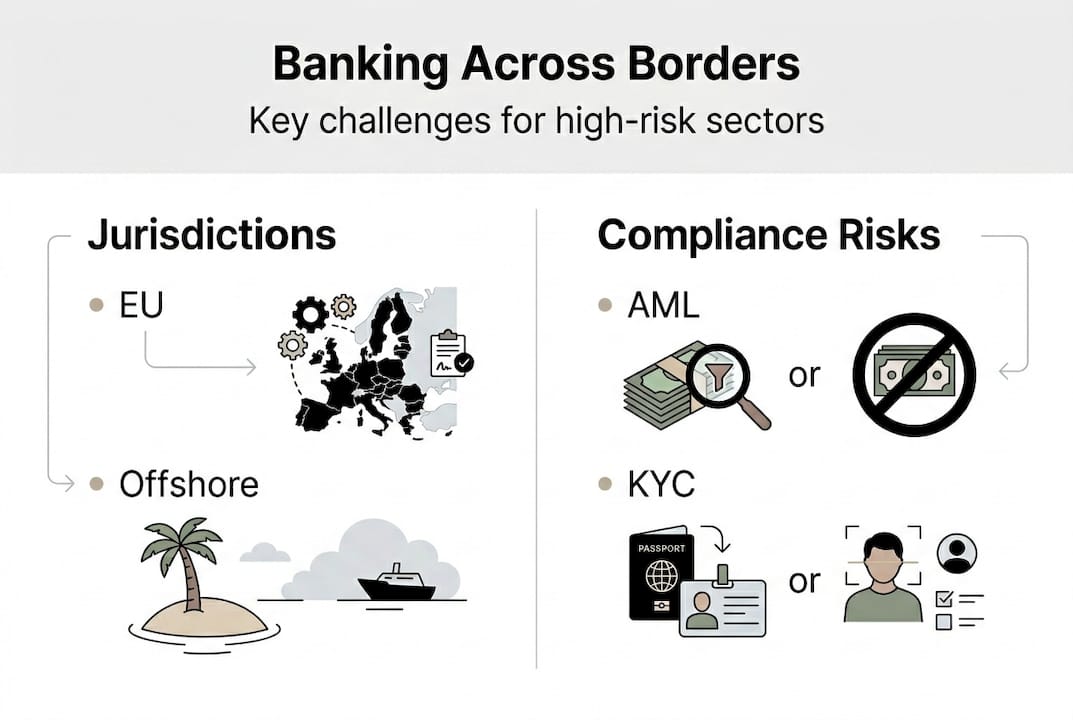
Anti-Money Laundering directives vary by country, with some jurisdictions demanding transaction monitoring thresholds as low as €1,000 whilst others set limits at €15,000. Know Your Customer requirements range from basic identity verification to invasive source of wealth investigations that demand years of financial history. Sanctions regimes present perhaps the most dangerous compliance trap. There were 74,000 regulatory alerts in 2023, highlighting the complexity and risks of conflicting regimes such as US versus EU sanctions. A transaction perfectly legal under EU law might violate US sanctions if it touches dollar-denominated accounts or US correspondent banking networks.
Data sovereignty laws add another layer. The EU’s GDPR imposes strict requirements on data storage and processing, whilst jurisdictions like Russia and China demand local data storage. If you operate across these regions, you need separate data infrastructure for each, multiplying compliance costs and technical complexity.
“Regulatory fragmentation forces high-risk businesses to adopt the strictest standards group-wide, as the weakest compliance link determines overall liability exposure.”
Stress testing your multi-jurisdiction setup is essential. Map every payment flow to identify which jurisdictions it touches, which sanctions regimes apply, and where regulatory conflicts might emerge. Pre-position liquidity in multiple jurisdictions so you can shift operations quickly if one banking partner restricts services. Jurisdiction mapping should include backup routes for every critical payment flow.
RegTech tools automate much of this complexity. Transaction monitoring platforms can screen payments against multiple sanctions lists simultaneously, flagging conflicts before they become violations. Automated KYC systems harmonise identity verification across jurisdictions, reducing manual workload whilst maintaining compliance. Regulatory change management platforms track the 74,000 annual alerts and filter them to show only changes affecting your specific business model and jurisdictions.
Pro Tip: Apply the strictest regulatory standard across your entire operation, regardless of local requirements. If one jurisdiction demands enhanced due diligence for transactions above €5,000, apply that threshold everywhere. This reduces liability risk, simplifies training, and demonstrates regulatory seriousness to banking partners.
Understanding bank compliance for high-risk accounts requires recognising that compliance is not a one-time hurdle but an ongoing operational requirement. Banks conduct periodic reviews, often annually, where they reassess your risk profile. Maintaining detailed records, updating policies as regulations change, and proactively communicating business model changes to your banking partners prevents surprise account closures. Banking solutions EU high-risk firms access must be earned continuously, not just during onboarding.
Choosing the best jurisdictions for your high-risk business banking needs
Jurisdiction selection determines whether you spend years fighting banking rejections or establish stable relationships within weeks. Malta has a 9/10 friendliness score for iGaming, whilst Switzerland and Singapore are preferred for crypto and forex sectors. Each jurisdiction offers distinct advantages based on your industry, transaction volumes, and regulatory tolerance.
| Jurisdiction | Specialisation | Friendliness Score | Regulatory Environment | Onboarding Timeline |
|---|---|---|---|---|
| Malta | iGaming, online gambling | 9/10 | MGA-licensed framework, EU passporting | 3-4 weeks |
| Switzerland | Crypto, forex, wealth management | 8/10 | FINMA oversight, strong privacy | 4-6 weeks |
| Singapore | Crypto, forex, fintech | 8/10 | MAS-regulated, Asia gateway | 4-5 weeks |
| Cyprus | Forex, iGaming | 7/10 | CySEC regulation, EU access | 3-4 weeks |
| Seychelles | Multi-sector offshore | 6/10 | Light regulation, fast setup | 2-3 weeks |
Malta dominates iGaming banking because the Malta Gaming Authority created a comprehensive licensing framework that banks understand and trust. If you hold an MGA licence, Maltese banks have established due diligence procedures that streamline onboarding. The jurisdiction offers full SEPA access, enabling seamless euro transactions across Europe, whilst maintaining reasonable compliance costs.
Switzerland attracts crypto and forex businesses seeking stability and privacy. Swiss banks demand rigorous compliance but offer unmatched reliability once relationships are established. FINMA regulation provides credibility that opens doors with international banking partners. Switzerland’s political neutrality and strong rule of law make it ideal for businesses operating in geopolitically sensitive regions.
Singapore serves as the Asian gateway for high-risk sectors. MAS regulation is strict but transparent, and Singaporean banks offer multi-currency capabilities essential for businesses operating across Asian markets. The jurisdiction’s time zone bridges European and American trading hours, making it strategically valuable for forex operations.
Cyprus provides a cost-effective EU option with CySEC regulation that satisfies most European banking partners. Onboarding is faster than Switzerland or Singapore, and compliance costs are lower than Malta, making it attractive for smaller operations or businesses testing European markets.
Offshore jurisdictions like Seychelles offer speed and minimal regulation but come with reputational costs. Many European banks view Seychelles accounts as high-risk, potentially limiting your ability to establish relationships in more regulated markets later.
Strategic use of EMIs and PSPs as backup solutions:
- EMIs offer faster onboarding and greater risk tolerance than traditional banks
- Payment Service Providers specialise in high-risk transaction processing
- Combining traditional banking with EMI accounts creates redundancy
- PSPs often maintain relationships across multiple jurisdictions, providing backup payment rails
Banking solutions EU high-risk firms access often requires combining traditional banking in one jurisdiction with EMI accounts in another. This hybrid approach provides stability from regulated banks whilst maintaining flexibility through EMIs that can adapt quickly to changing business needs. Offshore banking explained high risk contexts shows how layering jurisdictions creates resilience against regulatory changes or banking partner exits.
Practical strategies to establish and maintain multi-jurisdiction banking relationships
Establishing multi-jurisdiction banking requires methodical preparation and ongoing relationship management. High-risk onboarding success rate is around 87% for compliant businesses, whilst the Basel AML Index global average is 5.28/10 as an AML risk benchmark. Your goal is demonstrating you fall into the compliant 87%, not the rejected 13%.
Step-by-step onboarding preparation:
- Conduct a comprehensive compliance audit identifying gaps in your AML, KYC, and sanctions screening procedures
- Prepare detailed documentation including corporate structure, beneficial ownership, business model explanations, and fund flow diagrams
- Develop jurisdiction-specific compliance policies that address local regulatory requirements
- Establish transaction monitoring systems before approaching banking partners
- Create a banking relationship roadmap identifying primary, secondary, and backup banking partners across jurisdictions
- Engage specialist consultants who maintain relationships with high-risk banking partners
- Submit pre-approval applications to multiple banking partners simultaneously to compress timelines
Documentation quality determines approval speed. Banks want to see you understand your compliance obligations and have systems to meet them. Generic compliance manuals copied from templates signal inexperience. Jurisdiction-specific policies that reference local regulations and demonstrate you have invested in understanding requirements build confidence.
Liquidity management across jurisdictions requires balancing operational needs with regulatory requirements. Maintain sufficient balances in each jurisdiction to cover 30-60 days of operational expenses, ensuring you can continue operations if one banking partner freezes accounts during periodic reviews. Stress test your setup by simulating scenarios where your primary banking partner exits your sector, identifying how quickly you can shift operations to backup accounts.
| Approval Benchmark | Target | Common Pitfall |
|---|---|---|
| Documentation completeness | 100% of requested items | Submitting partial documentation |
| Compliance policy specificity | Jurisdiction-tailored | Generic templates |
| Transaction monitoring | Real-time automated | Manual review only |
| Fund flow transparency | Complete source-to-destination mapping | Vague explanations |
| Beneficial ownership disclosure | Full UBO chain | Incomplete ownership structures |
Pro Tip: Maintain transparent, thorough fund flow explanations that address chargeback concerns proactively. High-risk sectors face elevated chargeback rates, and banks want assurance you have systems to manage disputes. Document your chargeback prevention procedures, dispute resolution processes, and reserve policies. Showing you understand and manage this risk removes a major objection.
High-risk business banking checklist success requires ongoing effort, not just onboarding preparation. Schedule quarterly compliance reviews to ensure policies remain current as regulations change. Maintain regular communication with banking partners, proactively notifying them of business model changes, new product launches, or expansion into new markets. Banks hate surprises, and transparency builds trust that protects relationships during regulatory tightening.
What is high risk banking securing business in 2026 means recognising that banking relationships are strategic assets requiring active management. Diversify across jurisdictions, maintain backup relationships, invest in compliance infrastructure, and treat banking partners as long-term collaborators rather than service providers. The businesses that thrive in high-risk sectors are those that build resilient, multi-jurisdiction banking infrastructures capable of weathering regulatory storms.
Explore tailored banking solutions for high-risk businesses
Navigating multi-jurisdiction banking alone is possible but inefficient. Bank My Capital specialises in connecting high-risk businesses with pre-vetted banking partners across EU and offshore jurisdictions, compressing onboarding timelines and increasing approval rates through established relationships. Our high risk banking guide provides comprehensive insights into securing banking relationships that traditional consultants cannot access. We maintain partnerships with over 50 specialist banks and EMIs that understand crypto, iGaming, adult entertainment, and forex sectors.
Our high-risk banking checklist walks you through every documentation requirement, compliance policy, and onboarding step needed to maximise approval chances. We provide jurisdiction-specific guidance on passing bank compliance reviews, ensuring your application demonstrates the professionalism and preparedness that banking partners demand. Whether you need SEPA-enabled accounts, multi-currency IBANs, or offshore backup solutions, our network provides options tailored to your specific business model and risk profile.
Frequently asked questions
What is multi-jurisdiction banking and why is it important for high-risk businesses?
Multi-jurisdiction banking involves maintaining accounts across multiple countries to manage cross-border transactions, regulatory complexity, and banking partner risk. For high-risk sectors like crypto, iGaming, adult entertainment, and forex, this approach provides redundancy against account closures, enables compliance with varying regional regulations, and ensures payment capabilities remain intact even when individual banking partners exit your sector.
Which jurisdictions offer the best banking options for crypto and iGaming businesses?
Malta leads for iGaming with a 9/10 friendliness score and MGA-licensed framework that banks trust. Switzerland and Singapore are preferred for crypto and forex operations, offering strong regulatory frameworks, multi-currency capabilities, and established relationships with high-risk sectors. Cyprus provides a cost-effective EU alternative, whilst offshore jurisdictions like Seychelles offer speed but with reputational trade-offs.
How long does multi-jurisdiction banking onboarding typically take?
Onboarding timelines range from 2-3 weeks for well-prepared businesses with comprehensive documentation to 6-8 weeks for those lacking compliance frameworks. Pre-approval processes, specialist banking consultants, and jurisdiction-specific preparation significantly compress timelines. Businesses that arrive with detailed fund flow explanations, AML policies, and corporate structure documentation experience the fastest approvals.
What compliance challenges should I expect when operating across multiple jurisdictions?
You will navigate fragmented AML, KYC, and sanctions regulations that often conflict across jurisdictions. With 74,000 regulatory alerts issued annually, staying current requires automated RegTech tools and ongoing compliance monitoring. Compliance costs typically represent 15-25% of operational expenses, and you must harmonise requirements to avoid liability gaps where the weakest compliance link determines overall risk exposure.
How can I maintain multi-jurisdiction banking relationships long-term?
Conduct quarterly compliance reviews to keep policies current with regulatory changes. Maintain proactive communication with banking partners, notifying them of business model changes before implementing them. Pre-position liquidity across jurisdictions to cover 30-60 days of operational expenses, and maintain backup banking relationships that can activate quickly if primary partners restrict services. Treat banking relationships as strategic assets requiring active management, not passive service agreements.
