
TL;DR:
- High-risk businesses face frequent bank rejections mainly due to industry de-risking and regulatory concerns.
- Preparing comprehensive, sector-specific documentation and engaging with receptive institutions improves approval chances.
- Alternatives like EMIs and offshore banking provide viable options when traditional banks decline high-risk accounts.
Account closures and outright rejections are hitting high-risk businesses harder than ever. Research shows that 50-60% of high-risk businesses face serious banking difficulties within three years, driven by aggressive de-risking policies at major institutions. If you run a crypto exchange, iGaming platform, forex operation, or adult entertainment business, you already know how damaging a rejected application or sudden closure can be. This guide gives you a structured, practical roadmap covering why rejections happen, what to prepare, how to engage the right institutions, and what to do when things go wrong. No generic advice here. Just what actually works.
Key Takeaways
| Point | Details |
|---|---|
| Understand banking rejection | High-risk businesses are rejected mainly due to regulatory pressures and de-risking by traditional banks. |
| Prepare comprehensive documentation | Having all due diligence, KYC, and business model evidence ready greatly boosts acceptance chances. |
| Follow a strategic approach | Present your application confidently, engage compliance officers, and choose the right institutions for your profile. |
| Future-proof banking access | Regular compliance maintenance and alternative solutions protect your business from sudden disruptions. |
Why banks reject high-risk businesses
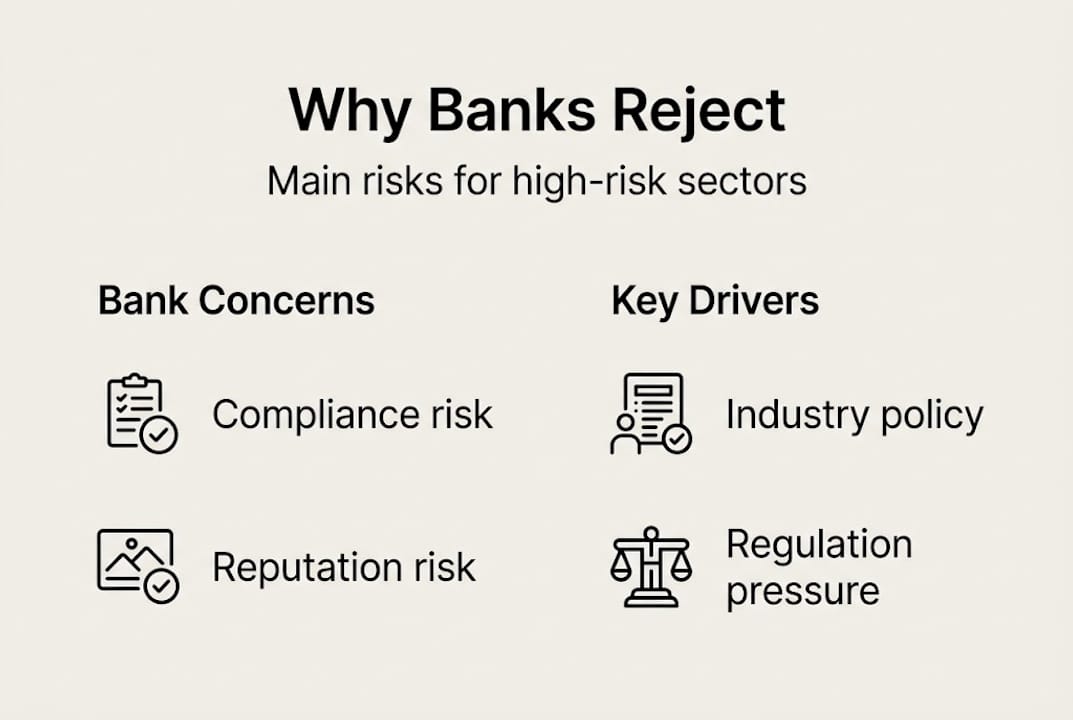
Bank rejection is not random. It follows a pattern driven by regulatory pressure, internal risk models, and reputational concerns. Understanding this pattern gives you a real advantage when you approach any institution.
The single biggest driver is de-risking. This is the practice of banks simply cutting off entire industry categories rather than managing individual client risk. It is cheaper and easier for a compliance department to say “no crypto” than to assess each crypto business on its merits. The result is that entire sectors lose access to banking infrastructure, regardless of how well-run individual businesses are.
Regulators are a key factor here. The EBA and FATF risk-based approach to anti-money laundering and counter-terrorism financing requires banks to apply enhanced due diligence to higher-risk clients. While the guidance actually calls for proportionate measures rather than blanket exclusions, many banks interpret it conservatively and apply outright bans. This misapplication of the rules is costing legitimate businesses their livelihoods.
Which sectors are most affected
Some industries face far greater scrutiny than others. Common banking rejection risks apply across the following categories:
- Crypto and digital asset businesses, including exchanges, custodians, and token issuers
- iGaming operators, whether licensed in Malta, Gibraltar, or elsewhere
- Forex and CFD brokers, particularly those with offshore regulatory licences
- Adult entertainment platforms and content creators
- Payment processors and money service businesses
- Nutraceuticals and supplements with subscription billing models
- Travel agencies and ticketing businesses with high chargeback exposure
The regional picture matters too. In the UK, account closures for high-risk sectors have surged sharply, driven by FCA pressure and correspondent banking risk. European Union banks operating under EBA supervision face similar pressures, though certain jurisdictions such as Lithuania, Malta, and the Netherlands maintain more pragmatic attitudes towards regulated high-risk operators. Offshore financial centres, including jurisdictions like the Cayman Islands, Seychelles, and Vanuatu, often offer more flexibility, but carry their own correspondent banking risks.
Key reasons banks decline applications
| Rejection reason | How it affects you | Typical sectors |
|---|---|---|
| Industry category policy | Automatic decline without review | Crypto, adult, iGaming |
| Unclear source of funds | AML red flag, triggers EDD | All high-risk |
| Offshore ownership structure | Perceived opacity | Forex, iGaming |
| High chargeback history | Operational risk concern | eCommerce, travel |
| Missing or weak compliance policy | Regulatory liability | All sectors |
| Unregulated business model | Reputational risk | Crypto, adult |
Understanding which specific reason is likely to apply to your business lets you address it directly, rather than submitting a generic application and hoping for the best.
What you need to prepare before applying
Understanding why banks reject applications leads directly to how you can prepare for approval. Preparation is where most businesses either win or lose the account before a single conversation takes place.
Banks are not just reviewing your financials. They are assessing whether onboarding you creates regulatory liability for them. Your application needs to answer their questions before they even ask. The EBA and FATF risk-based approach means banks must demonstrate they have assessed your risk profile in detail. If your documentation makes that job difficult, you will be declined.
Essential documents to gather
The following represent the absolute minimum for any high-risk banking application. Missing even one of these is grounds for immediate rejection:
- Certificate of incorporation and constitutional documents (articles of association, shareholder register)
- KYC packages for all ultimate beneficial owners (UBOs) holding more than 10% of shares, including certified passport copies, proof of address, and source of wealth declarations
- KYB documentation covering all entities in your corporate structure
- Audited financial statements or at minimum two years of management accounts
- Business plan covering your revenue model, customer base, transaction volumes, and geographic markets
- AML and compliance policy tailored to your specific sector
- Regulatory licence copies, if applicable
- Merchant processing history showing chargeback rates and transaction patterns
Gathering business account documents in advance is critical because most banks will request additional information at speed. Delays in responding are interpreted as either disorganisation or concealment.

EU versus offshore: what changes
| Requirement | EU institution | Offshore institution |
|---|---|---|
| UBO threshold | 10% or above | 10% or above |
| Source of wealth | Required, detailed | Required, sometimes lighter |
| AML policy | Must align with AMLD6 | More flexible but still required |
| Local presence | Often required | May be accepted remotely |
| Licence requirement | Strongly preferred | Less common but helpful |
| Onboarding timeline | 4-12 weeks typical | 2-6 weeks typical |
For EU institutions, your compliance documentation needs to align with the Sixth Anti-Money Laundering Directive (AMLD6). Offshore institutions are generally more flexible, but this does not mean you should submit a thinner application. A comprehensive file still dramatically increases your chances. Learning the nuances of passing bank compliance is what separates businesses that succeed from those that cycle through rejection after rejection.
Pro Tip: Write a one-page executive summary of your compliance programme and include it at the front of your application pack. This signals to the compliance officer reviewing your file that you understand their priorities and respect their time.
Step-by-step: how to approach banks and alternatives
Once your documents are ready, you can move on to the engagement process. This is where strategy matters as much as paperwork.
Most high-risk businesses make the same mistake: they apply to a list of banks based on name recognition, get rejected, and then try the next one on the list. This scattergun approach does not work. Every rejection is visible in certain banking intelligence networks, and repeated rejections can make you harder to bank over time.
The right process for securing a banking relationship
-
Research receptive institutions before approaching any of them. Not every bank accepts every sector. Specialist EMIs and fintech banks in Lithuania, Estonia, and Malta are often more open to regulated high-risk clients. Research their current onboarding policies before submitting a file.
-
Prepare a tailored cover letter. Your cover letter should directly address the risk factors your business carries and explain, clearly and factually, how you mitigate them. Do not hide risk. Banks know it exists. Demonstrate that you manage it professionally.
-
Request a pre-application call with the compliance team. Many institutions will allow a brief introductory call before you submit formally. Use this to gauge appetite and to establish a personal point of contact within their compliance function.
-
Submit a complete, well-organised file. Documents should be clearly labelled, in the correct format, certified where required, and translated if needed. A disorganised file is a red flag.
-
Follow up systematically but not aggressively. A polite follow-up every five to seven business days is appropriate. Chasing daily signals desperation and creates friction with compliance teams who are already under pressure.
-
Have alternative solutions lined up in parallel. You should never rely on a single banking application. Opening a high-risk bank account often requires working multiple channels simultaneously, including EMIs, offshore banks, and payment processors.
-
Engage a specialist where needed. Institutions that regularly onboard high-risk clients often have pre-existing relationships with specialist consultants. An introduction through a trusted intermediary can dramatically accelerate your application.
Pro Tip: When engaging banking compliance guidance professionals or specialist advisers, make sure they have actual relationships with the institutions they propose, not just theoretical knowledge of the landscape. Ask for named contacts and past case types.
It is also worth acknowledging that high-risk businesses face banking difficulties at a far higher rate than mainstream sectors, which makes pre-qualification from specialist networks significantly more valuable than cold applications.
Troubleshooting rejection and what to do next
Even with careful preparation, setbacks happen. Here is how to recover and get back on track without damaging your prospects further.
The first thing to understand is that a rejection is not necessarily final. Many institutions issue initial declines because of incomplete information rather than a fundamental policy objection to your business. The distinction matters enormously because it determines your next move.
Common reasons rejections happen at each stage
- Pre-screening rejection: Industry category policy or jurisdiction of incorporation. Solution: target institutions with a known appetite for your sector.
- Document review rejection: Missing, outdated, or inconsistent documentation. Solution: conduct a full audit of your file before resubmitting.
- Compliance review rejection: Gaps in your AML policy or unclear UBO structure. Solution: engage a compliance specialist to rebuild your policy documents.
- Final review rejection: Reputational concerns, adverse media, or issues with your source of wealth. Solution: obtain a legal opinion or independent compliance review and address findings formally.
“Banks are not obligated to tell you exactly why they declined your application. But you are absolutely entitled to ask, and a clear, polite enquiry often produces useful detail that makes your next application stronger.”
Alternatives when traditional banking fails
If traditional EU banks are not viable right now, you have real options. EU high-risk banking approval through specialist channels is one route, but there are others worth considering alongside it:
- EMIs (Electronic Money Institutions): Regulated under the EU’s EMD2 directive, EMIs like those authorised in Lithuania or the Netherlands can provide IBANs, payment processing, and multi-currency accounts with far shorter onboarding timelines.
- Offshore banking: Jurisdictions including the Seychelles, Mauritius, and Saint Vincent offer corporate banking to high-risk sectors, though you need robust correspondent banking arrangements to move funds internationally.
- Crypto treasury solutions: Stablecoin-based treasury management is now a viable operational tool for businesses that transact globally, reducing reliance on traditional fiat infrastructure.
- Payment processor accounts: High-risk merchant accounts through specialist acquirers allow you to process card payments even without a full corporate bank account.
The EBA and FATF proportionality principles actually support the use of these alternatives as part of a risk-based financial ecosystem. They are not workarounds. They are legitimate components of a well-structured high-risk business banking strategy.
To future-proof your banking relationships once you have established them, maintain detailed transaction records, update your compliance policy annually, and inform your banking partners proactively of any significant changes to your business model, ownership, or jurisdiction. Surprises kill banking relationships faster than almost anything else.
Why most businesses get this process wrong
Here is the uncomfortable truth: the majority of high-risk business owners approach banking as a box-ticking exercise. They assemble whatever documents they have, send them off, and assume that having a legitimate business is enough. It is not.
Banks do not just assess what your business is. They assess what working with you costs them in compliance effort and regulatory exposure. If your application forces their team to chase documents, interpret vague ownership structures, or make judgement calls on your AML controls, they will decline. Not because you are a bad client, but because you are an expensive one.
The businesses that consistently secure banking relationships do one thing differently: they present themselves as partners in compliance, not as applicants seeking a favour. They share information proactively, they maintain dialogue with compliance teams, and they seek bank compliance secrets grounded in actual institutional relationships rather than generic checklists.
Local expertise also matters more than most people realise. A specialist who understands that a specific Lithuanian EMI has recently tightened its approach to unregulated forex businesses, for example, saves you weeks of wasted effort. Generic sector knowledge does not give you that. Relationships do.
Secure the right banking solutions for your high-risk business
Navigating banking as a high-risk operator is genuinely complex, but it is absolutely solvable with the right preparation and the right partners. At BankMyCapital, we work with over 50 pre-vetted banking institutions and EMIs across European and offshore jurisdictions, giving our clients access to channels that are simply not available through cold applications. Our 87% approval rate comes from understanding what each institution actually needs before we submit a single document.
If you are concerned about dealing with rejection risks in your sector, start by reviewing your compliance positioning. For those ready to move forward, our successful bank compliance framework walks you through every stage of the process. You can also access our 6-step checklist designed specifically for high-risk business banking applications.
Frequently asked questions
What qualifies a business as ‘high-risk’ to banks?
Banks classify businesses as high-risk based on industry type, geographic exposure, ownership complexity, or regulatory signals linked to financial crime risk. The EBA and FATF risk-based framework requires institutions to apply enhanced due diligence to these categories, which often translates into higher rejection rates.
If my business is rejected by one bank, can I apply to another?
Yes, but revise your application first and address the specific reasons for the previous rejection before resubmitting elsewhere. Since 50-60% of high-risk businesses face banking difficulties, a targeted approach to receptive institutions is far more effective than applying broadly.
What documents do I need for a high-risk business bank account?
At minimum, you will need company incorporation documents, full KYC for all UBOs, a business plan, AML compliance policy, and financial statements. The EBA and FATF enhanced due diligence standards apply across almost all high-risk onboarding processes, so thorough documentation is essential.
Can using a payment provider or EMI be a valid alternative?
Yes, many high-risk businesses rely on licensed EMIs or specialist fintech payment platforms when traditional banks decline their applications, and these are legitimate, regulated alternatives rather than stopgap measures.
How can I reduce the risk of future account closure?
Maintain a strong, up-to-date compliance programme, keep your bank informed of any material business changes, and document all significant transactions clearly to demonstrate ongoing transparency.
