
TL;DR:
- EU banks often reject crypto startups, making EMIs the practical alternative for payment infrastructure. EMIs support faster onboarding, multi-currency support, and cross-border operations, crucial for crypto growth. Ongoing compliance, regulation, and relationship management are vital to maintaining EMI accounts and scaling within the EU.
Getting a bank account as a crypto startup in the EU is genuinely hard. Traditional banks reject digital asset businesses at alarming rates, often without explanation, leaving founders scrambling for compliant payment infrastructure before they can serve a single client. MiCA regulation, now fully applicable across the EU, raises the stakes further by introducing formal authorisation requirements for crypto asset service providers. EMI accounts have emerged as the most practical bridge: accessible before full licence approval, scalable across borders, and increasingly accepted by regulators as a legitimate financial foundation for crypto operations.
Key Takeaways
| Point | Details |
|---|---|
| EMI benefits for crypto | EMI accounts help crypto startups access reliable banking, payments, and compliance support throughout the EU. |
| Compliance is essential | Meeting MiCA and capital requirements is crucial for continued operations as rules evolve. |
| Scalability with passporting | EMI passporting makes it possible to operate across EU borders without seeking full banking status. |
| Stepwise application process | Crypto venture founders can secure EMI accounts with clear documentation and adherence to local rules. |
What is an EMI account and why do crypto startups need one?
An Electronic Money Institution, or EMI, is a regulated financial entity authorised to issue electronic money and provide payment services under the EU’s Payment Services Framework. Unlike a traditional bank, an EMI does not lend money or hold deposits in the conventional sense. Instead, it holds client funds in segregated safeguarding accounts and facilitates payments, currency exchange, and account management at speed. For a crypto startup, this distinction matters enormously.
Traditional EU banks view crypto businesses as high-risk by default. Their compliance teams flag digital asset operations under anti-money laundering frameworks, and most applications are declined before reaching a senior decision-maker. EMIs, by contrast, are built for the digital economy. Many have specific onboarding pathways for crypto businesses, understand the nature of blockchain transactions, and are equipped to handle the volume and velocity of payments typical in this sector.
Here is a direct comparison to help you assess your options:
| Feature | Traditional bank | EMI account |
|---|---|---|
| High-risk crypto onboarding | Usually refused | Often supported with documentation |
| Account opening time | 6-12 weeks | 2-4 weeks typically |
| Multi-currency support | Limited | Strong, often 30+ currencies |
| EU passporting | Yes, but slow | Multi-currency support for crypto via fast passporting |
| AML/KYC scrutiny | Very high, often blocking | High but crypto-literate |
| Credit/lending facilities | Available | Not typically offered |
The key use cases where EMI accounts are essential for crypto startups include:
- Pay-in and pay-out infrastructure for token sales, exchange operations, or OTC desks
- Client fund segregation, which is a regulatory requirement under MiCA for most crypto asset service providers
- Cross-border settlement across EU member states without needing multiple local accounts
- API-driven payment flows that integrate directly with crypto trading platforms or custody systems
Critically, EMIs enable scale via passporting without needing full bank status, which makes them the most cost-effective route to EU-wide financial access for early-stage crypto ventures. For a detailed breakdown of how EU banks versus EMI accounts compare in practice for high-risk businesses, the differences are often decisive.
Pro tip: Do not assume all EMIs are equal. Some are authorised only in one member state and passport into others with limited service capability. Always verify the specific services available in your target markets before committing.
preparing your crypto startup: key regulatory and compliance requirements
Once you recognise why EMI accounts matter, proper preparation is the next crucial step to avoid costly delays.
MiCA has fundamentally changed the compliance landscape for crypto businesses operating in the EU. The most significant shift is the transition from the old national Virtual Asset Service Provider (or V ASP) registration system to the new EU-wide C ASP (crypto asset service provider) authorisation framework. VASPs must transition to C ASP authorisation by 1 July 2026, and this deadline is not flexible.
Here is a summary of the capital requirements you need to plan for:
| Service type | MiCA minimum capital requirement |
|---|---|
| Basic custody services | €50,000 |
| Exchange or brokerage | €125,000 |
| Full trading platform | €150,000 |
| Asset-referenced token issuer | €350,000 |
For crypto licensing in the EU, the documentation requirements are substantial. Here is what you need to prepare before approaching either a regulator or an EMI:
- Corporate structure documentation: Certificate of incorporation, shareholder register, and ownership chart showing all beneficial owners above 25%
- AML and KYC policy framework: A written, board-approved compliance programme with named compliance officer
- Business plan: Revenue model, target markets, projected transaction volumes, and risk appetite statement
- Technology and security documentation: Description of your platform, custody arrangements, and cybersecurity controls
- Source of funds evidence: For founders and any investor contributing capital above regulatory thresholds
The MiCA and EMI guidance published by the European Banking Authority confirms that EMIs providing crypto services must notify their national competent authority under Article 59 of MiCA. This is not optional. Missing this notification can invalidate your transitional protection and expose you to enforcement action.
Pro tip: Start the crypto business account setup process at least four months before your target launch date. EMI onboarding alone can take four to six weeks, and regulatory notifications add further time. Build in buffer, not hope.
The most common compliance pitfall we see is founders submitting incomplete AML frameworks. A policy template downloaded from the internet will not pass scrutiny. Your compliance documentation must reflect your actual business model, transaction types, and risk profile.

How to open an EMI account as a crypto startup in the EU
Preparation done, it is time for practical execution. Here is how to secure your EMI account without unnecessary risk.
Follow these steps in sequence:
- Define your operational requirements first: Know your expected monthly transaction volumes, currencies needed, and whether you require API access, virtual IBANs, or physical card issuance
- Select a shortlisted EMI provider: Match providers to your business model. Trading platforms need high-volume payment rails; custody businesses need strong segregation capabilities; OTC desks need fast FX conversion
- Submit a pre-application enquiry: Most EMIs accept informal enquiries before formal application. Use this to confirm they serve your business type and jurisdiction
- Complete KYC and corporate due diligence: Submit all documentation in one complete package. Missing documents are the single biggest cause of delays
- Pass compliance review: The EMI’s internal compliance team will assess your AML framework, business model, and transaction risk profile. Be prepared to answer detailed questions
- Account activation and testing: Once approved, test payment flows before going live with client funds
For a complete step-by-step EMI account opening guide, the process is more nuanced than most founders expect.
Document errors or incomplete disclosures are the leading cause of EMI application rejection for crypto startups. A single missing AML policy section can set your timeline back by six to eight weeks.
One factor that catches founders off guard is national variations in transition that persist under MiCA. Ireland, Lithuania, and the Netherlands, for example, have different supervisory expectations for crypto businesses during the transitional period. An EMI passporting from Lithuania may face additional scrutiny when serving clients in Germany. Always verify the regulatory posture of your primary market before selecting a provider.
Pro tip: When setting up crypto banking, ask your EMI provider directly whether they have processed applications for businesses with your specific token or service type. Generic crypto experience is not the same as relevant crypto experience.
scaling and operating your crypto business with an EMI account
With your EMI account live, here is how to ensure your operations remain robust and compliant as you grow across Europe.
Day-to-day operations with an EMI account are straightforward once the infrastructure is in place. The critical discipline is maintaining clean transaction records from the outset. Every payment in and out should be categorised, reconciled, and documented. This is not just good practice; it is what protects you during regulatory reviews.
Key operational priorities include:
- Client fund segregation: Keep client assets strictly separate from operational funds. MiCA mandates this, and your EMI agreement will enforce it contractually
- Transaction monitoring: Most EMIs provide built-in monitoring tools. Use them actively, not just reactively
- Currency management: Use your multi-currency account capability to reduce FX exposure on cross-border settlements
- Regular compliance reviews: Schedule quarterly internal reviews of your AML framework against current transaction patterns
- EMI relationship management: Keep your account manager informed of significant changes to your business model or transaction volumes
EMIs allow scale across borders via passporting, which means your single EMI account can support operations across all EU member states without requiring separate local accounts in each country. This is a genuine competitive advantage over traditional banking arrangements.
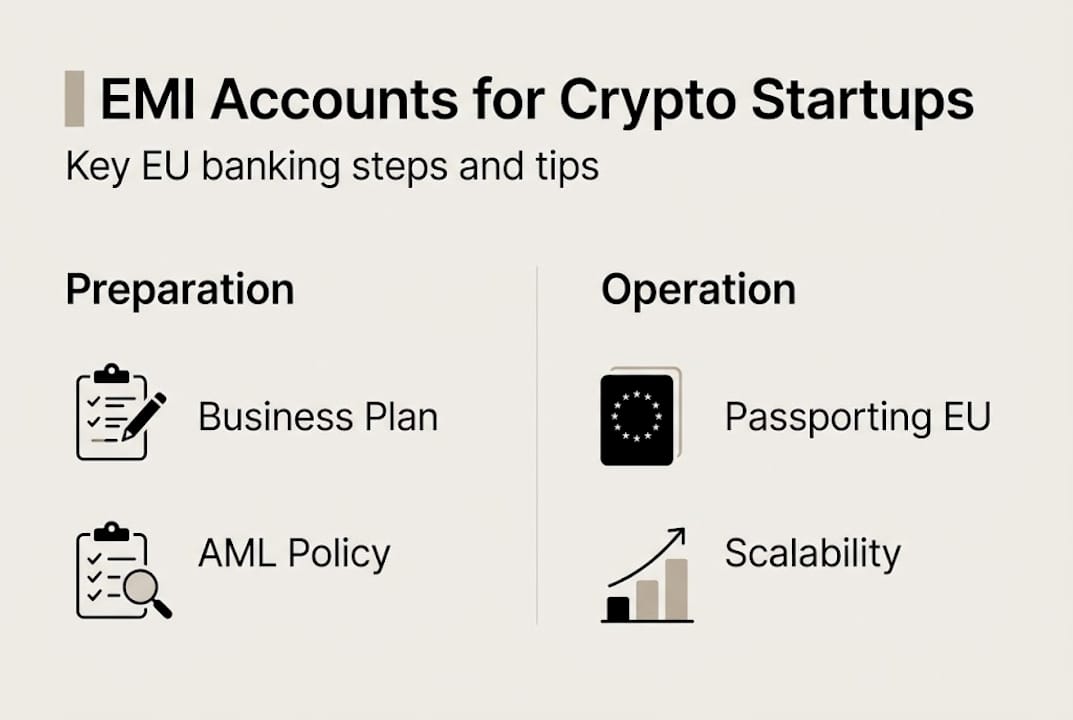
For crypto compliance and scalability as you grow, the most common scaling challenge is transaction volume thresholds. Many EMIs apply enhanced due diligence when monthly volumes exceed certain levels. Know your thresholds in advance and notify your provider before you breach them, not after.
Pro tip: Review real-world EU EMI account examples from comparable crypto businesses before finalising your operational setup. The practical lessons from live operations are often more useful than regulatory guidance documents.
A founder’s perspective: what most guides miss about EMI banking for crypto startups
Here is the uncomfortable truth that most technical guides avoid: EMI accounts are a bridge, not a destination. Too many crypto founders treat EMI approval as the end of their banking problem. It is not. It is the beginning of an ongoing compliance relationship that requires active management.
We have seen founders secure excellent EMI accounts and then lose them within twelve months because their transaction volumes grew faster than their compliance infrastructure. The EMI did not change. The business did, without telling anyone.
The other misconception is that an EMI versus EU bank comparison is purely about features. It is really about risk appetite and relationship management. EMIs that serve crypto businesses are taking a calculated risk on your operation. They expect transparency in return. The founders who maintain strong EMI relationships are those who treat their account manager as a compliance partner, not just a payment processor.
As 2026 approaches and MiCA deadlines harden, the EMI landscape will shift. Some providers will exit the crypto market. Others will raise their compliance bar significantly. Plan now for that possibility by maintaining relationships with more than one provider and keeping your compliance documentation current.
Take the next step: expert help for EMI and crypto banking success
Navigating EMI account applications, MiCA compliance, and cross-border crypto banking without specialist support is a significant risk to your timeline and approval chances. At BankMyCapital, we work directly with crypto startups to match them with the right EMI partners from our network of over 50 pre-vetted institutions, with an 87% approval rate and typical onboarding in two to three weeks. Whether you need a crypto banking setup guide, want to understand banking rejection risks before you apply, or need full support for crypto business banking in the EU, our team provides tailored guidance at every stage.
frequently asked questions
Can a crypto startup operate entirely with an EMI account in the EU?
In most cases, yes. EMI accounts fully support payments and standard operations, but certain crypto services will require full C ASP authorisation after 1 July 2026.
What is the typical capital requirement for a crypto startup to become a C ASP under MiCA?
C ASP capital requirements range from €50,000 for custody services to €150,000 for a full trading platform authorisation in the EU.
Are EMI accounts available to all crypto startups regardless of country?
EU EMI passporting allows cross-border access, but national variations persist under MiCA and some regulators impose additional restrictions during the transition period.
What documents are essential for opening an EMI account in the EU?
You will need founder identification, a detailed business plan, a board-approved AML compliance framework, and full documentation of your crypto operations and transaction types.
How do EMIs differ from traditional banks for crypto businesses?
EMIs enable scale via passporting without full bank status, while traditional banks offer broader lending but routinely restrict or decline high-risk crypto clients.
