
TL;DR:
- EU iGaming operators face increased risks of banking shutdowns due to stricter regulations and compliance requirements.
- Implementing tiered KYC and AML processes, maintaining documentation, and using reputable EU payment partners are essential for banking relationships.
- Building regulation-led, transparent payment infrastructures reduces operational risks, enhances player trust, and ensures sustainable growth.
Getting a bank account shut down mid-month is not an abstract risk for iGaming operators in the EU. It is a commercial emergency that freezes player withdrawals, triggers regulatory scrutiny, and can permanently damage player trust. The gap between operating legally and banking smoothly has widened considerably as regulators tighten frameworks across the bloc. Understanding exactly which rules apply, how compliance translates into daily banking decisions, and where payment solutions genuinely hold up under pressure is no longer optional. This guide gives you the practical, evidence-backed strategies to keep casino transactions flowing and banking relationships intact.
Key takeaways
| Point | Details |
|---|---|
| Regulation is non-negotiable | Meeting PSD2, AMLD5, and GDPR is essential to secure and sustain casino banking in the EU. |
| KYC/AML is complex but manageable | Tiered, well-documented onboarding and real-time monitoring are keys to approval and smooth payouts. |
| Choose partners wisely | Licensed EU processors deliver greater long-term safety and banking stability than offshore shortcuts. |
| Future-proof with compliance tech | Investing in compliance not only prevents fines but also protects your business reputation and client trust. |
Regulatory frameworks shaping casino banking in the EU
The EU regulatory landscape for casino banking is not a single rulebook. It is a layered stack of directives that interact in ways that catch operators off guard. Getting comfortable with each layer is the first step to building banking relationships that last.
PSD2 and strong customer authentication (SCA) require that card payments above certain thresholds use multi-factor verification, typically via 3D Secure. EU iGaming operators must comply with PSD2/SCA requiring strong customer authentication, which reduces conversion by 10 to 15% but cuts fraud significantly. That conversion drop is real money. For a casino processing €5 million per month in card deposits, a 12% drop in successful transactions costs over €600,000 in lost revenue monthly.
AMLD5 tightened anti-money laundering requirements across the EU, specifically targeting high-risk sectors including gambling. It introduced mandatory real-time monitoring, source-of-funds checks for high-value deposits, and enhanced due diligence for politically exposed persons. Operators must have documented KYC and AML policies in place before any reputable EU bank will consider opening an account.
GDPR adds a data layer to every compliance obligation. Non-compliance risks massive fines of €500,000 to €20 million, while GDPR permits data processing for licence obligations but demands full transparency with players about how their data is used and stored.
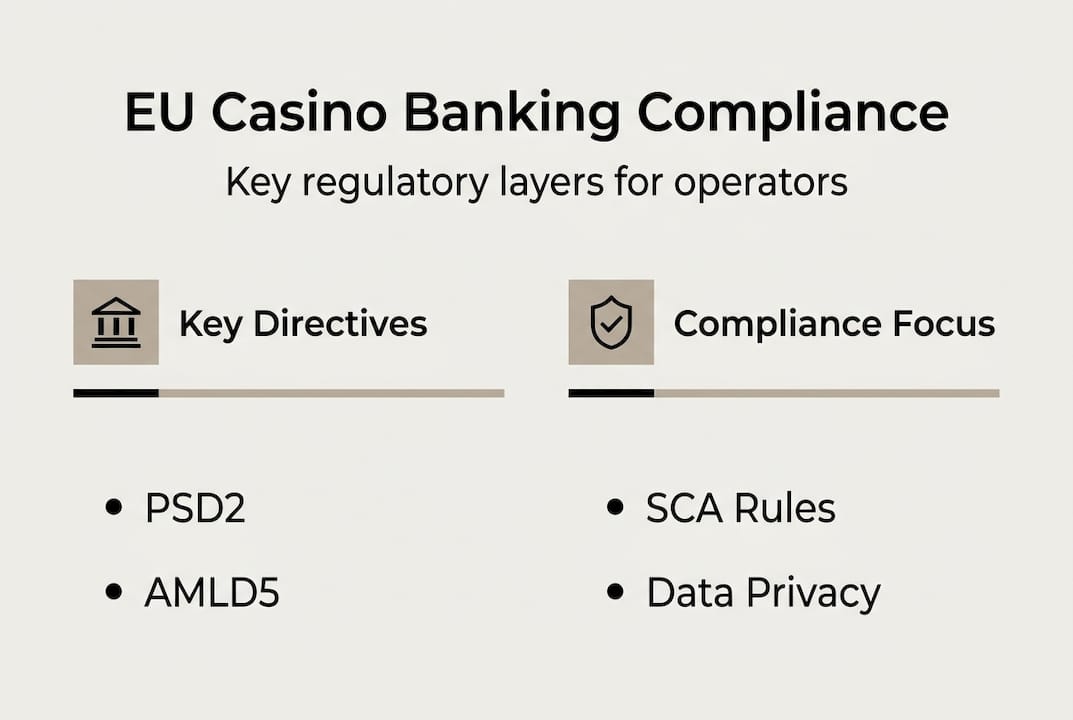
Here is how these regulations map to operator pain points:
| Regulation | Primary focus | Operator pain point | Typical response |
|---|---|---|---|
| PSD2/SCA | Payment authentication | Lower card conversion rates | Implement 3DS2, optimise checkout |
| AMLD5 | AML/KYC obligations | Onboarding friction, monitoring cost | Deploy automated AML software |
| GDPR | Data protection | Consent management, breach risk | Appoint DPO, encrypt player data |
For operators pursuing EU casino licensing, understanding these frameworks before approaching a bank is essential. Banks assess your compliance posture as part of their own risk appetite. A weak compliance manual is a rejection letter waiting to happen. Our high-risk banking guide covers jurisdiction-specific nuances that affect which banks will actually engage with you.
Regulators are not slowing down. The direction of travel across the EU is towards more granular monitoring, stricter source-of-funds requirements, and higher fines for procedural failures. Operators who treat compliance as a cost centre rather than a competitive asset will find banking doors closing faster than they can open new ones.
Understanding the KYC and AML process for casino payments
KYC is not a one-time checkbox. It is a tiered, ongoing process that scales with player activity and deposit behaviour. Getting this wrong is one of the most common reasons operators lose banking partners.
The tiered structure works roughly as follows:
- Basic KYC: Email address and phone number verification for low-value deposits. Suitable for initial registration and small transaction limits.
- Intermediate KYC: Government-issued ID and proof of address required when deposit thresholds are reached or when account activity triggers review.
- Full KYC: Facial recognition, source-of-funds documentation, and enhanced due diligence for withdrawals above €200 or for high-frequency players.
- Ongoing monitoring: Tiered KYC mechanics include 12-month rolling monitoring in the UK, with name/IBAN mismatches blocking payouts and third-party funding triggering AML flags automatically.
In practice, name and IBAN mismatches are among the most common causes of blocked withdrawals. A player deposits using a card registered to a slightly different name variant and the system flags it. Without a clear escalation process, that player’s withdrawal sits in limbo, your chargeback rate climbs, and your banking partner notices.

AML checks in practice require transaction monitoring software that can identify unusual patterns in real time. Sudden spikes in deposit frequency, large round-number transactions, and rapid deposit-withdrawal cycles are all red flags that your system must catch before your bank does.
Setup costs for compliant KYC and AML infrastructure are substantial. Year-one costs typically run between €335,000 and €695,000 when you factor in compliance technology, staff, legal review, and ongoing monitoring. That figure surprises operators who underestimate the operational commitment involved.
Pro Tip: Document every KYC decision, including why a case was escalated or cleared. Regulators and banking partners increasingly request audit trails, not just outcomes. A well-documented KYC log is evidence of a functioning compliance culture.
For operators setting up their first iGaming bank account, the KYC framework you present to a bank is as important as your licence. Equally, knowing which offshore banks for casinos apply lighter-touch KYC requirements can be a useful interim strategy while EU structures are built out.
Navigating payment processing solutions and approval rates
Payment processing for casino gaming is a different world from standard e-commerce. Approval rates tell the story clearly. Gambling card authorisation rates sit between 78% and 85%, compared to 90% to 95% for standard e-commerce merchants. That gap reflects issuer-level risk scoring, not just your compliance posture.
The choice between EU-licensed payment partners and offshore processors is one of the most consequential decisions an operator makes. Here is the honest breakdown:
- EU-licensed processors (e.g., Malta-based): Higher setup costs, stricter onboarding, but far greater sustainability. Malta Gaming Authority-regulated operators are preferred by EU banks for long-term relationships despite higher initial friction.
- Offshore high-risk processors: Faster to onboard, lower fees initially, but compliance gaps create downstream problems including account terminations, withheld funds, and regulatory exposure.
- E-wallets and alternative payment methods: Increasingly popular for bridging compliance gaps, particularly in markets where card acceptance rates are low.
- Crypto payment rails: Growing in relevance but require their own compliance infrastructure to avoid AMLD5 exposure.
Key criteria for selecting a payment partner:
- Licence status and regulatory standing in your target markets
- Chargeback thresholds and dispute resolution processes
- Real-time reporting and integration with your AML monitoring stack
- Contractual protections against unilateral account termination
- Reserve requirements and cash-flow implications
Pro Tip: Ask prospective processors for their average merchant approval rate specifically for gambling merchants, not their overall rate. The gap between those two numbers reveals how well they actually understand your sector.
Our payment processing solutions page covers vetted partners across EU and offshore jurisdictions. For operators wanting to benchmark their current setup, the processing best practices guide and our list of top EU payment partners are practical starting points.
Operational banking risks and sustainable solutions
The four risks that cause the most operational damage for EU casino operators are account rejection, forced account closure, regulatory investigation, and data breach. Each one can halt operations. All four are manageable with the right preparation.
Steps to reduce operational banking risk:
- Maintain relationships with at least two banking partners simultaneously. Single-bank dependency is the most avoidable operational risk in iGaming.
- Keep compliance documentation current and audit-ready at all times, not just during onboarding.
- Implement open banking integrations where available. Real-time account data sharing with banking partners builds trust and reduces manual reporting friction.
- Conduct quarterly internal AML reviews and document findings formally.
- Ensure your data processing agreements with third-party vendors are GDPR-compliant, as data breaches can trigger banking partner reviews independently of your own compliance.
- Engage legal counsel with specific iGaming regulatory experience before entering new EU markets.
Open banking is quietly reshaping how banks assess iGaming operators. Real-time transaction data shared via API gives banking partners visibility that reduces their risk perception. Operators who embrace this transparency tend to experience fewer account reviews and faster dispute resolution.
Fines for non-compliance range from €500,000 to €20 million under GDPR alone. When you add AMLD5 penalties and national gambling authority sanctions, the true cost of a compliance failure dwarfs any short-term saving from cutting corners on KYC or AML infrastructure.
For operators building resilient banking structures, our offshore bank accounts list and payment processing approval guide provide the framework for diversifying banking exposure intelligently.
Perspective: Why sustainable, regulation-led banking wins for casinos
We see operators take shortcuts every week. Offshore processors with no EU footprint, banking partners in jurisdictions with minimal oversight, KYC frameworks that exist on paper but not in practice. The short-term logic is understandable. Setup is faster, costs are lower, and the compliance burden feels lighter.
But the operators who build genuine competitive advantage are the ones who invest in regulation-led infrastructure from the start. Here is the uncomfortable truth: your players notice. Frictionless withdrawals, transparent data handling, and reliable payment methods are trust signals that drive retention. Compliance is not just a legal obligation. It is a product feature.
The operators we work with who have built robust EU-compliant banking structures spend less time firefighting account closures and more time growing. The upfront cost of proper KYC infrastructure, reputable EU-licensed processors, and documented AML frameworks pays back in reduced legal costs, fewer banking disruptions, and stronger player lifetime value.
Pro Tip: Invest in compliance technology that scales with your player base. A system that works at 10,000 active players will buckle at 100,000. Build for where you are going, not where you are now.
Our perspective on high-risk banking is consistent: regulated, transparent, and sustainable always outperforms clever workarounds over any meaningful time horizon.
Compliance and AML essentials: what Cyprus banks expect
Now that the risks and scrutiny are clear, let us break down exactly what banks look for in iGaming applicants wishing to do business in Cyprus.
Cyprus banks operate under EU Anti-Money Laundering directives, currently the sixth AML directive, and apply these standards rigorously to high-risk sectors. To open a high-risk bank account in Cyprus, your documentation needs to be thorough and consistent across every document submitted.
Comparison of AML standards: Cyprus vs. selected EU jurisdictions
| Requirement | Cyprus | Malta | Estonia |
|---|---|---|---|
| Enhanced due diligence for iGaming | Mandatory | Mandatory | Mandatory |
| Local substance requirement | High | Medium | Low |
| UBO disclosure threshold | 10% | 25% | 25% |
| On-site compliance officer | Expected | Recommended | Optional |
| Processing history required | 6 to 12 months | 3 to 6 months | 3 months |
Cyprus sits at the stricter end of the EU spectrum for substance and compliance officer requirements. This is not a disadvantage if you are prepared, but it catches underprepared operators off guard regularly.
Here is a practical step-by-step checklist to maximise your approval odds:
- Appoint a qualified AML compliance officer with a demonstrable track record.
- Draft an AML policy that reflects your actual business model, including specific risks from cross-border payments and player geographies.
- Compile certified copies of all UBO documentation, going back through every layer of ownership.
- Prepare a business plan that includes projected transaction volumes, revenue forecasts, and an explanation of your player acquisition strategy.
- Gather at least six months of processing history from existing payment providers.
- Document your local substance clearly: office lease, employee contracts, and organisational charts.
- Review your application for consistency before submission, as contradictions between documents are a common rejection trigger.
Pro Tip: Before approaching any bank, run a mock due diligence review on your own documents. Pretend you are the bank’s compliance officer and ask whether you would approve this application. This exercise alone identifies most weaknesses before they cost you time and money.
The risks of avoiding common banking mistakes are well documented. Operators who skip the self-audit step submit incomplete or contradictory applications and wonder why they receive rejections with no explanation.
Banks assess the full risk profile including volumes, cross-border flows, and governance structure. Matching your submission to this exact framework is the most reliable path forward.
Understanding payment processing in igaming
Payment processing, in the igaming context, refers to the complete chain of systems and relationships that authorise, settle, and reconcile financial transactions between players and your platform. It is not simply a payment gateway bolted onto your site. It is an ecosystem involving acquiring banks, payment service providers (PSPs), card networks, fraud detection layers, and currency conversion engines, all working in sequence every time a player deposits or withdraws.
Payment processing underpins igaming platforms’ ability to securely accept and remit funds globally, which is why disruption at any point in this chain has immediate revenue consequences. A failed withdrawal at 11pm on a Friday is not an IT problem. It is a player retention crisis.
So why do igaming operators fall into the high-risk category that banks and processors find uncomfortable? Several factors combine:
- Regulatory complexity: Licences vary by jurisdiction, and not all are recognised equally by financial institutions.
- Chargeback exposure: Gambling transactions carry elevated dispute rates compared with standard e-commerce.
- Reputational risk: Banks are cautious about association with gambling brands, particularly in markets with ambiguous legal status.
- Cross-border volume: High international transaction volumes trigger enhanced due diligence requirements.
- Player anonymity concerns: AML obligations are harder to satisfy when player identity verification is incomplete.
Understanding the igaming regulatory overview helps clarify why these factors collectively push operators into a category where standard merchant accounts are routinely declined.
The typical payment workflow involves a player initiating a deposit, the PSP routing the request to the acquiring bank, the card network (Visa, Mastercard, or a local alternative) authorising the transaction, and funds settling into your merchant account, usually within one to three business days. Withdrawals follow a reverse path, often with additional compliance checks. Each handoff is a potential point of failure, delay, or regulatory scrutiny.
| Stakeholder | Role in payment chain | Key concern |
|---|---|---|
| Acquiring bank | Holds merchant account, settles funds | Regulatory exposure, chargeback ratios |
| PSP / gateway | Routes and processes transactions | Uptime, fraud detection, coverage |
| Card networks | Authorise card payments | Compliance with network rules |
| Compliance layer | AML, KYC, sanctions screening | Regulatory liability |
| Player | Initiates deposit or withdrawal | Speed, security, choice of method |
Grasping this structure is essential before you evaluate any vendor or negotiate any contract.
Why banking is the biggest challenge for iGaming in Cyprus
With the ongoing struggles clear, it is vital to understand what makes banking solutions especially complex for iGaming operators in Cyprus.
Cyprus has built a reputation as a serious hub for online gaming businesses. The Cyprus Gaming and Casino Supervision Commission issues licences that are respected across Europe, and the island offers a favourable tax environment, a skilled multilingual workforce, and proximity to major financial centres. Yet despite all of this, banking remains the hardest challenge that operators face, often requiring months of back-and-forth before a single account is opened.
“A licence tells a bank that you are permitted to operate. It does not tell a bank that you are safe to bank. Those are two very different conversations.”
The core issue is that banks apply their own internal risk appetite on top of regulatory requirements. iGaming sits in a category that triggers enhanced due diligence automatically. Banks worry about money laundering, problem gambling-related fraud, chargebacks, and reputational exposure. A licence addresses none of these concerns directly.
When evaluating an application for opening business bank accounts, compliance teams look at several factors that go well beyond documentation:
- Transaction volumes and geography: High volumes and payments flowing through multiple jurisdictions raise red flags immediately.
- UBO transparency: Banks want clear, unambiguous ownership structures. Layered holding companies invite suspicion.
- AML programme quality: A policy document is not enough. Banks want to see a functioning compliance programme with named officers and audit trails.
- Local substance: Physical presence, local staff, and real operational activity matter to Cypriot banks more than many operators realise.
- Reputation of associated parties: If your payment processor or affiliate network has a poor track record, that affects your application.
Cyprus is indeed becoming a hub for high-risk fintech and iGaming precisely because of its expert ecosystem. But that ecosystem also means local banks are well-educated about the risks. Proactive governance is the price of entry. Operators who treat compliance as a box-ticking exercise consistently fail at the iGaming bank account opening stage.
Navigating banking regulations and compliance
Compliance is where most igaming operators encounter their first serious payment problem. The regulatory landscape is not static, and what was acceptable practice two years ago may now trigger account termination.
Core frameworks you must satisfy include Anti-Money Laundering (AML) obligations, which require transaction monitoring and suspicious activity reporting. Know Your Customer (KYC) protocols mandate identity verification before players can deposit or withdraw above defined thresholds. Payment Card Industry Data Security Standard (PCI DSS) governs how card data is stored and transmitted. Failure on any of these fronts is not a minor administrative issue.
Non-compliance leads to lost banking relationships and blocked access to financial networks, which can effectively halt operations overnight.
Regional approaches differ significantly, and choosing the right jurisdiction for your payment infrastructure is a strategic decision, not a formality:
| Region | Regulatory body | Approach | Practical impact |
|---|---|---|---|
| European Union | EBA, national regulators | Strict AML directives, GDPR | Higher compliance cost, greater banking access |
| United Kingdom | FCA, UKGC | Robust consumer protection rules | Demanding but prestigious licence |
| Malta (MGA) | MGA | EU-aligned, igaming-specific | Widely accepted by EU banks |
| Offshore (e.g. Curaçao) | Local authority | Lighter touch regulation | Faster setup, limited banking options |
Seeking regulatory guidance for igaming early in your setup process prevents costly restructuring later. Operators who treat compliance as an afterthought consistently face higher processing fees, restricted banking relationships, and elevated chargeback liability.
Practical compliance steps that protect your payment operations include:
- Implementing real-time transaction monitoring tools that flag unusual activity automatically.
- Maintaining thorough KYC documentation with regular refresh cycles for high-value players.
- Conducting periodic audits of your PSP’s own compliance posture, not just your own.
- Establishing clear escalation procedures for suspicious transaction reports.
- Following payment best practices to reduce chargeback ratios below the 1% threshold most acquirers enforce.
The operators who thrive long-term are those who treat compliance as a competitive advantage rather than a burden. A clean compliance record opens doors to better banking terms, lower processing rates, and access to premium payment methods that less compliant competitors simply cannot offer.

Get expert support for running compliant, resilient casino banking
BankMyCapital works specifically with iGaming operators who need banking relationships that hold up under regulatory scrutiny. Our network of over 50 pre-vetted banking partners and EMIs means we match operators to institutions already comfortable with casino gaming risk profiles. We do not send you to a bank that will reject you in week three.
If you are concerned about your current exposure, start with our banking rejection risk guide and work through the banking checklist for success to identify gaps before a bank does. For operators at the licensing stage, our casino licensing support team provides end-to-end jurisdiction selection and regulatory liaison. Get in touch to protect what you have built.
Recommended
- Bank Account Opening for iGaming and Online Casino » Bank My Capital
- Legal support in iGaming: regulatory success in 2026
- EU Banking Regulations – Securing High-Risk Banking
- Best 8 Offshore Bank Accounts for iGaming 2026
Frequently asked questions
What are the most common reasons banking partners reject iGaming operators?
Most rejections result from compliance gaps, insufficient KYC/AML frameworks, and perceived high regulatory risk. Banks assess your compliance posture as a direct proxy for their own exposure to regulatory fines ranging from €500,000 to €20 million.
How fast can a new casino operator get a compliant EU bank account?
With robust KYC documentation and valid licensing in place, first withdrawals are typically processed within 24 to 72 hours post-KYC verification, though full account setup costs between €335,000 and €695,000 in year one.
What are the key documents banks require from casino gaming operators?
Banks require proof of licensing, company incorporation documents, compliance manuals, and evidence of functioning KYC/AML monitoring systems including real-time transaction oversight and source-of-funds procedures.
How does strong customer authentication affect casino player payments?
SCA strengthens fraud prevention and regulatory compliance but reduces card payment conversion by 10 to 15% for casino operators, making checkout optimisation and alternative payment method integration essential for revenue protection.
How does a sports betting company open a bank account?
A sports betting operator (sportsbook) opens a bank account the same way a casino does — by holding a recognised betting licence, then approaching banks and EMIs that serve licensed gambling, since mainstream banks decline betting outright. Sportsbooks face additional scrutiny around in-play liquidity, fast settlement cycles and exposure management, so banks assess turnover, settlement speed and the markets served. A respected betting licence plus segregated player funds and documented AML procedures is the foundation for approval.
Which banks and payment providers work with sportsbooks?
Sportsbook banking sits with the same gaming-friendly EMIs and specialist banks that serve online casinos, paired with high-risk acquirers and alternative-payment PSPs that support betting. The right combination depends on your licence and markets — UK and Malta licences unlock broader banking, while Curacao and Anjouan betting licences typically rely on EMIs and specialist acquirers. Payment methods commonly include cards via a high-risk acquirer, open banking, e-wallets and, increasingly, crypto settlement.
What is the difference between casino and sports betting banking?
The core banking requirements are the same — a gambling licence, segregated player funds, AML controls and a gaming-friendly banking partner — but sportsbooks add liability and settlement timing risk that banks weigh more heavily, because payouts can spike around major events. Operators running both casino and sportsbook under one licence usually use a single banking structure, with the payments layer tuned for betting’s faster settlement and higher peak volumes.
