
Most business owners assume payment processing works the same for everyone, but if you operate in crypto, iGaming, or adult entertainment, you face a completely different landscape. Traditional processors reject high-risk sectors at rates exceeding 70%, leaving operators scrambling for alternatives. This guide breaks down what makes payment processing high risk, how the mechanics differ from standard accounts, and practical steps to secure reliable banking relationships that support growth rather than stifle it.
Key Takeaways
| Point | Details |
|---|---|
| High-risk criteria | Businesses with high chargebacks, heavy regulation, or cross-border payments need specialised processing. |
| Complexity and costs | Expect more verification, rolling reserves, and fees up to twice the standard rates. |
| Chargeback risk | Keeping chargebacks below card scheme thresholds is essential to keeping your account open. |
| Account structure | Hybrid setups using onshore, offshore, and crypto can minimise cost and risk. |
| Compliance is ongoing | Maintaining compliance and documentation is vital to avoid blacklists and operational disruption. |
What defines a high-risk business?
From a payment processor’s perspective, you’re high risk if your business model triggers frequent chargebacks, operates under complex regulations, or processes international payments across multiple jurisdictions. Industries like crypto, iGaming, and adult entertainment face classification as high risk because they combine all three factors.
Typical high-risk sectors share common characteristics. Crypto exchanges handle volatile assets and cross-border transactions. Online gaming and gambling sites face strict licensing requirements and age verification challenges. Adult entertainment platforms deal with subscription billing disputes and content-related chargebacks.
Several risk factors push businesses into this category:
- Chargeback rates exceeding 1% of total transactions
- Operating in jurisdictions with evolving or unclear regulatory frameworks
- Subscription-based or recurring billing models that increase dispute likelihood
- Cross-border sales requiring currency conversion and international compliance
- Products or services considered reputationally sensitive by traditional banks
Traditional processors avoid these sectors because the financial exposure outweighs potential profit. Banks face regulatory scrutiny when serving high-risk clients, and elevated chargeback rates threaten their standing with card networks like Visa and Mastercard.
Pro Tip: Present accurate company information and demonstrate a robust compliance posture from your first application. Processors flag inconsistencies immediately, and clean documentation significantly improves approval odds.
Understanding your high-risk merchant account criteria helps you prepare applications that address processor concerns upfront rather than triggering instant rejection.
How high-risk payment processing works: mechanics and fees
The application process for high-risk accounts involves intensive merchant underwriting. Processors examine your business registration documents, conduct Know Your Business and Know Your Customer checks, review your website content, and analyse financial statements. They’re assessing whether your operation can sustain the elevated risk profile.
Approval involves rigorous KYB/KYC, rolling reserves of 5-15% held for 90-180 days, and ongoing transaction monitoring. Settlement times stretch longer than standard accounts, often taking three to seven business days instead of next-day funding.

Fee structures differ dramatically from conventional processing:
| Account Type | Setup Fee | Transaction Fee | Chargeback Fee | Rolling Reserve |
|---|---|---|---|---|
| Standard Merchant | £0-£200 | 1.5-2.9% + £0.20 | £15-£25 | None |
| High-Risk Merchant | £500-£2,000 | 4-8% + £0.25-£0.50 | £25-£100 | 5-15% for 90-180 days |
These costs add up quickly. Fees and reserves can reach up to 15% effective cost, crushing margins for businesses operating on tight budgets. Transaction fees alone run two to three times higher than standard rates, and chargeback penalties escalate with each dispute.
Chargeback monitoring becomes intensive. Processors track your ratio weekly, and exceeding thresholds triggers account reviews or immediate termination. You’ll face monthly reporting requirements and regular compliance audits that standard merchants never encounter.
Adult sector merchants face rejection rates exceeding 70% during initial underwriting, with only specialised processors willing to assume the risk profile.
Pro Tip: Negotiate fees by demonstrating lower chargeback history or committing to higher processing volumes. Processors offer better terms when you prove your operation manages risk effectively.
Implementing best practices for fee management helps you reduce costs over time, and understanding the full scope of payment processing options ensures you’re not overpaying for services.
Understanding chargebacks and risk mitigation
A chargeback occurs when a customer disputes a transaction with their card issuer, forcing the processor to reverse the payment and return funds. For high-risk sectors, chargebacks stem from buyer’s remorse, subscription cancellation disputes, unauthorised use claims, and content dissatisfaction.
Card schemes set strict thresholds. Visa’s limit sits at 0.9-1% of monthly transactions, whilst Mastercard enforces similar standards. Exceed these ratios and you face escalating fines, enhanced monitoring programmes, or complete loss of processing privileges.
High-risk sectors average 2-5% chargeback rates, with adult entertainment at 3.5% and healthy merchants maintaining rates under 0.5%. This gap explains why processors demand rolling reserves and charge premium fees.
Common chargeback triggers for high-risk businesses include:
- Unclear billing descriptors that customers don’t recognise on statements
- Inadequate customer service response times for cancellation requests
- Subscription renewals without sufficient advance notice
- Product or service quality falling short of marketing promises
- Delayed delivery or access to digital content
Processors deploy multiple risk mitigation tools. Chargeback alerts notify you before disputes become official, giving you time to issue refunds and avoid ratio damage. Representment services help you fight illegitimate disputes with evidence packages. Anti-fraud checks screen transactions in real-time, blocking suspicious patterns before they process.
Pro Tip: Implement a multi-processor cascading setup to avoid single-point failure. If one account faces restrictions, transactions automatically route to backup processors, preventing revenue loss and blacklist risk.
Exploring comprehensive solutions for chargeback reduction protects your processing relationships and keeps your business operational.
Onshore, offshore, and cryptocurrency: choosing the right setup
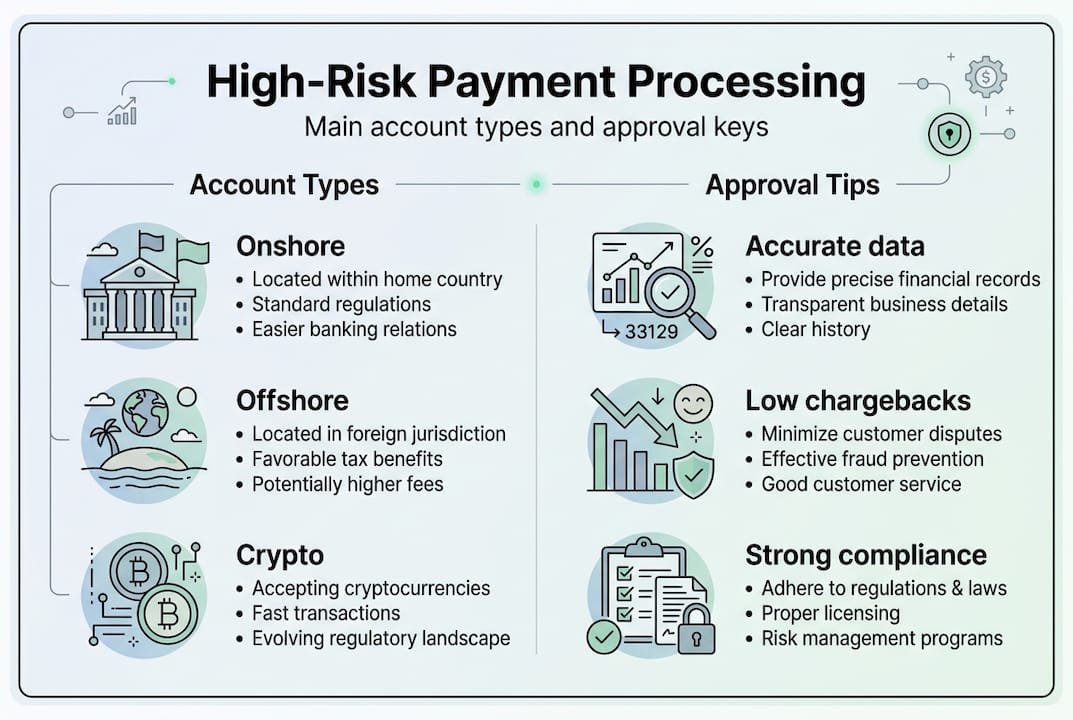
Onshore accounts operate within your home jurisdiction, offering regulatory familiarity and easier legal recourse. Offshore accounts establish processing relationships in jurisdictions with more flexible high-risk policies, often providing faster approvals but introducing currency conversion complexity.
| Setup Type | Approval Speed | Fee Range | Regulatory Oversight | Best For |
|---|---|---|---|---|
| Onshore | 4-8 weeks | 4-6% + fees | High | Established businesses with clean history |
| Offshore | 2-4 weeks | 5-8% + fees | Moderate | Startups or businesses facing domestic rejection |
| Cryptocurrency | 1-2 weeks | 0.5-1% | Evolving | Tech-savvy audiences, global transactions |
Offshore accounts carry higher risk and fees but sometimes faster settlements, whilst crypto eliminates chargebacks entirely through irreversible transactions. Each option presents distinct trade-offs.
Multi-MID setups distribute transaction volume across multiple merchant IDs, preventing any single account from hitting processing limits or chargeback thresholds. Cascading configurations automatically route failed transactions to alternative processors, maximising approval rates.
Cryptocurrency offers compelling advantages for high-risk sectors. Transactions settle instantly, eliminating chargeback risk entirely. Processing fees drop to 0.5-1% compared to 4-8% for traditional cards. Global transactions process without currency conversion headaches or international banking restrictions.
Crypto risks include price volatility affecting settlement values, evolving compliance requirements across jurisdictions, and customer education barriers. Many consumers remain unfamiliar with cryptocurrency payments, limiting adoption rates.
Traditional banks rarely serve high-risk merchants, pushing operators towards aggregator accounts that offer speed but less control, or dedicated accounts providing stability at the cost of longer approval times. Hybrid setups combining card processing with crypto acceptance increasingly represent the optimal approach.
Comparing offshore vs onshore options helps you select the structure matching your risk tolerance, and understanding benefits of offshore banking clarifies when international accounts make strategic sense.
Key compliance considerations for high-risk payment processing
Compliance never stops after initial approval. Processors conduct ongoing KYC and KYB updates, reviewing business model changes, ownership transfers, and website content modifications. They’re protecting their own relationships with card networks and banking partners.
The MATCH list represents the primary international blacklist for risky merchants. MATCH list blacklisting occurs after account termination for non-compliance, making future approvals nearly impossible. Once listed, you face five years of processing difficulties across all providers.
Core compliance steps for maintaining healthy high-risk merchant accounts:
- Maintain transparent billing descriptors that clearly identify your business
- Implement robust age verification systems for restricted content or services
- Provide detailed terms of service and refund policies prominently on your site
- Respond to customer service enquiries within 24 hours to prevent disputes
- Update processor documentation immediately when business operations change
- Conduct quarterly internal audits of transaction patterns and chargeback triggers
- Maintain rolling reserves as required without requesting early release
Site audits verify your website matches the business model described in your application. Processors flag discrepancies between approved activities and actual offerings, triggering account reviews or termination.
Clean site presentation and clear disclosure of business practices mitigate underwriting rejections, whilst empirical evidence of low chargeback history overcomes initial risk concerns.
Third-party validation services provide independent verification of your compliance posture, strengthening applications and renewal requests. These reports demonstrate proactive risk management to sceptical processors.
Proactive documentation prevents costly disruptions. Maintain organised records of all customer communications, transaction disputes, and resolution attempts. When processors request information during reviews, immediate comprehensive responses preserve account standing.
Following detailed compliance steps for approval ensures your accounts remain operational and your business continues processing without interruption.
Expert help for high-risk payment processing
Navigating account setup, compliance requirements, and chargeback management demands specialised knowledge that most business owners lack. The complexity of high-risk payment processing means mistakes cost thousands in lost revenue and months in approval delays.
Bank My Capital offers specialised payment processing solutions designed specifically for crypto, iGaming, and adult entertainment sectors. Our network of over 50 pre-vetted banking partners and EMIs provides options when traditional channels close, and our 87% approval rate demonstrates the value of expert guidance through the application process.
We provide tailored industry solutions addressing the unique challenges each sector faces, from crypto exchange compliance to iGaming licence acquisition. Our approach combines rapid onboarding timelines of two to three weeks with comprehensive legal and compliance support that keeps your accounts operational long-term.
Exploring diverse banking approaches helps you understand which structures best serve your specific business model, whether you need onshore stability, offshore flexibility, or hybrid solutions combining multiple processing channels.
Frequently asked questions
What is meant by high-risk payment processing?
High-risk payment processing refers to specialised banking setups with stricter scrutiny, higher fees, and added compliance for businesses prone to chargebacks and regulatory risk. These accounts require rolling reserves and intensive monitoring.
Why are chargebacks such a major issue for high-risk industries?
Chargebacks damage reputations, trigger fines, and quickly lead to account shutdowns when thresholds are exceeded. Visa’s threshold sits at 0.9-1%, whilst many high-risk sectors average 2-5%, creating constant pressure to maintain low dispute rates.
How do rolling reserves work in high-risk merchant accounts?
A rolling reserve holds back 5-15% of transactions for 90-180 days to cover possible losses from chargebacks or fraud. Processors release funds gradually as your account demonstrates stability.
Can cryptocurrency solve my payment processing problems?
Cryptocurrency reduces chargebacks to zero and cuts fees to 0.5-1%, but brings volatility risk and requires customer adoption. It works best as part of a hybrid approach rather than a complete replacement.
What happens if I get placed on a blacklist like MATCH?
MATCH list placement makes opening new accounts nearly impossible and severely limits payment options for five years. Prevention through compliance and chargeback management is essential.
