
Every Crypto or iGaming entrepreneur in Europe knows what it feels like to face rejection when trying to open a bank account for a high-risk business model. Banking hurdles are not just frustrating, they make daily operations nearly impossible. Offshore banking has evolved into a compliance-driven solution that meets international standards, offering real support for modern high-risk sectors like Crypto and iGaming. Discover how today’s offshore options provide the regulatory clarity, sector acceptance, and financial flexibility your business needs.
Key takeaways
| Point | Details |
|---|---|
| Modern Offshore Banking | Offshore banking is now compliant and operates within strict regulatory frameworks, catering to high-risk industries like crypto and iGaming. |
| Tailored Banking Solutions | Entrepreneurs can access specialised banking infrastructure that supports their unique transaction volumes and business models without undue rejection. |
| Enhanced Security Measures | Robust data protection and compliance standards are essential for maintaining relationships with offshore banks, including encryption and multi-factor authentication. |
| Rapid Onboarding with Compliance | Fast onboarding processes for high-risk sectors necessitate thorough compliance checks, ensuring operational integration without compromising regulatory adherence. |
What Offshore Banking Means Today
Offshore banking has evolved far beyond the secretive image many hold from decades past. Today, it refers to holding bank or investment accounts in jurisdictions outside your home country, whether that’s Malta, the UAE, Singapore, or other financial centres recognised globally.
For crypto and iGaming entrepreneurs, offshore banking isn’t about hiding money. It’s about accessing financial infrastructure that actually works for your sector.
The Core Reality
Offshore banking today means compliance first. You’re not working around regulations; you’re working with jurisdictions that have built regulatory frameworks specifically designed for high-risk industries.
The old perception was that offshore equals unregulated. That’s completely backwards now. Modern offshore financial centres operate under strict international standards including anti-money laundering rules, know-your-customer requirements, and automatic information exchange with tax authorities.
What offshore banking truly provides is access to banking infrastructure in jurisdictions where your business model isn’t automatically rejected at the application stage.
Why Crypto and iGaming Entrepreneurs Need This
Consider what happens when you apply for a business account at a traditional European bank as a crypto exchange operator or iGaming platform owner. You know the response before you ask. “High-risk sector. Application denied.”
Offshore banking solves this by placing your account in a jurisdiction where:
- Banking partners understand your sector and its legitimate operations
- Regulatory frameworks exist specifically for fintech and gaming businesses
- Your business model isn’t automatically flagged as problematic
- Compliance infrastructure is already built for your type of transaction volumes
What Modern Offshore Banking Actually Offers
Today’s offshore solutions provide far more than basic account access. They include access to specialised investment options, asset protection in stable jurisdictions, multi-currency transaction capabilities, and relationships with payment processors who understand high-risk sectors.
For iGaming platforms handling millions in monthly turnover, this means predictable processing without the constant threat of account closure. For crypto businesses navigating regulatory transitions, it means maintaining banking relationships whilst you pursue proper licensing.
To clarify the unique offerings of offshore banking for high-risk sectors, here’s how modern offshore banking compares to traditional European banks:
| Criteria | Modern Offshore Banking | Traditional European Banks |
|---|---|---|
| Sector Acceptance | Supports crypto and iGaming | Commonly rejects high-risk sectors |
| Regulatory Alignment | International compliance standards | EU local regulatory focus |
| Account Features | Multi-currency, fast settlement cycles | Limited flexibility for global business |
| Banking Relationships | Multiple jurisdictions available | Typically single home jurisdiction |
| Business Model Support | Tailored for transaction volume | Often restricts transaction intensity |
The Regulatory Environment
Offshore financial centres now operate within a global regulatory ecosystem. They report to international bodies, comply with FATCA and CRS regulations, and maintain audit trails that rival—often exceed—traditional banking standards.
This shift happened because legitimate businesses needed banking solutions. Regulators responded by creating frameworks where offshore banking could serve real business needs whilst maintaining compliance integrity.
Modern offshore banking isn’t about secrecy anymore. It’s about having banking partners who understand your business model and operate within regulated frameworks that accept you.
Key Characteristics of Today’s Offshore Banking
- Strict identity verification and beneficial ownership documentation
- Regular regulatory reporting and compliance audits
- Transparent fee structures and operational costs
- Access to multiple banking relationships across jurisdictions
- Integration with payment processing and settlement systems
- Ongoing regulatory monitoring and updated compliance requirements
Pro tip: When evaluating offshore banking options, verify that the jurisdiction maintains active regulatory oversight and publishes compliance standards publicly. This indicates a mature financial centre committed to legitimate business operations rather than opacity.
Types of Offshore Accounts and Services
Offshore accounts aren’t one-size-fits-all. Different business models need different solutions, and the right account type depends entirely on what your crypto or iGaming operation actually does.
The good news: specialised offshore accounts exist for virtually every legitimate high-risk business activity. You just need to match your needs to the right structure.
Corporate Business Accounts
Corporate accounts form the backbone of offshore banking for iGaming platforms and crypto exchanges. These are designed specifically for international business operations, not personal wealth management.

They support essential business functions like payroll processing, supplier payments, and customer settlements. Most importantly, they’re built to handle the transaction volumes and velocity that gaming and blockchain companies generate.
Corporate accounts typically require more detailed due diligence than personal accounts. You’ll need to provide articles of incorporation, beneficial ownership declarations, and detailed descriptions of your actual business operations.
Investment and Wealth Management Accounts
Beyond basic operational banking, offshore centres offer investment accounts that provide access to global markets unavailable in most European jurisdictions.
For profitable crypto companies or successful iGaming operators, these accounts enable currency diversification, hedging strategies, and access to specialised investment vehicles. You can hold multiple currencies, manage cryptocurrency reserves, and access structured investment products designed for high-net-worth operators.
Trade Finance and Cross-Border Solutions
Various account types support specialised services like trade finance, letters of credit, and structured payment arrangements. These matter significantly if your business involves international supplier payments, currency conversion, or complex settlement chains.
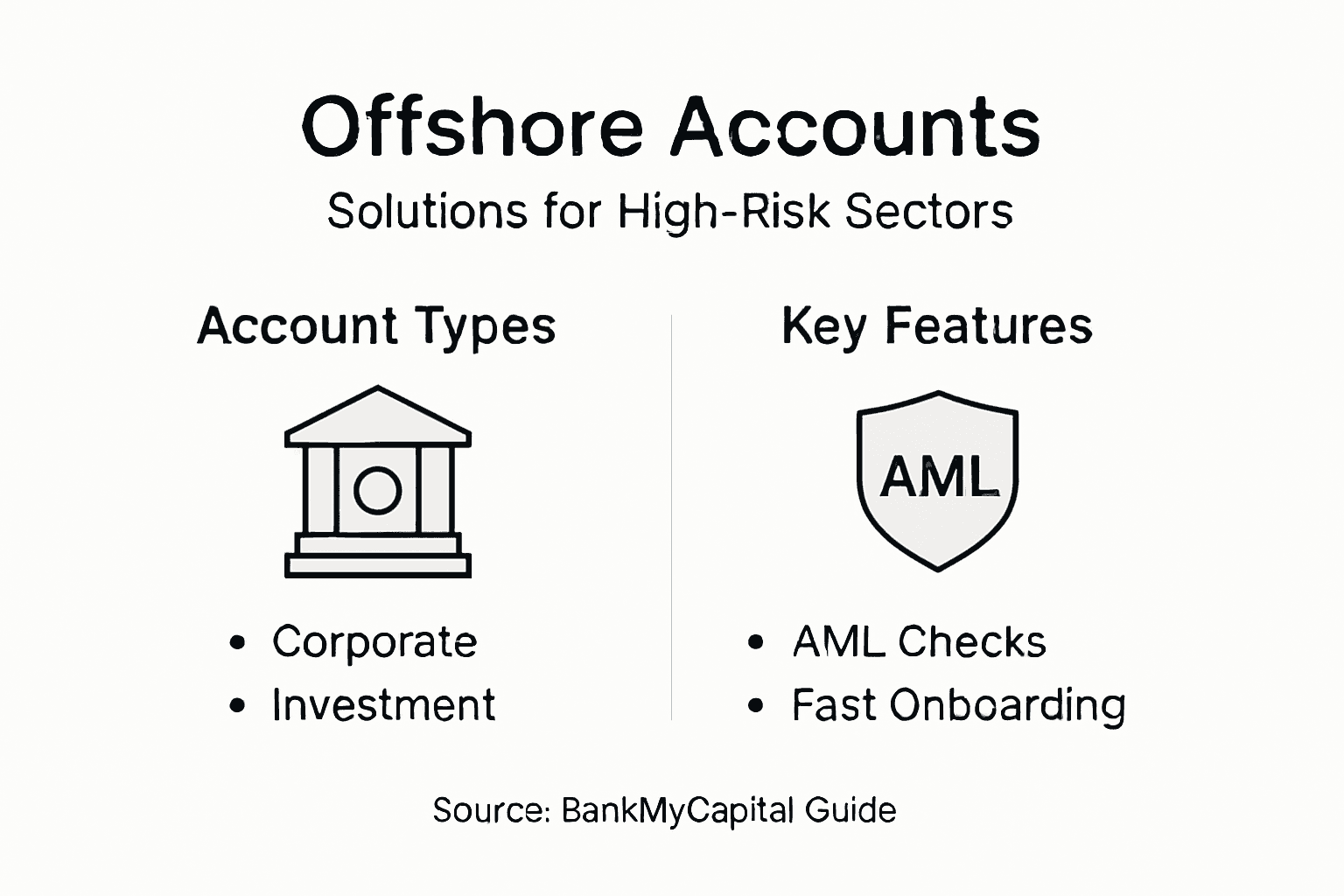
For iGaming platforms with suppliers across multiple continents, trade finance capabilities simplify vendor management and reduce settlement friction.
Payment Processing Integration
Modern offshore accounts integrate directly with payment processors. This means your account doesn’t exist in isolation—it connects to the broader payment ecosystem that actually processes customer transactions.
Your offshore account becomes the settlement hub where player funds arrive, get converted, and distribute to operator accounts or reserve holdings.
To help you choose the right offshore account for your business, here’s a practical summary of account types and their strategic benefits:
| Account Type | Best For | Key Benefit |
|---|---|---|
| Corporate Business | Crypto exchanges, iGaming platforms | Handles high volume and payroll processing |
| Investment Management | Profitable operators, holding companies | Enables currency diversification |
| Trade Finance | Suppliers, global settlements | Streamlines cross-border payments |
| Payment Processing Hub | Player funds, rapid settlements | Integrates with global payment networks |
Account Selection for Your Sector
Choosing correctly depends on your specific needs:
- Crypto exchanges typically need multi-currency corporate accounts with high transaction limits
- iGaming platforms require accounts supporting rapid settlement cycles and large player fund volumes
- Forex traders benefit from accounts with leverage, hedging tools, and currency pair access
- Hybrid operators often maintain multiple accounts across different jurisdictions for regulatory compartmentalisation
The right offshore account structure isn’t about access—it’s about having banking infrastructure built to handle your actual business operations without friction.
Key Features Across Account Types
- Enhanced privacy within regulatory compliance frameworks
- Access to multiple currencies and global markets
- Integration with international payment networks
- Support for high transaction volumes and velocity
- Specialised compliance reporting tailored to your sector
- Relationships with processors who understand your business model
Pro tip: Don’t select an account type based solely on privacy or tax advantages. Choose the account structure that matches your actual operational needs—settlement patterns, currency requirements, and transaction volume. The right fit will also simplify your ongoing compliance obligations.
Legal Requirements and Compliance Factors
Offshore banking isn’t a regulatory grey area anymore. Modern offshore jurisdictions operate under strict international frameworks that frankly rival—and often exceed—traditional banking compliance standards.
For crypto and iGaming entrepreneurs, understanding these requirements isn’t optional. They’re the foundation of whether your banking relationship survives.
Global Anti-Money Laundering Standards
Anti-money laundering (AML) compliance forms the core of modern offshore banking. Every offshore institution must implement robust systems to detect, monitor, and report suspicious transactions.
This means your account won’t be opened without thorough verification of fund origins. Offshore banks conduct enhanced due diligence, screening you against sanctions lists, and documenting where your capital comes from.
For iGaming platforms and crypto exchanges, this transparency actually protects you. Clean fund verification prevents future complications and regulatory exposure.
Counter-Terrorism Financing and Sanctions Compliance
Counter-terrorism financing (CTF) requirements ensure no funds flow to sanctioned entities or terrorist organisations. Offshore banks maintain compliance teams dedicated solely to CTF monitoring.
Your account remains subject to sanctions screening across multiple jurisdictions. If your business operates in restricted territories or processes payments from sanctioned regions, compliance failures occur quickly.
International Tax Reporting Standards
Modern offshore banking emphasises tax transparency standards like the OECD’s Common Reporting Standard (CRS) and FATCA. These require automatic information exchange with tax authorities in your home country.
You maintain tax residency documentation and declare all offshore income. The days of hidden offshore accounts are genuinely over—regulators have the infrastructure to track everything.
Customer Due Diligence Requirements
Offshore banks conduct enhanced customer due diligence (EDD) for high-risk sectors like crypto and iGaming. This goes far beyond standard identity verification.
You’ll provide:
- Detailed beneficial ownership declarations
- Comprehensive source of funds documentation
- Business operation descriptions and transaction forecasts
- Regulatory approval evidence (licences, permits)
- Ongoing transaction monitoring and reporting
Regulatory Framework Compliance
Offshore financial centres maintain supervisory oversight through regulatory bodies. The Financial Action Task Force (FATF) and OECD set international standards that jurisdictions must follow.
Compliance areas include customer due diligence, suspicious transaction reporting, record-keeping, and international cooperation with other regulators.
Ongoing Compliance Obligations
Compliance doesn’t end at account opening. Offshore banks conduct continuous monitoring of your transactions, account activity, and business operations.
You’ll submit regular reporting, update compliance documentation annually, and maintain accurate records of all transactions.
Regulatory compliance in offshore banking isn’t a barrier—it’s the requirement that separates legitimate financial infrastructure from genuinely risky jurisdictions.
Key Compliance Areas for High-Risk Sectors
- Enhanced due diligence on beneficial owners and fund sources
- Suspicious transaction monitoring and reporting
- Sanctions screening and politically exposed person checks
- Tax residency documentation and reporting
- Transaction record maintenance and audit trails
- Regular compliance certification and updates
Pro tip: Prepare comprehensive documentation of your business operations, fund sources, and regulatory approvals before applying for offshore banking. Banks approve accounts faster when compliance information arrives complete and credible, reducing back-and-forth delays.
Fast Onboarding for Crypto and iGaming
Speed matters when you’re operating a crypto exchange or iGaming platform. Every day without banking creates operational friction, payment delays, and risk exposure.
But here’s the critical reality: fast onboarding without proper compliance creates bigger problems than no onboarding at all.
The Speed vs. Compliance Balance
Traditional banks take months. Their rejection of high-risk sectors creates genuine business hardship. Offshore banking providers can accelerate this significantly, but not by cutting corners on due diligence.
Fast onboarding processes demand rigorous compliance work including identity verification, source of funds checks, sanctions screening, and comprehensive risk assessments.
The difference between legitimate fast onboarding and dangerous shortcuts is doing this work efficiently, not skipping it.
What Legitimate Fast Onboarding Actually Involves
Streamlined processes don’t mean reduced standards. They mean removing unnecessary delays whilst maintaining complete compliance rigour.
Legitimate offshore providers speed onboarding by:
- Having pre-vetted banking partnerships already in place
- Understanding high-risk sector requirements from day one
- Conducting enhanced due diligence concurrently rather than sequentially
- Maintaining standardised documentation requirements
- Leveraging technology for faster verification and screening
Timeline Expectations for Crypto and iGaming
Accelerated offshore onboarding typically takes 2-3 weeks when you arrive with complete documentation. This assumes you’ve prepared:
- Articles of incorporation and regulatory licences
- Beneficial ownership declarations
- Source of funds documentation
- Business operation descriptions
- Transaction forecasts and processing volumes
Providers working with 50+ pre-vetted banking partners can expedite placement across multiple jurisdictions.
Red Flags in Fast Onboarding Offers
Be cautious if providers promise banking without thorough compliance work. Genuinely fast processes still require:
- Comprehensive identity verification
- Enhanced due diligence on beneficial owners
- Sanctions and politically exposed person screening
- Source of funds documentation review
- Ongoing transaction monitoring capabilities
Any provider skipping these steps creates exposure for both you and the bank.
Why Crypto and iGaming Face Extended Scrutiny
Your sectors attract heightened regulatory attention globally. Enhanced due diligence protocols apply specifically to crypto exchanges and gaming operators under evolving AML regulations across the European Union and United Kingdom.
This isn’t discrimination—it’s regulatory reality. Offshore providers who understand your sector can navigate this efficiently without rushing dangerously.
The Real Cost of Improper Onboarding
Rushing compliance processes leads to regulatory breaches, account closures, substantial fines, and licence revocations. A month-long proper process beats a week-long shortcut that destroys your banking relationship.
Legitimate fast onboarding means completing full compliance requirements efficiently, not bypassing them. Speed comes from process optimisation, not corner-cutting.
Fast Onboarding Components for High-Risk Sectors
- Concurrent rather than sequential compliance workstreams
- Pre-established banking partner relationships ready for placement
- Sector-specific due diligence expertise
- Technology-enabled verification and screening
- Experienced compliance teams who understand crypto and iGaming
- Clear documentation requirements communicated upfront
Pro tip: Prepare your complete compliance documentation package before engaging offshore banking providers. Having articles of incorporation, regulatory approvals, beneficial ownership declarations, and source of funds verification ready allows providers to move you through onboarding in 2-3 weeks rather than months.
Managing Risks and Ensuring Data Security
Your offshore banking relationship handles sensitive financial data—transaction records, player information, customer payment details, and proprietary business operations. One breach destroys trust, triggers regulatory investigations, and kills your banking relationship.
Data security isn’t optional. It’s the foundation of sustainable offshore banking.
The Threat Landscape for High-Risk Sectors
Crypto and iGaming operations attract sophisticated cyberattacks. Threat actors target cryptocurrency reserves, player fund accounts, and operational data with precision.
Cybersecurity challenges expose sensitive financial data to breaches and operational risks that compromise both your business and customer trust. Ransomware, insider threats, and data exfiltration represent genuine operational dangers.
Essential Data Protection Infrastructure
Banking partners must implement robust security frameworks. This means encryption standards that protect data both in transit and at rest.
Proper offshore banking providers maintain:
- End-to-end encryption for all sensitive communications
- Multi-factor authentication across account access points
- Regular security audits and penetration testing
- Segregated systems isolating high-value accounts
- Continuous threat monitoring and incident response protocols
Access Control and Identity Management
Strict access controls prevent unauthorised account manipulation. Your offshore banking relationship should enforce role-based permissions, requiring multiple approvals for sensitive transactions.
Identity management systems verify legitimate users whilst blocking fraudulent access attempts. This protects your operational continuity and regulatory standing.
Risk Assessment and Mitigation
Proactive security requires comprehensive risk assessment. Your offshore banking provider should conduct threat identification, vulnerability assessments, and risk quantification before operational issues emerge.
Mitigation strategies must address evolving threat landscapes and regulatory requirements that shift continuously.
Compliance and Privacy Standards
Data privacy and security in banking requires encryption, access control, and continuous monitoring. Banking institutions must maintain regulatory compliance whilst protecting sensitive financial information.
Your provider should document security practices transparently, demonstrating alignment with global standards including ISO 27001 certification.
Operational Security for Your Team
Data security extends beyond the bank’s infrastructure. Your own internal practices matter significantly.
Implement these basics:
- Strong password protocols for all banking access
- Restricted employee access to sensitive financial information
- Secure communication channels for all transactions
- Regular security training for team members
- Documented procedures for data handling and storage
Incident Response and Breach Management
Even with robust security, breaches occur. Your offshore banking provider must maintain incident response procedures that notify you immediately, document everything, and coordinate regulatory reporting.
Clear incident response protocols minimise damage and preserve your licensing status.
Security isn’t a feature you add later. It’s the foundation upon which sustainable offshore banking relationships are built.
Key Security Requirements for Offshore Banking
- Swiss-grade encryption for all data transmissions
- Multi-factor authentication on all account access
- Regular penetration testing and security audits
- Segregated infrastructure for high-value accounts
- 24/7 threat monitoring and incident response
- ISO 27001 certification or equivalent standards
- Transparent security documentation and policies
Pro tip: Before selecting an offshore banking provider, request their security documentation, audit reports, and incident response procedures. Providers offering genuine Swiss-grade encryption and third-party security certifications demonstrate commitment to protecting your operational data and customer information.
Onshore vs Offshore: Building a Dual-Account Structure
Step 1: Understand What Offshore and Onshore Accounts Actually Do
Conflating offshore and onshore banking costs operators months of failed applications and rejected PSP integrations. Each serves a distinct function, and treating them as interchangeable is where most high-risk operators go wrong.
An offshore bank account is opened outside your company’s primary country of incorporation, typically in low-tax or neutral jurisdictions such as Belize, Nevis, Seychelles, Labuan, or the Cayman Islands. Offshore accounts offer high USD tolerance, strong privacy, and lenient onboarding for crypto, gambling, and adult businesses. They excel at treasury management, international settlements, and crypto off-ramp flows. What they do not offer is SEPA access, EU counterparty trust, or deposit insurance.
An onshore bank account is opened in the same country your operating entity is registered, or in a tax-cooperative jurisdiction such as Malta, Lithuania, or the Czech Republic. Onshore accounts provide SEPA and SWIFT support, stronger standing with EU clients and PSPs, and the compliance visibility required for licensed activity. The tradeoff is stricter UBO vetting, slower onboarding, and lower tolerance for crypto and adult flows.
| Feature | Offshore Account | Onshore Account |
|---|---|---|
| SEPA Access | No | Yes |
| USD Tolerance | High | Low to Medium |
| Crypto / Adult Onboarding | More Lenient | Often Rejected |
| PSP Integration | Limited | Preferred |
| Onboarding Speed | Faster | 30 to 90 Days |
| EU Counterparty Trust | Low | High |
Offshore accounts give you flexibility. Onshore accounts give you credibility. You need to know which problem you are solving before you apply.
Pro tip: Before selecting an account type, map your actual fund flows on paper. Identify where money enters, where it exits, and which currencies and regions are involved. That map determines your account structure — not your preference for privacy or cost.
Step 2: Understand How EMIs Change the Equation
Electronic Money Institutions operate in a space that traditional banking categories do not cover, and for high-risk operators they frequently represent the most practical starting point in 2026.
EMIs are legally onshore — typically EU-regulated — but operate with considerably more flexibility than traditional banks. They issue EUR IBANs and in some cases USD and GBP accounts via partner banks. They onboard faster, offer API access, and accept riskier client profiles when documentation is structured correctly. Lithuania dominates this space for crypto and PSP flows, whilst Czech Republic and Malta EMIs serve iGaming, FX, and adult operators effectively.
The practical value of an EMI is that it bridges the gap between offshore flexibility and onshore credibility. A Lithuania-based EMI gives you a SEPA-capable EUR account, faster onboarding than a traditional bank, and a compliance framework that PSPs recognise and trust — without the rigidity of a full banking relationship.
| EMI Jurisdiction | Best For | Key Advantage |
|---|---|---|
| Lithuania | Crypto, PSP flows | Fast onboarding, crypto-tolerant |
| Czech Republic | FX brokers, gaming | Multi-EMI setup, PSP integration |
| Malta | Licensed iGaming, adult | Known tolerance, EU licensing visibility |
| Cyprus | Licensed PSPs, FX | PSP integration, multi-currency |
EMIs are not a compromise between offshore and onshore — they are often the smartest standalone solution for high-risk operators who need SEPA access without traditional bank scrutiny.
Pro tip: If you are unsure whether to start with an offshore bank or an onshore EMI, default to the EMI first. It gives you an operational SEPA account faster, and you can layer an offshore USD account on top once your flows are established.
Step 3: Match Your Jurisdiction to Your Sector
Jurisdiction selection is not a tax decision. For high-risk operators it is a compliance decision, a PSP compatibility decision, and a client trust decision — all at once. Getting it wrong means slower approvals, rejected integrations, and banking relationships that collapse the moment your sector faces regulatory pressure.
For offshore accounts, match your jurisdiction to your primary use case. Belize suits crypto and FX operators managing USD inflows through an introducer. Labuan works for Asian OTC desks and crypto flows requiring detailed UBO documentation. Nevis suits treasury holding structures and privacy-focused operators. Seychelles handles adult and gambling flows but carries growing scrutiny and offers no SEPA access. Puerto Rico suits licensed entities with US connections but demands a longer onboarding process.
For onshore accounts, Lithuania remains the fastest route for crypto and PSP flows via EMIs. Czech Republic suits FX brokers and multi-EMI setups. Malta works for licensed iGaming and adult operators. Cyprus serves licensed PSPs and gaming businesses but requires a licence for smooth onboarding. Portugal suits operators seeking EU presence and residency-linked banking with lower crypto tolerance. Switzerland handles treasury and HNWI banking but is not suited for operational flows.
| Sector | Recommended Route | Reasoning |
|---|---|---|
| Crypto OTC | Lithuania EMI + Belize offshore USD | Crypto-tolerant EMI paired with treasury stability |
| iGaming | Malta or Czech EMI + Swiss reserve | PSP integration, licensing visibility, reputation |
| Adult | Czech EMI + Belize or Nevis bank | Flow separation with privacy layer |
| Forex | Cyprus EMI + offshore pairing | PSP integration and multi-currency flows |
| Affiliate | EMI + crypto-friendly PSP | Lightweight structure with SEPA focus |
The jurisdiction that worked for another operator in your sector is not automatically right for yours. Your UBO nationality, corporate structure, and fund flow determine which jurisdictions will actually approve you.
Pro tip: Before targeting a specific jurisdiction, verify that your UBO’s nationality does not create automatic complications. UBOs from certain countries face blanket restrictions regardless of how clean their documentation is. Resolve this at the planning stage, not after submission.
Step 4: Build a Dual-Account Structure That Protects Your Operations
Relying on a single banking relationship is the most common and most damaging mistake high-risk operators make. When one provider exits your sector — and in 2026 this happens regularly — a single-account business loses its ability to receive payments, pay suppliers, and operate entirely.
A dual-account structure separates your flows across two or more accounts in different jurisdictions, giving you operational resilience, compliance clarity, and currency coverage simultaneously. The structure does not need to be complex. A Lithuania EMI handling SEPA and PSP flows, paired with a Belize offshore account managing USD reserves, covers the core requirements for most crypto, FX, and adult operators.
For more complex operations, expand the structure to include a dedicated OTC desk for crypto off-ramp, a Swiss reserve account for treasury, and a licensed onshore bank for licensing visibility. Each layer serves a specific function and can operate independently if another layer is disrupted.
| Purpose | Provider Type | Jurisdiction |
|---|---|---|
| Client payments and SEPA | EMI | Lithuania |
| Crypto off-ramp | OTC desk | Switzerland |
| USD reserves and treasury | Offshore bank | Belize |
| Licensing presence | Onshore bank | Czech Republic or Malta |
A dual-account structure is not a luxury for large operators. It is the minimum viable setup for any high-risk business that cannot afford to stop receiving payments overnight.
Pro tip: When building a dual-account structure, confirm that your chosen providers do not share the same parent institution or banking correspondent. Two accounts at institutions that use the same correspondent bank offer less protection than they appear to — a single de-risking decision can affect both simultaneously.
Step 5: Prepare Documentation That Works Across Both Account Types
The most carefully planned banking structure fails if the compliance file does not support it. Offshore and onshore institutions have different documentation standards, and submitting the wrong pack to the wrong institution wastes months and creates rejection records that complicate future applications.
For offshore banks, prepare a valid passport, proof of address, certificate of incorporation, memorandum and articles of association with share registry, a concise business model description, UBO declaration, and apostilled or notarised corporate documents. Source of funds documentation is optional but strengthens your application significantly.
For onshore banks and EMIs, the requirements are considerably more detailed. Add a notarised passport, UBO structure chart, live website with legal imprint and KYC/AML policy, flow-of-funds diagram, monthly volume forecasts, KYT software confirmation for crypto operations, sample invoices or client contracts, and a UBO source of funds statement. For EU EMIs, expect a compliance interview via video call as part of standard onboarding.
| Document | Offshore Bank | Onshore EMI |
|---|---|---|
| Notarised Passport | Sometimes Optional | Mandatory |
| UBO Source of Wealth | Recommended | Always Required |
| KYT / AML Policy | Rarely Required | Mandatory for Crypto |
| Flow of Funds Diagram | Optional | Required |
| Compliance Interview | Rare | Common |
| Apostille | Frequently Required | Often Required |
Your compliance file is not just documentation — it is the narrative that tells a bank your business is legitimate, structured, and worth onboarding. A weak file produces rejections regardless of how clean your actual operations are.
Pro tip: Build a single master compliance file that contains every document both account types require, then create two submission packs from it — one stripped down for offshore and one complete for onshore. This prevents the common mistake of submitting an incomplete pack because you assumed requirements overlapped more than they do.
Securing Offshore Payment Processing
How to secure offshore payment processing: the compliance foundation
Before you approach a single acquirer, you need to understand what offshore acquiring actually requires. It changes the jurisdiction of your acquiring bank. It does not exempt you from card scheme rules, AML obligations, or KYC requirements. Businesses that approach this thinking they are bypassing compliance end up rejected, held, or terminated.
Here is what you need in place before applying:
- KYC and AML documentation. Every legitimate offshore acquirer will verify beneficial ownership, corporate structure, and source of funds. Prepare certified copies of incorporation documents, shareholder registers, and director ID for all parties holding more than 10% ownership. No-KYC offshore providers are a red flag, not a feature.
- Website compliance. Your site must display accurate business descriptors, clear refund and cancellation policies, terms and conditions, and contact information. Acquirers review your site during underwriting as carefully as your financials.
- Accurate business descriptors. The name customers see on their bank statement must match your registered entity or trading name. Mismatches drive chargebacks and acquirer disputes.
- Processing history. If you have prior processing statements, include them. Six months of clean history dramatically strengthens your application. If you are starting fresh, explain your projected volumes with evidence.
- Jurisdiction alignment. The offshore jurisdiction you choose should match your business activity and licensing. A Malta-licensed iGaming operator and a Cayman Islands forex broker have different optimal acquiring jurisdictions. Compliance alignment reduces underwriting friction significantly.
Pro Tip: Work with a compliance-focused consultancy before submitting your first application. A single rejected application on record with a card scheme creates friction for every subsequent application.
A solid underwriting process evaluates KYC, operational risk controls, and your dispute management history. Aligning your actual offer with your stated fulfilment terms reduces disputes before they happen, which is precisely what keeps your processing relationship stable long term.
Applying for offshore processing: the step-by-step process
Once your documentation is in order, the application process itself becomes far more manageable. Here is how it works in practice:
- Prepare a complete merchant application package. Include company documents, processing history, website URL, estimated monthly volumes, average transaction values, and your chargeback ratio if applicable. Incomplete applications are the single biggest cause of delays. Underwriters request the same documents multiple times, extending timelines unnecessarily.
- Submit to pre-vetted acquirers in the right jurisdiction. Not every acquirer accepts every high-risk vertical. Match your vertical to acquirers who have an approved appetite for it. Sending a crypto exchange application to an acquirer with no crypto programme wastes weeks.
- Navigate the underwriting period. Standard offshore underwriting takes 2 to 6 weeks depending on jurisdiction, business complexity, and how promptly you respond to document requests. Respond to every request within 24 hours.
- Integration and technical setup. Once approved, integrate via the acquirer’s API or hosted payment page. Configure your fraud tools including 3D Secure 2 (3DS2), AVS, and CVV checks during this phase.
- Testing by geography and card type. Before going live, run descriptor and authentication tests across the key geographies you plan to serve and across Visa and Mastercard separately. Authentication behaviour varies significantly by region.
- Staged rollout. Begin with capped volumes. Monitor authorisation rates, fraud ratios, and chargeback rates before opening full traffic.
| Phase | Typical timeline | Key risk |
|---|---|---|
| Document preparation | 1–2 weeks | Incomplete or uncertified documents |
| Underwriting review | 2–6 weeks | Slow document responses |
| Technical integration | 1–2 weeks | 3DS2 configuration errors |
| Testing and go-live | 1 week | Untested geographies and card types |
Pro Tip: Build a dedicated application tracker with document versions, submission dates, and underwriter contacts. It sounds administrative, but it cuts response lag in half when follow-ups are needed.
Understanding your payment processing setup requirements before you begin saves significant time during this phase.

Technical strategies to reduce fraud risks
Fraud prevention in offshore payment processing is not a single tool. It is a layered system. Each layer addresses a different attack vector, and they work better together than any one does alone.
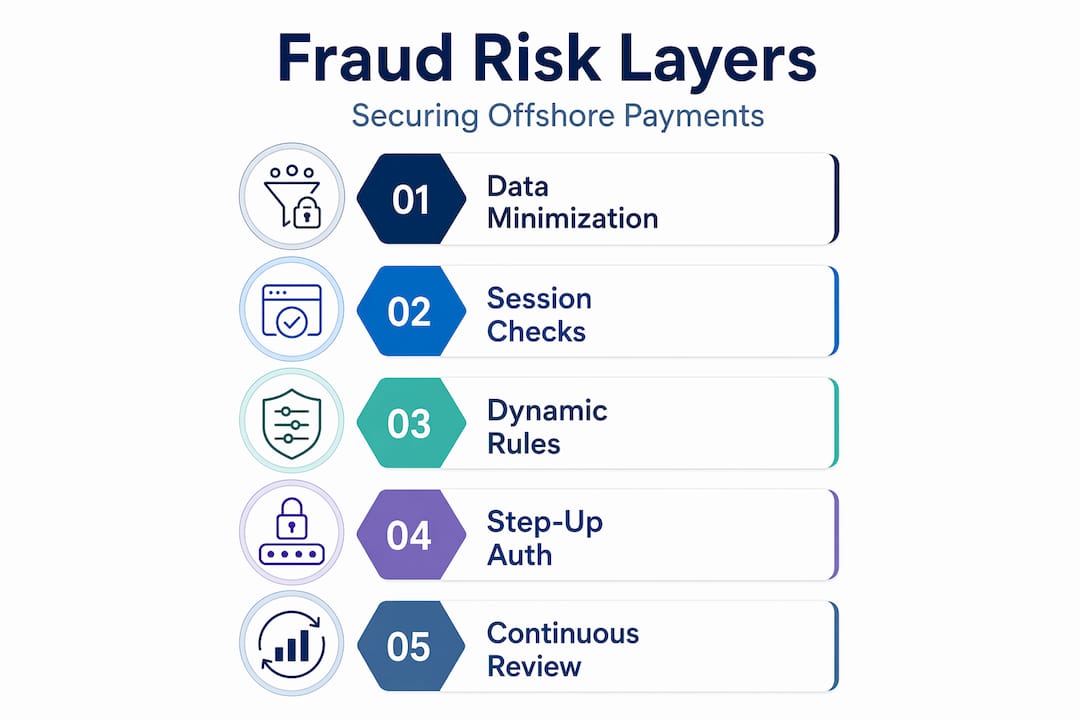
The first layer is data minimisation. Use hosted payment fields or a gateway-managed checkout so that raw card numbers never touch your servers. Tokenisation and hosted payment pages reduce your PCI compliance scope dramatically and remove your systems as a target for card data theft. If card data does not pass through your infrastructure, it cannot be stolen from it.
The second layer is authentication. Configure 3DS2 correctly for every market you serve. Pair it with AVS and CVV checks. These fraud prevention tools are well established and effective, but the configuration matters as much as the tools themselves. An overly aggressive AVS rule in a market where billing address formats differ from the US standard will kill legitimate transactions.
The third layer is session intelligence. This is where most high-risk businesses leave significant fraud protection on the table.
- Device fingerprinting. Identifies devices across sessions even when users clear cookies or switch browsers.
- Behavioural biometrics. Analyses how users interact with your checkout: typing rhythm, mouse movement, and navigation patterns. Fraudsters behave differently from genuine customers.
- Velocity checks. Flag multiple transactions from the same device, IP, or card within short windows.
- Real-time risk scoring. Combining transaction data with session signals produces far more accurate fraud scores than transaction data alone.
Pro Tip: Do not apply the same friction level to all transactions. Step-up authentication selectively targets high-risk orders. Challenging every transaction equally increases false declines and damages conversion rates without meaningfully improving security.
The most effective offshore payment security strategy integrates fraud tool configuration, session intelligence, and continuous threshold tuning into a single controls loop. Set it once and it degrades. Tune it continuously and it improves.
Life after approval: ongoing management
Approval is not the finish line. What happens next determines whether your offshore processing relationship remains stable for years or collapses within months.
Rolling reserves are common in high-risk offshore arrangements. Acquirers typically hold 5% to 15% of your processing volume in reserve for 90 to 180 days to cover potential chargebacks. Understand your reserve terms before you sign. Poor cash flow planning around rolling reserves creates real operational problems for growing businesses.
The table below outlines the key ongoing obligations after your offshore merchant account is live:
| Obligation | Frequency | Why it matters |
|---|---|---|
| Fraud and chargeback review | Weekly | Catch deteriorating ratios before scheme thresholds are breached |
| Fraud rule tuning | Monthly | Transaction patterns shift; static rules degrade |
| 3DS2 performance review | Monthly | Authentication rates vary by card brand and region |
| KYC/AML document updates | As changes occur | UBO changes, new licences, and address updates must be reported |
| PCI DSS assessment | Annual | Required for continued processing |
Multi-currency settlement is another post-approval priority. Settling in the currency of your customer’s card reduces conversion friction and improves authorisation rates. It also distributes your currency risk across multiple currencies rather than concentrating it in one. Consider a multi-currency business account specifically designed for high-risk operators to manage this efficiently.
The businesses that sustain stable offshore processing are the ones that treat compliance monitoring as an ongoing operating function, not a one-time setup task. Review your payment processing best practices periodically to stay current with evolving standards.
Unlock Reliable Offshore Banking Solutions Tailored for High-Risk Sectors
Navigating the complex world of offshore banking for crypto, iGaming, and other high-risk industries demands more than just access. It requires trusted partnerships, strict regulatory compliance, and swift onboarding adapted to your business needs. If you face frequent rejections or delays from traditional banks due to your sector’s inherent risks, you understand the critical importance of compliance-first banking that truly supports your operational realities.
At BankMyCapital, we specialise in overcoming these challenges by connecting you with over 50 pre-vetted banking partners across European Union and offshore jurisdictions. Our expertise ensures you receive the right corporate or investment account tailored exactly to your transaction volumes and settlement requirements. Benefit from high approval rates with fully transparent processes and top-tier security protocols including Swiss-grade encryption.
Don’t let banking obstacles stifle your growth. Explore our comprehensive tailored banking solutions and get started on fast onboarding with robust compliance support. Discover why crypto and iGaming entrepreneurs trust us to reduce rejection risk and secure optimal banking relationships. Visit BankMyCapital today and take the confident step towards seamless offshore banking designed for your high-risk business.
Recommended
- Offshore vs Onshore Bank Accounts
- How to Choose Best Offshore Banks for Crypto & Gambling in 2025
- SEPA Accounts for High-Risk Industries: What to Know in 2025
- How to Open a Business Bank Account for High-Risk Industries in 2025
Frequently asked questions
What is offshore banking?
Offshore banking refers to holding bank or investment accounts in jurisdictions outside your home country. It provides access to specialised financial services tailored for high-risk sectors like crypto and iGaming.
How does offshore banking benefit crypto and iGaming entrepreneurs?
Offshore banking offers access to banking infrastructure that understands and supports high-risk sectors. It provides essential services like multi-currency accounts, compliance with regulatory frameworks, and enhanced transaction processing capabilities without the rejection common in traditional banks.
What types of accounts can businesses set up offshore?
Businesses can set up various types of offshore accounts, including corporate business accounts, investment and wealth management accounts, trade finance accounts, and payment processing hubs. Each type is designed to meet specific operational needs and transaction volumes.
What are the compliance requirements for offshore banking?
Offshore banks require enhanced due diligence compliance tailored to high-risk sectors. This includes verifying beneficial ownership, checking the source of funds, conducting regular reporting, and maintaining detailed transaction records in line with global anti-money laundering and tax reporting standards.
