
High-risk businesses face mounting pressure as account closures surged 44% in the UK during 2024, signalling an intensifying crisis for crypto, iGaming, Forex, and adult entertainment sectors. Traditional banks increasingly reject these industries, citing fraud exposure and regulatory burdens. Offshore banking emerges as a strategic alternative, offering tailored solutions that combine legal tax optimisation, asset protection, and regulatory compliance. This guide explains why offshore banking has become essential for high-risk business owners navigating hostile banking environments in 2026, revealing practical pathways to financial stability and growth.
Key takeaways
| Point | Details |
|---|---|
| High-risk sectors face elevated scrutiny | Traditional banks close accounts frequently due to reputational concerns and regulatory pressure |
| Offshore banking enables tax optimisation | Legal frameworks in stable jurisdictions reduce tax burdens whilst maintaining compliance |
| Asset protection is a core advantage | Offshore accounts shield capital from currency volatility and political instability |
| Jurisdiction selection is critical | Matching your business risk profile to the right offshore location determines operational success |
| Compliance expertise is non-negotiable | Understanding KYC and AML frameworks prevents account closures and regulatory penalties |
Challenges high-risk businesses face with traditional banks
Mainstream financial institutions categorise businesses as high-risk when they exhibit elevated chargeback rates 2-5x higher than conventional sectors, particularly in adult entertainment and gaming platforms. Banks globally deny high-risk businesses because of increased exposure to fraud, chargebacks, and regulatory scrutiny that threatens their own compliance standings. Crypto exchanges, iGaming operators, Forex brokers, and adult content platforms bear the brunt of these restrictions.
You encounter specific obstacles when approaching traditional banks. Documentation requirements multiply exponentially, approval timelines stretch from weeks to months, and fees escalate without guarantees of account approval. Many banks reject high-risk businesses outright, citing reputational damage concerns and internal risk management policies that prioritise conservative portfolios over innovative sectors.
“The 44% surge in account closures reflects a fundamental shift in banking appetite for high-risk industries, forcing business owners to seek alternative financial infrastructure.”
Practical challenges extend beyond initial rejection. Even when you secure accounts, banks impose transaction limits, freeze funds during routine compliance reviews, and terminate relationships with minimal notice. These disruptions cripple operational continuity for businesses requiring seamless payment processing and international capital flows. Understanding how to open bank account high risk businesses navigate these barriers becomes essential for survival.
Regulatory demands compound these difficulties. Anti-money laundering frameworks, know-your-customer protocols, and enhanced due diligence procedures create administrative burdens that traditional banks often deem too costly for high-risk clients. The perception of unstable business models in emerging sectors like cryptocurrency further discourages banks from rejecting high-risk firms, leaving legitimate operators struggling to access basic financial services.
How offshore banking benefits high-risk business owners
Offshore banking facilitates legal tax optimisation by leveraging favourable tax regimes specifically designed to attract international business. You reduce tax liabilities through legitimate structures whilst maintaining full compliance with reporting obligations in your home jurisdiction. Jurisdictions like Liechtenstein and the Cayman Islands offer zero corporate tax rates combined with robust regulatory frameworks that satisfy international standards.
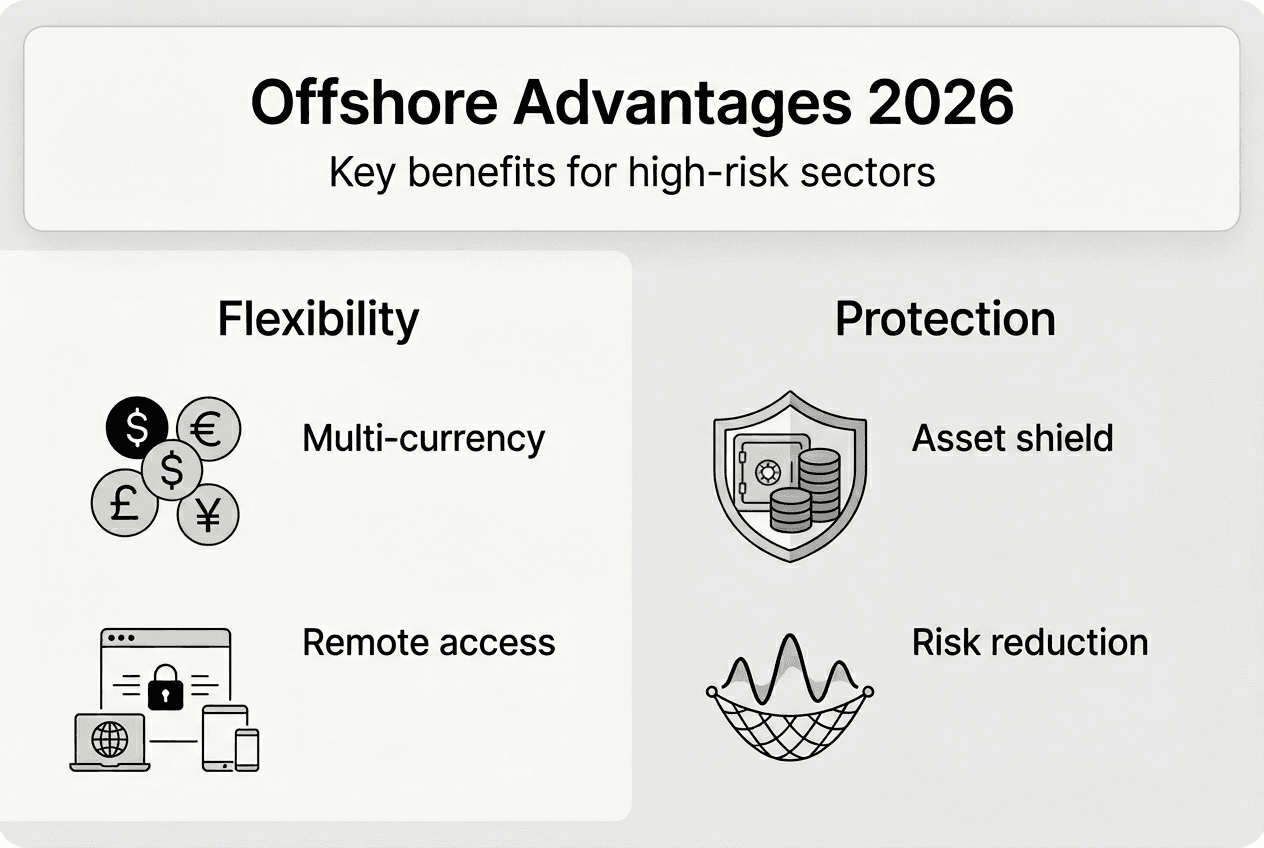
Asset protection represents a critical advantage. Offshore accounts in stable countries shield your capital against currency volatility and political risks that threaten domestic holdings. When regional instability strikes or currencies depreciate rapidly, your offshore assets remain insulated. This geographical diversification protects wealth accumulated through high-risk ventures from localised economic shocks.

Financial flexibility expands dramatically through offshore banking. Offshore banks offer specialised investment products unavailable domestically, including crypto custody services, forex trading platforms, and multi-currency accounts tailored for international operations. You gain access to global capital markets, enabling sophisticated hedging strategies and investment opportunities that domestic banks restrict for high-risk clients.
Pro Tip: Evaluate offshore jurisdictions based on three pillars: political stability scores, tax treaty networks, and regulatory alignment with your specific industry sector to maximise both protection and operational efficiency.
Jurisdictional advantages differ significantly. The Cayman Islands excels in financial services infrastructure with no direct taxation and strong privacy protections. Liechtenstein combines European Union banking standards with Swiss-level confidentiality, appealing to businesses requiring both legitimacy and discretion. These offshore banking solutions enable high-risk industries to operate with financial resilience unavailable through traditional channels.
These strategic benefits enhance growth potential. You deploy capital more efficiently, protect profits from adverse domestic conditions, and access banking partners who understand high-risk sector dynamics. Offshore crypto banking setup becomes particularly valuable for cryptocurrency businesses facing hostile regulatory environments in major economies, providing compliant pathways to institutional-grade financial services.
Choosing the right offshore banking jurisdiction and complying with regulations
Selecting the appropriate jurisdiction requires matching your business profile to specific regulatory and operational characteristics. The table below compares popular offshore banking locations relevant to high-risk industries:
| Jurisdiction | Corporate Tax Rate | Licensing Complexity | Political Stability | Primary Compliance Challenge |
|---|---|---|---|---|
| Cayman Islands | 0% | Moderate | Very High | Substance requirements |
| Curacao | 2-3% | Low (consolidated gaming) | High | Transaction monitoring |
| Liechtenstein | 12.5% | High | Very High | EU regulatory alignment |
| Malta | 5% (effective) | Moderate | High | MiFID II compliance |
The choice of offshore jurisdiction must align with your tax objectives, regulatory tolerance, and political stability requirements to ensure sustainable operations. Curacao hosts hundreds of active operators in online gambling, offering consolidated licences covering diverse gaming segments that simplify regulatory compliance for iGaming businesses.
Compliance demands have intensified globally. Offshore banking adheres to international standards like Common Reporting Standard, Foreign Account Tax Compliance Act, and anti-money laundering frameworks, eliminating historical opacity. You must prepare for rigorous due diligence regardless of jurisdiction selection.
Follow these compliance steps to maintain offshore banking eligibility:
- Implement robust know-your-customer procedures that exceed minimum regulatory standards, documenting beneficial ownership and source of funds comprehensively.
- Maintain transparent corporate structures with clear audit trails connecting business activities to banking transactions, avoiding complex arrangements that trigger enhanced scrutiny.
- Adhere strictly to Common Reporting Standard and Foreign Account Tax Compliance Act reporting obligations, filing accurate disclosures in all relevant jurisdictions to prevent penalties.
- Conduct regular compliance audits using independent specialists familiar with high-risk sector requirements, identifying vulnerabilities before regulators do.
- Establish ongoing monitoring systems that flag suspicious transactions automatically, demonstrating proactive anti-money laundering commitment to banking partners.
Pro Tip: Engage consultants with proven track records in your specific high-risk industry and target offshore jurisdiction, as generic compliance advice often misses sector-specific regulatory nuances that trigger account closures.
Transparency has become mandatory. Historical perceptions of offshore banking as secretive wealth hiding no longer reflect reality. Modern offshore jurisdictions compete on regulatory credibility, offering compliant frameworks that satisfy both business needs and international oversight requirements. Understanding offshore banking setup guide requirements prevents costly mistakes during initial establishment.
Jurisdiction selection impacts operational flexibility profoundly. Curacao’s gaming-friendly regulations contrast sharply with Liechtenstein’s conservative approach suited to institutional clients. Comparing offshore vs onshore bank accounts reveals how jurisdiction choice determines transaction limits, currency options, and banking partner availability for your specific business model.
Practical steps to set up and optimise offshore banking for your high-risk business
Implementing offshore banking requires methodical preparation and strategic execution. Follow these essential steps:
- Select your target jurisdiction based on tax efficiency, regulatory alignment, and banking infrastructure suited to your industry sector and transaction volumes.
- Prepare comprehensive documentation including corporate certificates, beneficial ownership declarations, business plans, financial projections, and source of funds evidence.
- Engage compliance experts specialising in high-risk sectors who understand both offshore banking requirements and your specific industry regulatory landscape.
- Open accounts with multiple banking partners to diversify counterparty risk and ensure operational continuity if one relationship encounters difficulties.
- Integrate payment processing solutions compatible with offshore account structures, ensuring seamless customer transaction flows and multi-currency capabilities.
Understanding KYC requirements proves fundamental to navigating high-risk business banking challenges successfully. Documentation standards vary significantly between jurisdictions, but all demand verifiable proof of legitimate business operations and transparent ownership structures.
The comparison below illustrates typical differences between onshore and offshore banking for high-risk businesses:
| Requirement Category | Onshore Banking | Offshore Banking |
|---|---|---|
| Initial approval duration | 8-16 weeks | 3-6 weeks |
| Documentation volume | Extensive | Very extensive |
| Monthly maintenance fees | £200-500 | £400-1,200 |
| Transaction monitoring intensity | High | Very high |
| Multi-currency account availability | Limited | Standard |
High-risk businesses face higher fees, longer approval times, and stricter documentation requirements than mainstream companies, making preparation and professional guidance essential for success. Offshore banking amplifies these demands but delivers superior services tailored to complex operational needs.
Pro Tip: Maintain meticulous record-keeping systems that track every transaction, customer interaction, and compliance milestone, enabling rapid responses to banking partner inquiries and reducing account closure risks dramatically.
Common pitfalls derail offshore banking initiatives. Underestimating documentation rigour leads to application rejections and wasted fees. Failing to understand anti-money laundering and know-your-customer rules triggers immediate account terminations. Choosing jurisdictions based solely on tax rates without considering regulatory compatibility creates unsustainable structures requiring costly migrations.
Partnering with experienced banking facilitators who specialise in high-risk sectors accelerates success. These professionals navigate regulatory complexities, negotiate favourable terms with banking partners, and provide ongoing compliance support that prevents relationship breakdowns. Reviewing a high-risk banking checklist before initiating setup identifies gaps in your preparation.
Ongoing monitoring and adaptation remain critical. Regulatory landscapes evolve continuously, requiring periodic reviews of compliance procedures and banking arrangements. Understanding how to pass bank compliance for high-risk accounts ensures sustained access to financial services as standards tighten. Proactive engagement with banking partners demonstrates commitment to compliance, building trust that withstands regulatory scrutiny and market volatility.
Explore tailored offshore banking solutions for high-risk industries
BankMyCapital delivers specialised guidance for securing your high-risk business banking infrastructure in 2026’s challenging regulatory environment. Our proven strategies leverage relationships with over 50 pre-vetted banking partners across European Union and offshore jurisdictions, achieving 87% approval rates for crypto, iGaming, Forex, and adult entertainment clients. We provide comprehensive compliance assistance, strategic jurisdiction selection, and multi-currency account setups tailored to your operational requirements.
Our expertise extends beyond account opening. We navigate complex regulatory frameworks, liaise with banking partners throughout the approval process, and deliver ongoing support that maintains banking relationships long-term. Whether you require offshore banking solutions for cryptocurrency operations or iGaming payment processing, our consultants bring sector-specific knowledge that generic banking advisors lack. Rapid onboarding timelines of two to three weeks enable you to establish financial infrastructure quickly, minimising operational disruptions whilst maximising compliance confidence.
Frequently asked questions about offshore banking for high-risk businesses
How long does offshore banking setup take for high-risk businesses?
Typical offshore banking setup requires three to six weeks from initial application to account activation, depending on jurisdiction complexity and documentation completeness. Expedited processes exist in certain jurisdictions for well-prepared applicants with comprehensive compliance documentation. Engaging specialists familiar with opening bank accounts for high-risk businesses reduces timelines significantly through streamlined preparation and banking partner relationships.
Does offshore banking actually mitigate financial risks for high-risk sectors?
Offshore banking mitigates specific risks including currency devaluation, political instability, and domestic banking hostility towards high-risk industries. Geographical diversification protects assets from localised economic shocks whilst access to specialised banking partners ensures operational continuity. However, offshore banking introduces compliance complexity and higher costs that require professional management to realise protective benefits fully.
Are offshore banking jurisdictions truly transparent in 2026?
Modern offshore jurisdictions maintain transparency through Common Reporting Standard, Foreign Account Tax Compliance Act, and anti-money laundering compliance that matches or exceeds domestic standards. Historical secrecy has been replaced by regulated frameworks requiring beneficial ownership disclosure and automatic information exchange with tax authorities. Legitimate offshore banking operates within international regulatory norms, not outside them.
What know-your-customer requirements apply to offshore accounts?
Offshore banks demand comprehensive documentation including corporate certificates, beneficial ownership declarations, proof of address, source of funds evidence, business plans, and financial projections. Enhanced due diligence applies to high-risk sectors, requiring detailed explanations of business models, customer bases, and transaction patterns. Following an offshore crypto banking guide ensures you prepare appropriate documentation for sector-specific requirements.
How do recent regulations impact offshore banking for crypto and iGaming?
Recent regulatory developments including Markets in Crypto-Assets Regulation and enhanced anti-money laundering directives increase compliance demands but simultaneously legitimise offshore banking for properly structured high-risk businesses. Jurisdictions adapting regulations to accommodate crypto and iGaming attract compliant operators whilst eliminating non-compliant competitors. Regulatory evolution favours professionally managed offshore banking relationships over informal arrangements, creating advantages for businesses investing in robust compliance infrastructure.
