
Regulatory pressure across the US, EU, and UK is pushing crypto businesses towards offshore banking solutions at an unprecedented rate. UK banks alone blocked 40% of crypto transactions in recent months, forcing firms to seek alternatives. This guide explores why offshore banking has become essential for high-risk crypto operations, covering regulatory drivers, top jurisdictions, compliance frameworks, and practical operational advantages that make offshore solutions indispensable for navigating today’s complex financial landscape.
Key takeaways
| Point | Details |
|---|---|
| Regulatory pressure drives offshore adoption | Tightening US, EU, and UK crypto regulations force businesses to seek jurisdictions with clearer frameworks and banking access. |
| Cayman Islands and UAE lead crypto banking | These jurisdictions offer tax neutrality, robust legal structures, and FATF-compliant frameworks tailored for crypto operations. |
| Compliance and custody are critical | Strategic AML/KYC implementation and diversified custody methods mitigate regulatory and operational risks in offshore banking. |
| Operational flexibility enhances business growth | Offshore banking provides multi-currency capabilities, faster transactions, and broader payment processing unavailable onshore. |
| Expert guidance accelerates setup success | Specialist advisors familiar with crypto compliance and jurisdiction-specific requirements ensure faster approvals and sustainable operations. |
The regulatory landscape pushing crypto business offshore
The global regulatory environment for crypto has transformed dramatically. Major jurisdictions now impose stricter compliance requirements that make traditional banking relationships increasingly difficult for crypto businesses. The US GENIUS Act introduced enhanced reporting obligations for digital asset transactions, whilst the EU’s Markets in Crypto-Assets (MiCA) regulation established comprehensive licensing and operational standards. The UK has focused intensely on crypto sanctions enforcement and anti-money laundering controls.
These regulatory shifts create tangible barriers. UK banks blocked 40% of crypto transactions recently, reflecting broader institutional reluctance to serve crypto clients. Traditional financial institutions increasingly view crypto businesses as high risk, leading to account closures, frozen funds, and outright application rejections. The compliance burden has grown exponentially, with firms needing dedicated legal teams just to maintain onshore banking relationships.
Consequences extend beyond simple access issues. Businesses face:
- Limited banking options with high fees and restrictive terms
- Constant compliance audits consuming operational resources
- Risk of sudden account termination disrupting cash flow
- Inability to process certain transaction types or volumes
- Geographic restrictions on customer bases and markets
This regulatory tightening paradoxically coexists with surging offshore crypto adoption. Regulatory pressure in major jurisdictions pushes participants towards jurisdictions offering clearer frameworks and more accommodating banking infrastructure. Cayman Islands, UAE, Switzerland, and Singapore have emerged as preferred destinations, each developing sophisticated regulatory regimes that balance oversight with innovation support.
The migration offshore isn’t about evading regulation. It’s about accessing jurisdictions where crypto-specific frameworks exist, where banks understand digital asset business models, and where regulatory clarity enables sustainable operations. For businesses exploring compliant solutions, understanding crypto business banking EU compliance 2026 alongside offshore banking explained for high-risk sectors provides essential context for strategic planning.
Why offshore jurisdictions like the Cayman Islands attract crypto businesses
The Cayman Islands has established itself as a premier offshore crypto banking hub through deliberate regulatory development and infrastructure investment. Three core features drive this attraction: tax neutrality, legal certainty, and world-class financial infrastructure. The jurisdiction offers tax neutrality, robust legal framework, and stable political climate, creating an environment where crypto businesses can operate efficiently without complex tax compliance burdens.

Legal certainty stems from the Virtual Asset (Service Providers) Act 2020, amended in 2024 to strengthen compliance standards. The Virtual Asset Act aligns Cayman with FATF standards, providing clear licensing requirements and operational guidelines for crypto businesses. This regulatory clarity contrasts sharply with ambiguous frameworks in many onshore jurisdictions, where businesses operate in grey areas vulnerable to sudden regulatory shifts.
The numbers speak volumes. Cayman hosts approximately 70% of offshore investment funds globally, with crypto-native funds representing a rapidly growing segment. The jurisdiction’s mature financial services ecosystem includes experienced legal counsel, audit firms, and banking partners familiar with digital asset operations. This expertise ecosystem reduces friction in setup and ongoing compliance.
| Jurisdiction | Regulatory Framework | Tax Environment | Infrastructure Quality | Crypto Ecosystem Maturity |
|---|---|---|---|---|
| Cayman Islands | VASP Act 2020 (amended 2024), FATF-compliant | Zero corporate, income, capital gains tax | Excellent: mature financial services sector | High: 70% of offshore funds, growing web3 hub |
| UAE (Dubai) | VARA framework, ADGM regulations | Zero corporate tax (with conditions) | Excellent: modern fintech infrastructure | High: rapidly growing crypto free zones |
| Switzerland | DLT Act, FINMA oversight | Moderate: cantonal variations | Excellent: established banking sector | High: Crypto Valley ecosystem |
| Singapore | Payment Services Act | Moderate: 17% corporate tax | Excellent: advanced digital infrastructure | High: established fintech hub |
For businesses evaluating options, crypto banking setup with BankMyCapital streamlines the process across multiple jurisdictions. Understanding best offshore banks for crypto helps identify institutions aligned with specific business models and transaction volumes.
Pro Tip: Choose jurisdictions based on compliance reputation and ecosystem depth, not just tax benefits. A jurisdiction with clear regulations and experienced service providers accelerates setup and reduces long-term operational friction, whilst purely tax-driven choices often create compliance headaches that offset initial savings.
Navigating compliance and asset protection in offshore crypto banking
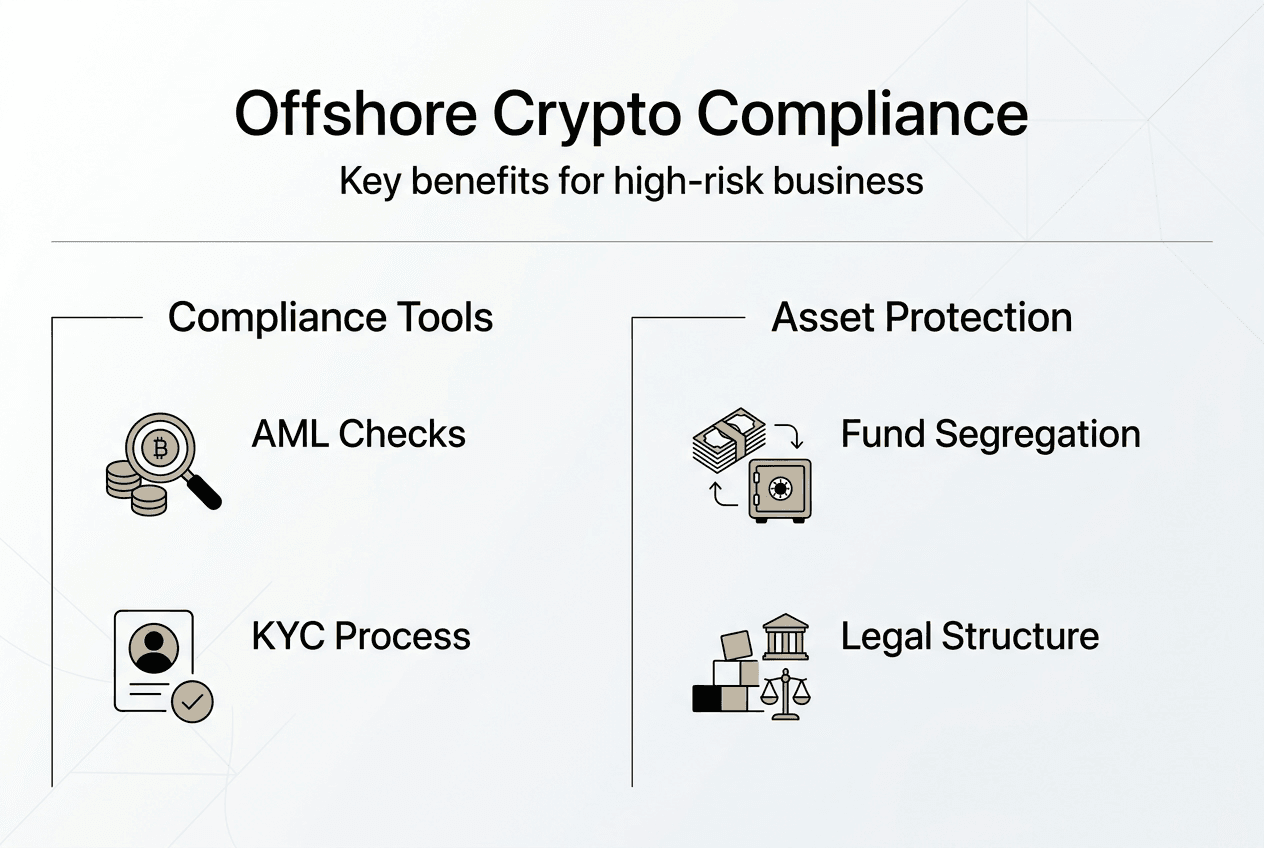
Compliance forms the foundation of sustainable offshore crypto banking. Businesses must implement robust anti-money laundering and know-your-customer frameworks that meet or exceed international standards. The Financial Action Task Force (FATF) guidelines provide the baseline, with jurisdictions like Cayman requiring licensed Virtual Asset Service Providers to maintain comprehensive transaction monitoring, customer due diligence, and suspicious activity reporting systems.
The Beacon Network represents a significant compliance innovation, creating transparency around beneficial ownership and entity structures. This blockchain-based system allows regulators and financial institutions to verify entity legitimacy whilst maintaining appropriate privacy protections. Businesses operating offshore benefit from proactively engaging with such transparency initiatives, demonstrating commitment to legitimate operations.
Asset protection requires strategic custody approaches. Strategic compliance and diversified custody become critical for risk mitigation in offshore holdings. Cold wallet storage provides security against cyber threats, whilst STAR trusts (Specific Trust Alternative Regime) in Cayman offer legal structures that protect assets from creditor claims whilst maintaining beneficial owner control.
Mitigating regulatory and operational risks requires systematic approaches:
- Engage specialist legal counsel familiar with both crypto operations and chosen jurisdiction requirements before initiating setup.
- Implement institutional-grade custody solutions with multi-signature controls and segregated client asset protocols.
- Establish comprehensive AML/KYC procedures including enhanced due diligence for high-risk customers and transaction monitoring systems.
- Maintain detailed transaction records and audit trails exceeding minimum regulatory retention periods.
- Develop incident response protocols for regulatory enquiries, security breaches, and operational disruptions.
- Schedule regular compliance audits by independent third parties to identify gaps before regulators do.
- Create transparent beneficial ownership structures that withstand regulatory scrutiny whilst protecting legitimate privacy interests.
Pro Tip: Engage specialist advisors familiar with crypto compliance in your chosen jurisdiction from day one. Generic offshore advisors often lack the technical crypto knowledge needed to structure operations correctly, leading to expensive restructuring later. Specialists understand nuances like wallet custody requirements, transaction reporting thresholds, and jurisdiction-specific licensing conditions that generic advisors miss.
For practical implementation, offshore crypto banking setup guide 2026 provides step-by-step frameworks. Businesses requiring formal licensing should explore offshore crypto licence options aligned with their operational scope and target markets.
How offshore banking enhances financial operations for high-risk crypto businesses
Operational advantages extend far beyond regulatory arbitrage. Offshore banking provides crypto businesses with financial infrastructure capabilities often unavailable through onshore institutions. Tax efficiency remains significant, with jurisdictions like Cayman offering zero corporate, income, and capital gains taxes, allowing businesses to reinvest profits into growth rather than tax obligations. Multi-currency wallets enable seamless operations across global markets without expensive foreign exchange conversions.
Transaction speed and flexibility represent crucial advantages. Offshore banks serving crypto clients typically process transactions faster than onshore institutions burdened by legacy systems and conservative risk policies. Payment processing capabilities expand dramatically, with offshore banks more willing to facilitate crypto-to-fiat conversions, merchant services, and cross-border transfers that onshore banks restrict or prohibit entirely.
The Cayman Islands has become a leading web3 hub with many crypto-native funds and businesses leveraging the jurisdiction’s supportive ecosystem. This concentration creates network effects, where service providers develop deep expertise, banks understand crypto business models, and regulators engage constructively with industry participants.
| Feature | Offshore Banking | Onshore Banking |
|---|---|---|
| Account Opening Speed | 2-4 weeks with specialist support | 3-6 months (if approved) |
| Approval Rate for Crypto | 70-85% with proper structuring | 15-30% for crypto businesses |
| Multi-Currency Support | Extensive: 10+ currencies standard | Limited: 2-5 currencies typical |
| Crypto Transaction Acceptance | High: banks familiar with crypto flows | Low: many prohibit crypto entirely |
| Tax Efficiency | Zero corporate/capital gains (many jurisdictions) | Standard corporate rates 15-35% |
| Payment Processing Flexibility | Broad: crypto-to-fiat, merchant services | Restricted: limited crypto processing |
| Relationship Manager Expertise | High: dedicated crypto banking teams | Low: general banking without crypto knowledge |
Typical features crypto companies prioritise in offshore banking include:
- Dedicated relationship managers with crypto industry knowledge
- Real-time settlement capabilities for time-sensitive trading operations
- Integration with major crypto exchanges and liquidity providers
- Segregated client asset accounts meeting regulatory requirements
- Multi-signature approval workflows for enhanced security
- Comprehensive API access for automated treasury management
- Flexible credit facilities secured against digital asset holdings
For businesses comparing options, offshore vs onshore bank accounts high risk business provides detailed analysis. Those requiring integrated solutions should explore payment processing solutions designed specifically for high-risk crypto operations.
How BankMyCapital supports your offshore crypto banking journey
Navigating offshore crypto banking requires expertise across multiple domains: regulatory compliance, jurisdiction selection, banking relationships, and ongoing operational support. BankMyCapital specialises in guiding high-risk crypto businesses through this complex landscape, leveraging relationships with over 50 pre-vetted banking partners across EU and offshore jurisdictions. Our 87% approval rate reflects deep understanding of what banks require and how to structure applications for success.
We provide tailored services covering the entire journey. Initial consultations identify optimal jurisdictions based on your business model, transaction volumes, and compliance requirements. Licensing assistance ensures you meet regulatory standards in chosen jurisdictions, whilst our banking setup services connect you with institutions aligned with your operational needs. Ongoing compliance support adapts to evolving regulations, protecting your banking relationships long-term.
Pro Tip: Early consultation accelerates setup and compliance success dramatically. Businesses that engage specialists before initiating incorporation or banking applications avoid costly restructuring and delays, whilst those attempting DIY approaches often face rejections requiring complete restarts.
Explore crypto banking setup with BankMyCapital for comprehensive solutions, review our offshore crypto banking setup guide 2026 for detailed frameworks, or understand broader context through high risk banking securing business 2026.
Frequently asked questions
What is offshore banking for crypto and why is it important?
Offshore banking for crypto involves establishing banking relationships in jurisdictions outside your primary operating country, typically in locations with favourable regulatory frameworks and tax environments. It’s important because major onshore jurisdictions increasingly restrict crypto banking access, with institutions viewing digital asset businesses as high risk and imposing stringent requirements that make operations difficult or impossible. Offshore solutions provide access to banks that understand crypto business models and offer the infrastructure needed for sustainable operations.
Which jurisdictions are best for offshore crypto banking in 2026?
The Cayman Islands and UAE lead offshore crypto banking in 2026 due to comprehensive regulatory frameworks aligned with FATF standards, tax neutrality, and mature financial infrastructure. Cayman’s VASP Act and UAE’s VARA framework provide clear licensing requirements and operational guidelines that reduce regulatory uncertainty. Switzerland and Singapore also remain strong options, offering established banking sectors with crypto expertise, though with higher tax obligations than zero-tax jurisdictions. Jurisdiction choice should balance regulatory clarity, banking access, tax efficiency, and ecosystem maturity based on specific business needs.
How can high-risk crypto businesses ensure compliance when using offshore banking?
High-risk crypto businesses ensure compliance by implementing robust AML/KYC frameworks that meet FATF guidelines, selecting licensed VASPs as banking partners, and maintaining comprehensive transaction monitoring systems. Registration under jurisdiction-specific frameworks like the Cayman Islands VASP Act provides regulatory legitimacy and demonstrates commitment to compliance standards. Engaging specialist compliance advisors familiar with both crypto operations and chosen jurisdiction requirements prevents costly mistakes and ensures sustainable banking relationships. Regular third-party audits identify compliance gaps before regulators do, protecting operations from sudden disruptions.
What are the main operational benefits of offshore banking for crypto businesses?
Offshore banking provides enhanced payment processing capabilities, tax efficiency through zero corporate and capital gains rates in jurisdictions like Cayman, and banking flexibility unavailable onshore. Multi-currency support enables seamless global operations, whilst faster transaction processing and willing acceptance of crypto-to-fiat conversions solve practical operational challenges. Offshore banks serving crypto clients typically offer dedicated relationship managers with industry expertise, API integrations for automated treasury management, and flexible credit facilities secured against digital assets. These capabilities combine to create operational infrastructure supporting growth that onshore banking increasingly restricts or prohibits entirely.
