
Nearly every business in crypto, iGaming, or adult entertainment will encounter payment fraud or chargebacks, with 98% of high-risk merchants reporting direct fraud exposure. Yet most operators only discover the full weight of this when their account is frozen, their funds are held in reserve, or their processor drops them without warning. A high-risk merchant account is not simply a standard account with higher fees. It is a fundamentally different financial product, built for sectors that conventional banks and acquirers refuse to touch. This guide breaks down everything you need to know, from definitions and costs to jurisdiction choices and fraud management, so you can make informed decisions before problems arise.
Key Takeaways
| Point | Details |
|---|---|
| High-risk means scrutiny | If you process payments in crypto, iGaming, or adult, expect stricter reviews and requirements. |
| Fees and reserves are higher | Expect to pay 4-8% in processing fees and set aside up to 15% of sales in rolling reserves. |
| Jurisdiction shapes options | EU accounts offer stability; offshore gives flexibility but requires careful assessment of trade-offs. |
| Managing chargebacks is critical | Stay under Visa and Mastercard thresholds to avoid fines and account shutdown. |
What makes a business ‘high-risk’?
In merchant services, ‘high-risk’ is not an insult. It is a technical classification that acquirers and banks use to assess the probability of financial loss from chargebacks, fraud, or regulatory action. If your business operates in a sector where customers frequently dispute transactions, where regulations shift rapidly, or where reputational risk is elevated, you will almost certainly be labelled high-risk.
Common high-risk sectors include:
- Crypto exchanges and wallets
- iGaming, online casinos, and sports betting
- Adult content platforms and subscription services
- Forex and CFD trading
- Nutraceuticals and subscription box services
- Travel agencies and ticketing platforms
- Firearms and CBD retailers
As high-risk merchant accounts are required by businesses facing elevated chargebacks and regulatory scrutiny, acquirers price in the additional risk through higher fees, rolling reserves, and stricter contract terms. Banks see these industries as liabilities because a single wave of chargebacks can cost them more than months of processing revenue.
“The high-risk label is not a dead end. It is a signal that you need a specialist processor, not a mainstream one.”
If your business falls into any of these categories, standard merchant accounts will either reject you outright or terminate your account the moment volumes spike. Exploring high-risk payment solutions built specifically for your sector is not optional. It is essential.
How high-risk merchant accounts work
After covering which sectors fall under ‘high-risk’, the next step is to see exactly how the accounts themselves operate. The process is more involved than opening a standard business account, but it follows a clear structure once you know what to expect.
Here is how the typical application and activation process unfolds:
- Submit your application with full business documentation, including company registration, ownership structure, and processing history.
- Undergo underwriting, which involves a business model review, financial assessment, website compliance check, and AML/KYC verification.
- Receive a conditional offer outlining your processing limits, reserve requirements, and fee structure.
- Integrate the payment gateway with your platform, either via API or hosted payment page.
- Begin processing under a monitored period, during which your chargeback ratio and fraud rates are tracked closely.
The key players in this ecosystem are acquirers (the banks that hold merchant funds), payment service providers or PSPs (who connect you to acquirers), and processors (who handle the technical routing of transactions). In high-risk processing, these roles are often combined into a single specialist provider.

Underwriting is stricter than in standard processing because the acquirer is taking on real financial exposure. Expect delays of several days to two weeks, requests for additional documents, and a rolling reserve withheld from your settlements.
Pro Tip: Prepare a clean compliance pack before you apply. This means up-to-date AML policies, a clear terms and conditions page, a functional refund policy, and a privacy notice. Processors who see this upfront move faster, and you signal that you are a serious operator. Review processing best practices before submitting your first application.
Costs and fees in high-risk merchant processing
With the mechanics explained, it is crucial to understand the fees and financial obligations that come with high-risk merchant accounts. The numbers are higher than standard processing, but they are predictable once you know what to look for.
| Fee type | Standard merchant | High-risk merchant |
|---|---|---|
| Processing rate | 1.5% to 3% | 4% to 8% |
| Rolling reserve | None or minimal | 5% to 15% of volume |
| Chargeback fee | £10 to £20 per dispute | £20 to £80 per dispute |
| Monthly minimum | £25 to £50 | £100 to £500 |
| Setup fee | Often waived | £200 to £1,000+ |
| Early termination | Rare | Common, often £500+ |
The rolling reserve is the cost that surprises most new operators. Your processor withholds a percentage of every settlement, typically for 90 to 180 days, as a buffer against future chargebacks. If your chargeback rate stays low, those funds are released on a rolling basis. If disputes spike, the reserve absorbs the losses before the acquirer is exposed.
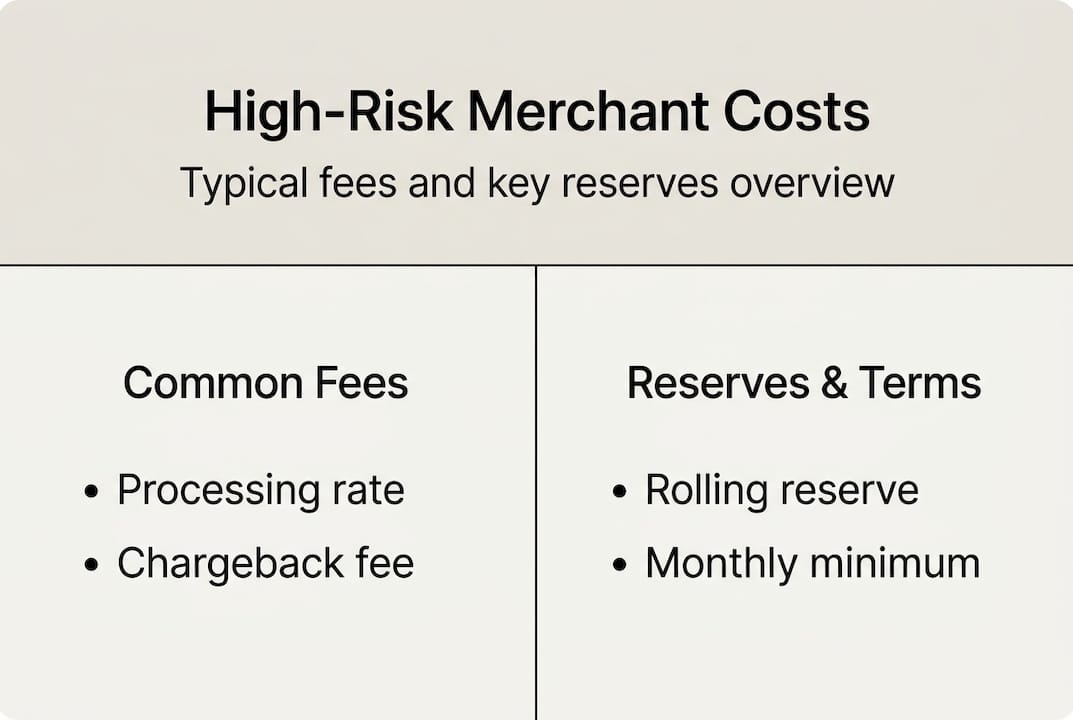
As fees of 4 to 8% are standard for high-risk accounts, alongside rolling reserves of 5 to 15% and chargeback fees of £25 to £100 per dispute, budgeting accurately from day one is critical. A business processing £100,000 per month could have £10,000 to £15,000 locked in reserve at any given time.
Key insight: Rolling reserves are not a penalty. They are a negotiable term. Operators with clean processing histories often reduce their reserve percentage after six months of consistent performance.
Chargebacks, fraud, and compliance: Managing the big risks
Understanding fees is only half the battle. The true challenge lies in controlling fraud and chargebacks under strict card scheme rules. Visa and Mastercard both operate formal monitoring programmes that can escalate quickly if your ratios breach their thresholds.
Here is how to stay compliant and protect your account:
- Know your thresholds. Visa and Mastercard set chargeback thresholds at 1% and 1.5 to 2% respectively. Breaching these triggers formal monitoring, fines, and potentially account termination.
- Monitor your ratio weekly, not monthly. By the time a monthly report flags a problem, you may already be in breach.
- Use 3D Secure authentication on all card transactions. This shifts liability for fraud disputes from you to the card issuer.
- Deploy a chargeback alert service such as Ethoca or Verifi. These services notify you of disputes before they become formal chargebacks, giving you time to issue a refund and avoid the ratio impact.
- Respond to every dispute with evidence. Delivery confirmations, IP logs, signed terms, and communication records all strengthen your representment case.
- Segment your MIDs (merchant IDs) by product line or geography. If one segment spikes, it does not contaminate your entire processing relationship.
Exceeding card scheme thresholds triggers a cascade: first a monitoring programme with monthly fines, then increased reserves, then potential termination and placement on the MATCH list, which makes future processing extremely difficult. Following chargeback best practices from the outset is far cheaper than recovering from a MATCH listing.
Pro Tip: After six to twelve months of clean performance, approach your processor to renegotiate. Lower reserves, reduced fees, and higher processing limits are all achievable if your metrics support the conversation. Processors want to retain profitable, compliant merchants.
EU vs offshore: Jurisdictions and account options
To round out your understanding, consider where to set up your account. Location shapes your fees, terms, banking reliability, and the level of consumer protection your customers receive.
EU merchant accounts are issued by acquirers operating under European Economic Area regulation. They offer strong consumer protection frameworks, access to SEPA payments, and credibility with card schemes. Cyprus and Malta are the most common EU jurisdictions for high-risk processing, offering EU legal frameworks with relative flexibility compared to larger EU markets.
Offshore merchant accounts are issued in jurisdictions such as Seychelles, Belize, or Vanuatu. They offer higher approval rates for businesses that EU acquirers reject outright, fewer restrictions on business model, and faster onboarding. The trade-off is less regulatory oversight and occasionally less stability.
| Factor | EU account | Offshore account |
|---|---|---|
| Approval rate | Moderate | Higher |
| Processing fees | 4% to 6% | 5% to 9% |
| Consumer protection | Strong (EEA rules) | Limited |
| Card scheme access | Visa/Mastercard direct | Often via third-party |
| Onboarding time | 1 to 3 weeks | 3 to 10 days |
| Regulatory stability | High | Variable |
Most mature high-risk operators use both. An EU account handles regulated markets and card scheme volume, while an offshore account processes jurisdictions or business lines that EU acquirers will not touch. Understanding the full range of banking solution types available to your sector is the starting point for building a resilient payment infrastructure.
Key considerations when choosing:
- Your customer base geography (EU customers expect EU-regulated billing)
- Your licence status (a Malta Gaming Authority licence opens EU acquirer doors)
- Your chargeback history (offshore is more forgiving for new operators)
- Your long-term growth plans (EU accounts scale better with card scheme programmes)
For a detailed breakdown of the trade-offs, the offshore vs onshore account comparison and the case for why go offshore are both worth reviewing before you commit to a structure.
Features and payment options: What to prioritise
Finally, consider what makes a merchant account not only accessible but genuinely useful. Feature set and payment versatility determine whether your account can support real business growth or just keep the lights on.
Essential features to look for:
- Multi-currency processing to accept payments in EUR, USD, GBP, and local currencies without conversion friction
- Crypto payment acceptance for Bitcoin, Ethereum, and stablecoins, particularly relevant for iGaming and adult platforms
- Discreet billing descriptors that reduce customer confusion and prevent friendly fraud disputes
- Recurring billing and subscription management for membership and SaaS-style revenue models
- Fraud scoring and velocity checks built into the gateway
- Chargeback management tools integrated directly with your dashboard
As multi-currency, crypto payments, and discreet descriptors are core features for EU and offshore high-risk processing, these are not optional extras. They are baseline requirements for any serious operator in 2026.
Clear billing descriptors deserve special attention. When a customer does not recognise a charge on their statement, their first instinct is to dispute it. A descriptor that clearly identifies your brand, even if discreet about the product category, dramatically reduces this type of friendly fraud. It is one of the simplest and most overlooked chargeback reduction tools available.
Pro Tip: Use multiple MIDs across different processors and payment methods. If one processor experiences downtime or freezes your account, you have immediate fallback options. Combining card processing with crypto acceptance and alternative payment methods also reduces your dependence on any single channel. Explore the multi-currency account guide and multi-currency account benefits to structure this properly.
Unlock your high-risk merchant solutions
Once you know what is required, having the right partner makes all the difference. Navigating acquirer relationships, KYC and AML documentation, jurisdiction selection, and contract negotiation is time-consuming and high-stakes. A misstep at the application stage can result in rejection, and repeated rejections make future approvals harder.
Bank My Capital works exclusively with high-risk operators in crypto, iGaming, adult entertainment, and forex, connecting them with a network of over 50 pre-vetted banking partners and EMIs. With an 87% approval rate and onboarding timelines of two to three weeks, the focus is on getting your high-risk payment processing live without the back-and-forth that comes from approaching acquirers directly. From KYC preparation and compliance documentation to selecting the right jurisdiction for your business model, the full range of banking solutions is available to support your next step.
Frequently asked questions
How long does approval for a high-risk merchant account take?
Approval typically takes between 48 hours and two weeks, depending on documentation readiness and the depth of compliance review required by the acquirer.
Why are processing fees higher for high-risk businesses?
Because of elevated chargeback and fraud exposure, fees of 4 to 8% are standard for high-risk accounts, compared to 1.5 to 3% for low-risk merchants.
Is it possible to negotiate better fees or terms over time?
Yes. After six to twelve months of low chargebacks and consistent compliance, you can renegotiate terms for lower reserves, reduced fees, and higher processing limits.
What happens if my chargeback ratio is too high?
Exceeding Visa’s 1% or Mastercard’s 1.5 to 2% thresholds triggers monitoring programmes, monthly fines, increased reserves, and potential account termination.
