
TL;DR:
- EU banking compliance for high-risk sectors like crypto, iGaming, and forex involves stricter regulations such as AMLR, MiCA, DORA, and PSD3, which are harmonizing EU standards and increasing scrutiny. Building a strong governance framework with management accountability, clear roles, documented policies, and ongoing training is essential to meet supervisory expectations. Effective transaction monitoring, sanctions screening, and third-party ICT risk management are critical operational pillars to prevent breaches and maintain banking relationships.
EU banking compliance is not equally difficult for everyone. If you operate in crypto, iGaming, or forex, you are navigating a landscape where the rules are stricter, the scrutiny is heavier, and the cost of getting it wrong is a frozen account or a rejected licence application. This guide to EU banking compliance cuts through the regulatory noise and gives you a clear, sequential picture of what actually applies to your business, what is changing in 2026 and 2027, and how to build a compliance framework that holds up under supervisory examination.
Key Takeaways
| Point | Details |
|---|---|
| Know key regulations | AMLR, AMLA, MiCA, CRR3, DORA, and PSD3 form the core EU compliance framework affecting high-risk sectors. |
| Establish governance | Management must lead sanctions compliance with regular risk assessments covering all business channels. |
| Implement robust screening | Use continuous transaction monitoring and fuzzy matching sanctions screening to detect risks effectively. |
| Manage ICT third-party risks | Maintain updated ICT provider registers and contractual clauses per DORA to ensure operational resilience. |
| Prepare for change | Conduct gap analyses and engage with AMLA consultations now to meet the 2027 harmonised compliance deadline. |
Understanding key regulatory frameworks impacting high-risk businesses
Having outlined why EU banking compliance is crucial, we first explore the key regulations shaping the landscape for high-risk businesses.
EU banking regulations are not one single rulebook. They are a stack of overlapping directives and regulations, each targeting a different dimension of risk. For high-risk operators, five frameworks matter most right now.
The AML framework: AMLR and AMLA
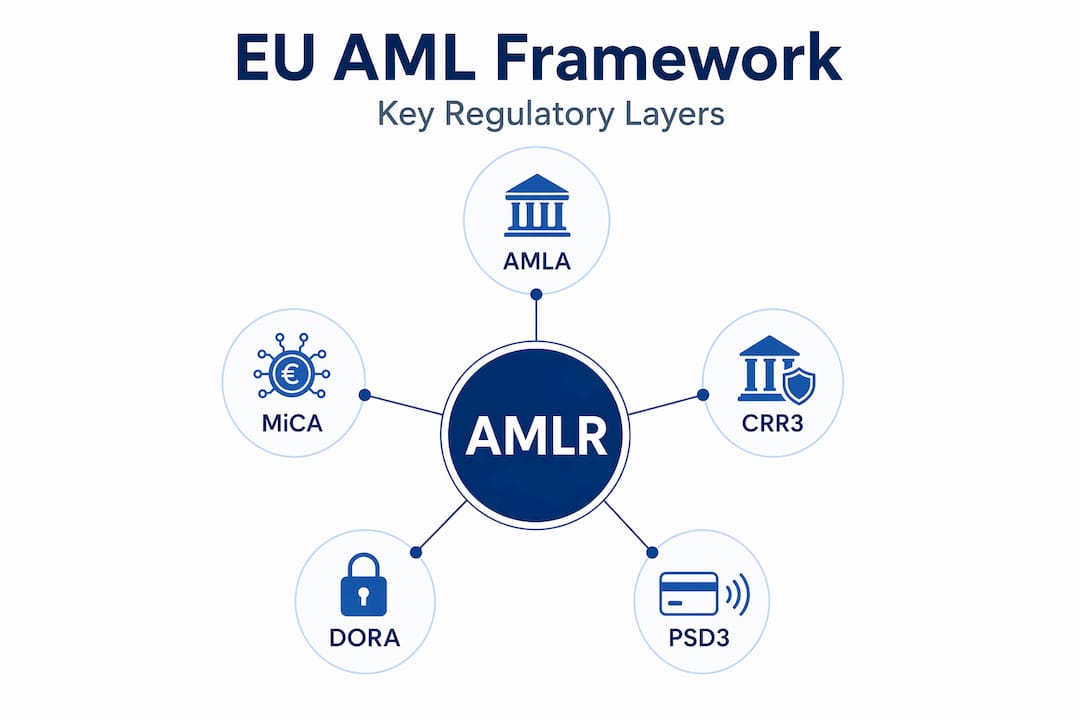
The harmonised EU AML rulebook takes effect from July 2027, with AMLA supervision commencing January 2026. This replaces the patchwork of national transpositions with a single directly applicable regulation. For high-risk firms, this matters because there is no longer a “softer” jurisdiction to shelter under.
MiCA for crypto-asset service providers (CASPs)
MiCA requires CASPs to hold minimum own funds and meet AML and counter-terrorist financing (CTF) obligations. If you are running a crypto exchange or custody service, you need authorisation before you can touch EU customers. Our crypto licensing guide outlines what that process actually looks like in practice.
CRR3 and capital requirements
CRR3 classifies crypto exposure into distinct groups with conservative capital requirements attached. Banks working with crypto businesses are constrained by these rules, which directly affects their willingness to open accounts for CASPs.
DORA for digital operational resilience
DORA mandates annual ICT third-party risk reporting including contractual clauses for critical functions. Any firm relying on cloud infrastructure, payment processors, or third-party software for core operations falls under this.
PSD3 for payment services
PSD3 mandates enhanced fraud prevention and harmonised licensing, expected to be fully applied in 2027. iGaming and forex operators using third-party payment rails need to understand how this affects their payment service providers.
Here is a quick-reference overview of what applies to which sector:
| Regulation | Crypto | iGaming | Forex | Effective date |
|---|---|---|---|---|
| AMLR / AMLA | Yes | Yes | Yes | July 2027 |
| MiCA | Yes | No | Partial | In force 2024 |
| CRR3 | Indirect | No | Indirect | January 2025 |
| DORA | Yes | Partial | Yes | January 2025 |
| PSD3 | Partial | Yes | Yes | 2027 (expected) |
- Understand which regulations apply to your specific business model, not just your sector category.
- CASPs must track both MiCA authorisation requirements and AMLR obligations simultaneously.
- Payment processors embedded in iGaming platforms carry PSD3 obligations even if the operator does not.
Pro Tip: Review our crypto compliance checklist to map your current status against each of these frameworks before your next banking application.
Building a robust compliance governance framework for your high-risk enterprise
With regulatory context established, let us focus on how to build and maintain a compliance governance framework that meets EBA and AMLR expectations.
Governance is where most high-risk businesses have the largest gap. Regulators and banks do not just want policies on paper. They want evidence of accountability reaching to board level.
Management responsibility is non-negotiable
Management bodies must approve the sanctions compliance strategy and conduct annual exposure assessments covering geographic and channel risks. This means your CEO or board cannot delegate sanctions responsibility entirely to a junior compliance officer and consider the matter resolved.
Two distinct roles under AMLR
This is a point many firms miss. AMLR requires appointing a compliance manager separate from the compliance officer, each carrying defined governance responsibilities. The compliance officer handles day-to-day monitoring; the compliance manager is responsible for governance, policy ownership, and board reporting. Conflating the two roles is a common compliance failure.
How to build your governance structure in five steps:
- Appoint a board-level compliance sponsor with documented authority over the compliance programme.
- Designate a compliance manager (governance and policy) and a compliance officer (operational monitoring) as separate roles.
- Conduct an annual sanctions exposure assessment covering all geographies served, customer segments, products, and delivery channels.
- Document all internal AML and sanctions policies in writing, with version control and annual review cycles.
- Establish a board reporting schedule for compliance metrics, suspicious activity report (SAR) volumes, and audit findings.
Your policies must be living documents. A policy written in 2023 and never updated is a liability, not a control. Supervisors examining your governance framework will look at policy version history, training records, and board minutes.
- Keep board minutes that explicitly reference compliance updates and approvals.
- Document the rationale for every risk-based decision, especially where you deviate from standard thresholds.
- Ensure staff at all levels receive role-specific AML and sanctions training annually.
Pro Tip: When a bank’s compliance team reviews your application, they are essentially auditing your governance framework. Review how to pass bank compliance for a high-risk business account to understand exactly what they are looking for.
Implementing practical transaction monitoring and sanctions screening processes
Having governance in place, next is executing effective sanctions and transaction monitoring systems tailored to regulatory expectations.

This is where understanding banking compliance moves from theory to daily operations. Getting it wrong here generates regulatory breaches, fines, and account closures.
Sanctions screening: beyond a simple name check
Financial institutions must deploy sanctions screening including fuzzy matching for PSPs and CASPs, with annual system reviews. Fuzzy matching means your system must catch name variants, transliterations, and deliberate misspellings, not just exact matches.
Key data elements your screening must cover:
- Full legal name and all known aliases of payers and payees
- Wallet addresses and associated entity names for crypto transactions
- Intermediary institutions involved in correspondent banking chains
- Nationality, country of residence, and country of incorporation
- Ultimate beneficial owners (UBOs) behind corporate customers
Transaction monitoring under AMLR
AMLR mandates continuous transaction monitoring replacing the older model of periodic batch reviews. This is a significant operational shift. Your system must flag anomalies in real time, not quarterly.
A five-step process for effective monitoring:
- Define your baseline customer behaviour profiles using at least 90 days of historical transaction data before going live.
- Set alert thresholds calibrated to your specific customer risk tiers, not generic industry defaults.
- Investigate every alert with documented reasoning, including why alerts are closed without escalation.
- Escalate confirmed concerns to your compliance officer within 24 hours with a written record.
- Run annual system reviews testing both sensitivity (catching true positives) and specificity (reducing false positives).
| Monitoring element | Minimum requirement | Best practice |
|---|---|---|
| Sanctions screening frequency | Per transaction | Real-time with batch catch-up |
| Fuzzy matching threshold | Defined, documented | Calibrated annually against evasion typologies |
| Alert investigation turnaround | No standard set | 48 hours maximum |
| Annual system review | Required | Independent third-party validation |
| Crypto wallet screening | Required for CASPs | Blockchain analytics integration |
Pro Tip: False positive rates above 95% are not just inefficient; they create alert fatigue that causes genuine suspicious activity to be missed. Review our EU banking approval tips for sector-specific calibration guidance.
Managing ICT third-party risks and compliance in line with DORA requirements
Beyond internal systems, compliance also requires managing third-party ICT risks as mandated by DORA.
Most high-risk businesses rely heavily on third-party technology providers for payments, KYC, fraud detection, and cloud infrastructure. Under DORA, this dependence is itself a regulated risk.
What DORA actually requires
DORA requires submission of annual ICT third-party registers, mandatory contractual clauses, and exit strategies for critical functions. The register is not a spreadsheet of vendor contacts. It is a structured document submitted to your national competent authority each year, identifying every provider that supports a critical or important function.
Your DORA compliance checklist:
- Maintain a live ICT third-party register updated whenever providers are added, changed, or terminated.
- Classify each provider by function type: critical, important, or standard.
- Include all 18 or more mandatory contractual clauses from DORA Article 30 in every critical function contract.
- Develop a written exit strategy for each critical provider, covering data portability, transition timelines, and fallback arrangements.
- Report on third-party risk annually to your management body.
Five steps to build your DORA compliance programme:
- Audit all existing ICT contracts against the Article 30 mandatory clause list and identify gaps.
- Renegotiate or amend contracts that do not meet DORA requirements before renewal.
- Conduct concentration risk analysis: if three firms rely on the same cloud provider, that is a systemic risk.
- Test exit strategies at least annually with documented outcomes.
- Submit your annual register to your national authority on time, with accurate function classifications.
Pro Tip: Many high-risk firms discover during DORA audits that their KYC or fraud screening provider holds critical function status but was never contracted with the required DORA clauses. Audit your contracts before your regulator does. Explore banking solutions for high-risk businesses that already factor DORA requirements into their onboarding.
Preparing for upcoming changes and ensuring ongoing compliance verification
Finally, we cover how to prepare for imminent changes and maintain ongoing compliance verification as part of best practices for EU banking.
The regulatory calendar is clear. 2026 is the year of consultation and preparation. 2027 is the year of enforcement.
What is changing and when:
- AMLA technical standards consultations are active throughout 2026, with Level 2 and Level 3 measures published before AMLR application.
- Active engagement with AMLA consultations and gap analysis ahead of 2027 is now a regulatory expectation, not a voluntary exercise.
- Shifting from directive-based to regulation-based rules means national gold-plating disappears and every firm faces the same standard.
Legacy directive rules versus new regulation-based requirements:
| Dimension | Legacy directive approach | AMLR regulation approach |
|---|---|---|
| Legal basis | Transposed into national law | Directly applicable EU regulation |
| Flexibility | National discretion allowed | Uniform across all member states |
| Scope | Minimum harmonisation | Maximum harmonisation |
| Supervisor | National FIUs and competent authorities | AMLA for high-risk cross-border firms |
Your preparation checklist for 2027:
- Conduct a gap analysis comparing your current AML programme against published AMLR technical standards.
- Update all internal policies to reflect regulation-based language, not directive-based references.
- Refresh staff training materials to cover AMLA’s new supervisory expectations.
- Recalibrate transaction monitoring systems to align with any new threshold guidance from AMLA’s Level 2 measures.
- Establish proactive communication channels with your national supervisor now, before a crisis requires it.
Pro Tip: Track EU banking regulation updates and the high-risk banking guide for 2026 to stay ahead of AMLA’s rolling consultation schedule. Firms that engage early with their supervisors fare significantly better when the formal review period begins.
Unique challenges and practical wisdom for high-risk EU banking compliance
Understanding the regulatory framework matters. But the gap between reading a regulation and surviving a supervisory examination is wider than most compliance officers expect. Here is what experience actually teaches you.
The first thing most firms underestimate is delivery channel risk in sanctions compliance. Many firms overlook delivery channel risks in sanctions exposure assessments, which increases evasion potential. A crypto exchange operating via mobile wallets, API integrations, and peer-to-peer channels has three completely different evasion surfaces. Yet most firms conduct their annual exposure assessment as though all transactions arrive through the same door.
The second misconception is that CRR3 capital rules only affect banks. They do not. Netting and collateral rules for crypto exposures under CRR3 constrain risk appetite and require early risk assessment. When a bank applies a 1,250% risk weight to an unhedged crypto exposure, it effectively prices that relationship out of existence. If your banking partner cannot hold your deposits efficiently under CRR3, you lose the account, regardless of how well your own compliance is structured. You need to understand your bank’s capital constraints, not just your own obligations.
The third lesson is about proactive versus reactive compliance. Firms that wait for a supervisory review to discover deficiencies typically face Pillar 2 add-ons (additional capital charges imposed by supervisors on top of the standard minimums). Conducting an honest ex-ante assessment of your own programme, with the same rigour a supervisor would apply, is genuinely protective. It is also how you build the kind of credibility with compliance in high-risk finance that accelerates banking relationships rather than stalling them.
False positive management deserves a sharper mention too. Reducing false positives is not about gaming your screening system to avoid work. It is about ensuring your compliance team has the bandwidth to investigate genuinely suspicious activity. A system generating thousands of false alerts per day is not a strong control. It is a compliance failure waiting to happen.
How BankMyCapital supports your high-risk business compliance journey
After learning how to navigate EU banking compliance, discover how BankMyCapital’s expert services can support your high-risk business effectively.
At BankMyCapital, we work exclusively with high-risk businesses in crypto, iGaming, forex, and related sectors. We understand that European financial compliance is not a checkbox exercise for your industry; it is a continuous operational requirement that directly affects whether you can hold funds, process payments, and maintain your licence. Our team helps you map your compliance programme against AMLR, MiCA, DORA, and PSD3, identify gaps before your bank does, and structure your governance documentation for maximum approval success. From crypto banking setup to full-spectrum banking solutions for high-risk businesses, we connect you with pre-vetted banking partners who already understand your sector and your compliance obligations.
Frequently asked questions
What is the role of AMLA in EU banking compliance?
AMLA is the new EU authority that centralises AML supervision and sets harmonised regulations across member states, directly supervising high-risk cross-border entities. AMLA became operational in 2025 and will directly supervise high-risk cross-border institutions from 2028.
What are the sanctions screening requirements for crypto firms?
Crypto-asset service providers must implement screening using fuzzy matching techniques with annual system reviews to prevent breaches of restrictive EU measures. PSPs and CASPs must use screening systems reviewed annually with fuzzy matching as per EBA guidelines.
How does CRR3 impact capital requirements for crypto exposures?
CRR3 classifies crypto assets into groups with high-risk weighted capital requirements, with capital charges of up to 1,900% risk weight applied to certain assets and total crypto exposure limited to 1% of Tier 1 capital.
What are the DORA requirements for ICT third-party risk?
DORA mandates financial firms maintain a detailed annual register of ICT third-party providers, include mandatory contractual clauses, and plan exit strategies for critical ICT functions. DORA requires annual submission of ICT third-party registers and inclusion of 18 or more mandatory contractual clauses for critical ICT functions.
When do new harmonised AML rules apply across the EU?
The EU AML Regulation applies uniformly from 10 July 2027, after a transition period including AMLA’s standards publication and national adjustments. AMLR applies directly across all EU member states from that date, with no national discretion over its scope or application.
