
TL;DR:
- Forex firms operate in highly regulated environments where secure payment processing is essential for business continuity and compliance. Proper preparation, proactive transparency, and working with specialized providers significantly increase the likelihood of securing reliable banking relationships in the high-risk forex sector. Ongoing compliance and monitoring are vital to maintaining access, as regulators and banks continuously scrutinize payment flows and risk management practices.
Forex firms operate in one of the most scrutinised financial environments on the planet. The moment regulators and banks see “forex” on an application, they apply an entirely different level of review, and many providers simply refuse to engage. Without secure, compliant payment processing, your business cannot receive client funds, pay liquidity providers, or sustain daily operations. This guide walks you through every stage, from preparing your documents to maintaining long-term compliance, so that your forex business can access reliable banking and payment infrastructure without unnecessary rejections or costly delays.
Key takeaways
| Point | Details |
|---|---|
| High-risk needs compliance | Forex firms must prioritise secure, compliant payment processing to maintain banking access. |
| Be thoroughly prepared | Advance preparation and complete documentation greatly improve approval chances. |
| Choose the right partner | Specialist payment providers for high-risk sectors offer better support and higher acceptance. |
| Monitor compliance constantly | Ongoing transaction audits and KYC updates are essential for uninterrupted service. |
Why secure payment processing is critical for forex firms
Payment processing is not just a convenience for forex firms; it is the operational backbone of the entire business. Every client deposit, withdrawal, and inter-broker settlement depends on it. When that infrastructure is unstable, unreliable, or suddenly withdrawn, trading activity stops entirely.
Forex is widely categorised as a high-risk industry, which directly affects both payment processing approval rates and compliance requirements placed on your business. This classification exists because forex involves large, rapid money movements, cross-border transactions, and exposure to regulatory differences across multiple jurisdictions. Banks and payment service providers (PSPs) treat this combination as inherently risky, regardless of your firm’s actual track record.
Understanding the consequences of getting this wrong is essential:
- Account freezes can happen without notice if your compliance documentation is out of date or your transaction patterns trigger automated fraud alerts
- Banking relationship termination leaves your business scrambling to find alternative infrastructure, often at a premium cost and with significant downtime
- Regulatory penalties arise when payment flows do not meet Anti-Money Laundering (AML) or Know Your Customer (KYC) standards set by your licensing jurisdiction
- Reputational damage with institutional counterparties can permanently restrict your access to competitive settlement terms
Explore forex payment processing basics to understand how these risks manifest in practice and what structures protect against them.
“Regulatory scrutiny of forex payment flows is intensifying globally. Firms that treat compliance as a box-ticking exercise, rather than an ongoing operational standard, consistently face the most severe disruptions.”
With the stakes clear, the next step is to understand what you need before starting the process.
Preparation: what you need before applying for payment processing
Most forex firms do not fail at the application stage because of their business model. They fail because of poor preparation. Inadequate documentation is a leading cause of forex firms being refused payment processing, and it is entirely preventable.

The following documents are typically required by any reputable PSP or banking partner:
| Document | Purpose | Typical source |
|---|---|---|
| Certificate of incorporation | Confirms legal entity existence | Company registry |
| Regulatory licence | Proves authorised status | Licensing authority |
| AML/KYC policy document | Demonstrates compliance framework | Internal compliance team |
| Shareholder registry | Identifies beneficial owners | Corporate secretary |
| Directors’ passport copies | Personal identity verification | Individual directors |
| Proof of registered address | Confirms physical location | Utility bill or lease |
| Proof of domain ownership | Links entity to operational website | Domain registrar |
| Bank reference letter | Demonstrates existing banking history | Your current bank |
| Business plan or financial projections | Shows viability and expected volumes | Internal finance team |
Beyond gathering these items, you need to ensure they are current. A licence that expired six months ago is worse than no licence at all in the eyes of a compliance officer. Similarly, an AML policy written in 2021 and never updated signals that your firm is not actively managing risk.
Key preparation steps include:
- Review your corporate structure for any complexity that might raise beneficial ownership questions, and prepare clear explanations in advance
- Reconcile your transaction history so that your projected volumes in the application match your actual business activity
- Appoint a named compliance officer whose credentials can be presented to the PSP during onboarding
- Align your business description precisely with your licensed activities, avoiding vague or overly broad language that triggers additional review
Following payment best practices from the outset will significantly reduce the time spent on back-and-forth requests from providers.
Pro Tip: Scan all documents into clearly labelled PDF files and organise them in a shared, encrypted folder before you begin any application. Providers who receive complete, well-structured document packs process applications notably faster than those who must chase missing items.
With groundwork in place, the next section details each step of the payment processing setup process.
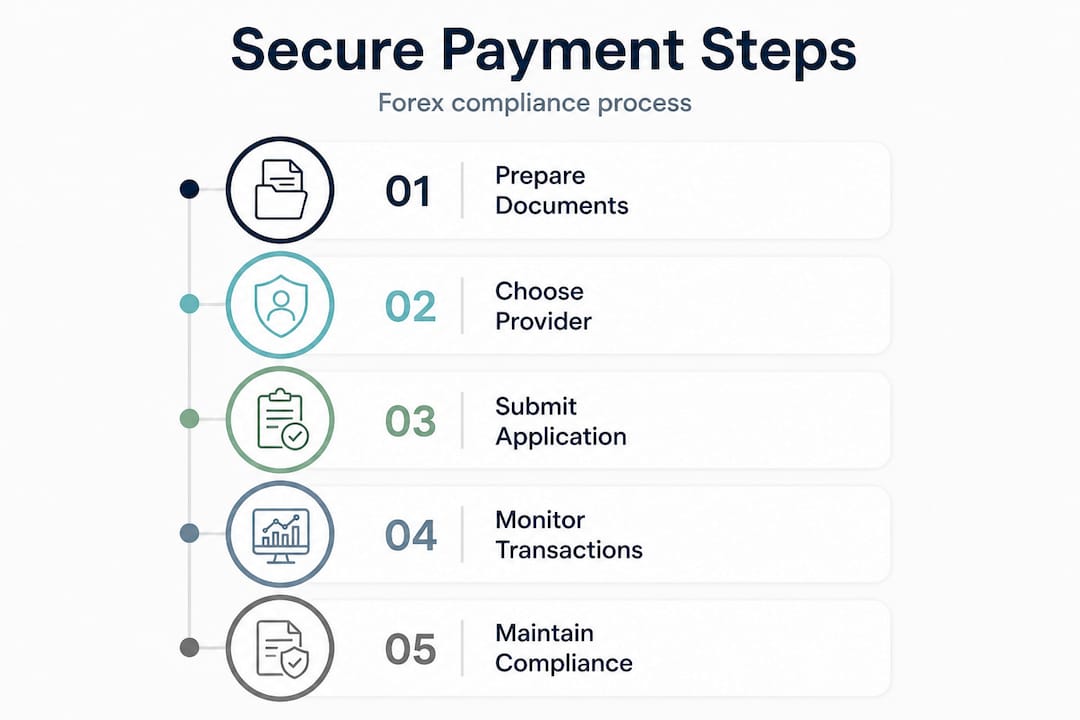
Step-by-step: how to secure payment processing for your forex business
A structured approach to securing payment processing avoids the reactive scrambling that characterises most failed applications. Follow this sequence carefully, and consult detailed payment processing steps for a more granular breakdown at each stage.
- Research providers that specialise in high-risk sectors. Generic PSPs are rarely equipped to handle forex onboarding. Choosing a provider familiar with high-risk sectors significantly raises approval rates because their compliance teams understand the regulatory nuances involved.
- Vet shortlisted providers against your specific needs. Compare processing fees, settlement currencies, chargeback management policies, and geographic reach. Consider whether the provider supports multi-currency accounts, which is often essential for forex operations.
- Prepare your application pack. Use the document checklist above and write a clear, concise business description that explains your model, your client base, and your risk management protocols.
- Submit the application with complete supporting materials. Partial submissions are the single most common reason for delays. Never submit incomplete packs hoping to add documents later.
- Attend the compliance interview prepared. Most high-risk PSPs require a call or written questionnaire with their compliance team. Know your transaction volumes, your top client jurisdictions, and your chargeback ratios before this conversation.
- Complete technical integration. Once approved, work with your development team to integrate the payment gateway into your trading platform. Test all payment flows in a sandbox environment before going live.
- Go live with monitoring in place. Do not activate live processing without real-time transaction monitoring already running. Unusual spikes in activity on day one can trigger automated reviews that put new accounts on hold.
The table below compares key features to assess when selecting a payment processor for forex:
| Feature | Why it matters | What to look for |
|---|---|---|
| High-risk sector experience | Reduces compliance friction | Published case studies or client references |
| Multi-currency support | Essential for global forex operations | Minimum 15 to 20 currencies supported |
| Chargeback management | Protects against dispute escalations | Dedicated dispute team and clear SLAs |
| Settlement speed | Affects liquidity management | T+1 or T+2 settlement preferred |
| Fee transparency | Prevents unexpected cost increases | Full fee schedule in writing upfront |
| Technical support | Reduces integration delays | 24/7 availability for high-risk accounts |
You can also review top payment partners in Europe for a vetted list of providers operating in key forex jurisdictions.
Pro Tip: Never mention competitor firms or previous processing disputes in your application. Keep your business narrative forward-looking. Compliance officers are assessing risk appetite, and dwelling on past problems, even if resolved, creates unnecessary doubt.
Even with correct steps, common pitfalls can derail approval. Next, learn what to avoid and how to fix issues.
Troubleshooting: common mistakes and how to resolve them
Even well-prepared forex businesses encounter obstacles during the payment processing application process. Knowing the most frequent errors in advance allows you to address them before they cause a rejection.
Common mistakes that block approval include:
- Missing or expired AML policy documents, which signal that compliance is not actively managed
- Vague business descriptions that do not clearly explain revenue streams, client acquisition methods, or risk controls
- Inconsistent transaction volume projections that contradict existing bank statements or platform data
- Unresolved beneficial ownership questions arising from complex holding structures without clear explanatory notes
- Failure to disclose previous account closures, which, when discovered during due diligence, immediately damages credibility
- No named compliance officer, leaving providers uncertain about who is responsible for ongoing regulatory obligations
Over 60% of payment processing rejections stem from incomplete compliance responses, which means the majority of refusals are avoidable with better preparation and communication.
Quick solutions to these problems:
- Use standardised AML policy templates designed specifically for forex firms and update them at least annually
- Retain a compliance specialist to draft or review your business description before submission
- Request a pre-application review call with your preferred provider to identify gaps before formal submission
- Prepare a brief ownership structure chart as a separate attachment to simplify due diligence reviews
For ongoing solutions for high-risk payment issues, having a specialist in your corner reduces the risk of repeated rejection cycles.
“Approval hinges on responsiveness and complete transparency. Providers are not looking for perfect businesses; they are looking for businesses that communicate openly, respond promptly, and demonstrate that they take compliance seriously.”
Prevention beats cure, but sometimes mistakes happen. After troubleshooting, understand how to monitor and maintain your payment security.
Ongoing compliance and monitoring for secure payment processing
Securing payment processing approval is not the end of the process; it is the beginning of an ongoing obligation. Banks and PSPs can withdraw services at any point if they determine that your compliance posture has deteriorated. Regular internal audits and prompt updating of KYC documents are your primary defences against surprise account freezes.
Building a compliance calendar is the most practical way to manage these obligations. Schedule the following on a recurring basis:
- Quarterly AML policy reviews to incorporate any regulatory updates relevant to your licensing jurisdiction
- Annual KYC refresh for all high-value clients, ensuring that identity documents remain current and risk ratings are accurately assigned
- Monthly transaction monitoring reviews to identify unusual patterns before they escalate into compliance events
- Bi-annual staff compliance training to ensure that anyone interacting with client accounts understands current obligations
- Annual licence renewal checks to confirm that all regulatory authorisations remain valid and applications for renewals are submitted on time
For transaction monitoring specifically, you should implement automated systems that flag anomalies in real time. Manual review alone is insufficient for a forex business processing hundreds or thousands of transactions daily. The ongoing payment monitoring solutions available through specialist providers give you dashboards and alerts that make this manageable without requiring a large internal compliance team.
Anti-fraud practices worth implementing from day one include velocity checks on deposits and withdrawals, IP geolocation matching against declared client locations, and device fingerprinting to detect account sharing or takeover attempts. These measures not only protect your clients but also demonstrate to your banking partners that you are actively managing risk.
With technical, strategic, and compliance steps covered, it is time for a candid industry perspective.
Why most forex firms get payment processing wrong (and how to do better)
Here is the uncomfortable reality that most consultants will not tell you plainly: the majority of forex firms that struggle with payment processing are not struggling because the rules are unfair or because providers are unreasonably cautious. They are struggling because they fundamentally misunderstand what banks and PSPs are actually evaluating.
Firms frequently assume that high trading volumes and strong revenue figures will compensate for compliance shortcomings. They believe that demonstrating profitability makes them attractive clients and that providers will overlook documentation gaps in exchange for the processing revenue. This assumption backfires, almost every time.
Banks are not looking for profitable clients in the way a typical business seeks customers. They are looking for low-risk, transparent, long-term partners. A forex firm processing ten million euros per month with patchy AML records is, from a banking perspective, a liability. A smaller firm processing one million euros per month with meticulous compliance documentation is a far more attractive proposition.
The firms that consistently succeed in securing and maintaining payment processing relationships share a specific characteristic: they communicate proactively. They do not wait for a compliance officer to ask whether their KYC policy is current. They send quarterly updates. They notify their provider when their ownership structure changes. They flag unusual transaction periods before automated systems trigger reviews. This level of transparency builds the kind of trust that survives difficult regulatory environments.
The other pattern we observe consistently is that firms which invest in specialist guidance at the outset spend far less time and money than those who attempt the process independently, get rejected, and then seek help. Clearer guidance for forex processing from specialists who understand the specific requirements of high-risk banking dramatically shortens the path from application to approved account.
Step 2: Select optimal offshore jurisdiction
Choosing where to register your offshore account is just as important as opening it. Your jurisdiction determines your tax obligations, regulatory requirements, operational ease, and overall credibility with banks and clients. Get this decision wrong, and you’ll face unnecessary compliance costs or struggle to attract banking partners later.
Start by identifying your core priorities. Are you chasing tax optimisation, asset protection, regulatory flexibility, or a combination? Forex traders typically prioritise jurisdictions with light-touch regulation and reasonable corporate tax rates. Your specific business model should guide everything else. A trading operation needs different features than a holding company managing funds across borders.
Consider these key factors when comparing jurisdictions:
- Corporate tax rates and whether they apply to non-resident trading income
- Regulatory environment ranging from strict tier-1 options to lighter offshore alternatives
- Banking accessibility and whether local banks readily serve forex traders
- Reputation and credibility in financial markets and with international partners
- Operational costs including registration fees, annual compliance, and reporting requirements
Popular choices vary by your specific needs. Jurisdictions like British Virgin Islands, Belize, Seychelles, and Nevis offer strong confidentiality and competitive tax structures. For forex brokers specifically, lower-cost alternatives like Vanuatu and St. Vincent & the Grenadines provide faster setup with lighter regulation, though you sacrifice some tier-1 credibility.
Think about your target clients and market positioning. If you’re targeting institutional traders or managing significant capital, a more established jurisdiction builds trust. If you’re bootstrapping a smaller operation, cost-effective jurisdictions accelerate your launch without crushing your margins.
Your jurisdiction choice affects everything from banking approval rates to client perception—select based on your long-term business trajectory, not just immediate tax savings.
Balancing cost against reputation matters enormously. Cheaper jurisdictions get you operational faster, but some banks distrust them. Tier-1 jurisdictions offer credibility but demand higher capital reserves and compliance investment. Your sweet spot depends on your growth stage and capital availability.
Below is a summary of key considerations when choosing an offshore jurisdiction:
| Factor | Impact on Forex Operations | Example Jurisdictions |
|---|---|---|
| Tax optimisation | Lower trading costs, higher profit | Belize, Seychelles |
| Regulatory stringency | Higher credibility, costlier setup | Switzerland, Singapore |
| Banking accessibility | Easier account opening process | British Virgin Islands, Nevis |
| Reputation with partners | Builds client trust | Singapore, Monaco |
Pro tip: Map out your three-year business plan before choosing your jurisdiction—your tax, compliance, and growth needs today might differ dramatically from next year, so select a jurisdiction flexible enough to accommodate your expansion without requiring costly relocation.
Preparing to open a forex broker bank account: requirements and documents
Understanding the rules is one thing. Presenting yourself to a bank in a way that inspires confidence is another challenge entirely. Banks that accept forex brokers are taking on regulatory and reputational risk. Your job is to demonstrate that you have already mitigated that risk before they even ask.
The essential document dossier
Banks will scrutinise your application thoroughly. A disorganised or incomplete submission is one of the most common reasons for rejection, and it signals poor internal governance. Here is what you need to prepare before making contact:
- Regulatory licence documentation — Certified copies of your FCA, CySEC, ASIC, or equivalent licence, including any conditions attached.
- Business plan — A detailed document covering your client acquisition strategy, target markets, trading volumes, and revenue model.
- Client fund policy — A written internal policy explaining exactly how you segregate, reconcile, and report on client funds.
- AML and KYC procedures — Your anti-money laundering and know-your-customer frameworks, including how you screen clients and report suspicious activity.
- Corporate structure documents — Certificate of incorporation, shareholder register, director IDs, and ownership chart.
- Source of funds declaration — Evidence of where your initial capital originates, particularly important for offshore applications.
- Trust letter or set-off waiver — Either a pre-agreed letter from your target bank or a template approved by your legal counsel.
Segregated accounts require daily reconciliations, trust letters from banks waiving set-off rights, and holding at Tier-1 regulated banks; failure leads to regulatory fines or licence revocation. This means your choice of bank is itself a compliance decision.
| Document | Why banks require it | Common errors |
|---|---|---|
| Regulatory licence | Confirms legal trading status | Expired or unverified copies |
| AML/KYC policy | Demonstrates risk controls | Generic templates without customisation |
| Client fund policy | Shows segregation procedures | Missing reconciliation frequency detail |
| Trust letter | Protects client funds in insolvency | Not negotiated before account opening |
Choosing the right bank
Not every bank will accept a forex brokerage. Most retail banks treat forex brokers as too complex or too risky. You need to target institutions with proven experience in regulated financial services. Tier-1 banks in jurisdictions like Cyprus, Malta, Luxembourg, and the UK are more familiar with the requirements, though they still conduct rigorous due diligence.
Getting a bank account pre-approval before submitting a full application is a smart move. It saves time and protects your compliance record from multiple hard rejections. You can also explore a multi-currency business account if you serve clients across different currency zones, which is increasingly common for brokers operating in Asia, the Middle East, or Latin America.
Pro Tip: Review the high-risk business account guide before submitting any application. It outlines the specific red flags banks look for in forex brokerage submissions and how to address them proactively.
Understanding regulatory requirements for forex broker bank accounts
Before you approach a single bank, you need to understand exactly what regulators expect of your banking structure. This is not optional reading. Regulators such as the FCA, CySEC, and ASIC have specific, codified rules about how client money must be held, and banks that serve forex brokers are fully aware of these obligations.
Segregated versus operational accounts
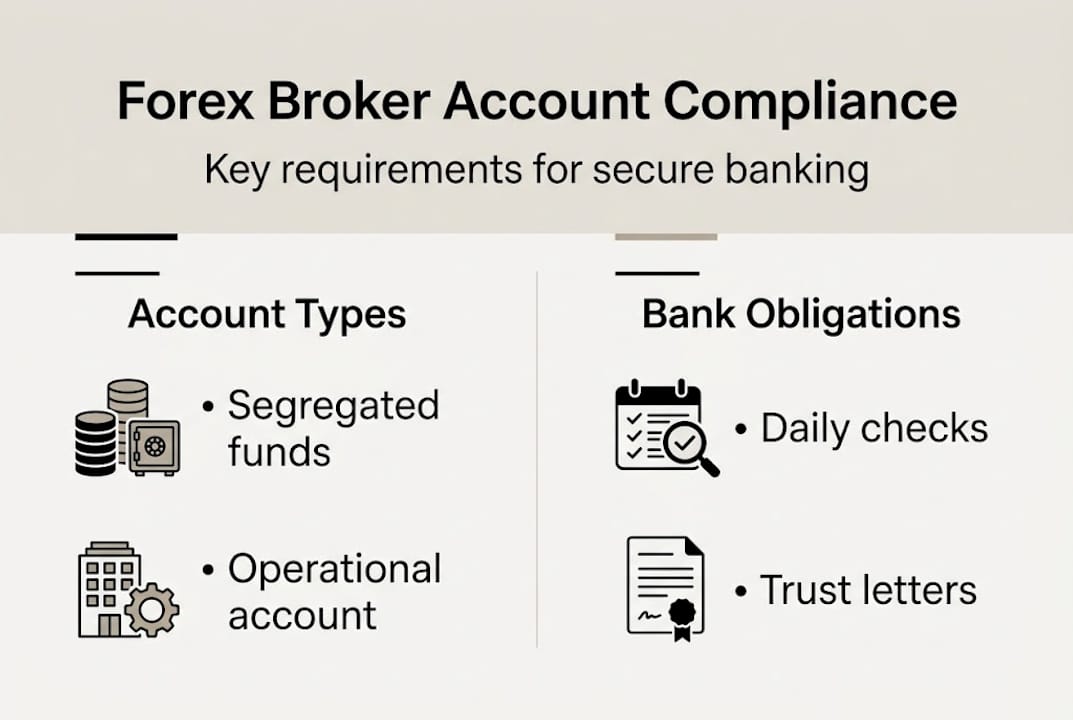
The most fundamental requirement is the separation of client funds from your own operational money. Forex brokers must hold client funds in segregated accounts separate from operational funds to comply with regulations like FCA CASS, CySEC, and ASIC requirements. In practical terms, this means you need at least two distinct accounts: one for your business expenses, salaries, and overheads, and one that holds client deposits exclusively.
This is not simply good practice. Mixing these funds, even accidentally, constitutes a regulatory breach. The FCA’s Client Assets Sourcebook (CASS) is particularly explicit on this point, requiring brokers to identify, record, and protect client money at all times. CySEC and ASIC follow similar frameworks, each with their own audit and reporting cycles.
| Account type | Purpose | Regulatory requirement |
|---|---|---|
| Segregated client account | Holds client deposits only | Mandatory under CASS, CySEC, ASIC |
| Operational account | Business expenses and revenue | Standard commercial account |
| Reserve or buffer account | Covers operational shortfalls | Recommended, not always mandatory |
Daily reconciliations and trust letters
Regulators do not simply trust that you are segregating funds correctly. They expect you to prove it, every single day. Daily reconciliation means comparing your internal records of client balances against the actual bank balance in your segregated account. Any discrepancy must be investigated and resolved promptly.
Banks also play a direct role here. Most regulators require that your segregated account is held at a bank that has issued a trust letter, also known as a set-off waiver. This letter confirms that the bank will not use client funds to offset any debts your brokerage owes to that bank. Without this letter, client funds remain vulnerable in an insolvency scenario.
Pro Tip: When approaching banks for a forex bank account opening, ask directly whether they issue trust letters as standard practice. Many mainstream banks do not, which immediately disqualifies them for your segregated account.
Failure to comply with these requirements carries serious consequences. Regulators can issue fines, suspend trading permissions, or revoke your licence entirely. The FCA alone has issued penalties exceeding £1 million for CASS breaches. For brokers operating across multiple jurisdictions, SEPA accounts for high-risk businesses can provide the multi-currency infrastructure needed to meet obligations in several regulatory zones simultaneously.
Need support? Secure your forex payment processing with experts
Navigating forex payment processing alone is genuinely challenging, and the cost of repeated rejections goes far beyond wasted application fees. BankMyCapital specialises in helping forex firms and other high-risk businesses access secure, compliant forex payment processing setup through a network of over 50 pre-vetted banking partners and EMIs. With an 87% approval rate and typical onboarding completed within two to three weeks, we reduce the friction that makes this process so costly for businesses attempting it without specialist support. Our team handles everything from document preparation to compliance interviews and technical integration guidance, following best practices for high-risk payments. If you have already experienced rejection or want to avoid it entirely, review our banking rejection risks resource to understand where the gaps in your application may lie.
Recommended
- Step-by-step payment processing setup for high-risk businesses
- Payment processing setup guide for high-risk businesses
- Adult site payment processing: secure solutions guide
- Payment processing best practices for high-risk businesses 2026
Frequently asked questions
What documents are required to secure forex payment processing?
Common documents include company formation records, licences, proof of address, shareholder registry, and AML/KYC policy statements. Refer to preparation documents for payment accounts for a full checklist tailored to forex broker applications.
Why do banks often reject forex payment processing applications?
Banks typically reject applications due to missing paperwork, unclear business models, or inadequate compliance measures. Reviewing the causes of rejection for high-risk sector applications helps firms identify and address gaps before submission.
How can a forex business improve its approval chances?
Work exclusively with providers that specialise in high-risk sectors and submit complete, well-organised compliance documentation from the outset. Specialist providers increase high-risk business payment success rates measurably compared to generic PSPs.
What are ongoing compliance requirements for maintaining payment processing?
Update KYC documents regularly, conduct internal audits at least twice yearly, and monitor transactions for suspicious activity in real time. KYC updating and audit necessity for high-risk businesses is a continuous obligation, not a one-time exercise at onboarding.
