
TL;DR:
- Regulatory licensing grants legal authority and builds trust in high-risk sectors like crypto and gaming.
- Licensing improves banking access, reduces breach risks, and directly increases revenue opportunities.
Regulatory licensing is the mandatory government authorisation that legitimises business operations, enforces accountability, and protects the public from unqualified or fraudulent operators. For businesses in crypto, iGaming, adult entertainment, and forex, this is not a bureaucratic formality. It is the foundation on which banking relationships, enterprise contracts, and consumer trust are built. Compliance certifications directly affect revenue: SOC 2 Type II certified firms win 40% more enterprise deals, and compliant startups close those deals 20–30% faster. Understanding why regulatory licensing matters is the first step to treating it as a business asset rather than a cost.
Why regulatory licensing matters in high-risk industries
Regulatory licensing is the formal process by which a government authority grants a business the legal right to operate within a defined scope. It differs from voluntary certification in one critical way: licensing creates permanent jurisdiction. Authorities can subpoena records, investigate conduct, and bar a business from operating entirely. Voluntary certification carries no such power.
For high-risk operators, the types of licences you need depend on your sector and target jurisdiction. Common examples include:
- VASP licences (Virtual Asset Service Provider) for crypto businesses operating in the EU under MiCA regulation
- iGaming licences issued by bodies such as the Malta Gaming Authority or the UK Gambling Commission
- EMI licences (Electronic Money Institution) for payment processing and fintech operations
- Forex dealer licences required by regulators such as the FCA or CySEC for currency trading platforms
Each licence type comes with ongoing obligations. These typically include surety bonds, regular examinations, anti-money laundering controls, and annual compliance reporting. Surety bonds for licensed businesses can range from thousands to six figures, providing financial protection to consumers if the business fails to meet its obligations. That financial commitment signals to banks, partners, and customers that you have skin in the game.
Pro Tip: Map your target markets before applying for any licence. Jurisdictional requirements vary significantly. A Maltese iGaming licence covers EU markets but may not satisfy regulators in the UK or specific offshore territories. Getting this wrong early costs months of remediation later.

How does licensing improve business performance?
The measurable business case for compliance is stronger than most operators realise. Firms with compliance certifications report 50% fewer security breaches. Security breaches cost an average of $4.4 million in 2026. That means a single avoided breach can outweigh years of compliance investment.
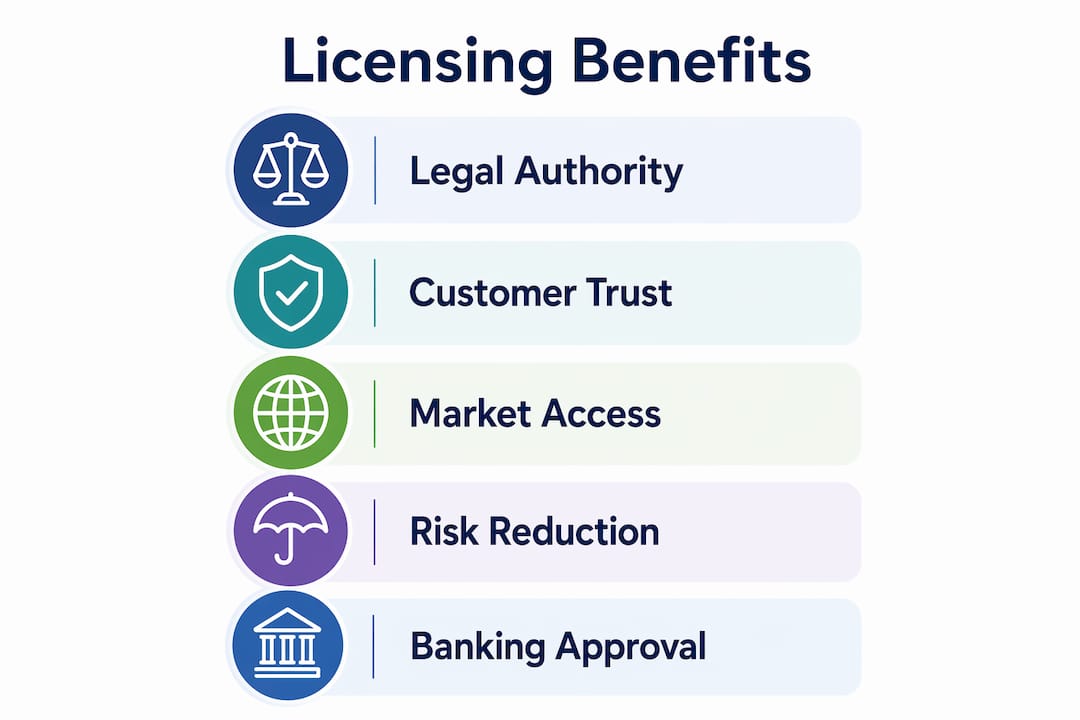
The revenue impact is equally significant. Compliance can unlock between $250 million and $770 million in new revenue for large firms. For smaller high-risk operators, the practical effect shows up in deal velocity and banking access. Banks and enterprise buyers run compliance checks before they commit. A valid licence removes the single biggest objection in those conversations.
The benefits of regulatory compliance extend beyond risk reduction:
- Banking access. Licensed businesses face far fewer rejections from EU banks and EMIs. Bankmycapital’s network of over 50 pre-vetted banking partners prioritises applicants with clean licensing documentation.
- Insurance terms. Strong regulatory compliance aligns with insurer requirements, improving coverage terms and potentially lowering premiums. Your risk posture directly affects what underwriters will offer.
- Brand credibility. A licence from a recognised regulatory body signals legitimacy to customers who cannot otherwise verify your operations. This is particularly valuable in crypto and iGaming, where consumer scepticism is high.
- Competitive positioning. Licensing acts as a market entry barrier. Once you hold a licence, competitors without one cannot access the same customer base or banking infrastructure.
Privacy and regulatory requirements, when treated as a competitive advantage rather than a burden, build trust with customers and partners that is very difficult to replicate through marketing alone.
What are the consequences of unlicensed practices?
Operating without the correct licence in a high-risk sector is not a grey area. The consequences are direct, severe, and often irreversible.
- Regulatory prosecution. Authorities in the EU, UK, and most offshore jurisdictions treat unlicensed operation as a criminal offence. Fines can reach millions of euros, and directors face personal liability in many cases.
- Banking termination. Banks conduct periodic reviews of their business clients. An unlicensed operator discovered during a review faces immediate account closure, often with frozen funds and no appeal window.
- Failed compliance audits. Failed compliance reports cost upwards of $100,000 each, including remediation costs and lost pipeline time. Remediation alone can take up to three months, stalling sales and partnerships during that period.
- Reputational collapse. A single enforcement action or public compliance failure can end customer relationships that took years to build. In iGaming and crypto, where trust is the product, reputational damage is often permanent.
- Loss of payment processing. Payment processors and card networks terminate merchants who fail compliance checks. Without payment infrastructure, a high-risk business cannot operate regardless of its other assets.
Pro Tip: Do not assume that 12% of businesses experiencing rejected compliance reports is a remote risk. That figure reflects real audit failures across regulated industries. Budget for compliance from day one, not as a crisis response.
The impact of licensing regulations on business continuity is not theoretical. Operators who treat licensing as optional discover its importance only after enforcement action has already begun.
How to build licensing into your business strategy
The most common mistake high-risk operators make is treating licensing as a late-stage task. Integrating licensing strategy early in product design avoids costly pivots and compliance failures later in the growth cycle. Late-stage licensing issues cause product feature rollbacks and operational constraints that are expensive to fix.
A second critical mistake is relying on a partner’s licence rather than acquiring your own. Using a partner’s licence creates strategic dependency. You lose operational control, and if that partner loses their licence or exits the market, your business loses its legal foundation overnight. This risk is particularly acute in crypto and iGaming, where regulatory environments shift quickly.
The table below compares two approaches to licensing strategy:
| Approach | Timing | Risk level | Business control |
|---|---|---|---|
| Licence acquired independently | Pre-launch or early growth | Low | Full operational autonomy |
| Reliance on partner’s licence | Ongoing dependency | High | Limited, subject to partner’s status |
| Late-stage licence application | Post-product build | Medium to high | Requires potential feature rollbacks |
| Jurisdiction-first planning | Pre-roadmap | Low | Maximised from day one |
Practical steps to secure and maintain your licence include selecting the right jurisdiction before building your product, engaging a specialist consultancy to manage the application process, and scheduling compliance reviews at least quarterly. Licensing is not a one-time event. Regulatory bodies conduct ongoing oversight, and your compliance posture must reflect current requirements, not those that existed at the time of your original application.
The roles of regulatory agencies extend well beyond issuing licences. They monitor conduct, respond to consumer complaints, and update requirements as markets evolve. Staying ahead of those changes is an operational discipline, not a legal department task.
Key takeaways
Regulatory licensing is the single most important compliance asset a high-risk business can hold, directly affecting banking access, revenue growth, and long-term operational survival.
| Point | Details |
|---|---|
| Licensing creates legal authority | Regulatory bodies can subpoena, investigate, and bar unlicensed operators from trading entirely. |
| Compliance drives measurable revenue | SOC 2 Type II certified firms win 40% more enterprise deals and close them 20–30% faster. |
| Breaches cost millions without compliance | Firms with certifications report 50% fewer breaches; the average breach costs $4.4 million in 2026. |
| Late licensing causes costly rollbacks | Integrating licensing early in product design prevents feature reversals and stalled growth. |
| Partner licence dependency is a serious risk | Relying on a third party’s regulatory status removes your operational control and business continuity. |
Bankmycapital supports your licensing and banking compliance
High-risk operators face a specific problem: banks and regulators assess your licensing status before they assess anything else. Without the right documentation, even a well-run business faces rejection. Bankmycapital specialises in guiding crypto, iGaming, forex, and adult entertainment businesses through the full licensing and banking approval process. With a network of over 50 pre-vetted banking partners and an 87% approval rate, Bankmycapital removes the guesswork from compliance preparation. Whether you need to understand banking rejection risks or want a clear path to passing bank compliance for your high-risk account, the team provides jurisdiction-specific guidance built around your sector. Onboarding takes 2–3 weeks, and every engagement is backed by Swiss-grade data encryption.
FAQ
What is regulatory licensing for a business?
Regulatory licensing is the formal government authorisation that grants a business the legal right to operate within a specific sector and jurisdiction. It differs from voluntary certification because it creates ongoing jurisdiction, meaning authorities can investigate and bar operations at any time.
Why is licensing essential for high-risk businesses specifically?
High-risk businesses in sectors such as crypto, iGaming, and forex face heightened scrutiny from banks, payment processors, and regulators. A valid licence removes the primary objection in banking applications and enterprise sales conversations, directly improving approval rates and deal velocity.
What are the financial consequences of operating without a licence?
Unlicensed operation exposes a business to criminal prosecution, account termination, and compliance audit failures that cost upwards of $100,000 each in remediation and lost pipeline time. Remediation can stall operations for up to three months.
How does licensing affect banking access for high-risk operators?
Banks and EMIs conduct compliance checks before opening accounts for high-risk businesses. A recognised licence from a body such as the Malta Gaming Authority, FCA, or a VASP-authorised regulator significantly reduces rejection risk and accelerates the onboarding process.
When should a high-risk business apply for its licence?
Licensing strategy should be embedded at the product design stage, before the business builds features that may require regulatory approval. Late-stage applications frequently force feature rollbacks and create compliance gaps that delay market entry.
