
Adult entertainment, dating platforms, and adult content creators face severe banking discrimination despite regulatory legitimacy in many jurisdictions. Traditional banks categorise adult businesses as reputational risks, imposing impossible requirements or outright rejecting applications. This guide explains compliance requirements specific to adult industry operations, banking partner selection strategies that succeed, and operational best practices enabling adult industry businesses to secure stable banking infrastructure despite regulatory hostility.
Key takeaways
| Point | Details |
|---|---|
| Adult industry regulatory legitimacy varies by jurisdiction | EU member states regulate adult content differently; clear licensing significantly improves banking access |
| Traditional bank rejection rates exceed 90% | Mainstream banks avoid adult industry regardless of business legitimacy due to reputational concerns |
| Compliance becomes competitive advantage | Robust age verification, content moderation, and transaction monitoring demonstrate institutional-grade operations |
| Specialist banks understand adult industry operations | Boutique banks serving adult sectors understand revenue patterns, customer demographics, and regulatory nuances |
| EMIs increasingly serve adult industry | Payment Service Directive frameworks enable EMI specialisation in adult industry payment processing |
| Pre-approval strategy dramatically improves approval likelihood | Engaging banking specialists before applications prevents rejections that damage banking reputation |
Understanding adult industry banking challenges
Adult businesses encounter fundamentally different banking challenges than mainstream commercial operations. Traditional banks apply blanket policies excluding adult entertainment regardless of individual business legitimacy. These policies reflect reputational risk management rather than legal prohibitions—adult industry operations remain legal in most jurisdictions, yet banking access remains severely restricted.
Multiple layers of regulatory complexity compound banking difficulty. Age verification requirements demand robust systems preventing minor access. Payment processing incorporates additional fraud prevention requirements. Content moderation obligations require operational transparency satisfying banking compliance teams. Transaction monitoring thresholds differ from mainstream business, requiring sector-specific compliance frameworks. According to the FCA’s position on adult industry banking access, legitimate, properly-licensed adult operations should receive equivalent banking access as other regulated industries, though implementation remains inconsistent across individual banks.
Banking discrimination impacts adult business operations severely. Payment processing interruptions devastate businesses depending on continuous cash flow. Customer acquisition costs soar when payment methods become unreliable. Vendor relationships deteriorate when banking uncertainty makes payment obligations uncertain. Growth financing becomes impossible—credit facilities disappear when banking partners terminate relationships.
Pro Tip: Assume all adult businesses face banking hostility from mainstream institutions. Plan strategy assuming traditional banking access will never materialise reliably. This realistic framing prevents wasted effort approaching banks unlikely to approve regardless of application strength, focusing instead on specialist banking partners understanding adult industry operations.
Regulatory compliance frameworks for adult content businesses
Effective adult industry banking requires understanding that compliance becomes your primary competitive advantage. Unlike mainstream businesses where compliance represents minimum legal requirement, adult businesses achieve banking access through exceeding compliance expectations—demonstrating operational standards exceeding those of mainstream industries.
Age verification systems represent the regulatory cornerstone for adult content platforms. Effective systems verify user age before access, preventing minor exposure and satisfying banking compliance requirements. Technical implementation matters—basic age-gating systems trigger banking partner skepticism; comprehensive document verification (ID scanning, age verification services integration) demonstrates compliance seriousness. According to UK legislation on age verification, robust age verification systems significantly strengthen banking applications for adult content platforms.
Content moderation systems address legitimate compliance concerns about illegal content distribution. Adult industry banking applications improve dramatically when you demonstrate comprehensive moderation preventing copyright violation, non-consensual content, exploitation material, and other regulatory violations. Moderation-related account closures represent primary risk for adult businesses; demonstrating proactive compliance prevents this disruption category.
Transaction monitoring and fraud prevention systems warrant particular attention for adult industry banking. Payment processing in adult sector attracts fraud attempts, chargebacks, and dispute escalation at rates significantly exceeding mainstream business. Banking partners scrutinise fraud prevention capability carefully; robust systems detecting fraud patterns, preventing account takeover, and managing chargeback response demonstrate operational sophistication satisfying banking compliance requirements.
| Compliance Element | Requirement | Banking Significance | Best Practice |
|---|---|---|---|
| Age Verification | Prevent minor access (regulatory) | Critical for account approval | Document verification + ID scanning integration |
| Content Moderation | Remove illegal/exploitative content | Account stability foundation | Automated flagging + human review process |
| Payment Processing Compliance | KYC/AML standards | Transactional foundation | Equivalent standards as mainstream business |
| Chargeback Management | Dispute resolution capability | Account preservation critical | Targeted retention messaging + documentation protocol |
| Transaction Monitoring | Fraud/AML detection | Ongoing relationship requirement | Advanced velocity checks + unusual pattern flagging |
Legitimate adult industry operations can satisfy these requirements comprehensively. The challenge involves communicating compliance effectiveness to banking partners. Generic compliance claims trigger skepticism; specific operational documentation—system architecture descriptions, moderation metrics, fraud loss rates, chargeback management statistics—demonstrates institutional-grade operations.
Banking partner selection for adult industry businesses
Traditional EU banks rarely approve adult industry applications regardless of compliance strength. Attempts to force access through traditional banking waste time and damage banking reputation (rejected applications create records affecting future applications). Strategic banking partner selection focuses instead on specialist institutions understanding adult industry operations.
Specialist banks serving adult industry operate globally from jurisdictions like Malta, Cyprus, Curacao, and Seychelles. These institutions build their business models around serving sectors traditional banks reject, maintaining dedicated teams with adult industry expertise. Their compliance frameworks specifically accommodate adult business patterns—they understand high chargeback rates, high-frequency transactions, and international customer bases characteristic of adult industry operations.
EMIs increasingly serve adult industry, particularly in EU jurisdictions where PSD2 frameworks enable specialisation. Adult-focused EMIs maintain higher approval rates (60-70% vs 10-20% for banks) and faster onboarding (2-4 weeks vs 8-16 weeks for traditional banking). According to EBA guidance on payment institution licensing for high-risk sectors, EMIs properly licensed under PSD2 can maintain equivalent compliance standards as traditional banks whilst accommodating innovation in underserved sectors.
Payment processor selection represents the critical operational decision for adult businesses. Specialist processors understand adult industry transaction patterns, maintain banking relationships with adult-friendly institutions, and provide customer acquisition-compatible payment options. Mainstream payment processors increasingly exclude adult businesses through merchant agreements; specialist processors maintain adult compatibility.
Multi-currency capabilities become operationally critical for adult businesses serving global customer bases. Adult content consumption patterns transcend geographic boundaries; global payment processing capability enables customer acquisition across jurisdictions. Banking partners serving adult industry maintain multi-currency settlement, enabling revenue management across different currency exposure and customer concentration.
Pro Tip: Prioritise banking partners demonstrating adult industry experience over those claiming openness to high-risk businesses broadly. Specialist adult-focused banks have overcome regulatory obstacles, developed compliant operational frameworks, and managed industry-specific challenges. Generic high-risk banking partners lack adult industry expertise, increasing relationship risk.
Implementation strategy: Securing adult industry banking access
Implementation begins with honest assessment of your operational compliance posture. Document age verification systems, content moderation processes, transaction monitoring capabilities, and fraud prevention effectiveness. This documentation becomes your primary asset when approaching banking partners.
Engage banking specialists experienced with adult industry before direct bank approaches. These specialists understand which institutions maintain open applications, which compliance frameworks satisfy specific bank requirements, and which positioning strategies overcome regulatory objections. Pre-application consultation prevents wasted rejection applications damaging banking reputation.
Application strategy should emphasise compliance comprehensiveness rather than business model innovation. Adult industry banking applications succeed when demonstrating how thoroughly your operations prevent harms traditional banks fear. Age verification prevents minor exposure. Content moderation prevents exploitation and copyright violation. Payment processing compliance prevents money laundering misuse. Transaction monitoring prevents fraud. This compliance focus satisfies regulatory concerns, enabling banking approval.
Prepare for extensive documentation requirements. Banking partners evaluating adult industry applications demand greater documentation depth than mainstream business applications. System architecture documentation, operational procedure documentation, compliance policy documentation, team expertise documentation, and audit results documentation all strengthen applications. The documentation effort appears substantial, but separates successful applications from rejected ones consistently.
Documentation checklist for adult industry banking applications should include: business registration and licensing documentation; compliance policy documentation (age verification, content moderation, fraud prevention, AML/KYC frameworks); technical system documentation (payment processing integration, fraud detection systems, transaction monitoring infrastructure); operational metrics (monthly active users, transaction volumes, chargeback rates, fraud loss rates); team expertise documentation (relevant experience managing regulated operations); and independent audit results demonstrating compliance effectiveness.
Timeline expectations require patience. Adult industry account approvals typically require 6-10 weeks—longer than mainstream business but substantially faster than attempting direct traditional bank approaches (which rarely succeed regardless of timeline). This timeline allows banking partners to thoroughly evaluate operations and satisfy their own compliance requirements.
Multi-jurisdiction strategy for adult industry banking resilience
Single-jurisdiction reliance creates severe risk for adult businesses when regional regulatory shifts trigger mass account terminations. Multi-jurisdiction strategy distributes risk across different regulatory environments, ensuring business continuity survives regional disruption.
EU jurisdictions provide market access for European customer bases and regulatory alignment within European frameworks. However, EU regulatory environment increasingly pressurises adult industry—recent content regulation focus and age verification mandates add compliance burden. EU accounts remain valuable for European market access, but shouldn’t represent sole banking foundation.
Offshore jurisdictions (Malta, Cyprus, Seychelles, Curacao) provide operational flexibility and adult-friendly regulatory environments. These jurisdictions actively accommodate adult industry, maintaining sophisticated regulatory frameworks without hostile policy posture. Offshore accounts enable back-office operations, liquidity management, and non-EU customer processing without EU regulatory burden.
Hybrid strategy combining EU and offshore accounts provides optimal positioning: EU accounts serve European customer operations meeting local regulatory requirements; offshore accounts manage global operations and back-office functions. This structural separation prevents the appearance of regulatory arbitrage whilst actually enabling operational flexibility and regulatory resilience.
How to Open an Adult Industry Bank Account: Step by Step
What you need before applying
The single biggest reason adult industry applications stall is missing or inconsistent paperwork. Banks, particularly those willing to serve higher-risk sectors, use your documents to build a picture of who is behind the business. Gaps in that picture trigger scrutiny. Complete it before you walk through the door, digitally or otherwise.
Core documents every applicant needs
Opening a business bank account requires government-issued ID, EIN, and formation documents as a baseline. In practice, your checklist will look like this:
- Government-issued photo ID (passport or driving licence) for every applicant
- Employer Identification Number (EIN) confirmation letter from HMRC or the IRS, depending on your jurisdiction
- Certificate of incorporation or articles of organisation
- Operating agreement (mandatory for multi-member LLCs and strongly recommended for single-member entities)
- Business licence or regulatory permit where applicable
- Recent bank statements or financial projections for new businesses
For corporations, you will also need board resolutions authorising the account opening and naming the authorised signatories.
Beneficial ownership requirements in 2026
This is where many applicants underestimate the complexity. Beneficial ownership rules require 25%+ owners to provide their full name, date of birth, residential address, and a government-issued ID number. For each control person, you will typically need the same. If your adult entertainment business has multiple investors or shareholders above that threshold, each one must be documented individually.

FinCEN’s 2026 exceptive relief reduces how often banks must re-verify this data. The practical implication: banks can limit re-verification to the initial account opening unless ownership changes or doubts arise. That is good news for ongoing administration, but it places significant weight on getting the information right the first time.
| Business type | Core documents required |
|---|---|
| Sole trader | Photo ID, EIN/UTR, proof of business address |
| Single-member LLC | Photo ID, EIN, articles of organisation, operating agreement |
| Multi-member LLC | IDs for all 25%+ owners, EIN, operating agreement, beneficial ownership forms |
| Corporation | Articles of incorporation, EIN, board resolution, beneficial ownership forms |
Pro Tip: Have your solicitor or legal adviser review your operating agreement before submission. Generic agreements that do not explicitly grant banking authorities are frequently rejected by banks during compliance review.
Step-by-step account opening process
Once your documentation is in order, the process becomes considerably more manageable. The mistake most people make is approaching a mainstream bank first, receiving a rejection, and then struggling to recover from that negative mark on their record.
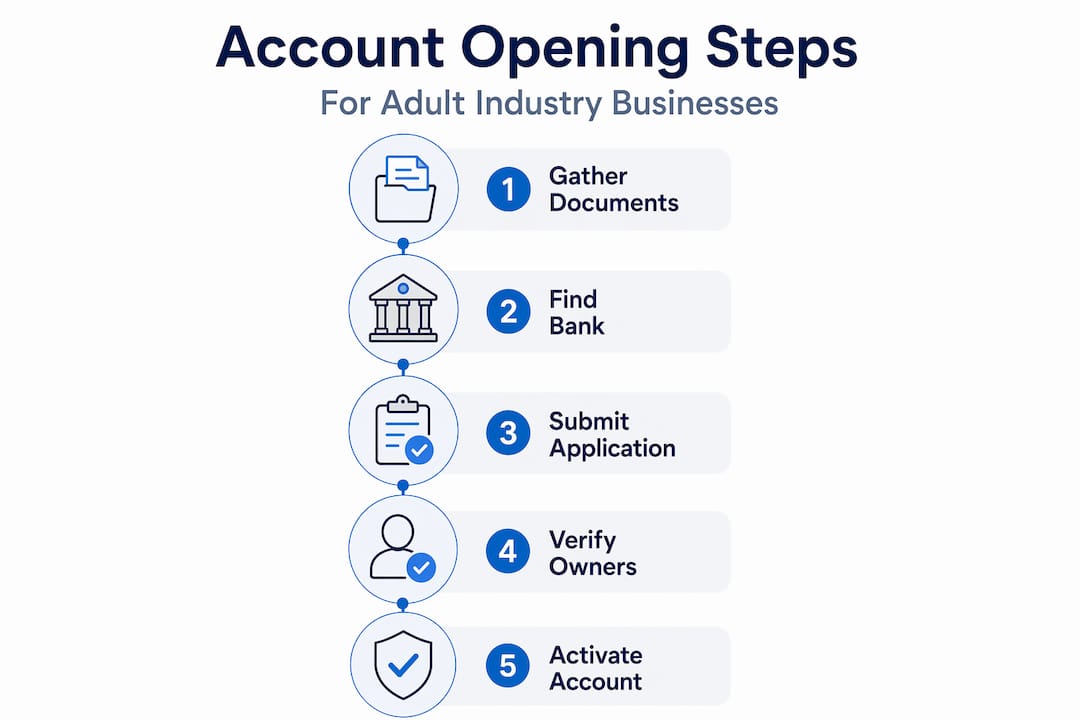
- Identify adult-friendly institutions first. Specialist banking providers and certain European banks are far more receptive to adult businesses than high-street banks. Research your options before submitting anything.
- Prepare a clean application pack. Organise all documents as outlined in the previous section. Make sure every name, address, and registration number is consistent across all documents. Inconsistencies raise flags immediately.
- Complete beneficial ownership declarations accurately. For multi-member structures, each owner above 25% must complete their own form. Do not approximate or omit anyone.
- Submit your application and ID verification. Many specialist providers and online banking platforms now offer digital identity verification, which allows signatories in different locations to participate without visiting a branch. This is particularly useful for businesses with partners across multiple countries.
- Execute signature cards and account authority documents. Once the bank approves the application, you will sign documents defining who can operate the account and at what level. Be specific about transaction limits and dual-authority requirements if relevant.
- Fund the account and confirm functionality. Make an initial deposit, test the payment rails you need (card processing, international transfers, and so on), and confirm your payment processor has the correct account details.
Pro Tip: When dealing with multi-member businesses, get your operating agreement to explicitly state who holds banking authority and what transaction thresholds require joint approval. Banks need to see this in writing, not just hear about it verbally.
Common mistakes and how to avoid them
The adult entertainment sector faces a particular set of obstacles when it comes to adult industry business banking. Understanding them in advance is how you avoid them.
Banks delay or reject accounts for predictable reasons. The most common are listed below, along with the fixes.
- Unclear or generic business descriptions. Vague descriptions like “media company” or “content services” without specifics raise more suspicion than honest disclosure. Be precise about what the business does. Banks doing their due diligence will find out anyway.
- Inconsistent ownership documentation. If your articles of organisation name four members but your beneficial ownership form only lists two, expect the application to be paused. Audit every document for consistency before submission.
- Outdated business registration. Missing annual filings or delinquent status causes applications to stall or fail. Check your standing with the relevant registrar before applying.
- Misunderstanding 2026 FinCEN updates. Some business owners assume the exceptive relief means they can submit less information upfront. It does not. The relief applies to re-verification frequency, not initial submission requirements.
- Applying to the wrong institutions. A mainstream retail bank is not your best starting point. Understanding your banking options for adult industry businesses, including specialist EMI providers and offshore accounts, can dramatically improve your success rate.
When an application is delayed rather than outright rejected, communicate directly with the bank’s compliance officer rather than the relationship manager. Compliance staff can often tell you exactly what is missing, whereas relationship managers may not have visibility into the specific concern.
Why Banks Reject Adult Businesses (and How to Get Approved)
Understanding the high-risk label: why adult businesses are flagged
Before you can solve a banking problem, you need to understand how banks categorise your business. The term “high risk” is not a moral judgement. It is a technical classification that determines how much compliance work a bank must do to maintain your account, and how much regulatory exposure they accept by doing so.
Adult industry businesses are frequently classified as high risk due to reputational, legal, and regulatory factors. This matters because classification directly affects which internal team reviews your application, what documentation they demand, and whether the bank’s board-level risk policy even permits them to onboard you.
Several characteristics push adult businesses into this category:
- Reputational sensitivity: Banks are publicly traded or publicly scrutinised institutions. Associating with adult content can attract negative press, shareholder concern, or activist campaigns.
- Legal ambiguity across jurisdictions: What is fully legal in the Netherlands may be restricted in another EU member state. Cross-border operations create compliance headaches that most banks prefer to avoid.
- Elevated chargeback rates: Adult subscription services and pay-per-view platforms historically see higher chargeback rates than mainstream e-commerce. Banks treat this as a direct financial risk.
- Fraud exposure: The adult sector attracts a disproportionate share of stolen card usage and identity fraud, which increases a bank’s anti-money laundering obligations.
- Regulatory scrutiny: Regulators in multiple jurisdictions actively monitor financial institutions that service adult content platforms, adding compliance cost for the bank.
You can explore risk profiles for adult companies in detail, but the core issue is this: banks are businesses too, and the cost of managing your account often outweighs the revenue you generate for them.
According to high-risk business banking research, financial institutions apply tiered risk assessments that factor in industry type, transaction volume, and geographic reach simultaneously.
“The adult sector is not rejected because it is illegal. It is rejected because the compliance cost of servicing it exceeds what most banks are willing to absorb.”
Pro Tip: When approaching any bank, reframe your application around risk mitigation rather than business description. Lead with your compliance certifications, chargeback management tools, and fraud prevention systems before you mention what your platform actually does.
Frequent rejection reasons: what banks tell you (and what they don’t)
Bank rejection letters are famously unhelpful. Most cite vague risk terminology, and owners report generic explanations for rejections that give them no actionable information. This is partly legal caution on the bank’s part, and partly a reflection of how internal decisions are actually made.
Here is a comparison of what banks say versus what is typically driving the decision:
| Official reason given | Real underlying motivation |
|---|---|
| Outside our risk appetite | Board-level policy bans adult sector entirely |
| Reputational risk concerns | Fear of negative press or activist pressure |
| Compliance concern | Application documentation was incomplete or unclear |
| Policy change | Bank lost a major client due to adult sector exposure |
| Incomplete documents | Reviewer found a gap and used it as an exit point |
Beyond the table above, several factors trigger rejections that applicants rarely anticipate:
- Inconsistent business descriptions: If your website, your incorporation documents, and your application form describe your business differently, compliance officers flag this immediately.
- Unresolved chargebacks: Any history of unresolved payment disputes will surface during the review and is treated as evidence of poor operational controls.
- Beneficial owner red flags: If any director or shareholder appears on a sanctions list or has a prior financial crime conviction, the application stops immediately regardless of the business’s own record.
- Jurisdiction mismatch: Incorporating in a low-tax jurisdiction while claiming to serve only EU customers raises questions about the true purpose of the structure.
The banks clamp down on adult sector trend has accelerated since 2020, with several major European banks formally excluding the category from their commercial banking programmes. Understanding common application mistakes is essential before you submit anywhere.
For operators specifically in the dating and adult content space, the adult and dating account setup process has its own specific requirements that differ from broader adult industry applications.
Alternative banking routes: offshore, fintech, and pre-approval strategies
Repeated rejections from mainstream banks do not mean you are out of options. The banking landscape for high-risk businesses has changed considerably, and several viable routes now exist if you know where to look.

Offshore and fintech banking options continue to grow in popularity among high-risk sectors, though they require careful vetting. Here is a practical overview:
| Banking route | Key advantages | Key risks |
|---|---|---|
| Offshore bank (EU-regulated) | Flexible risk appetite, multi-currency | Higher fees, slower transfers |
| E-money institution (EMI) | Fast onboarding, API integration | Lower transaction limits |
| Specialist fintech bank | Adult sector experience, fewer restrictions | Fewer consumer protections |
| Pre-approval service | Matched to willing banks before applying | Requires a trusted intermediary |
To access these routes safely, follow these steps:
- Assess your actual needs first. Do you need a full current account, a merchant account, or simply a payment processing solution? The answer determines which route suits you.
- Vet the provider’s regulatory status. Any bank or EMI you consider must hold a valid licence from a recognised regulator. Check the relevant national register before engaging.
- Understand the fee structure fully. Alternative banking routes often carry higher transaction fees or monthly maintenance costs. Model these against your revenue before committing.
- Use a pre-approval process where available. Bank account pre-approval matches your profile to institutions that have already confirmed willingness to review your sector, saving time and protecting your credit history from unnecessary hard checks.
The high-risk sector assessment published in 2026 highlights the growing regulatory attention on non-bank financial institutions serving high-risk sectors, making provider vetting more important than ever.
Pro Tip: Never apply to multiple banks simultaneously without a pre-approval strategy. Each rejection creates a record that subsequent banks can sometimes identify, reducing your approval odds further. A structured, sequential approach with matched institutions dramatically improves outcomes.
Payment Processing and Merchant Accounts for Adult Businesses
How can adult businesses optimise payment processing?
Payment stack design directly determines whether an adult business survives its first year of operation. The right architecture reduces chargeback exposure, handles subscription renewals without friction, and gives you the data needed to stay ahead of VAMP thresholds.
A well-constructed payment stack for an adult website typically includes a merchant account with an adult-experienced acquirer, a gateway with tokenisation and recurring billing support, a fraud screening layer, and a reporting tool that surfaces dispute and fraud metrics in real time. Each component must be selected with adult industry expertise in mind. A gateway built for e-commerce will not handle the subscription churn patterns or the dispute profiles typical of adult content platforms.
For recurring billing, card updater services reduce involuntary churn by automatically refreshing expired or reissued card details before a renewal attempt fails. Tokenisation stores card data securely off your servers, reducing PCI DSS scope and the risk of a data breach triggering account termination. These are not optional features. They are the difference between a subscription business that retains 85 per cent of its subscribers month-on-month and one that loses 20 per cent to failed renewals.
Fraud prevention at the transaction level requires Address Verification Service (AVS) checks, CVV validation, velocity rules that flag unusual transaction patterns, device fingerprinting, and enumeration detection to catch credential-stuffing attacks. Adult platforms are disproportionately targeted by enumeration because stolen card testing is harder to detect on sites where cardholders are reluctant to report fraudulent charges. Each of these controls reduces your TC40 fraud metric, which feeds directly into your VAMP score.
Pro Tip: Review your billing descriptor with a test transaction before going live. Ask five people who know nothing about your business what they think the charge is for. If they cannot identify it, your descriptor will generate disputes.
Security and Encryption for Adult Finance
What encryption methods are essential for protecting financial data in adult finance?
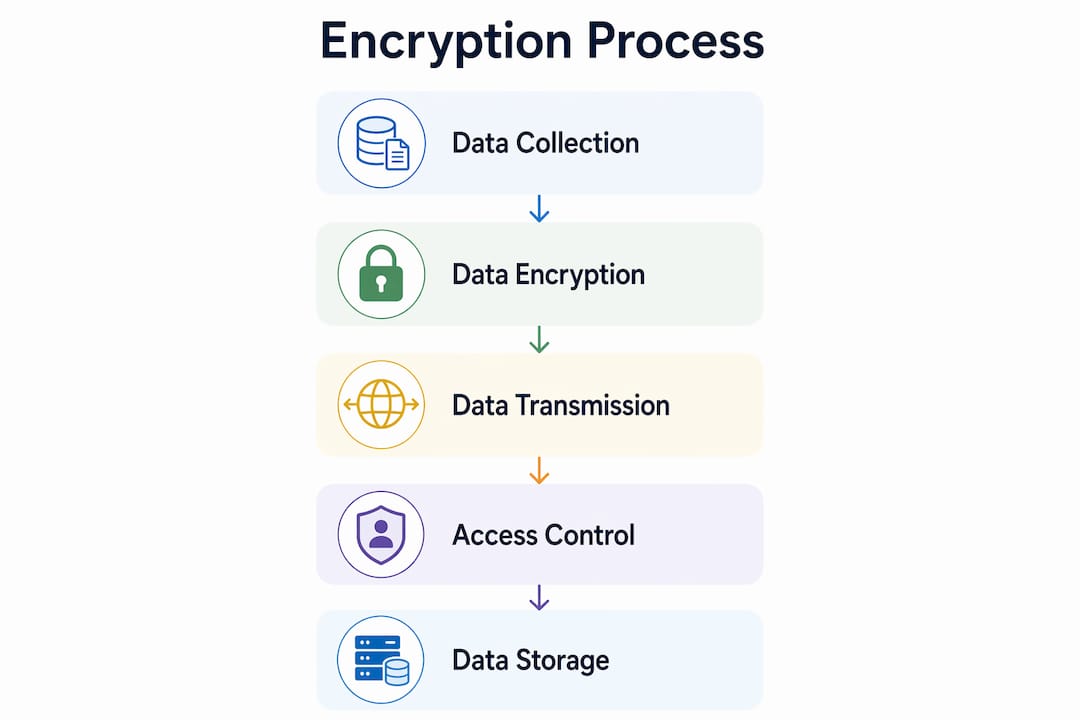
Financial data protection in adult finance rests on two distinct encryption requirements: protecting data while it moves between systems, and protecting data while it sits in storage. Both are mandatory, not optional.

For data in transit, TLS 1.2+ is the minimum accepted by the FTC Safeguards Rule and PCI DSS v4.0. This means every API call, payment gateway connection, and customer portal session must use a current TLS configuration with approved cipher suites. Older protocols such as TLS 1.0 and SSL are explicitly prohibited and will trigger audit failures.
For data at rest, the requirements are equally specific:
- AES-128 as the minimum standard, with AES-256 strongly preferred for cardholder data and personally identifiable information. PCI DSS v4.0 mandates AES-128+ with full documentation of the key management lifecycle.
- Full-disk or equivalent encryption on all servers, laptops, and storage media that hold customer financial records.
- Application-layer field encryption beyond what your cloud provider applies by default. Platforms such as Microsoft Dynamics 365 Finance use Transparent Data Encryption (TDE) at the infrastructure level, but field-level encryption APIs can be added to protect specific sensitive identifiers against insider access.
- Documented cryptographic key management, covering generation, storage, distribution, rotation, retirement, and access controls with separation of duties.
The adult finance environment differs from standard financial services in one critical respect: the sensitivity of client identity data is higher, and the reputational damage from a breach is disproportionate. A payment processor breach at a mainstream retailer is embarrassing. The same breach at an adult platform can destroy client trust permanently.
Pro Tip: Never rely solely on your cloud provider’s default encryption. Apply application-layer field encryption to any field that could identify a customer, including email addresses, billing descriptors, and subscription identifiers.
MFA must be active on every system that touches nonpublic personal information. Authenticator apps and hardware keys are the accepted standard. SMS-based codes are vulnerable to SIM-swap attacks and are no longer considered sufficient for regulated financial environments.
What are the best practices for implementing encryption and security controls?
Implementing adult industry cybersecurity controls effectively requires a structured approach, not a checklist ticked once and forgotten. The table below compares the baseline approach most operators take against the standard that regulators and auditors actually expect.
| Control area | Baseline (common practice) | Compliant standard (required) |
|---|---|---|
| Data in transit | TLS enabled on main website | TLS 1.2+ on all APIs, admin panels, support tools, and third-party integrations |
| Data at rest | Cloud provider default encryption | AES-128+ with documented key management and field-level encryption for sensitive identifiers |
| MFA coverage | Login portal only | All systems accessing nonpublic data: email, VPN, cloud apps, support platforms, remote access |
| Key management | Informal rotation | Documented lifecycle: generation, storage, rotation schedule, retirement, and access logs |
| Vendor security | Contract signed | Contractual security requirements with audit rights and evidence of vendor compliance |
The most common gap Bankmycapital sees in adult finance clients is MFA coverage. Data exposure frequently occurs through support ticketing systems, email logs, and admin dashboards rather than the primary payment platform. These peripheral systems hold the same sensitive data and must be treated identically.
Key management documentation is the second most common failure point. Regulators and auditors expect evidence of the full key lifecycle, not just confirmation that AES-256 is in use. If you cannot produce records showing when keys were generated, who has access, and when they were last rotated, you will fail a PCI DSS audit regardless of the strength of your algorithms.
Pro Tip: Conduct a full inventory of every system that stores or transmits customer financial data before your next compliance review. Include support tools, email platforms, and any third-party integrations. This inventory is the foundation of your encryption programme and a required artefact under the FTC Safeguards Rule.
Vendor management deserves specific attention in adult finance. Payment processors, KYC providers, and fraud detection vendors all handle your clients’ data. Contracts must include explicit security requirements, the right to audit, and breach notification timelines. A vendor’s weak security posture becomes your compliance liability. For guidance on secure payment processing specific to high-risk sectors, the standards are more demanding than mainstream finance.
Offshore Banking Options for the Adult Industry
Top offshore banking options for the adult industry
Several offshore jurisdictions and banking institutions have developed specialised services addressing adult industry financial needs. Understanding the strengths and limitations of each option helps you match banking solutions to your specific operational requirements.
Belize-based banks offer attractive combinations of privacy protection, reasonable fees, and adult industry experience. These institutions typically provide multi-currency accounts, online banking platforms, and relatively straightforward onboarding processes. Belize’s banking secrecy laws protect account holder information whilst maintaining sufficient transparency to satisfy international compliance standards. Transaction fees generally range from 0.5% to 1.5% for international wires, with monthly maintenance costs between $50 and $150.
Cayman Islands banking institutions deliver premium services with correspondingly higher costs. Certain jurisdictions and banks specialise in serving high-risk adult businesses with tailored services and compliance support that justify the increased expense for larger operations. These banks offer sophisticated treasury management, investment services, and established relationships with international payment processors. Expect setup fees from $2,000 to $5,000 and monthly maintenance costs exceeding $200, but benefit from rock-solid stability and extensive banking infrastructure.
Malta and Cyprus present European Union alternatives with strong regulatory frameworks and growing acceptance of banking for adult industry businesses. These jurisdictions combine EU credibility with pragmatic approaches to high-risk sectors. Banks in these locations often provide integrated payment processing, crypto-friendly policies, and access to SEPA transfers. Their compliance requirements are more stringent than Caribbean alternatives but offer enhanced legitimacy for businesses seeking institutional partnerships.
| Jurisdiction | Setup Cost | Monthly Fees | Key Advantages | Typical Processing Time |
|---|---|---|---|---|
| Belize | $500-$1,500 | $50-$150 | Privacy, low cost, straightforward onboarding | 2-3 weeks |
| Cayman Islands | $2,000-$5,000 | $200-$500 | Stability, premium services, processor relationships | 4-6 weeks |
| Malta | $1,000-$3,000 | $100-$250 | EU credibility, SEPA access, crypto-friendly | 3-5 weeks |
| Cyprus | $800-$2,500 | $80-$200 | Competitive fees, EU framework, adult industry experience | 3-4 weeks |
Several best offshore banks for crypto and gambling also serve adult industry clients effectively. These institutions understand high-risk business models and offer cryptocurrency integration, which increasingly matters for adult platforms accepting digital currency payments. Their experience managing volatile transaction volumes and navigating complex compliance landscapes translates well to adult industry requirements.
- Banks in Belize offer the most accessible entry point with moderate privacy protection
- Cayman Islands institutions provide maximum stability but require larger capital commitments
- European options deliver regulatory credibility whilst maintaining practical high-risk sector support
- Crypto-friendly banks enable diverse payment acceptance and appeal to privacy-conscious customers
Comparing offshore and onshore banking for adult industry businesses
Understanding the fundamental differences between offshore and onshore banking options clarifies why many adult industry businesses ultimately choose international solutions despite the additional complexity.
Onshore banking limitations create constant operational friction for adult entertainment businesses. Domestic banks frequently impose transaction limits, restrict payment processor options, and maintain the right to terminate accounts with minimal notice. You’ll face regular requests for additional documentation, explanations of business activities, and compliance reviews that treat legitimate operations with suspicion. Many onshore institutions simply refuse adult industry accounts outright, forcing you into relationships with second-tier banks charging premium rates for basic services.
Offshore accounts typically offer greater privacy, risk mitigation, and compliance agility compared to onshore accounts whilst providing stable, long-term banking relationships. International banks specialising in high-risk sectors build their business models around serving clients that domestic institutions reject. They won’t suddenly change policies or close accounts because of shifting political winds or reputational concerns.
| Factor | Onshore Banking | Offshore Banking |
|---|---|---|
| Account closure risk | High – frequent policy changes affect adult industry | Low – banks specialise in high-risk sectors |
| Legal protections | Limited – subject to domestic political pressures | Strong – jurisdiction-specific privacy laws |
| Transaction fees | Moderate to high for high-risk accounts | Variable – competitive in specialised jurisdictions |
| Compliance flexibility | Rigid – one-size-fits-all policies | Tailored – industry-specific frameworks |
| Multi-currency support | Limited – primarily domestic currency | Extensive – designed for international business |
| Payment processor access | Restricted – many processors unavailable | Broad – established high-risk processor relationships |
Offshore banking provides regulatory leniency that shouldn’t be confused with regulatory avoidance. Specialised international banks maintain robust compliance programmes specifically designed for adult industry operations rather than forcing square pegs into round holes. They understand that higher chargeback rates, age verification costs, and content moderation expenses represent normal business operations rather than red flags.
The international reach of offshore banking matters enormously for adult platforms serving global audiences. Domestic banks often struggle with international wire transfers, impose unfavourable currency conversion rates, and lack relationships with overseas payment processors. Offshore institutions build their infrastructure around cross-border transactions, offering competitive foreign exchange rates and streamlined international payment processing.
- Onshore banks impose arbitrary restrictions treating adult industry as inherently problematic
- Offshore solutions provide stability through specialisation rather than grudging accommodation
- International banks offer superior multi-currency and cross-border transaction capabilities
- Privacy protections shield business operations from domestic political and reputational pressures
Pro Tip: Use offshore banking combined with compliance strategies to ensure smoother operations and reduce account interruptions. Maintain meticulous records, implement robust age verification systems, and document your compliance efforts to demonstrate professionalism to banking partners.
BankMyCapital guidance for adult industry banking
BankMyCapital specialises in securing banking access for adult entertainment, dating platforms, and content creator businesses operating across EU and offshore jurisdictions. Our 87% approval rate reflects deep expertise in adult industry compliance requirements, regulatory positioning, and banking partner relationships. We understand the specific compliance frameworks satisfying adult industry banking requirements—age verification system specifications, content moderation process documentation, chargeback prevention strategies—that separate successful applications from rejected ones.
Our approach combines assessment of operational compliance posture with strategic banking partner matching. We prepare comprehensive documentation packages satisfying banking partner requirements, position applications to overcome regulatory objections, and maintain relationships ensuring account stability long-term. Our team’s adult industry experience prevents costly mistakes and accelerates approval timelines significantly.
Contact BankMyCapital for comprehensive adult industry banking strategy tailored to your specific operations, or explore our full banking solutions to understand how specialised guidance strengthens banking access for adult industry businesses.
Recommended
- EU Banks vs EMIs for High-Risk Businesses
- Building Resilient Banking Structures for High-Risk Businesses
- Banking Compliance Best Practices for High-Risk Accounts
- How to Open a Business Bank Account for High-Risk Industries in 2026
Frequently asked questions
Why do banks reject adult industry applications despite operational legitimacy?
Traditional banks apply blanket policies excluding adult industry to minimise reputational risk, not due to legal prohibitions. Adult industry remains legal in most jurisdictions; the banking discrimination reflects institutional risk aversion rather than regulatory requirements. Specialist banks and EMIs have overcome these reputational concerns, maintaining adult industry operations successfully. According to the Financial Conduct Authority guidance, properly regulated adult operations should receive equivalent banking access as other regulated industries.
What compliance requirements specifically strengthen adult industry banking applications?
Robust age verification systems preventing minor access represent the primary compliance strength. Comprehensive content moderation systems removing illegal/exploitative content strengthen applications significantly. Advanced transaction monitoring detecting fraud patterns, chargeback management documentation demonstrating dispute resolution capability, and team expertise documentation all contribute to approval likelihood. The key involves demonstrating institutional-grade compliance exceeding, rather than merely meeting, regulatory minimum standards.
Are EMIs better than traditional banks for adult industry banking?
EMIs demonstrate significantly higher approval rates (60-70% vs 10-20%) and faster onboarding (2-4 weeks vs 8-16 weeks) for adult industry applications. However, each banking relationship type offers different advantages—EMIs excel at payment processing and transaction volumes; traditional banks offer institutional credibility. Hybrid strategies combining EMI operational accounts with traditional bank credibility accounts often prove optimal.
How do I handle chargebacks and payment disputes in adult industry banking?
Chargebacks in adult industry occur at higher rates than mainstream business; banking partners expect this pattern. Effective chargeback management involves clear billing descriptors preventing customer confusion, responsive customer service resolving disputes rapidly, and documented chargeback response procedures. The key involves demonstrating that you manage chargebacks aggressively rather than accepting high loss rates passively.
What multi-jurisdiction structure works best for adult industry operations?
EU accounts provide European customer access and market legitimacy; offshore accounts (Malta, Cyprus, Seychelles) provide operational flexibility and adult-friendly regulatory environment. Hybrid structure with EU customer-facing operations and offshore back-office functions provides optimal positioning, though specific structure depends on customer base geographic distribution and operational requirements.
How does an adult business open a bank account?
An adult business opens a bank account by approaching specialist EMIs and high-risk-friendly banks rather than mainstream retail banks, which almost always decline the sector on reputational grounds. Approval depends on a clean corporate structure, documented KYC/AML and age-verification/content-moderation controls, and a clear explanation of the business model and expected volumes. A high-risk merchant account for card acceptance is usually arranged alongside the bank or EMI account, since payments are the harder part for adult operators.
What is the best merchant account for the adult industry?
The best adult-industry merchant account is one underwritten by an acquirer that explicitly serves adult content and dating, with realistic chargeback thresholds, multi-currency settlement and fraud tooling built for the vertical. There is no single “best” provider — it depends on your content type, geographies and chargeback history. BankMyCapital matches adult and dating operators to acquirers and PSPs that already process the vertical, and structures the setup to keep approval and processing stable.
Can an adult or dating business get an EU bank account?
Yes — through EU-licensed EMIs and high-risk-friendly banks that accept adult and dating businesses, provided the company has clean ownership, robust KYC/AML, age verification and content-moderation procedures, and a clear compliance file. EU EMI accounts give SEPA access and faster onboarding than traditional banks, which is why most adult operators start with an EMI relationship.
How do web3 and crypto-based adult businesses get banking?
Web3 adult businesses — token-gated platforms, crypto-paid content, and creator marketplaces — need a banking and payments stack that bridges crypto and fiat: a crypto-friendly EMI for IBAN and on/off-ramps, plus a high-risk acquirer for any card payments. The compliance bar is higher because regulators scrutinise both adult content and crypto flows, so KYC, source-of-funds and AML processes must be strong. This is an emerging niche with little specialist support, and BankMyCapital advises operators on combining crypto rails with compliant fiat banking.
