
Opening a bank account should be straightforward for any legitimate business, yet high-risk sectors like crypto, iGaming, and forex routinely face rejections despite full legal compliance. Over 3,500 IBAN discrimination cases emerged in France and Spain alone between 2021 and 2023. This guide provides actionable steps to successfully secure a high-risk business bank account in Europe in 2026, navigating regulatory complexities and provider selection.
Key takeaways
| Point | Details |
|---|---|
| Main obstacles | Regulatory scrutiny, reputational risk, and IBAN discrimination create banking barriers for high-risk sectors. |
| Documentation crucial | Complete, accurate paperwork and compliance preparation significantly increase approval chances. |
| Specialist providers | Risk-friendly banks and offshore options offer viable alternatives to mainstream rejection. |
| Common mistakes | Incomplete applications, inconsistent documents, and unlicensed providers cause delays and failures. |
| Professional support | Expert consultancy accelerates approvals through pre-vetted partners and compliance structuring. |
Understanding the challenges of high-risk banking in Europe
Traditional banks systematically avoid sectors they classify as high-risk because these industries carry perceived reputational damage and attract intense regulatory oversight. Crypto exchanges, online gaming platforms, and forex brokers operate legally, yet banks fear association with money laundering allegations or regulatory penalties.
IBAN discrimination remains widespread despite EU payment regulations designed to prevent it. Over 3,500 documented cases in just two countries demonstrate how banks refuse accounts based purely on business type. This discrimination extends beyond initial rejections—existing account holders experience sudden closures without clear justification.
The UK exemplifies accelerating de-banking trends, with systematic account closures for high-risk businesses intensifying since 2020. Banks prioritise compliance costs over serving entire sectors, creating a paradox where legitimate businesses cannot access basic financial infrastructure.
Understanding these systemic barriers allows you to prepare applications that address bank concerns proactively rather than reacting to rejections.
Regulatory bodies increasingly demand enhanced due diligence for high-risk clients, requiring banks to allocate substantial resources to monitoring and reporting. Many institutions simply decide the profit margin does not justify the compliance burden. This creates concentrated pressure on businesses already navigating complex EU banking regulations for high-risk sectors.
Key challenges include:
- Banks face reputational risk associating with controversial industries
- Regulatory compliance costs exceed revenue from high-risk accounts
- IBAN discrimination persists despite legal protections
- Account closures occur without warning or clear appeals process
- Traditional institutions lack expertise in crypto or iGaming compliance
Recognising these obstacles allows strategic preparation rather than repeated rejection cycles.
Preparing your documentation and compliance for application
Comprehensive documentation separates successful applications from rejections. Banks conducting enhanced due diligence scrutinise every detail, and incomplete or inconsistent documentation triggers immediate refusal. Your preparation must demonstrate absolute transparency and regulatory compliance.

Start with foundational company documents. Gather certified incorporation certificates, memorandum and articles of association, shareholder registry with beneficial ownership details, and director identification. Every document must be current, translated where necessary, and apostilled for international recognition.
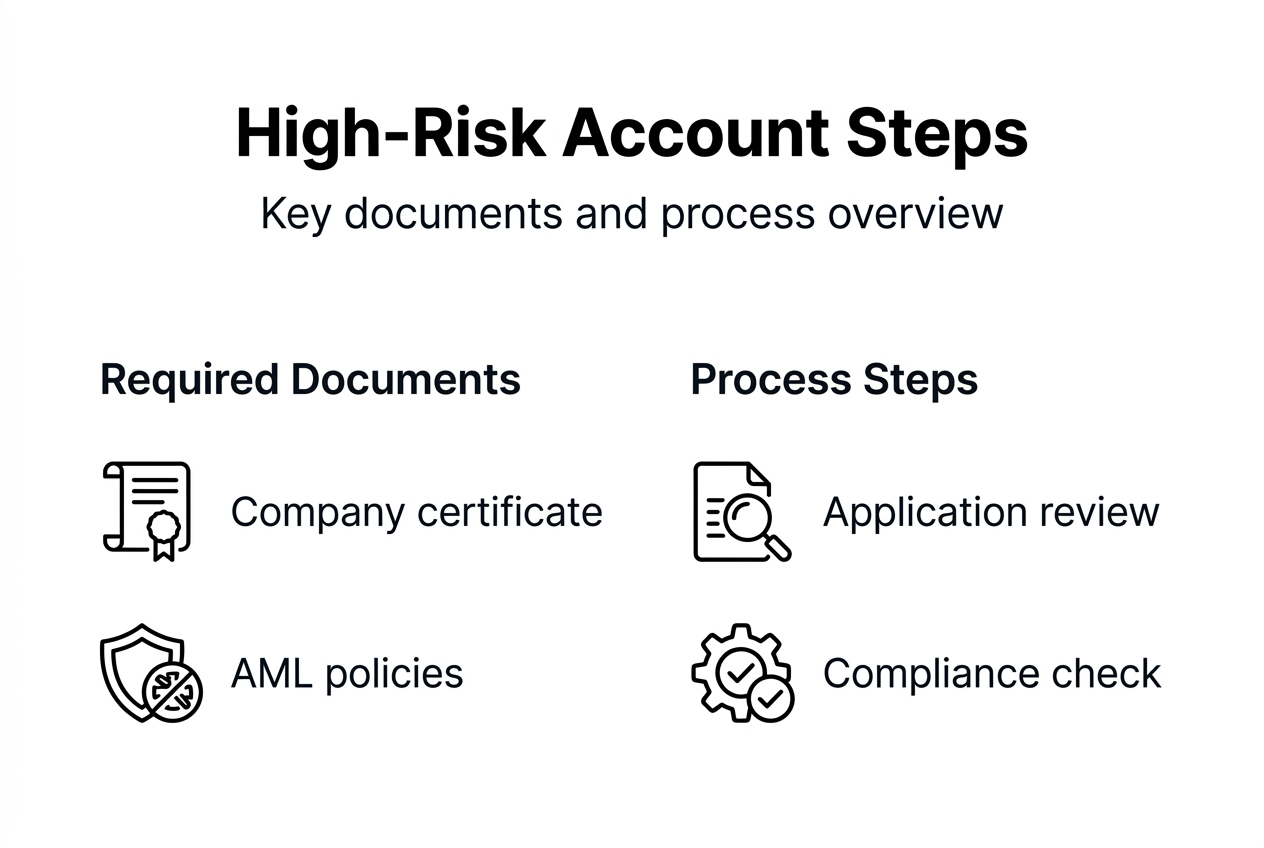
Compliance documentation proves your business operates within legal frameworks. Prepare detailed AML and KYC policies showing how you verify customers, monitor transactions, and report suspicious activity. Include any industry licences, gaming authority approvals, or financial services registrations relevant to your sector. Reference your high-risk business bank account documents checklist to ensure completeness.
Your business model explanation must be crystal clear. Banks need to understand precisely how you generate revenue, who your customers are, expected transaction volumes, and geographic markets. Vague descriptions raise red flags. Provide financial projections, existing bank statements if available, and contracts with major clients or suppliers.
Pro Tip: Create a compliance calendar showing when licences renew, audits occur, and regulatory filings are due. This demonstrates ongoing commitment to regulatory obligations beyond the initial application.
Follow this preparation sequence:
- Compile all company formation and ownership documents with certified translations
- Document your AML/KYC procedures with specific examples and training records
- Gather industry licences and regulatory correspondence showing good standing
- Prepare detailed business plan with revenue models and customer profiles
- Create financial projections with conservative assumptions and supporting data
- Organise shareholder and director documentation including proof of address and funds source
- Review everything for consistency across documents—mismatched addresses or dates cause rejection
Common documentation errors include outdated certificates, unsigned forms, missing beneficial ownership declarations, and inconsistent business descriptions across different documents. Triple-check that names, addresses, and dates align perfectly. Banks interpret discrepancies as red flags warranting rejection.
Understanding how to pass bank compliance requirements transforms applications from hopeful submissions to strategic presentations addressing known bank concerns.
Step-by-step process to open a high-risk bank account
Securing banking access requires systematic targeting of appropriate providers rather than mass applications to mainstream banks. Follow this structured approach to maximise approval probability whilst minimising wasted effort on unsuitable institutions.
- Research specialised providers: Identify banks and EMIs with proven track records serving your specific industry. Risk-friendly providers like Xpaid focus exclusively on high-risk sectors, understanding compliance requirements that mainstream banks find intimidating. Create a shortlist of 5 to 8 candidates.
- Verify licensing and stability: Confirm each provider holds proper regulatory authorisation in their jurisdiction. Check for negative news, customer complaints, or financial instability. Unlicensed entities promise easy approval but deliver account freezes and fund losses.
- Complete applications methodically: Submit applications sequentially rather than simultaneously to multiple banks. This allows you to refine your presentation based on feedback. Use your prepared documentation package, ensuring every field is completed accurately.
- Prepare for enhanced due diligence: Expect detailed questioning about business operations, customer acquisition, transaction patterns, and compliance procedures. Respond promptly with comprehensive answers. Delays signal reluctance or hidden issues.
- Consider multi-jurisdictional strategies: Explore offshore banking in jurisdictions with established financial services infrastructure and appropriate regulatory frameworks. This provides backup options if European providers remain inaccessible. Consult guides to opening accounts for high-risk industries.
- Track applications rigorously: Maintain detailed records of submission dates, contact persons, requested documents, and follow-up schedules. Proactive communication demonstrates professionalism and commitment.
Pro Tip: Request preliminary assessments before formal applications. Many specialised providers offer initial reviews identifying potential issues you can address before official submission, avoiding formal rejections that complicate future applications.
| Provider type | Approval timeline | Key advantages | Typical requirements |
|---|---|---|---|
| Specialised EMIs | 2-4 weeks | Industry expertise, flexible | Enhanced KYC, compliance policies |
| Offshore banks | 4-8 weeks | Privacy, multi-currency | Higher deposits, complex documentation |
| Fintech platforms | 1-3 weeks | Digital processes, speed | Strong tech infrastructure, licences |
| Boutique private banks | 6-12 weeks | Relationship banking | Substantial balances, established business |
Utilise a high-risk business banking checklist ensuring you address every requirement systematically rather than discovering gaps mid-process. Success depends on thorough preparation meeting provider expectations precisely.
Common mistakes to avoid and verifying your account setup
Even with strong documentation, specific errors repeatedly derail applications. Recognising these pitfalls allows proactive avoidance rather than learning through expensive failures.
Incomplete paperwork ranks as the primary rejection cause. Banks request specific documents for regulatory reasons, not bureaucratic preference. Missing a single form triggers rejection regardless of other strengths. Double-check requirements against provider checklists before submission.
Inconsistent information across documents raises immediate fraud concerns. If your business address differs between incorporation certificates and utility bills, banks assume deception. Verify that names, addresses, ownership percentages, and business descriptions match precisely across every document.
Unrealistic business projections damage credibility. Banks employ analysts who recognise inflated revenue forecasts or understated risk profiles. Conservative, well-supported projections demonstrate maturity and realistic planning. Aggressive growth claims without substantiation appear suspicious.
Choosing unlicensed or poorly regulated providers creates worse problems than rejection. Thousands of UK businesses lost banking access not through wrongdoing but economic pressures and regulatory changes. Unlicensed entities offer no protection when accounts freeze or funds disappear.
Key mistakes include:
- Submitting applications with missing documents or unsigned forms
- Providing inconsistent information across different paperwork
- Failing to respond promptly to bank queries during due diligence
- Choosing providers based solely on ease rather than licensing and reputation
- Neglecting ongoing compliance after approval
After account approval, verification ensures functionality before relying on the account for business operations. Conduct small test transactions confirming deposits, withdrawals, and international transfers work as expected. Verify online banking access, payment integration capabilities, and customer support responsiveness.
Understand ongoing compliance obligations. Banks monitor high-risk accounts continuously, requiring regular documentation updates, transaction explanations, and licence renewals. Avoiding high-risk banking mistakes means treating compliance as continuous rather than one-time.
| Mistake | Consequence | Prevention |
|---|---|---|
| Incomplete documentation | Immediate rejection | Use comprehensive checklists, verify every requirement |
| Inconsistent details | Fraud suspicion, blacklisting | Cross-reference all documents for alignment |
| Unlicensed providers | Frozen funds, no recourse | Verify regulatory authorisation independently |
| Poor communication | Assumed disinterest, rejection | Respond within 24 hours to all bank queries |
| Ignoring ongoing compliance | Account closure, fund seizure | Calendar compliance deadlines, proactive reporting |
Implement account opening checklists for 2026 that cover both initial approval and post-opening verification, ensuring sustained access rather than brief success followed by closure.
Approval criteria and documentation requirements for high-risk banking
Specialist banks evaluating high-risk applications assess similar criteria to mainstream banks but weight factors differently. Understanding these criteria and documentation requirements enables application positioning dramatically improving approval odds.
Business legitimacy and regulatory compliance form the foundation. Banks require documentation proving your business operates legally in its jurisdiction—business registration, specific sector licensing (crypto licenses, iGaming licenses, Forex licenses), compliance framework documentation. Unlike mainstream banking where established reputation sometimes substitutes for documentation, high-risk banking requires comprehensive regulatory documentation regardless of business maturity.
Beneficial ownership transparency increasingly represents mandatory documentation. Banks require clear documentation identifying all beneficial owners, their roles, and their source of wealth. Complex ownership structures raise scrutiny; straightforward ownership documentation improves approval odds. Documentation should clarify beneficial ownership chains, preventing ambiguity about ultimate controllers.
Source of funds documentation satisfies anti-money laundering requirements. Banks require tracing initial capital sources, demonstrating that business funds originate from legitimate sources. Cryptocurrency businesses often encounter specific scrutiny regarding crypto holdings origins. Documentation explaining how initial operating capital was sourced and how existing crypto holdings were acquired strengthens applications significantly.
Operational documentation describes business models and revenue generation. Banks require understanding how you generate revenue, where customer funds flow, and what controls prevent misuse of banking infrastructure. Detailed operational documentation—customer acquisition processes, payment flow documentation, customer identity verification procedures—demonstrates institutional-grade operations.
Compliance framework documentation addresses AML/KYC, fraud prevention, and regulatory requirements. Banks require documentation of your compliance procedures, transaction monitoring systems, customer due diligence processes, and regulatory reporting capabilities. Sector-specific compliance becomes critical—crypto documentation addressing travel rule compliance, iGaming documentation addressing responsible gambling controls, Forex documentation addressing leverage limits and investor protection measures.
Financial documentation demonstrates operational viability. Banks require financial statements (if available), revenue forecasts, operational budget documentation. Newer businesses lacking extensive financial history should provide detailed revenue projections and operational budgeting. The documentation quality and specificity matter more than historical track record for newer operations.
| Documentation Category | Minimum Standard | Competitive Advantage |
|---|---|---|
| Business Registration | Certificate of incorporation, registration | Certificate + specific sector licensing |
| Beneficial Ownership | Ownership structure documentation | Clear chain, identified beneficial owners, source of wealth documentation |
| Compliance Framework | General AML/KYC procedures | Sector-specific procedures addressing crypto/iGaming/Forex requirements |
| Operational Documentation | Business model description | Detailed revenue flows, customer verification procedures, transaction monitoring protocols |
| Financial Documentation | Available statements or projections | Audited financials, detailed budgets, revenue forecasts with assumptions |
| Team Expertise | Management team bios | Team industry experience, regulatory compliance background, operations expertise |
Preparation investment determines application success substantially. Applications demonstrating comprehensive documentation and operational understanding face substantially higher approval odds than those providing minimal documentation. The documentation investment separates successful applications from rejected ones consistently.
Making onboarding work for your high-risk business
With an understanding of automation’s limits, let us focus on how you can proactively succeed at onboarding for your high-risk business.
Success in high-risk banking onboarding is not accidental. It is the result of deliberate preparation, the right partner selection, and a considered approach to how you present your business. Here is a practical framework:
- Audit your documentation before you approach any bank. Gather every document that a compliance team might request: UBO chain diagrams, certified identity documents, audited accounts, your AML policy, your licence certificates, and transaction history. Treat this as building a compliance dossier, not collecting paperwork.
- Research and pre-qualify your banking partners. Not every bank serves every high-risk category. Approaching a bank that has never onboarded a crypto exchange wastes your time and creates a rejection on your record. Target institutions with a demonstrable track record in your specific sector and jurisdiction.
- Present your business proactively. Do not wait for the compliance team to ask questions. Submit a structured business overview that explains your model, your regulatory status, your customer base, and your risk controls. Banks respond well to applicants who demonstrate compliance maturity.
- Maintain the relationship post-onboarding. Account closures often occur not at onboarding but months later when transaction patterns diverge from what was disclosed. Update your bank proactively when your business model, ownership structure, or transaction volumes change significantly. Silence breeds suspicion.
- Work with specialists who understand your sector. The evidence on consistent onboarding processes shows that businesses working with experienced advisors achieve better and more durable outcomes than those relying on speed-focused generic platforms.
Our high-risk EU case studies show clearly how preparation and partner selection separate successful onboardings from rejected applications. The patterns are consistent: the businesses that succeed invest time upfront in compliance preparation and choose banking partners carefully.
Pro Tip: Never submit simultaneous applications to multiple banks without a strategy. If one application is rejected, other banks may discover this through screening tools, and multiple recent rejections significantly weaken your position. Sequence your applications and use each one as a learning exercise.
For a broader view of the regulatory landscape, our EU high-risk approval guide provides jurisdiction-specific guidance that covers the key differences between EU and offshore banking options.
Know your risk category and pre-qualify
Before you approach a single bank, you need to understand exactly how underwriters will categorise your business. EU banks do not assess high-risk applications the same way they assess a retail shop or a consulting firm. They apply layered risk models that weigh your sector, your transaction patterns, your country of incorporation, and the nationalities of your beneficial owners.
The first thing any compliance officer will check is whether your jurisdiction appears on the FATF grey list. FATF (the Financial Action Task Force) publishes a list of countries with weak anti-money laundering controls, and any connection to those countries raises an immediate red flag. Beyond jurisdiction, banks look at ownership transparency. If your corporate structure involves multiple holding layers without clear ultimate beneficial ownership, expect delays or outright rejection.
To self-assess before applying, work through this checklist:
- Jurisdiction check: Is your company incorporated in an EU or EEA jurisdiction, or a reputable offshore centre? Avoid structures routed through FATF grey-listed countries.
- Ownership clarity: Can you produce a clear, verified beneficial ownership chart with supporting ID for every person holding more than 25%?
- Licence status: Do you hold a valid operating licence for your sector (e.g., a MiCA-compliant crypto licence or an EU iGaming licence)?
- Transaction history: Do you have at least 6 to 12 months of clean, documented transaction records?
- Source of funds: Can you evidence where your initial capital originated?
The EBA ML/TF risk guidelines are explicit: businesses must avoid connections to grey-listed jurisdictions, prove a clean transaction history, and align with EBA ML/TF standards before approaching a bank. Treating this as a box-ticking exercise will not work. Banks can tell when documentation has been assembled hastily.
For a broader view of what EU banks expect, the EU banking approval overview sets out the full picture. If you are ready to start the process, understanding the mechanics of opening a high-risk account is the logical next step.
Pro Tip: Run your own risk score before applying. List every potential red flag your business presents and prepare a written response to each one. Banks appreciate applicants who anticipate objections rather than react to them.
The onboarding process: KYC to enhanced due diligence
The formal bank onboarding process follows a structured path, and understanding what happens at each stage removes the anxiety that derails many applications. Here is what the journey looks like in practice.
- Initial identity and entity verification. The bank collects and verifies basic KYC data: who you are, who owns the business, and whether the entity is registered and in good standing. This phase is largely automated at many institutions.
- Business risk classification. Your application is categorised based on sector, geography, and ownership structure. High-risk cases are elaborate and less likely to be fast-tracked, entering a deeper review pathway from this point forward.
- Transaction and operational review. The bank examines your business model in detail, including expected transaction volumes, average transaction sizes, the jurisdictions involved, and the nature of your end customers. This is where your money flow narrative becomes critical.
- Enhanced due diligence (EDD). For high-risk businesses, EDD is standard, not exceptional. Source-of-wealth evidence must be independently corroborated, meaning plausible explanations are not sufficient. Banks require documentary trails that can be verified externally.
- Exception handling. If your application contains discrepancies or triggers specific risk flags, it routes into a manual review workflow. Exception handling introduces defined review criteria and sometimes temporary controls such as payout limits during an initial monitoring period.
- Final decision and account set-up. Once all verification steps are satisfied, the bank issues account details and operational parameters. You may receive initial limits that expand as the relationship matures.
Timeline expectations matter here. Approval for high-risk applications averages around 3.2 weeks when documentation is thorough, though complex cases with EDD requirements can extend considerably beyond that. The single biggest accelerator is completeness at the point of submission. Delays almost always trace back to incomplete KYC data, not to bank capacity.
Pro Tip: If the bank uses a digital onboarding portal, upload documents in the exact format specified, typically PDF with embedded text rather than scanned images. Automated document parsing fails on poor-quality scans, which pushes your application into manual review unnecessarily.

You can find a detailed breakdown of each phase in Bankmycapital’s bank onboarding overview for high-risk businesses.
How Bank My Capital supports high-risk businesses in 2026
Navigating high-risk banking complexities alone wastes months and risks repeated rejections that complicate future applications. Bank My Capital specialises in accelerating approvals through established relationships with over 50 pre-vetted banking partners experienced in crypto, iGaming, forex, and adult entertainment sectors.
Our clients achieve 87% approval rates by leveraging resilient banking structures designed specifically for regulatory scrutiny. We prepare documentation that addresses bank concerns proactively, reducing due diligence friction. Typical onboarding completes in 2 to 3 weeks rather than months of uncertainty.
We provide multi-currency accounts, offshore solutions when European options remain inaccessible, and ongoing compliance support ensuring sustained access. Our expertise in passing bank compliance requirements transforms complex regulatory demands into manageable processes.
Whether you need initial account establishment or replacement banking after closure, our 2026 approval-focused checklists and partner network provide practical solutions rather than generic advice. High-risk banking requires specialised knowledge—our boutique consultancy delivers exactly that expertise.
Recommended
- How High-Risk Companies Opened Bank Accounts in the EU in 2025
- How to open a high risk business bank account in 2026
- How to Open a Business Bank Account for High-Risk Industries in 2025
- Bank Account Opening Checklist 2026: Boost Approval by 70%
Frequently asked questions
Can I open a high-risk business bank account as a crypto company in Europe?
Yes, crypto companies can secure European banking, though mainstream institutions typically reject such applications. Specialised providers understand blockchain business models and cryptocurrency compliance requirements. Focus on banks and EMIs with proven crypto client portfolios. Our crypto banking solutions connect you with appropriate partners.
What documents do I need to prepare to improve my banking application approval?
Essential documents include certified company incorporation certificates, detailed business plans explaining revenue models, comprehensive AML and KYC compliance policies, current industry licences, and complete shareholder identification with proof of funds source. Accuracy and completeness significantly reduce rejection risk. Review our high-risk business bank account documents guide for detailed requirements.
How long does it typically take to open a high-risk business bank account in Europe?
Account opening ranges from two weeks to several months depending on provider type and application completeness. Enhanced due diligence extends timelines beyond standard business accounts. Thorough documentation and selecting specialised providers familiar with your sector accelerates approval. Utilise our high-risk business banking checklist to streamline the process.
What are my options if mainstream banks reject my high-risk business account application?
Rejection from traditional banks opens alternative pathways including specialised high-risk banks, offshore accounts in compliant jurisdictions, and fintech providers focusing on underserved sectors. Professional consultancy identifies risk-tolerant providers matching your specific business profile and structures compliance documentation addressing common rejection triggers. Explore crypto and fintech banking alternatives designed for challenging sectors.
Does IBAN discrimination affect my ability to operate across Europe?
IBAN discrimination remains a practical barrier despite legal prohibitions, with many payment processors and platforms refusing accounts from certain jurisdictions or provider types. This forces businesses into less optimal banking relationships or multi-account strategies. Choosing well-established EMIs with broad acceptance reduces discrimination impact, though complete elimination remains challenging in 2026.
