
Selecting the right offshore jurisdiction determines whether your high-risk business thrives or faces constant banking rejections and regulatory roadblocks. High-risk businesses in sectors like crypto, iGaming, and forex encounter complex regulatory and banking challenges offshore that demand careful jurisdiction evaluation. Poor choices lead to frozen accounts, licence revocations, and operational paralysis. This guide provides a practical framework for choosing jurisdictions that balance regulatory compliance with genuine banking accessibility, helping you avoid costly mistakes while establishing sustainable offshore operations.
Key takeaways
| Point | Details |
|---|---|
| Balance regulation and banking | Selecting an offshore jurisdiction requires weighing regulatory compliance against practical banking accessibility. |
| Assess legal frameworks and licensing | Evaluate the legal frameworks, licensing requirements and reputational risks before deciding. |
| Prepare step by step | A structured preparation, setup and verification process reduces costly mistakes. |
| Strategic tips for high risk | Expert tips help navigate common pitfalls in high risk sectors. |
| Support sustainable growth | Careful jurisdiction choice supports sustainable business growth and banking stability. |
Understanding the challenges of offshore jurisdiction selection
High-risk businesses face a complex web of obstacles when selecting offshore jurisdictions. Regulatory frameworks vary dramatically between locations, creating uncertainty about compliance requirements and operational permissions. What works perfectly for a forex broker in Belize may prove disastrous for a crypto exchange seeking European market access.
Banking represents the most immediate challenge. Many financial institutions restrict high-risk sector accounts due to stringent AML and KYC policies, regardless of jurisdiction. You might secure a licence in a favourable jurisdiction only to discover that banks refuse to open accounts for your business type. This disconnect between licensing and banking accessibility creates operational deadlock for unprepared businesses.
Licensing requirements differ wildly across jurisdictions, impacting both initial setup and ongoing operations. Some locations offer streamlined processes with minimal capital requirements, whilst others demand substantial deposits, local directors, and extensive compliance infrastructure. These variations directly affect your timeline, budget, and operational flexibility.
Key regulatory challenges include:
- Inconsistent AML/KYC standards across jurisdictions creating compliance complexity
- Evolving regulations requiring constant monitoring and adaptation
- Varying reporting obligations impacting administrative burden
- Different capital adequacy requirements affecting financial planning
- Jurisdictional cooperation levels with international regulators
Reputational risks vary significantly with jurisdiction transparency and compliance history. Operating from a jurisdiction on international grey lists or with poor regulatory enforcement damages your credibility with banking partners and clients. Even legitimate businesses suffer from association with jurisdictions known for lax oversight or financial crime.
Pro Tip: Research the jurisdiction’s recent regulatory actions and enforcement history, not just current laws. A jurisdiction with strong laws but weak enforcement creates future compliance risks as international pressure increases.
Understanding these challenges shapes realistic expectations about timeline, costs, and operational constraints. No jurisdiction offers perfect solutions for high-risk businesses. Success comes from matching your specific business model, target markets, and risk tolerance with jurisdictions that provide the best overall fit rather than chasing unrealistic promises of zero compliance or unlimited banking access.

Preparing to choose the right offshore jurisdiction
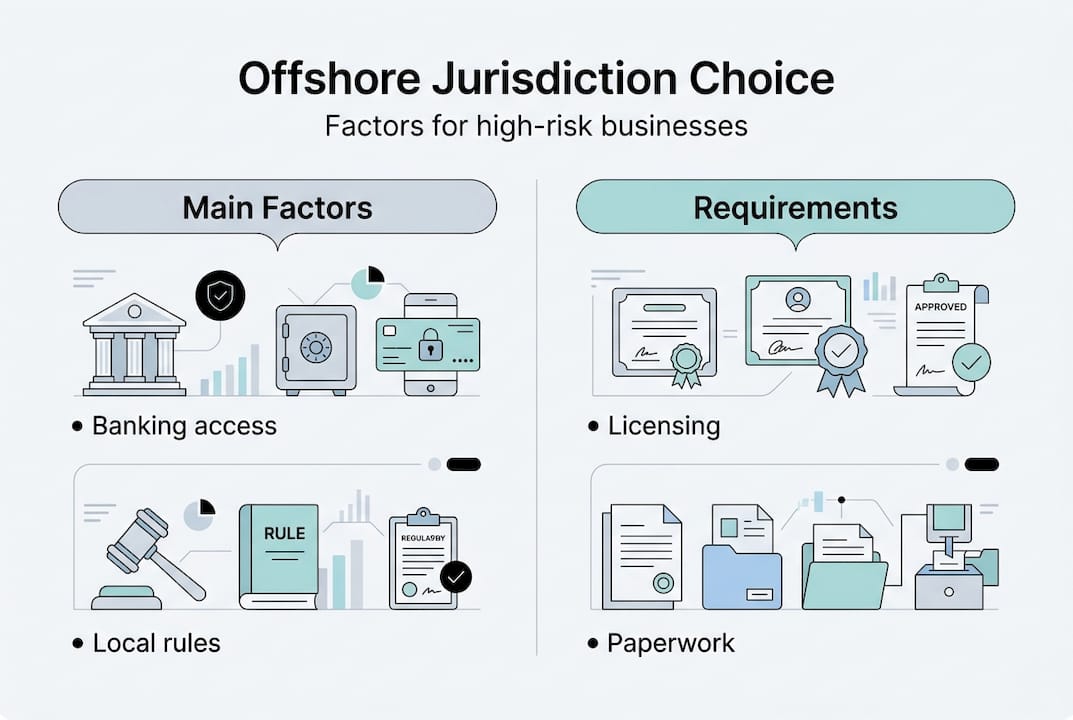
Thorough preparation prevents expensive mistakes and accelerates your offshore establishment timeline. Evaluating legal stability, licensing frameworks, and banking friendliness is essential before selection. Start by assessing jurisdiction legal frameworks and financial regulations that govern your specific sector. Different jurisdictions specialise in particular industries, with some favouring iGaming whilst others focus on forex or crypto operations.
Review licensing availability and conditions particular to your sector. Some jurisdictions offer multiple licence types with varying permissions and costs. A basic licence might suffice for initial operations but restrict future growth, whilst premium licences provide broader permissions at higher costs. Understanding these distinctions prevents costly licence upgrades or relocations later.
Banking options require careful comparison across multiple dimensions. Accessibility matters most, as securing a licence proves worthless without functioning bank accounts. Research which banks actively serve your sector in each jurisdiction, their account opening success rates, and typical timelines. Compliance ease varies significantly between banking partners, with some requiring extensive ongoing documentation whilst others offer streamlined processes.
Essential preparation criteria:
- Jurisdiction political and economic stability over the past decade
- Banking infrastructure quality and international connectivity
- Tax treaty network and substance requirements
- Language and time zone compatibility with your operations
- Professional service availability including legal and accounting support
This comparison table helps evaluate key jurisdiction factors systematically:
| Evaluation factor | High priority jurisdictions | Medium priority jurisdictions | Lower priority jurisdictions |
|---|---|---|---|
| Regulatory clarity | Clear, codified rules | Evolving frameworks | Ambiguous or frequently changing |
| Banking access | Multiple willing partners | Limited but available | Severely restricted |
| Licence cost | Proportional to benefits | Moderate investment | Excessive relative to permissions |
| International reputation | Whitelisted, cooperative | Neutral standing | Grey-listed or scrutinised |
| Setup timeline | 2 to 4 months | 4 to 8 months | Over 8 months |
Tax implications extend beyond headline corporate rates. Consider withholding taxes on dividends and interest, VAT or sales tax obligations, and substance requirements that mandate physical presence. Some jurisdictions with zero corporate tax impose strict economic substance rules requiring local employees and offices, negating tax savings through increased operational costs.
Reputational factors influence both banking relationships and client trust. Operating from well-regulated, transparent jurisdictions enhances credibility with payment processors and institutional partners. Conversely, jurisdictions with poor reputations create ongoing friction regardless of your actual compliance standards.
Pro Tip: Create a weighted scoring matrix for your top five jurisdictions, assigning points based on your specific priorities. Banking accessibility and regulatory stability should carry the highest weights for high-risk sectors, as these factors determine operational viability more than tax savings.
Prepare required documentation early in your evaluation process. Most jurisdictions demand similar core documents including corporate records, beneficial ownership declarations, business plans, and compliance policies. Having these ready accelerates applications once you select your jurisdiction. Understanding ongoing compliance demands prevents surprises after establishment, as some jurisdictions require quarterly reporting whilst others accept annual submissions.
Step-by-step execution: selecting and establishing in your chosen jurisdiction
Systematic execution transforms preparation into operational reality. Following systematic steps reduces costly errors and accelerates setup time for high-risk offshore businesses. Begin by shortlisting three to five jurisdictions based on your prepared criteria, then conduct detailed due diligence on each option before final selection.
Jurisdiction selection and establishment process:
- Shortlist jurisdictions matching your sector, budget, and banking requirements from initial research
- Conduct detailed due diligence on banking partners, verifying their current policies for your business type
- Verify licensing authority reputation, processing times, and approval rates for similar applications
- Engage local legal counsel to review jurisdiction-specific compliance requirements and risks
- Finalise jurisdiction choice based on comprehensive evaluation of all factors
- Prepare incorporation documents including articles of association and shareholder agreements
- File company registration with jurisdiction authorities and obtain certificate of incorporation
- Apply for business licence with complete documentation and compliance framework
- Establish corporate bank accounts, submitting required KYC documentation and business plans
- Set up compliance infrastructure including AML policies, transaction monitoring, and reporting systems
- Register for tax obligations and obtain necessary tax identification numbers
- Implement operational systems including accounting, record keeping, and regulatory reporting tools
Due diligence on banking partners determines account opening success. Contact banks directly rather than relying solely on online information, as policies change frequently for high-risk sectors. Request specific information about documentation requirements, approval timelines, and account features. Some banks accept remote account opening whilst others mandate in-person meetings, affecting your setup timeline and costs.
Licensing authorities vary in transparency and efficiency. Research recent applicant experiences through industry forums and professional networks. Authorities with clear guidelines and responsive communication simplify the process, whilst opaque bureaucracies create frustration and delays. Factor authority responsiveness into your jurisdiction choice, as licensing delays cascade into banking and operational setbacks.
Corporate structure setup requires careful planning for tax efficiency and operational flexibility. Consider whether a single entity suffices or if holding company structures provide benefits. Some businesses establish separate entities for licensing, banking, and operations to compartmentalise risks and optimise tax treatment. Local legal counsel guides these decisions based on your specific circumstances.
This comparison illustrates typical setup timelines and requirements across jurisdiction types:
| Jurisdiction type | Typical timeline | Key requirements | Banking difficulty | Ongoing costs |
|---|---|---|---|---|
| EU regulated | 4 to 8 months | Substantial capital, local presence | Moderate | High |
| Offshore financial centre | 2 to 4 months | Moderate capital, registered office | High | Moderate |
| Emerging fintech hub | 3 to 6 months | Variable capital, compliance framework | Moderate to high | Moderate |
Multi-currency bank accounts provide operational flexibility for international businesses. Prioritise banks offering accounts in your primary transaction currencies to minimise conversion costs and delays. Verify transaction limits, as some banks impose restrictions on high-risk sector volumes that could constrain growth.
Maintaining transparent records from day one establishes credibility with regulators and banking partners. Implement robust accounting systems that track all transactions, beneficial ownership changes, and compliance activities. Many jurisdictions require annual audits, so engaging qualified auditors early prevents scrambling before deadlines. Regular internal reviews identify compliance gaps before they become regulatory issues.
Monitor regulatory changes continuously post-setup. Subscribe to jurisdiction regulatory authority updates, join industry associations, and maintain relationships with local legal counsel. Regulations evolve constantly in high-risk sectors, and early awareness of changes allows proactive adaptation rather than reactive crisis management.
Verifying and maintaining compliance post-establishment
Ongoing verification protects your offshore structure from regulatory and banking disruptions. Ongoing verification and compliance monitoring are critical to avoid licence revocation and banking issues. Regularly review compliance with jurisdiction laws and bank policies, as both evolve in response to international pressure and local enforcement priorities.
Conduct internal audits quarterly rather than waiting for annual regulatory reviews. These audits examine transaction monitoring effectiveness, KYC documentation completeness, and policy adherence across your organisation. Identifying gaps early allows corrective action before regulators or banks discover issues. Document all audit findings and remediation steps to demonstrate proactive compliance management.
KYC and AML updates require systematic attention. Customer due diligence standards tighten regularly, requiring enhanced verification for existing clients, not just new onboarding. Establish refresh cycles for customer information, typically annually for standard risk clients and more frequently for higher risk relationships. Banks increasingly scrutinise client bases, and outdated KYC documentation triggers account reviews or restrictions.
Compliance maintenance best practices:
- Designate a compliance officer responsible for monitoring regulatory changes and implementation
- Establish quarterly compliance committee meetings reviewing policies, procedures, and incidents
- Maintain a compliance calendar tracking reporting deadlines, licence renewals, and audit requirements
- Implement automated transaction monitoring systems that flag suspicious patterns for review
- Conduct annual staff training on AML, KYC, and sector-specific regulatory requirements
- Document all compliance decisions and risk assessments for regulatory scrutiny
Stay informed on regulatory updates from licensing bodies through multiple channels. Official gazettes and regulatory websites provide primary sources, but industry associations and legal advisers offer practical interpretation and implementation guidance. Regulatory changes often include transition periods, and early awareness maximises your adaptation time.
Robust record keeping extends beyond financial transactions to include all compliance activities, board decisions, and regulatory correspondence. Many jurisdictions require records retention for five to seven years. Implement secure, organised systems that allow rapid retrieval during regulatory examinations or bank reviews. Cloud-based solutions offer accessibility and disaster recovery benefits but require appropriate data protection measures.
Transparent reporting practices build trust with regulators and banking partners. Submit required reports on time with complete, accurate information. If issues arise, proactive disclosure with remediation plans demonstrates good faith and often results in more lenient treatment than regulators discovering problems independently. Banks particularly value transparency, as it reduces their compliance risks associated with your account.
Pro Tip: Establish relationships with multiple banking partners even if you primarily use one institution. Backup banking relationships provide continuity if your primary bank exits your sector or imposes sudden restrictions, preventing operational disruption whilst you secure alternatives.
Seek professional advice promptly when issues arise or regulations change significantly. Delayed responses to compliance problems compound difficulties and narrow your resolution options. Experienced advisers navigate regulatory negotiations, remediation planning, and implementation more efficiently than internal teams unfamiliar with enforcement processes. The cost of expert advice proves minimal compared to licence suspensions, banking terminations, or regulatory penalties.
Regular compliance reviews should assess not just current adherence but also emerging risks from regulatory trends and enforcement patterns. Jurisdictions often signal future requirements through consultation papers and enforcement actions against other businesses. Anticipating these changes allows proactive adaptation rather than reactive scrambling under deadline pressure.
Comparing key offshore jurisdictions for high-risk businesses
Choosing a jurisdiction without a side-by-side comparison is like picking a payment processor without checking their chargeback thresholds. The differences between popular offshore jurisdictions are significant and directly affect your approval odds, licensing costs, and long-term banking relationships.
Cayman Islands suits crypto funds and forex operations that need maximum credibility with institutional counterparties. The regulatory environment is sophisticated, costs are higher, but the reputational weight is considerable. Curacao remains the go-to for iGaming operators, with a well-established licensing framework and banks experienced in gaming revenue flows.
Seychelles and Belize are strong choices for International Business Companies (IBCs) seeking low-cost, fast-setup structures with broad sector acceptance. St Vincent and the Grenadines has become a preferred base for forex brokers, with a 2 to 3 week setup timeline and minimal licensing friction.
For iGaming offshore banks, Curacao consistently outperforms other jurisdictions on both licensing speed and banking access. For adult industry operators, the adult industry benefits of Seychelles and Belize structures are particularly strong, given their broad acceptance of content-related revenue streams.
Key factors to weigh when comparing jurisdictions:
- Regulatory reputation: Does the jurisdiction appear on FATF grey or blacklists?
- Sector licensing: Is there a formal licence available for your specific business type?
- Banking access: Do local banks actively serve your sector, or merely tolerate it?
- Cost structure: What are the annual maintenance, compliance, and renewal fees?
- Exit flexibility: Can you migrate to another jurisdiction if regulations shift?
How to decide: framework for choosing the right offshore jurisdiction
A structured decision process removes emotion from what is ultimately a strategic business choice. Each jurisdiction offers unique value based on your sector and compliance profile, so matching those variables systematically is essential.
Follow this framework:
- Define your risk profile: What is your primary sector, average transaction size, and chargeback history?
- Identify required services: Do you need crypto custody, multi-currency accounts, or high-volume merchant processing?
- Assess licensing needs: Does your sector require a formal licence in the chosen jurisdiction?
- Calculate total cost: Include setup fees, annual maintenance, compliance costs, and banking fees
- Evaluate reputational impact: How will your investors, partners, and customers perceive the chosen jurisdiction?
- Engage a specialist intermediary: Work with a consultancy that has pre-vetted relationships with banks in your target jurisdiction
Use the sector banking guide to map your specific requirements against available jurisdictions before committing to any structure.
Pro Tip: Prioritise transparency and thorough documentation from day one. Banks that understand your sector will reward clean, well-organised compliance files with faster approvals and more stable long-term relationships. Cutting corners on documentation is the fastest route to account closure, even offshore.
Popular offshore jurisdictions for crypto, iGaming, and Forex businesses in 2026
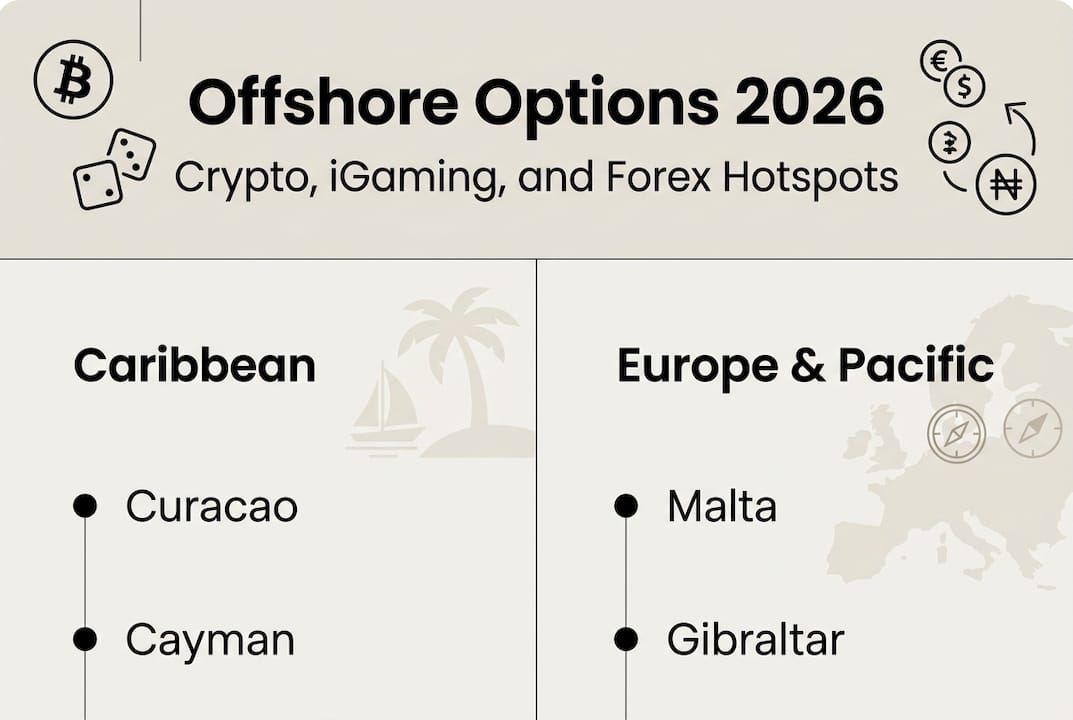
The Caribbean dominates offshore preferences for high-risk sectors in 2026, though European and Pacific options also attract specific business models. St. Lucia, Belize, Seychelles, Curacao, and St. Vincent lead the pack due to their established acceptance of high-risk activities, integrated crypto frameworks, and expedited setup processes. Each offers distinct advantages depending on your sector focus and operational requirements.
Curacao stands out for iGaming operations with its globally recognised gaming licence and robust regulatory framework that balances oversight with business-friendly policies. The jurisdiction processes applications in approximately eight weeks and offers corporate tax rates around 2% on qualifying income. Seychelles attracts Forex and crypto businesses with even faster licensing, minimal capital requirements starting at $50,000, and zero corporate tax on foreign-sourced income. St. Vincent provides the most streamlined approach with minimal reporting obligations, though this comes with reduced international recognition.
Cost and timeline comparisons reveal significant differences:
| Jurisdiction | Licence Type | Setup Time | Initial Cost | Annual Tax Rate |
|---|---|---|---|---|
| Curacao | iGaming | 8-12 weeks | €25,000-€35,000 | 2% on profits |
| Seychelles | Forex/VASP | 4-6 weeks | $10,000-$15,000 | 0% foreign income |
| St. Vincent | Forex | 2-4 weeks | $5,000-$8,000 | 0% foreign income |
| Belize | Multi-sector | 6-8 weeks | $15,000-$20,000 | 0% foreign income |
Beyond the Caribbean, Malta and Gibraltar offer EU-adjacent options with stronger international reputation but higher costs and longer timelines. These hybrid jurisdictions work well when you need European market access whilst maintaining some offshore advantages. Estonia’s e-Residency programme provides digital infrastructure for crypto businesses, though it lacks the tax benefits of pure offshore locations.
Regulatory acceptance varies by sector. iGaming companies prioritise jurisdictions with established gaming commissions and international licence recognition. Crypto businesses need VASP registration capabilities and banking partners comfortable with digital assets. Forex operations require securities licensing frameworks and access to liquidity providers who accept offshore entities.
Multi-jurisdictional strategies increasingly define successful high-risk offshore operations. You might incorporate in Seychelles for tax efficiency, obtain an iGaming licence in Curacao for regulatory credibility, and maintain banking relationships in St. Lucia for payment processing. This distributed approach provides redundancy if one jurisdiction faces regulatory changes or banking partner issues.
Pro Tip: Consider hybrid onshore-offshore structures where you maintain a visible presence in a reputable jurisdiction (UK, Singapore, UAE) for client-facing operations whilst routing backend functions through offshore entities. This balances operational efficiency with brand reputation, particularly important when courting institutional clients or partnerships.
How BankMyCapital supports your offshore banking journey
Navigating offshore jurisdiction selection and establishment challenges your internal resources and expertise. BankMyCapital offers expert guidance to avoid common offshore banking pitfalls through specialised knowledge of high-risk sector requirements across multiple jurisdictions. Our network of over 50 pre-vetted banking partners and EMIs provides access to resilient banking structures designed specifically for high-risk sectors including crypto, iGaming, and forex operations.
We provide comprehensive support throughout your offshore journey, from initial jurisdiction evaluation through licensing, banking setup, and ongoing compliance management. Our 87% approval rate and typical 2 to 3 week onboarding timeline reflect deep banking relationships and streamlined processes that bypass traditional rejection barriers. Explore our complete banking and financial services portfolio to discover how partnering with trusted professionals enhances your compliance standards and banking success whilst you focus on core business growth.
Recommended
- Why choose offshore banking for high-risk businesses in 2026
- Why offshore banking matters for high-risk businesses in 2026
- Offshore Banking Explained: Solutions for High-Risk Sectors
- Offshore banking setup guide for high-risk businesses 2026
Frequently asked questions
What defines a high-risk offshore jurisdiction?
A high-risk offshore jurisdiction typically appears on international grey lists maintained by organisations like the FATF, exhibits weak regulatory enforcement despite formal laws, or lacks transparency in beneficial ownership registries. These jurisdictions face enhanced scrutiny from international banks and regulators, making banking relationships difficult and compliance burdens heavier. Businesses operating from high-risk jurisdictions experience frequent account closures and payment processing restrictions regardless of their actual compliance standards.
Which jurisdictions best support crypto businesses?
Malta, Gibraltar, and certain Caribbean jurisdictions including the Cayman Islands offer established regulatory frameworks specifically designed for crypto operations. These locations provide clear licensing pathways, crypto-friendly banking options, and regulatory certainty that reduces compliance risks. However, banking accessibility varies significantly even within crypto-friendly jurisdictions, requiring thorough due diligence on specific banking partners rather than assuming jurisdiction choice alone guarantees account access.
How do licensing requirements differ between jurisdictions?
Licensing requirements vary dramatically in capital adequacy, local presence mandates, and operational permissions granted. EU jurisdictions typically require substantial minimum capital ranging from €50,000 to €730,000 depending on licence type, plus local offices and qualified staff. Offshore financial centres often impose lower capital requirements but may restrict certain activities or require additional licences for comprehensive operations. Processing timelines range from 6 weeks in streamlined jurisdictions to over 12 months in heavily regulated markets.
What are the main banking challenges post-jurisdiction setup?
Account maintenance proves more challenging than initial opening for high-risk businesses. Banks conduct periodic reviews of high-risk accounts, often imposing sudden transaction limits, requesting extensive documentation, or terminating relationships based on risk appetite changes. Payment processing restrictions emerge as banks limit certain transaction types or geographic corridors. Maintaining multiple banking relationships mitigates these risks but requires managing different compliance requirements and reporting formats across institutions.
How often should compliance audits be conducted offshore?
Quarterly internal compliance audits provide optimal frequency for high-risk offshore businesses, supplemented by annual external audits as required by most licensing authorities. Quarterly reviews allow timely identification and remediation of compliance gaps before they escalate into regulatory issues. High-volume businesses or those in rapidly evolving regulatory environments benefit from monthly compliance reviews of critical areas like transaction monitoring and KYC updates, whilst annual comprehensive audits satisfy regulatory requirements and provide independent validation of compliance frameworks.
