
TL;DR:
- Compliance in iGaming requires ongoing alignment of operations, technology, and staff conduct with strict regulatory standards. Poor adherence risks enforcement actions, banking rejections, and license suspensions, emphasizing continuous compliance management especially in AML, responsible gambling, and audit readiness.
Compliance in iGaming is defined as the continuous process of aligning operations, technology, and staff conduct with regulatory requirements set by bodies such as the UK Gambling Commission (UKGC), the Alcohol and Gaming Commission of Ontario (AGCO), and the European Union’s Anti-Money Laundering (AML) framework. This is not a one-off licensing exercise. Operators who treat compliance as a static state routinely face enforcement action, banking rejection, and licence suspension. The role of compliance in iGaming covers AML controls, responsible gambling obligations, customer protection standards, and audit readiness. For operators and compliance professionals, understanding these requirements is the foundation of any sustainable business model in regulated markets.
What are the key compliance regulations shaping iGaming operations?
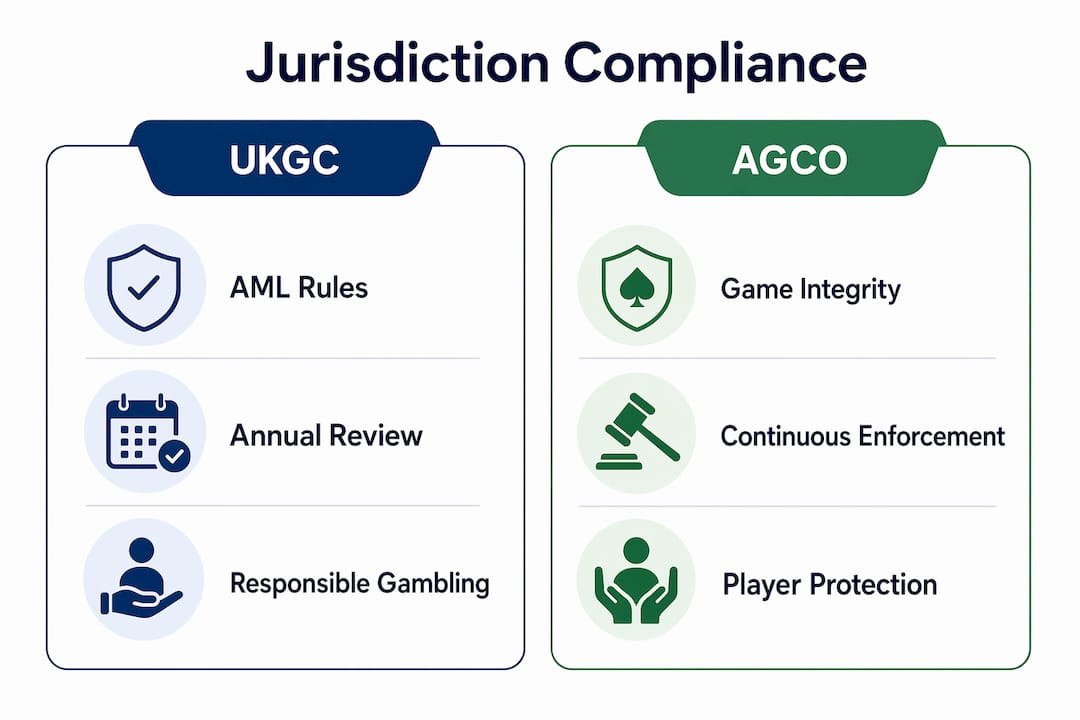
The UKGC’s Licence Conditions and Codes of Practice (LCCP) is the primary compliance framework for UK-facing operators. Under the LCCP, operators must perform an AML risk assessment reviewed at least annually and whenever material circumstances change. That requirement makes AML compliance a living discipline, not a document filed at licensing and forgotten.

Ontario operates under the AGCO’s Registrar’s Standards for Internet Gaming, which came into force in april 2022 and applies concrete technical and operational requirements to all registered operators. The AGCO enforces these standards continuously, meaning operators cannot rely on a single point-in-time review.
At the EU level, Regulation (EU) 2024/1624 harmonises AML and counter-financing of terrorism (CFT) obligations across member states. It applies a strict risk-based approach to online gambling with no exceptions for high-risk activities. This cross-border regulation directly affects any operator serving EU customers, regardless of where the operator is incorporated.
The Gaming Laboratories International Gaming Security Framework, specifically GLI-GSF-1 v1.1, sets common controls requirements for gaming enterprises seeking certification. It defines the documentary evidence required for compliance audits, including policies, risk assessments, and network diagrams.
| Regulation | Jurisdiction | Core focus | Review cycle |
|---|---|---|---|
| UKGC LCCP | United Kingdom | AML, responsible gambling, customer protection | Annual plus trigger-based |
| AGCO Registrar’s Standards | Ontario, Canada | Technical and operational standards | Continuous enforcement |
| EU Regulation 2024/1624 | European Union | AML/CFT, risk-based approach | Ongoing, cross-border |
| GLI-GSF-1 v1.1 | Multi-jurisdiction | Security controls, audit evidence | Certification cycle |
How does compliance affect iGaming operational controls and risk management?
Compliance is best understood as continuous alignment between documented policies and actual operational practice. Failures arise when operators write strong policies but allow day-to-day operations to drift away from them. Regulators now assess whether controls work in practice, not merely whether they exist on paper.
AML risk assessments under the UKGC framework must function as living documents, updated annually and triggered by events such as new payment methods, new products, technology changes, or shifts in customer demographics. Each trigger event requires a documented review, not just an internal note. That cadence creates a continuous compliance workload that operators must resource properly.
Staff training is a core component of operational compliance. Regulators expect documented evidence that staff understand AML obligations, responsible gambling procedures, and customer due diligence requirements. Training records form part of the audit evidence pack alongside policies and risk treatment plans.
Affiliate marketing adds another layer of operational complexity. Affiliate tracking compliance requires auditable attribution chains and record retention of five or more years to satisfy regulatory audits. Operators who treat affiliate management as a purely commercial function, separate from compliance, create material regulatory risk.
Common operational compliance activities include:
- Annual AML and terrorist-financing risk assessment reviews
- Trigger-based risk assessment updates for product, technology, or demographic changes
- Staff AML and responsible gambling training with documented completion records
- Customer due diligence and enhanced due diligence procedures with audit trails
- Affiliate attribution record retention for the required regulatory period
- Incident response documentation and escalation logs
- Regular policy reviews to confirm alignment with current operational practice
Pro Tip: Document every gap between your written policy and actual operational practice before a regulator does. A gap register with remediation dates is far stronger evidence of compliance intent than a policy document alone.
What role does compliance-by-design play in iGaming technology?
Compliance-by-design means embedding regulatory requirements into product development and system architecture from the outset, rather than retrofitting controls after launch. Early integration of compliance into product workflows reduces launch friction and regulatory rework, turning compliance into a growth enabler rather than a barrier.
The practical impact shows up in onboarding flows, transaction monitoring, and audit trail architecture. A KYC onboarding journey built with UKGC or AGCO requirements in mind from day one will have the correct data capture fields, verification steps, and record retention built into the product. Adding these after launch requires rebuilding core flows, which is expensive and often incomplete.
Retrofitting compliance after product release frequently fails because foundational product and data flow dependencies make it structurally difficult to add controls without breaking existing functionality. Operators who launch quickly into regulated markets without compliance-by-design often face enforcement action within their first operating year.
GLI-GSF-1 v1.1 makes the documentation burden explicit. Assembling a comprehensive evidence pack well before the audit date is the primary bottleneck for certification. That pack must include policies, risk treatment plans, incident response procedures, and network diagrams. Operators who prepare reactively consistently underestimate the breadth of artefacts required.
Pro Tip: Add a compliance checkpoint to every product sprint. Before any feature ships, confirm it has a documented data retention approach, an audit trail, and a named policy owner. This takes minutes per sprint and prevents months of remediation later.
How do compliance requirements vary across key iGaming jurisdictions?
Compliance obligations share common themes across jurisdictions but differ significantly in their specifics, enforcement style, and documentation expectations. Operators active in multiple markets must maintain parallel compliance frameworks, not a single unified approach.
The UKGC operates the most prescriptive AML regime for iGaming. Its iGaming compliance standards require annual risk assessments, trigger-based updates, and evidence that national and sector-level risk updates have informed the operator’s own assessment. The UKGC also expects operators to demonstrate responsible gambling controls through operational data, not just policy statements.
Ontario’s AGCO framework is technically detailed and continuously enforced. It covers game integrity, responsible gambling, and player protection with specific technical standards for software and systems. Unlike the UKGC’s principles-based approach in some areas, the AGCO’s Registrar’s Standards are prescriptive and leave limited room for operator interpretation.
The EU’s 2024 AML package applies to operators serving EU customers and requires a risk-based approach without carve-outs for online gambling. Operators must conduct customer risk assessments, apply enhanced due diligence for high-risk customers, and maintain records that satisfy cross-border regulatory requests.
| Jurisdiction | Regulator | AML review cadence | Affiliate compliance | Responsible gambling standard |
|---|---|---|---|---|
| United Kingdom | UKGC | Annual plus trigger-based | Auditable attribution required | Operational evidence required |
| Ontario, Canada | AGCO | Continuous enforcement | Included in technical standards | Prescriptive player protection rules |
| European Union | EU AML Authority (AMLA) | Ongoing, risk-based | Varies by member state | Member state implementation |
Operators entering multiple markets should treat the most demanding jurisdiction as the baseline. Building to UKGC standards, for example, provides a strong foundation for AGCO and EU compliance, though jurisdiction-specific gaps will still require local adaptation. For a detailed comparison of iGaming licence jurisdictions, the regulatory obligations differ enough to warrant specialist advice before committing to a market.
Bankmycapital: compliance and banking support for iGaming operators
Compliance failures in iGaming do not stay contained to regulatory proceedings. They flow directly into banking relationships, payment processing approvals, and licence renewals. Bankmycapital works with iGaming operators to address the financial side of compliance risk, including banking rejection risks that arise when operators cannot demonstrate adequate AML controls or regulatory standing to prospective banking partners.
Bankmycapital’s network of over 50 pre-vetted banking partners and EMIs is specifically structured for high-risk sectors, including iGaming. The consultancy provides jurisdiction selection guidance, regulatory liaising, and iGaming payment processing solutions that account for the compliance requirements of target markets. Operators facing banking rejection or payment processing gaps because of compliance concerns can access tailored support designed to resolve those barriers within a defined timeline.
FAQ
What is the role of compliance in iGaming?
Compliance in iGaming is the continuous process of meeting regulatory requirements set by bodies such as the UKGC, AGCO, and EU AML authorities. It covers AML controls, responsible gambling, customer protection, and audit readiness across all operational areas.
How often must iGaming operators review their AML risk assessments?
The UKGC requires AML risk assessments to be reviewed at least annually and updated whenever circumstances change, such as new products, payment methods, or shifts in customer demographics.
What is compliance-by-design in iGaming?
Compliance-by-design means building regulatory requirements into product architecture and operational workflows from the start. Early integration reduces regulatory rework and prevents the structural failures that arise from retrofitting controls after launch.
How does affiliate tracking relate to iGaming compliance?
Affiliate tracking compliance requires operators to maintain auditable attribution chains and retain records for five or more years. Regulators treat affiliate management as part of the broader compliance framework, not a separate commercial function.
Does compliance affect iGaming banking access?
Compliance failures directly affect banking relationships. Banks and EMIs assess AML controls and regulatory standing before approving accounts for iGaming operators, making compliance a prerequisite for stable payment infrastructure.
Key takeaways
Compliance in iGaming is a continuous operational discipline, not a licensing milestone, and operators who treat it as such consistently outperform those who do not in regulatory stability, banking access, and market longevity.
| Point | Details |
|---|---|
| Compliance is continuous | AML risk assessments must be reviewed annually and updated at every material trigger event. |
| Regulations vary by jurisdiction | UKGC, AGCO, and EU frameworks share AML themes but differ in enforcement style and documentation requirements. |
| Compliance-by-design reduces risk | Embedding controls into product development from the outset prevents costly retrofitting and regulatory delays. |
| Audit evidence must be proactive | GLI-GSF-1 v1.1 requires a comprehensive evidence pack assembled well before the audit date, not assembled reactively. |
| Compliance affects banking access | Operators with weak AML controls face banking rejection, making compliance a direct financial risk factor. |
