
TL;DR:
- iGaming compliance involves proactive measures that ensure operators meet regulatory and ethical standards across multiple jurisdictions. It is essential for securing banking relationships, retaining licenses, and avoiding legal liabilities, with continuous review and technological support being critical. Maintaining operational alignment, thorough documentation, and vendor compliance helps operators navigate complex regulations and sustain long-term business viability.
iGaming compliance is the set of proactive measures, policies, and controls that ensure operators meet the regulatory, financial, and ethical standards required for legal and sustainable industry participation. Without it, operators face criminal liability, frozen funds, and permanent exclusion from banking relationships. The UK Gambling Commission, the Malta Gaming Authority, and frameworks like the Economic Crime Act form the regulatory backbone that every serious operator must understand. Compliance in online gaming is no longer a back-office function. It is a core business discipline that determines whether you can open a bank account, process payments, and retain your licence.
Why iGaming needs compliance: the regulatory stakes in 2026
The iGaming sector operates under over 210 regulations across 60+ jurisdictions, covering seven distinct regulatory categories. That scale means no single compliance framework covers every market you serve. Each jurisdiction adds its own layer of obligation.
The seven categories shaping iGaming regulatory requirements are:
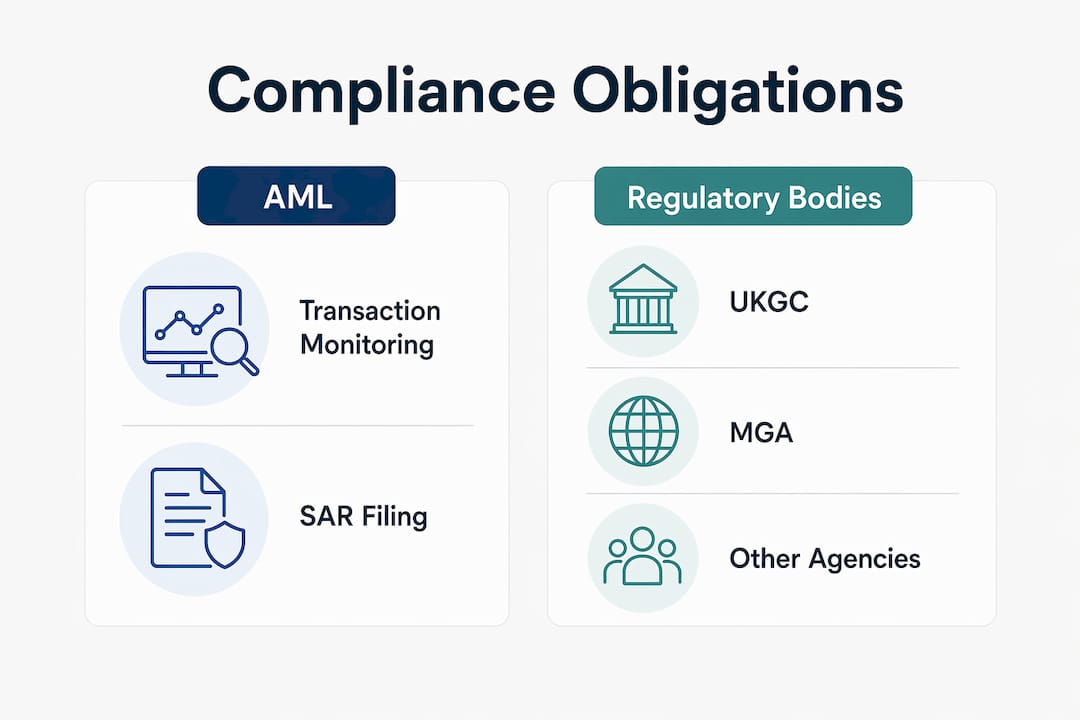
- Anti-Money Laundering (AML): Operators must monitor transactions, file Suspicious Activity Reports, and maintain audit trails.
- Know Your Customer (KYC): Identity verification at onboarding and throughout the player lifecycle.
- Data protection: GDPR compliance for EU players; equivalent standards apply in other markets.
- Gaming law: Licence conditions, responsible gambling obligations, and game fairness standards.
- Advertising regulation: Restrictions on targeting vulnerable groups and mandatory safer gambling messaging.
- AI usage: Emerging rules on algorithmic decision-making in player risk profiling.
- Payment regulation: PSD2, open banking obligations, and transaction monitoring requirements.
The enforcement environment has sharpened considerably. The UK Gambling Commission now applies corporate criminal liability under the Economic Crime Act, meaning senior executives face personal exposure for compliance failures. Brazil introduced a 15% withholding tax on gambling winnings exceeding BRL 2,259.20, adding a new fiscal compliance layer for operators active in that market. These are not theoretical risks. They are live enforcement tools that regulators are actively using.
| Regulatory area | Primary obligation | Enforcement body |
|---|---|---|
| AML | Transaction monitoring and SAR filing | UKGC, MGA, national FIUs |
| KYC | Identity verification and ongoing due diligence | UKGC, MGA |
| Data protection | GDPR-compliant data handling | ICO, national DPAs |
| Gaming law | Licence conditions and responsible gambling | UKGC, MGA, national regulators |
| Payment regulation | PSD2 compliance and fraud monitoring | FCA, national payment authorities |

Is compliance just a legal obligation, or a business imperative?
Compliance is a direct business driver. Operators lacking risk controls face criminal liability, frozen funds, and brand damage at the critical level. Those consequences do not just affect legal standing. They destroy the financial relationships that keep operations running.
Banks and payment providers treat iGaming as a high-risk sector by default. Compliance documentation is the primary tool operators use to change that assessment. A well-structured AML programme, clean KYC records, and a valid licence from a recognised authority like the MGA or UKGC all signal to financial partners that your business is manageable. Understanding why banks reject iGaming businesses comes down almost entirely to perceived compliance gaps.
The competitive angle is equally significant. Operators who treat compliance as a market differentiator gain access to banking relationships, payment processors, and jurisdictions that are closed to less rigorous competitors. Compliance is increasingly a key to trust and scaling market presence, not merely a regulatory burden.
- Compliant operators access a wider pool of banking partners and EMIs.
- Strong KYC and AML records reduce the cost of due diligence for new financial relationships.
- Licence holders in respected jurisdictions command higher player trust and lower churn.
- Documented compliance frameworks reduce the time and cost of regulatory audits.
Pro Tip: Build your compliance documentation with your banking application in mind. Banks review AML policies, KYC procedures, and licence status before approving accounts. A compliance file that reads like a banking due diligence pack accelerates onboarding significantly.
How does operational alignment affect effective compliance in iGaming?
Real compliance means alignment between documented policies and actual operational practices, maintained continuously as operations and rules evolve. A policy document filed at licence application and never reviewed again is not compliance. It is a liability.
Operators who focus solely on document-heavy compliance often fail audits precisely because their live operations have drifted from their stated procedures. The gap between policy and practice is where regulators find violations. Closing that gap requires structured review cycles, not annual tick-box exercises.
The three core training and execution cycles that must run continuously are:
- AML training: Staff must understand current red flags, transaction thresholds, and SAR obligations. Annual AML and sanctions training cycles are mandatory across key jurisdictions.
- KYC execution: Verification procedures must match the documented process at every touchpoint, including re-verification triggers for high-value players.
- Responsible gaming: Staff must apply intervention protocols consistently, not selectively.
Regulatory rules are updated frequently, and operators must review their frameworks against current regulator output quarterly. Ignoring updates risks using stale compliance frameworks, which leads directly to fines. A quarterly review cycle, tied to published guidance from the UKGC and MGA, keeps your documentation current and your operations defensible.
Pro Tip: Assign a named compliance owner for each regulatory category. When the UKGC or MGA publishes updated guidance, that owner is responsible for assessing the impact and updating the relevant procedure within 30 days.
What technologies support compliance throughput and real-time risk management?
Compliance throughput embeds regulatory logic directly into infrastructure, enabling real-time risk assessment and faster product launches. The concept treats regulation as a technical specification, not an afterthought. Systems flag rule violations during development cycles before a human auditor ever reviews the code.
The practical benefits of this approach are significant:
- Real-time transaction monitoring: AI systems flag suspicious transactions instantly, reducing the window between a potential violation and a SAR filing.
- Automated KYC verification: Machine-readable identity checks process player documents in seconds, reducing onboarding friction without sacrificing accuracy.
- Compliance-aware product development: Regulatory rules are encoded into the development pipeline, so new features are tested against compliance requirements before release.
- Audit-ready data architecture: All player interactions, transactions, and decisions are logged in formats that satisfy regulator requests without manual reconstruction.
- Reduced compliance latency: Automated systems reduce the time between a regulatory change and its implementation across the platform.
Compliance throughput requires encoding regulation into network data flows and using compliance-aware AI systems to reduce manual review time dramatically. The legal threshold for Suspicious Activity Reports is suspicion, not proof, which means iGaming operations must prepare to handle large volumes of regulatory reports appropriately.
Third-party vendors offering onboarding, payment, or risk screening services within iGaming are also subject to AML and KYC obligations. Regulators rarely view them as neutral infrastructure. This means your technology stack carries compliance obligations, not just your internal team. Selecting vendors with their own compliance certifications reduces your aggregate risk exposure. You can read more about the importance of compliance in payments to understand how this applies across your payment infrastructure.
What practical steps can iGaming operators take to maintain compliance?
A sustainable compliance programme requires structure, not improvisation. The following framework covers the core components that regulators and banking partners expect to see.
- Establish a risk control system. Map your player base, transaction volumes, and geographic exposure. Assign risk ratings to each segment and document the controls that apply to each.
- Engage professional compliance consultation. Jurisdiction selection, licence applications, and AML programme design require specialist knowledge. Generic legal advice is not sufficient for multi-jurisdictional iGaming operations.
- Implement mandatory staff training. AML, KYC, and responsible gaming training must be completed on joining and refreshed annually. Training records must be retained and available for audit.
- File SARs correctly and promptly. The legal standard for SAR filing is knowledge or suspicion, not proof. Operators who wait for certainty before filing are already in breach.
- Run pre-launch compliance checklists. Before entering any new market, verify licence requirements, payment regulation, advertising rules, and data protection obligations for that jurisdiction.
- Monitor post-launch continuously. Compliance does not end at launch. Player behaviour, transaction patterns, and regulatory updates all require ongoing review.
The table below compares the compliance posture of operators at different maturity levels:
| Compliance area | Basic operator | Mature operator |
|---|---|---|
| AML programme | Annual review, manual monitoring | Quarterly review, automated transaction monitoring |
| KYC process | Document collection at onboarding | Continuous due diligence with re-verification triggers |
| SAR filing | Filed on confirmed evidence | Filed on suspicion, high volume, well-documented |
| Staff training | Ad hoc, undocumented | Annual cycle, records retained for audit |
| Regulatory updates | Reactive, when fines occur | Proactive, quarterly review against regulator output |
For operators managing iGaming banking and payment operations, compliance maturity directly determines which financial partners will work with you and on what terms.
Bankmycapital: compliance and banking support for iGaming operators
iGaming operators face a compounding challenge: meeting complex regulatory requirements while simultaneously securing banking and payment infrastructure that most traditional institutions refuse to provide. Bankmycapital specialises in exactly this intersection. With a network of over 50 pre-vetted banking partners and EMIs, Bankmycapital helps iGaming businesses establish compliant financial relationships in EU and offshore jurisdictions, with an 87% approval rate and onboarding in 2–3 weeks. Services cover iGaming licensing, payment processing, and compliance-aligned banking applications. Operators facing banking rejection risks can use Bankmycapital’s structured approach to address the compliance gaps that cause those rejections and secure the financial partnerships their business needs.
Key takeaways
Compliance in iGaming is a continuous operational discipline that directly determines banking access, licence retention, and long-term business viability.
| Point | Details |
|---|---|
| Regulatory scope | Over 210 regulations across 60+ jurisdictions govern AML, KYC, data protection, and payments. |
| Business consequences | Non-compliance triggers criminal liability, frozen funds, and permanent banking exclusion. |
| Operational alignment | Policies must match live operations; quarterly reviews against UKGC and MGA output are mandatory. |
| Technology integration | Embedding compliance into infrastructure enables real-time monitoring and faster product launches. |
| Banking access | Compliance maturity is the primary factor banks use to assess iGaming partnership risk. |
FAQ
What is iGaming compliance?
iGaming compliance is the set of policies, controls, and procedures that ensure operators meet regulatory, financial, and ethical standards across every jurisdiction they operate in. It covers AML, KYC, data protection, responsible gambling, and payment regulation.
Why does compliance matter for iGaming banking relationships?
Banks treat iGaming as high-risk by default. Operators with documented AML programmes, valid licences, and clean KYC records are far more likely to secure and retain banking partnerships than those without structured compliance frameworks.
What happens if an iGaming operator fails to comply?
Non-compliance at the critical level results in criminal liability, frozen funds, and permanent account bans. The UK Gambling Commission applies corporate criminal liability under the Economic Crime Act, meaning senior executives face personal exposure.
How often should iGaming operators review their compliance frameworks?
Operators must review their compliance frameworks against current regulator output quarterly. Ignoring regulatory updates risks using stale frameworks, which leads directly to fines and enforcement action.
Are third-party payment vendors subject to iGaming compliance obligations?
Third-party vendors offering onboarding, payment, or risk screening services within iGaming are subject to AML and KYC obligations. Regulators do not treat them as neutral infrastructure, so vendor compliance certifications form part of the operator’s overall compliance posture.
