
TL;DR:
- In 2026, high-risk businesses must shift from policy compliance to demonstrating operational effectiveness and AI governance to stay bankable. Credit tightening, increased risk perception, and regulatory reforms demand proactive infrastructure, continuous monitoring, and transparent practices. Success depends on building operational legibility, choosing suitable partners, and preparing evidence aligned with evolving standards.
Most high-risk businesses treat banking access as a compliance problem. Fix the policy, update the KYC pack, add another layer of documentation, and the doors will open. That framing is now dangerously outdated. What is unfolding in 2026 is not a policy adjustment cycle. It is a structural rethink of how banks assess, onboard, and retain clients in sectors like crypto, forex, and iGaming. Understanding precisely what has shifted, and why, is the difference between staying bankable and being quietly exited.
Key Takeaways
| Point | Details |
|---|---|
| 2026 banking climate shift | Tightened credit and compliance drive banks to be more selective, especially for high-risk sectors. |
| Demonstrable compliance required | Regulators and banks now focus on effectiveness and evidence, not box-ticking checklists. |
| Fraud risks rise with speed | Faster payments increase scam pressure, requiring layered, real-time ID and fraud controls. |
| Global rule changes impact all | Major US/EU regulatory reforms reshape expectations, demanding anticipatory adjustment. |
| Operational readiness is critical | Ongoing monitoring, AI governance, and transparent risk processes separate survivors from the rest. |
Why 2026 is different: Banking climate for high-risk sectors
The phrase “credit tightening” gets thrown around constantly, but the scale in 2026 deserves specific attention. The ECB April 2026 Bank Lending Survey confirms that credit standards tightened across all major loan categories in the eurozone, with further tightening expected through Q2 2026. The drivers are not abstract: higher perceived risks, lower institutional risk tolerance, geopolitical pressure, energy costs, and funding constraints are all cited. For high-risk sectors, this is not a theoretical concern. It translates directly into fewer banks onboarding high-risk clients and shorter windows to make a compelling case during due diligence.
“The environment in 2026 is not simply stricter. It is more sceptical. Banks are not just looking for compliant businesses. They are looking for businesses whose risk profile they can justify holding on their books indefinitely.”
What makes this cycle different from previous tightening phases is that risk perception is now as influential as formal regulation. Even where a high-risk business meets every technical requirement, a bank’s internal appetite committee may still decline based on sector categorisation alone. Forex, crypto, and iGaming operators face this reality regularly. Regulators are also shifting their scrutiny from whether rules exist to whether they demonstrably work. That is a fundamentally different standard.
| Pressure driver | Impact on high-risk banking |
|---|---|
| Geopolitical instability | Increased sector-wide risk aversion |
| Credit tightening across eurozone | Fewer willing banking partners |
| Regulatory effectiveness focus | More evidence demanded at onboarding |
| AI-driven internal bank risk models | Automated rejections without explanation |
| Faster payment infrastructure | Higher fraud scrutiny on all transactions |
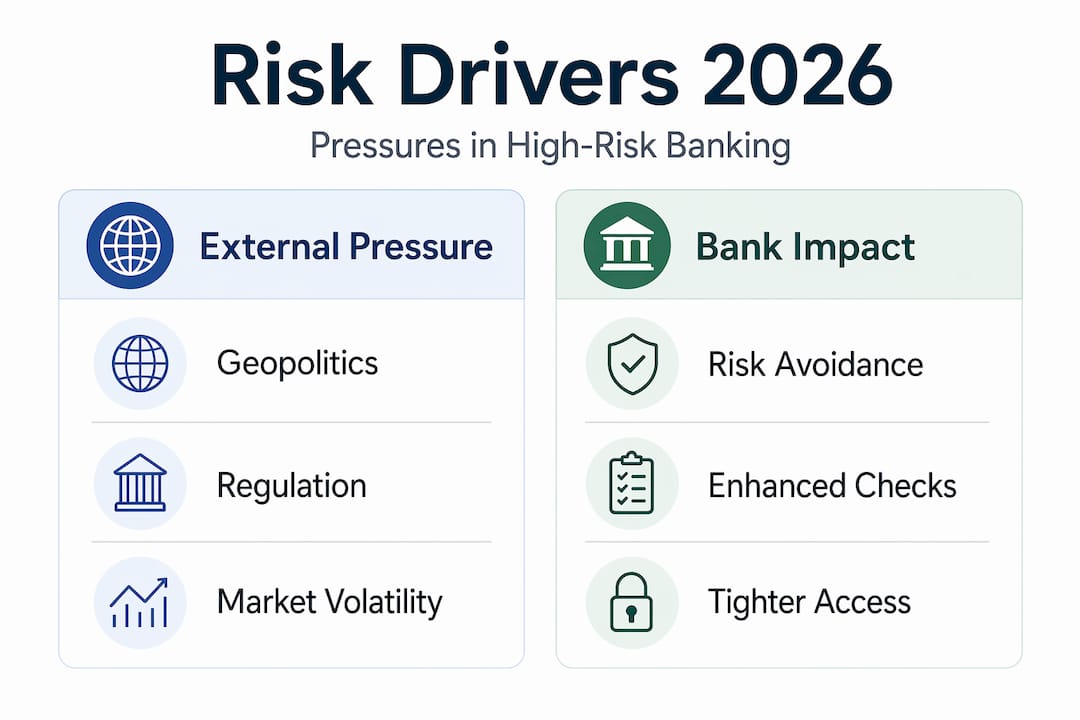
The high-risk banking EU guide for 2026 outlines how jurisdiction selection and structural preparation can significantly reduce exposure to these pressures. Understanding the climate is the foundation. Acting on it is the work.
Compliance in 2026: Demonstrable effectiveness and AI governance
Compliance used to mean producing the right documents. A solid AML policy, a KYC procedure manual, a PEP screening process, and a SAR log. That box-ticking model is not gone, but it is no longer sufficient. The NICE Actimize AML Tech Barometer 2026 makes this shift explicit: expectations are moving from rule-based technical compliance toward demonstrable effectiveness, with specific emphasis on the governance of AI-assisted controls and stronger data practices for ongoing monitoring.
This matters enormously for high-risk operators. Regulators and bank compliance teams are now asking: does your compliance programme actually catch what it claims to catch? Can you show evidence of continuous monitoring rather than periodic reviews? And if you are using automated tools, including AI-driven transaction monitoring or ID verification, can you document how those models work, what they flag, and how decisions are reviewed by humans?
For the sectors BankMyCapital works with, this creates a three-layer challenge:
- Effectiveness evidence: Banks now expect quantitative data from compliance systems. Businesses need to demonstrate how many alerts were generated, investigated, and resolved over a given period, not just that an alerting system exists.
- AI model governance: If you use any AI or machine learning in compliance workflows, regulators expect documented model governance. That means version control, bias testing, explainability records, and human oversight logs.
- Continuous monitoring over point-in-time reviews: Static annual risk assessments are increasingly viewed with scepticism. Real-time or near-real-time monitoring with audit trails is becoming the baseline expectation.
For businesses operating in crypto or iGaming, where customer transaction patterns are highly variable and asset values can shift dramatically within hours, this continuous evidence requirement is particularly demanding. It requires investment in infrastructure, not just policy.
Pro Tip: Before approaching any banking partner in 2026, prepare a compliance evidence pack that includes monitoring statistics from the past 12 months, your AI model governance documentation if applicable, and a clear audit trail of how suspicious activity investigations were escalated and resolved. This pack can significantly accelerate due diligence conversations.

The broader high-risk finance compliance guide outlines precisely how to structure this type of evidence-based approach, including jurisdiction-specific nuances that affect what banks expect to see. Meanwhile, the crypto compliance trends 2026 resource provides sector-specific depth for digital asset businesses navigating these shifting standards.
Faster payments, greater risks: Payments innovation and fraud pressure
Instant payment infrastructure is genuinely useful. Settlement in seconds, reduced counterparty exposure, smoother customer experience. For high-risk businesses operating globally, faster payments represent a meaningful competitive advantage. The problem is that they also represent a significantly expanded attack surface for fraud, and banks know it.
J.P. Morgan’s payment trends analysis for 2026 highlights a clear supervisory emphasis on pre-transaction checks and layered identity validation, driven directly by the increase in scams targeting faster payment flows. The speed that makes instant payments attractive is precisely what fraudsters exploit. Once a payment clears, recovery is exceptionally difficult.
Here is how the risk landscape looks in practical terms:
| Payment type | Fraud risk profile | Required control layer |
|---|---|---|
| Instant bank transfers | High: irreversible, rapid clearing | Real-time fraud scoring, beneficiary verification |
| Crypto settlements | Very high: pseudonymous, cross-border | On-chain analytics, KYT (Know Your Transaction) |
| Card-not-present | High: identity spoofing risk | 3DS2, device fingerprinting, behavioural analysis |
| SEPA instant credit | Medium-high: velocity fraud risk | Pre-transaction limits, counterparty checks |
For high-risk sectors, regulators and banking partners now expect a layered defence model, not a single control point. The following sequence represents current baseline expectations:
- Pre-transaction identity validation: Confirm counterparty identity and legitimacy before any funds move, using layered checks that go beyond basic ID matching.
- Real-time fraud scoring: Apply automated risk scoring at the point of transaction initiation, flagging anomalies for human review before settlement.
- Beneficiary account validation: Verify receiving account details against fraud registers and known-bad databases before authorising payment.
- Velocity and pattern monitoring: Identify unusual transaction frequency or value clustering that suggests structuring or account takeover activity.
- Post-transaction audit trails: Maintain detailed records of all fraud decisions, including both flagged and cleared transactions, for regulatory review.
The payment processing best practices resource for 2026 covers these controls in depth, with specific guidance for businesses operating across multiple jurisdictions where payment regulation differs substantially.
Pro Tip: If your business processes instant payments across borders, consider implementing a dedicated fraud control matrix that distinguishes between domestic and cross-border payment risk. Banks reviewing your onboarding application will look specifically for evidence that you treat these risk profiles differently.
The risk management best practices 2026 guide provides further operational depth on building fraud frameworks that satisfy both banking partners and regulators simultaneously.
Regulatory reform and enforcement: Global momentum in 2026
While European credit conditions dominate the immediate banking climate, the most significant structural changes in regulatory expectations originate partly from the United States. AML/CFT reform proposals in 2026 from the US Treasury and banking regulators are designed to overhaul BSA/AML/CFT obligations, with a stated intention to harmonise expectations across covered institutions. When the US moves, correspondent banking relationships globally shift in response.
This matters for European and offshore-based high-risk operators for a practical reason: your banking partners, wherever they are domiciled, likely maintain US dollar clearing relationships. Those clearing banks are subject to US regulatory pressure. They pass that pressure downstream to their clients, including the smaller banks and EMIs that high-risk businesses use. The compliance standards effectively travel across borders through the correspondent banking chain.
The key preparation actions in response to this global momentum are:
- Maintain living compliance documentation: Static policy manuals that were written two years ago and never updated will not satisfy 2026 standards. Documentation should reflect current operations, current technology, and current risk assessments.
- Update governance structures proactively: Regulators on both sides of the Atlantic are scrutinising accountability structures. Who owns AML risk? Who reviews AI model outputs? These questions need documented answers.
- Anticipate cross-border data requests: Harmonisation of standards means harmonisation of evidence requests. Businesses operating across multiple jurisdictions should prepare to produce consistent compliance data in formats suitable for review by multiple regulatory bodies.
- Monitor timelines actively: Regulatory reform timelines frequently slip. But businesses that wait for finalised rules before preparing invariably fall behind those who anticipate and adapt early.
Regulatory reform is not a one-time adaptation event. The businesses that survive successive regulatory cycles treat compliance infrastructure as an ongoing operational capability, not a project to complete and close. That mindset is what separates genuinely resilient operators from those who scramble through each cycle.
Accessing accurate guidance on EU high-risk banking approval requirements, including jurisdiction-specific regulatory expectations, is increasingly important as reform timelines accelerate.
Why survival thinking isn’t enough: A fresh perspective for high-risk banking in 2026
Here is an uncomfortable observation: the majority of high-risk businesses approach banking access with a defensive mindset. The goal is to pass review, avoid rejection, and not attract attention. That approach worked in a less scrutinised era. In 2026, it is a liability.
Banks are not just assessing whether you are compliant at the point of onboarding. They are increasingly evaluating whether you are the kind of business they want to explain to their own regulators two years from now. That is a fundamentally different question. It asks about operational character, not documentation completeness.
The businesses we see succeed in the current environment share a specific quality: they treat compliance and risk management as genuine operational capabilities rather than overhead costs. They monitor proactively, communicate openly with banking partners about changes in their business, and invest in infrastructure that produces evidence as a natural byproduct of operations rather than scrambling to produce it when a bank asks. They also embrace AI governance not as a burden but as a differentiator, because a well-documented AI compliance model signals operational sophistication that most competitors cannot match.
Survival thinking says: what is the minimum I need to do to stay onboarded? Resilience thinking says: how do I build the kind of operational transparency that makes me genuinely low risk to hold? The practical gap between those two mindsets is significant. The banking onboarding process for high-risk businesses rewards the second approach consistently.
The winners in 2026’s banking climate are not necessarily the most compliant businesses in a technical sense. They are the most legible ones, the businesses whose risk profile is easy for a bank to understand, document, and defend internally. Legibility comes from operational transparency, consistent monitoring evidence, and clear governance structures. It is not achieved through better paperwork alone.
Accessing banking solutions for high-risk sectors in 2026
The strategic picture above makes one thing clear: navigating 2026’s banking landscape requires more than a good application. It requires the right partners, the right jurisdictions, and compliance infrastructure built to current standards before you approach a bank.
BankMyCapital’s high-risk banking consultancy services are specifically designed for businesses operating in crypto, iGaming, forex, and adjacent sectors who need banking relationships that will hold up through continued regulatory evolution. With a network of over 50 pre-vetted banking partners and EMIs, an 87% approval rate, and typical onboarding timelines of two to three weeks, the focus is on structuring your application to match what banks genuinely want to see in 2026. Explore the full range of types of high-risk banking solutions available, and find out how dedicated payment processing for high-risk businesses can be integrated into your overall banking strategy.
Frequently asked questions
How can a high-risk business improve its chances of bank approval in 2026?
Focus on demonstrable compliance effectiveness rather than documentation volume. Banks in 2026 want evidence of ongoing monitoring outcomes and documented AI governance, not just policy manuals.
What is the biggest regulatory change affecting high-risk banking in 2026?
The most far-reaching shift is the proposed overhaul of AML/CFT obligations in the US, which is driving harmonised supervision standards that filter through correspondent banking relationships globally.
Are payment fraud risks increasing for high-risk companies?
Yes. The growth of instant payment infrastructure in 2026 directly increases exposure to scams, with supervisors now expecting layered pre-transaction controls and real-time fraud monitoring as a baseline rather than a bonus.
How does AI impact compliance monitoring for high-risk sectors?
In 2026, using AI in compliance is acceptable, but regulators and banks both demand documented AI model governance, including explainability records and human oversight logs, making undocumented automation a liability rather than an advantage.
