
TL;DR:
- The crypto payments onboarding process involves regulatory checks, technical setup, and ongoing monitoring to ensure compliance. Proper preparation of documentation, careful selection of integration methods, and thorough testing prevent delays and operational errors. Continuous oversight and staff training are vital for maintaining secure and compliant cryptocurrency payment operations.
The crypto payments onboarding process is a structured sequence of regulatory verification and technical integration steps that online businesses must complete before accepting cryptocurrency payments compliantly. Known formally as merchant payment integration and compliance onboarding, this process spans Know Your Business (KYB) checks, technical gateway configuration, and transaction monitoring obligations under frameworks such as MiCA and the EU’s Anti-Money Laundering Regulation (AMLR). Getting it right from the start determines whether your first live transaction goes through cleanly or triggers a compliance flag that stalls your entire operation.
What regulatory and compliance prerequisites must businesses meet before crypto payment onboarding?
Compliance is the foundation of any cryptocurrency payment integration, not an afterthought. Regulators across the EU and offshore jurisdictions require businesses to satisfy KYB obligations before a single transaction is processed. Skipping or rushing this stage is the single most common reason onboarding stalls.
The KYB process mandates verifying all Ultimate Beneficial Owners (UBOs) with 25% or greater ownership, submitting valid registration documents, and providing proof of operating address dated within the last three months. That threshold exists because regulators treat any owner above 25% as a material controller of the business. Utility bills and bank statements are the standard accepted documents for address verification.
Beyond basic KYB, businesses in high-risk sectors face enhanced due diligence (EDD). This means sanctions screening, watchlist checks against bodies such as OFAC and the EU Consolidated List, and a documented risk assessment of the business model. For crypto, iGaming, forex, and adult entertainment operators, EDD is not optional. Regulators expect it as a baseline.
The documentation you need to prepare includes:
- Certificate of incorporation or equivalent registration document
- Proof of registered and operating address (utility bill or bank statement, under three months old)
- Identification documents for all UBOs holding 25% or more equity
- A description of the business model and expected transaction volumes
- Source of funds declaration for the business and its principals
- Any existing licences relevant to your sector (e.g., VASP, EMI, gambling licence)
Pro Tip: Prepare your full documentation pack before approaching any payment provider. Compliance experts confirm that pre-assembled KYB files cut onboarding delays by weeks, not days.
Post-onboarding, continuous transaction monitoring against sanctions lists, blockchain analytics tools, and the Travel Rule is mandatory. Record-keeping obligations extend beyond a five-year minimum under AMLR. Compliance does not end at approval. It runs for the life of the account.
Which technical tools and integration methods work best for crypto payment setup?
The technical side of crypto payment setup splits into two clear paths: plug-and-play gateway plugins and API-based custom integrations. Each suits a different business profile, and choosing the wrong one creates unnecessary rework later.

Plug-and-play integrations for platforms such as Shopify can be completed in under one hour. These solutions handle wallet generation, payment confirmation, and fiat conversion automatically. They suit businesses with standard e-commerce flows and no need for bespoke transaction logic.
API-based integrations give you full control over the payment lifecycle. You define the order states, set confirmation thresholds, and manage webhook endpoints directly. The trade-off is complexity. Enterprise setups with custom internal state machines can take days or weeks to configure correctly, depending on your development team’s familiarity with blockchain finality concepts.
The right gateway is not always the cheapest one. Gateway selection depends on alignment with your transaction model, geography, and regulatory posture. A gateway that supports your target currencies, settles in your preferred jurisdiction, and holds the relevant licences is worth more than one that saves you 0.5% in fees.
| Integration method | Complexity | Setup time | Control level | Best suited for |
|---|---|---|---|---|
| Plugin (e.g., Shopify app) | Low | Under one hour | Limited | Standard e-commerce stores |
| Hosted payment page | Low to medium | A few hours | Moderate | SMEs without developer resource |
| API with webhooks | High | Days to weeks | Full | Enterprise and custom platforms |
| White-label gateway | Medium to high | One to two weeks | High | Businesses requiring branded checkout |
Pro Tip: Whichever integration path you choose, build your webhook handler to log every unrecognised event for manual review. Technology experts confirm that operational stability depends more on correct webhook and state handling than on the API integration itself.
What are the step-by-step best practices for the crypto payments onboarding process?
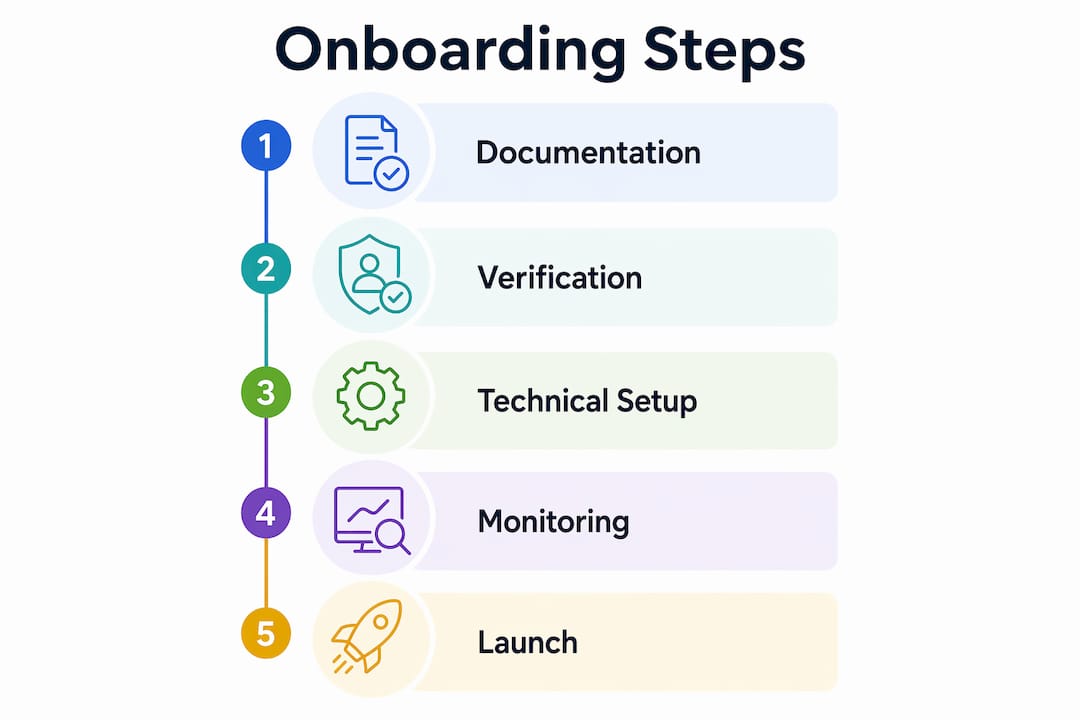
A structured walkthrough removes ambiguity and prevents the most common operational errors. The following sequence reflects industry best practice for businesses moving from documentation to first live transaction.
-
Prepare and submit all regulatory documentation. Assemble your full KYB pack before contacting any provider. This includes UBO identification, registration documents, proof of address, and source of funds. Providers reject incomplete submissions, which restarts the clock.
-
Select your integration method and configure your wallet. Choose between plugin, hosted page, or API based on your platform and technical capacity. Generate your receiving wallets and confirm which cryptocurrencies you will accept. Bitcoin, Ethereum, and USDT are the most widely supported.
-
Set confirmation thresholds. Variable confirmation thresholds based on transaction value reduce the risk of chain reorganisations affecting payment finality. Use 2–3 confirmations for low-value Bitcoin orders and up to 6 for high-value transactions. Apply equivalent logic to other networks based on their finality characteristics.
-
Configure webhook endpoints and build your payment state machine. Map every gateway event (pending, confirmed, expired, failed) to a defined internal order state. Proper webhook handling requires pre-defined responses for every event to avoid double-fulfilment or zombie invoices.
-
Test with sandbox transactions. Run your full payment flow in a test environment before touching live funds. Simulate edge cases: expired invoices, underpaid amounts, and network delays. Fix failures here, not in production.
-
Conduct a soft launch with limited transactions. Process a small volume of real transactions before full rollout. Payment operations experts treat merchant onboarding as a lifecycle, using pilot programmes of 5–20 merchants over 60–90 days to identify process failures before scaling.
The table below maps each step to its primary risk and the checkpoint that confirms it is complete.
| Step | Primary risk | Completion checkpoint |
|---|---|---|
| Documentation submission | Incomplete KYB causing rejection | Provider confirms receipt and completeness |
| Wallet and currency configuration | Unsupported assets or wrong network | Test deposit received on correct address |
| Confirmation threshold setup | Chain re-org causing false payment confirmation | Threshold rules documented and tested |
| Webhook and state machine build | Duplicate fulfilment or missed events | All event types handled in staging |
| Sandbox testing | Undetected edge-case failures | Zero critical errors across test scenarios |
| Soft launch | Operational gaps at scale | First 50 live transactions processed without error |
How can businesses troubleshoot common issues during crypto payments onboarding?
Most onboarding failures trace back to a small set of recurring problems. Recognising them early saves significant time and cost.
Incomplete KYB documentation is the leading cause of onboarding delays. Providers cannot progress an application without a full, verified document set. The fix is straightforward: use a crypto payment checklist before submission and assign one person internally to own the documentation process from start to finish.
Webhook misconfiguration causes a disproportionate share of operational errors. Failure to handle webhook idempotency leads to duplicate payment processing in high-volume environments. Your endpoint must accept the same notification multiple times without triggering multiple fulfilments. This is not a nice-to-have. It is a hard requirement for any business processing more than a handful of daily transactions.
Incorrect confirmation thresholds create a subtler problem. Set them too low and a chain reorganisation can mark an order as paid when the underlying transaction is later reversed. Set them too high and customers abandon the checkout before confirmation arrives. The solution is variable thresholds calibrated to transaction value and network.
“Most merchants underestimate the need for well-documented onboarding policies and continuous training of staff to manage crypto payments.” This gap shows up not in the technology but in how teams respond when something goes wrong at 2am on a Saturday.
Ongoing monitoring matters as much as the initial setup. Automated screening against sanctions lists and blockchain analytics tools catches suspicious activity that manual review would miss. Staff training on payment processes, troubleshooting procedures, and customer communication is a compliance obligation, not just good practice. Build it into your onboarding programme from day one.
How Bankmycapital supports your crypto payment integration
Bankmycapital works with crypto businesses, iGaming operators, forex firms, and other high-risk sectors to navigate the full onboarding lifecycle. From KYB documentation preparation to jurisdiction selection and regulatory liaising, the consultancy removes the friction that causes most applications to stall. With a network of over 50 pre-vetted banking partners and EMIs, Bankmycapital achieves an 87% approval rate and typical onboarding timelines of 2–3 weeks. For businesses that have already faced banking rejection risks, the structured approach makes a measurable difference. Explore Bankmycapital’s crypto payment solutions to find the right fit for your operation.
Key takeaways
A compliant crypto payments onboarding process requires complete KYB documentation, correctly configured webhooks, variable confirmation thresholds, and a tested soft-launch phase before full transaction volume begins.
| Point | Details |
|---|---|
| KYB documentation is non-negotiable | Prepare UBO identification, registration documents, and proof of address before approaching any provider. |
| Integration method determines complexity | Plugin setups take under one hour; API integrations with custom state machines require days to weeks. |
| Confirmation thresholds protect payment finality | Use 2–3 confirmations for low-value Bitcoin orders and up to 6 for high-value transactions. |
| Webhook idempotency prevents duplicate fulfilment | Endpoints must handle repeated notifications without triggering multiple order completions. |
| Soft launches identify failures before scale | Pilot with limited transactions to catch process gaps before full rollout. |
FAQ
What is the crypto payments onboarding process?
The crypto payments onboarding process is the sequence of KYB compliance checks, technical gateway configuration, and transaction monitoring setup that a business must complete before accepting cryptocurrency payments. It covers regulatory verification, wallet setup, webhook integration, and a test phase before going live.
How long does crypto payment onboarding take?
Plug-and-play plugin integrations for standard e-commerce platforms can be completed in under one hour. Full API-based enterprise integrations, combined with KYB review periods, typically take days to several weeks depending on documentation readiness and provider processing times.
What documents do I need for KYB during crypto onboarding?
You need a certificate of incorporation, proof of operating address dated within three months, identification for all UBOs holding 25% or more equity, a business model description, and a source of funds declaration. High-risk sectors also require enhanced due diligence documentation.
What is webhook idempotency and why does it matter?
Webhook idempotency means your payment endpoint processes each notification only once, even if the gateway sends it multiple times. Without it, duplicate notifications trigger multiple order fulfilments, which causes financial losses and operational errors in high-volume environments.
Do compliance obligations end after onboarding is complete?
Compliance obligations continue for the life of the account. Businesses must conduct continuous transaction monitoring against sanctions lists, apply blockchain analytics screening, comply with the Travel Rule, and maintain records for a minimum of five years under AMLR requirements.
