
TL;DR:
- Payment processing risk encompasses fraud, chargebacks, compliance failures, and reputational damage that can threaten a merchant’s payment access. High-risk sectors face heightened scrutiny, higher reserve requirements, and regulatory challenges, making ongoing risk management essential for stability. Building transparent, compliant operations and leveraging proactive controls help businesses maintain secure, long-term payment processor relationships.
Payment processing risk is something every business faces the moment it accepts a card payment, yet most operators only learn about it after something goes wrong. Defined by Stripe as the potential for a merchant to create financial or legal liability for their payment processor through fraud, chargebacks, compliance failures, or reputational damage, payment processing risk extends well beyond simple fraud prevention. For business owners in high-risk sectors such as crypto, iGaming, forex, and adult entertainment, understanding the full scope of these risks is the difference between maintaining processor relationships and losing access to payments entirely.
Key takeaways
| Point | Details |
|---|---|
| Risk extends beyond fraud | Payment processing risk covers chargebacks, compliance failures, reputational damage, and operational vulnerabilities. |
| Chargeback thresholds matter | Exceeding a 1.5% chargeback rate can trigger fines or account suspension from card networks. |
| Processors assess your whole business | Underwriting considers financial stability, business model, regulatory compliance, and transaction behaviour, not just fraud history. |
| High-risk industries face extra scrutiny | Sectors like gambling, crypto, and adult entertainment attract more intensive monitoring and compliance obligations. |
| Early intervention prevents account loss | Automated monitoring flags issues before human review, so rapid remediation is critical to avoid termination. |
Core types of payment processing risk
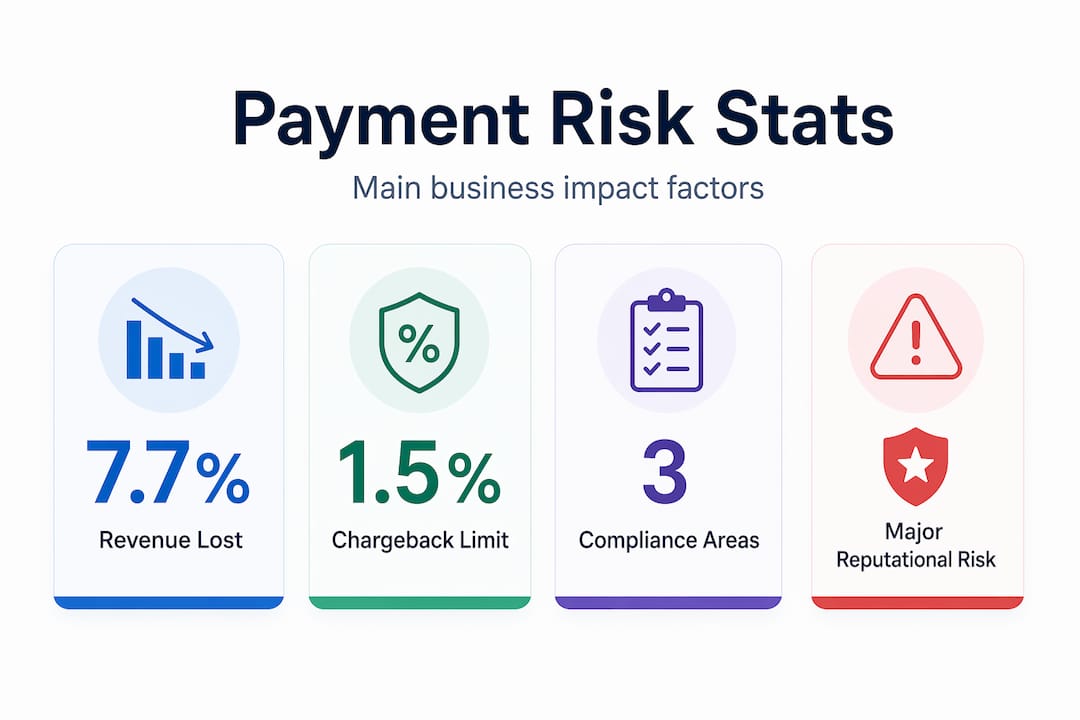
Most businesses treat payment risk as synonymous with fraud. That framing is dangerously incomplete. The risks in payment processing span four distinct categories, each with its own mechanics, consequences, and mitigation requirements.
Fraud risk
Fraud is the most visible category, but its detection has become genuinely sophisticated. Modern processors use real-time fraud scoring that analyses behavioural and payment signals within milliseconds, flagging elevated-risk transactions before they complete. These signals include device fingerprinting, IP geolocation, transaction velocity, and card verification results.
The financial stakes are significant. Businesses lost 7.7% of annual revenue to fraud in the 2024 to 2025 period. That figure includes direct losses, dispute fees, and the operational cost of managing fraudulent orders. For high-risk businesses, fraud exposure is compounded by the fact that many operate in digital environments where physical verification is impossible.
Chargeback risk
A chargeback occurs when a cardholder disputes a transaction directly with their bank rather than seeking a refund from the merchant. This is distinct from a refund. The merchant bears the cost of the original transaction, a dispute fee, and the administrative burden of responding.
Card networks set hard thresholds. Mastercard fines merchants who exceed a 1.5% chargeback rate, and approaching 1% is already considered problematic by most processors. Sustained high chargeback rates can result in account suspension, placement on industry blacklists such as MATCH, and difficulty securing future processing relationships.
Compliance risk
Payment compliance obligations include PCI DSS (the Payment Card Industry Data Security Standard), Know Your Customer (KYC) protocols, and Anti-Money Laundering (AML) regulations. Failing to meet these requirements does not just expose your own business to penalties. It creates liability for your processor, which is precisely why non-compliant merchants are terminated quickly.

The regulatory environment is tightening. Regulators are increasingly holding processors accountable for inadequate merchant monitoring, which means processors are in turn placing greater compliance demands on the businesses they onboard.
Reputational risk
Reputational risk is the most underestimated category. A business operating in a legal but socially contentious industry, such as online gambling or adult content, can lose processing access not because it did anything wrong, but because the processor decides the association no longer aligns with its risk appetite. Conduct matters. Public regulatory actions, media coverage, or customer complaints can shift a processor’s willingness to maintain the relationship.
Pro Tip: Keep a documented compliance record, including KYC verification logs, PCI DSS attestations, and chargeback response histories. This documentation actively reduces perceived risk during processor reviews and underwriting.
How processors assess merchant risk
Understanding how a payment processor evaluates your business gives you the ability to manage that relationship proactively rather than reactively. The assessment begins before you accept a single transaction.
Processors use a structured underwriting process that examines multiple dimensions of your operation:
- Business model analysis. What products or services are sold, what is the average transaction size, and does the business model present unusual dispute or refund patterns?
- Financial stability. Processors review financial statements, bank history, and sometimes personal credit. A business with volatile revenue or thin reserves represents greater exposure.
- Compliance posture. Does the business have active PCI DSS certification? Are KYC and AML procedures documented and enforced?
- Transaction history. Prior chargeback rates, fraud ratios, and processing volumes from previous processors are scrutinised. A history of account terminations is a significant negative signal.
- Regulatory environment. Is the business operating in a jurisdiction with clear legal frameworks for its industry, or does it exist in a grey area?
Once onboarded, monitoring does not stop. Automated systems flag merchants before any human review takes place. Thresholds for fraud ratios, chargeback rates, and transaction velocity trigger alerts that may result in holds, reserves, or termination if not addressed promptly.
Processors also watch for load balancing schemes. The FTC took action against Nexway for load balancing to hide chargebacks, resulting in a $16.5 million judgment. Distributing transactions across multiple processors to keep individual chargeback rates below threshold is viewed as deliberate concealment, and processors treat it accordingly.
| Risk signal | Processor response |
|---|---|
| Chargeback rate approaching 1% | Enhanced monitoring, possible reserve requirement |
| Chargeback rate exceeding 1.5% | Fines, account suspension, potential MATCH listing |
| Fraud ratio anomaly | Transaction holds, manual review, possible account freeze |
| Load balancing detected | Immediate termination, regulatory referral |
| KYC/AML non-compliance | Account suspension, legal and regulatory reporting |
How to manage payment risk effectively
Managing payment risk is not a one-time project. It requires ongoing processes, technical controls, and organisational discipline. The businesses that retain stable processing relationships over time are those that treat risk management as a continuous operational function rather than a compliance checkbox.
Here are the core components of an effective payment risk programme:
- Multi-factor authentication (MFA) at checkout. MFA significantly reduces account takeover fraud, which is one of the leading sources of disputed transactions in subscription-based and digital goods businesses.
- Address Verification Service (AVS) and CVV checks. These basic controls are often overlooked by smaller operators, but they eliminate a significant proportion of card-not-present fraud at minimal cost.
- Tokenisation. Replacing card data with secure tokens reduces your PCI DSS scope and eliminates the risk of stored cardholder data being compromised in a breach.
- Fraud scoring with layered business rules. Combining fraud scores with business rules and human review produces significantly better outcomes than relying on automated scoring alone. Legitimate transactions can receive high fraud scores due to unusual but valid behaviour, such as a customer travelling abroad.
- Chargeback management workflows. This means clear return and refund policies, proactive customer communication, and a structured dispute response process. Preventing chargebacks is always preferable to winning them.
- Regular PCI DSS assessments. A Qualified Security Assessor (QSA) audit each year identifies vulnerabilities before they become incidents.
For businesses managing payment processing best practices, disaster recovery planning is equally important. System downtime during peak transaction periods creates both direct revenue loss and reputational harm if customers are unable to complete purchases.
Pro Tip: Set your internal chargeback alert threshold at 0.65%, well below the industry concern point of 1%. This gives you time to investigate and remediate before your processor takes notice.
Risk considerations for high-risk industries
Certain sectors face scrutiny that goes beyond what standard merchant underwriting involves. Gambling, adult entertainment, crypto, cannabis, travel, and forex businesses are classified as high-risk not because they are inherently dishonest, but because their operating characteristics increase the statistical likelihood of disputes, regulatory complications, and fraud exposure.
The key payment processing challenges specific to these sectors include:
- Legal grey areas. A crypto exchange may operate legally in one jurisdiction and be entirely unregulated in another. Processors serving these businesses must navigate multi-jurisdictional compliance, and they pass that complexity directly back to the merchant.
- Elevated chargeback rates. Adult entertainment and travel businesses historically see higher dispute rates, partly driven by buyer’s remorse and subscription billing misunderstandings. Managing this requires meticulous billing descriptors, clear cancellation policies, and responsive customer service.
- Reputational sensitivity. A processor’s exposure to reputational risk increases when serving sectors that generate public controversy. Understanding enterprise crypto risk oversight requires businesses to actively manage their public regulatory profile, not just their internal controls.
- Regulatory enforcement actions. Regulators in the EU and UK have demonstrated willingness to take direct action against payment processors that fail to identify and prevent abuse by high-risk merchants. This creates a cascading effect where processors become more restrictive across entire sectors following a single enforcement action.
- Higher reserve requirements. High-risk businesses often face rolling reserves of 5% to 10% of transaction volume, sometimes held for 180 days. This creates working capital constraints that must be factored into financial planning.
For businesses in these sectors, a payment gateway risk assessment conducted before merchant account applications significantly improves approval rates and reduces the likelihood of mid-contract terminations.
My perspective on managing payment risk
I have worked with businesses across crypto, iGaming, and forex long enough to see the same mistakes repeated. The most common is treating risk management as a pre-launch compliance exercise rather than an ongoing operational discipline. Businesses get approved, go live, and then quietly let their chargeback response process lapse or allow PCI attestations to expire. Processors notice. And by the time they do, the merchant has already crossed a threshold.
What I find most underappreciated is the human review layer in fraud detection. The fraud scoring models that operate within milliseconds are genuinely impressive at catching known fraud patterns, but legitimate transactions can get caught in automated filters due to unusual but entirely valid behaviour. Businesses that skip the human review step because it adds friction are effectively letting automated systems make final decisions on borderline cases. That leads to both false declines, which cost revenue, and missed fraud, which costs more.
The other thing I tell every high-risk operator is to be completely honest during underwriting. Processors will discover your real chargeback history and prior terminations. Attempting to obscure these details destroys trust immediately and permanently. The businesses that build stable long-term processing relationships are those that enter those relationships with full transparency and demonstrate they have the controls to manage their risk profile.
— Vadim
Managing payment risk with the right support
For businesses in crypto, iGaming, adult entertainment, and forex, understanding payment processing risk is only the first step. Applying that understanding in a way that secures stable, compliant processing is considerably harder without the right structure in place. Bankmycapital works specifically with high-risk operators to establish banking and payment relationships that account for the full complexity of sector-specific risk profiles.
Whether you need guidance on a processor’s underwriting requirements, support building KYC and AML frameworks, or help accessing a pre-vetted network of payment partners familiar with your sector, Bankmycapital provides the compliance and banking infrastructure to get there. Explore the high-risk banking guide for a detailed breakdown of what financial institutions actually look for, or review the banking rejection risk guide to understand exactly where applications fail and how to address those vulnerabilities before they become costly rejections.
FAQ
What is payment processing risk?
Payment processing risk is the potential for a merchant’s transaction activity to create financial, legal, or reputational liability for their payment processor. It covers fraud, chargebacks, compliance failures, and reputational exposure, not just fraudulent conduct.
What causes high chargeback rates?
High chargeback rates are typically caused by unclear billing descriptors, poor customer communication, subscription cancellation difficulties, and fraud. Rates above 1% draw processor scrutiny, and exceeding 1.5% can result in fines or account suspension.
How do payment processors identify risky merchants?
Processors use automated monitoring tools that track fraud ratios, chargeback rates, and transaction velocity in real time. Anomalies trigger alerts and can result in account holds or termination without prior warning if thresholds are breached.
Why are some industries classified as high risk?
Industries such as gambling, crypto, adult entertainment, and travel are classified as high risk because they statistically generate higher dispute rates, operate in complex regulatory environments, and carry greater reputational exposure for processors.
How can a business reduce its payment processing risk?
Businesses reduce processing risk by implementing MFA, AVS, and tokenisation, maintaining PCI DSS compliance, managing chargeback rates proactively, and using layered fraud scoring combined with human review for borderline transactions. Regular audits and transparent relationships with processors further reduce exposure.
