
TL;DR:
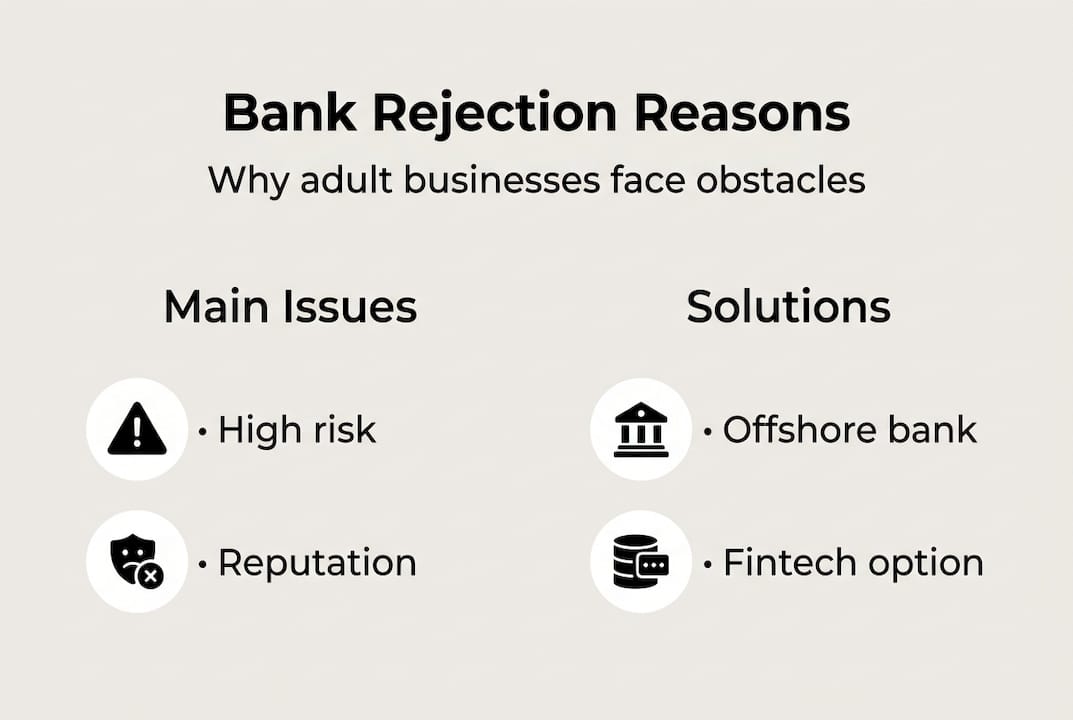
- Adult businesses are classified as high risk due to reputational, legal, and payment processing concerns.
- Rejections often stem from incomplete documentation, inconsistent business descriptions, and unaddressed risk factors.
- Offshore, fintech, and pre-approval strategies offer alternative banking solutions with careful provider vetting.
Running a profitable, fully licensed adult business in Europe is no guarantee that a bank will accept you. Thousands of legitimate operators discover this the hard way every year, receiving terse rejection letters with little explanation beyond vague phrases like “outside our risk appetite.” The reality is that banks apply a separate set of rules to adult businesses, rules shaped by reputational pressure, regulatory complexity, and internal risk scoring that has nothing to do with whether your business is actually profitable or lawful. Understanding exactly why these rejections happen is the first step towards finding a banking route that genuinely works.
Key Takeaways
| Point | Details |
|---|---|
| Adult sector flagged as high risk | Banks classify adult businesses as high risk due to reputational and regulatory factors. |
| Compliance hurdles are key | Adult firms face enhanced due diligence with stricter KYC and AML requirements. |
| Official vs. hidden rejection reasons | Banks often give vague reasons for rejection, concealing deeper risk concerns. |
| Alternative solutions exist | Offshore, fintech, and specialist providers can offer viable banking routes for adult businesses. |
Understanding the high-risk label: why adult businesses are flagged
Before you can solve a banking problem, you need to understand how banks categorise your business. The term “high risk” is not a moral judgement. It is a technical classification that determines how much compliance work a bank must do to maintain your account, and how much regulatory exposure they accept by doing so.
Adult industry businesses are frequently classified as high risk due to reputational, legal, and regulatory factors. This matters because classification directly affects which internal team reviews your application, what documentation they demand, and whether the bank’s board-level risk policy even permits them to onboard you.
Several characteristics push adult businesses into this category:
- Reputational sensitivity: Banks are publicly traded or publicly scrutinised institutions. Associating with adult content can attract negative press, shareholder concern, or activist campaigns.
- Legal ambiguity across jurisdictions: What is fully legal in the Netherlands may be restricted in another EU member state. Cross-border operations create compliance headaches that most banks prefer to avoid.
- Elevated chargeback rates: Adult subscription services and pay-per-view platforms historically see higher chargeback rates than mainstream e-commerce. Banks treat this as a direct financial risk.
- Fraud exposure: The adult sector attracts a disproportionate share of stolen card usage and identity fraud, which increases a bank’s anti-money laundering obligations.
- Regulatory scrutiny: Regulators in multiple jurisdictions actively monitor financial institutions that service adult content platforms, adding compliance cost for the bank.
You can explore risk profiles for adult companies in detail, but the core issue is this: banks are businesses too, and the cost of managing your account often outweighs the revenue you generate for them.
According to high-risk business banking research, financial institutions apply tiered risk assessments that factor in industry type, transaction volume, and geographic reach simultaneously.
“The adult sector is not rejected because it is illegal. It is rejected because the compliance cost of servicing it exceeds what most banks are willing to absorb.”
Pro Tip: When approaching any bank, reframe your application around risk mitigation rather than business description. Lead with your compliance certifications, chargeback management tools, and fraud prevention systems before you mention what your platform actually does.
Compliance hurdles: how regulations and due diligence affect approvals
Even if a bank is willing to consider your application, the compliance process itself becomes a barrier. Banks are not just following their own internal rules. They are responding to external regulatory pressure from bodies like the Financial Action Task Force and national financial regulators across the EU.
Banks are required to conduct enhanced due diligence on all high-risk business applicants, particularly those in the adult sector. Enhanced due diligence goes far beyond a standard KYC check. It involves verifying the source of all funds, scrutinising ownership structures, and assessing the legality of operations in every jurisdiction where you process payments.
Here are the core compliance steps that typically affect adult business applications:
- Know Your Customer (KYC): Full identity verification for all beneficial owners holding more than 25% of the business.
- Anti-Money Laundering (AML) review: Detailed transaction history and source of funds documentation for the past 12 to 24 months.
- Licensing verification: Proof that your business holds the correct licences for every jurisdiction in which you operate or serve customers.
- Cross-border payment assessment: If you process payments across multiple countries or use offshore entities, banks require a full map of your payment flows.
- Ongoing monitoring commitments: Banks may require you to accept periodic account reviews and transaction reporting obligations.
The FATF high-risk guidance sets the international standard that most EU banks follow when building their due diligence frameworks.
Geographic footprint matters enormously. An adult business incorporated in Malta but serving customers across 15 countries and using a payment processor based in a non-EU jurisdiction will face exponentially more scrutiny than a single-market operator.
Pro Tip: Before submitting any bank application, prepare a single compliance dossier that includes your corporate structure chart, beneficial ownership declarations, all active licences, and a clear written explanation of your payment flows. Gaps in this document are the single biggest trigger for rejection.
The statistics are stark. Businesses that submit complete, well-organised compliance documentation when opening a high-risk account are significantly more likely to reach the final approval stage than those who provide incomplete files.
Frequent rejection reasons: what banks tell you (and what they don’t)
Bank rejection letters are famously unhelpful. Most cite vague risk terminology, and owners report generic explanations for rejections that give them no actionable information. This is partly legal caution on the bank’s part, and partly a reflection of how internal decisions are actually made.
Here is a comparison of what banks say versus what is typically driving the decision:
| Official reason given | Real underlying motivation |
|---|---|
| Outside our risk appetite | Board-level policy bans adult sector entirely |
| Reputational risk concerns | Fear of negative press or activist pressure |
| Compliance concern | Application documentation was incomplete or unclear |
| Policy change | Bank lost a major client due to adult sector exposure |
| Incomplete documents | Reviewer found a gap and used it as an exit point |
Beyond the table above, several factors trigger rejections that applicants rarely anticipate:
- Inconsistent business descriptions: If your website, your incorporation documents, and your application form describe your business differently, compliance officers flag this immediately.
- Unresolved chargebacks: Any history of unresolved payment disputes will surface during the review and is treated as evidence of poor operational controls.
- Beneficial owner red flags: If any director or shareholder appears on a sanctions list or has a prior financial crime conviction, the application stops immediately regardless of the business’s own record.
- Jurisdiction mismatch: Incorporating in a low-tax jurisdiction while claiming to serve only EU customers raises questions about the true purpose of the structure.
The banks clamp down on adult sector trend has accelerated since 2020, with several major European banks formally excluding the category from their commercial banking programmes. Understanding common application mistakes is essential before you submit anywhere.
For operators specifically in the dating and adult content space, the adult and dating account setup process has its own specific requirements that differ from broader adult industry applications.
Alternative banking routes: offshore, fintech, and pre-approval strategies
Repeated rejections from mainstream banks do not mean you are out of options. The banking landscape for high-risk businesses has changed considerably, and several viable routes now exist if you know where to look.

Offshore and fintech banking options continue to grow in popularity among high-risk sectors, though they require careful vetting. Here is a practical overview:
| Banking route | Key advantages | Key risks |
|---|---|---|
| Offshore bank (EU-regulated) | Flexible risk appetite, multi-currency | Higher fees, slower transfers |
| E-money institution (EMI) | Fast onboarding, API integration | Lower transaction limits |
| Specialist fintech bank | Adult sector experience, fewer restrictions | Fewer consumer protections |
| Pre-approval service | Matched to willing banks before applying | Requires a trusted intermediary |
To access these routes safely, follow these steps:
- Assess your actual needs first. Do you need a full current account, a merchant account, or simply a payment processing solution? The answer determines which route suits you.
- Vet the provider’s regulatory status. Any bank or EMI you consider must hold a valid licence from a recognised regulator. Check the relevant national register before engaging.
- Understand the fee structure fully. Alternative banking routes often carry higher transaction fees or monthly maintenance costs. Model these against your revenue before committing.
- Use a pre-approval process where available. Bank account pre-approval matches your profile to institutions that have already confirmed willingness to review your sector, saving time and protecting your credit history from unnecessary hard checks.
The high-risk sector assessment published in 2026 highlights the growing regulatory attention on non-bank financial institutions serving high-risk sectors, making provider vetting more important than ever.
Pro Tip: Never apply to multiple banks simultaneously without a pre-approval strategy. Each rejection creates a record that subsequent banks can sometimes identify, reducing your approval odds further. A structured, sequential approach with matched institutions dramatically improves outcomes.
Why most advice about high-risk banking gets it wrong
Most guides on high-risk banking hand you a checklist and send you on your way. Gather your documents, tick the compliance boxes, apply to a specialist bank. Simple. Except it rarely works that way, and here is why.
Banking decisions at the approval level are made by people, not algorithms. A compliance officer reviewing your application is asking one question above all others: “Do I trust this business?” No checklist answers that question. What answers it is the quality of your narrative, the consistency of your documentation, and the proactive transparency you demonstrate before you are even asked.
The operators we see succeed are not necessarily the ones with the cleanest corporate structures. They are the ones who treat the bank relationship as exactly that: a relationship. They explain their business model clearly, they anticipate the questions a reviewer will have, and they provide context rather than waiting to be interrogated.
The uncomfortable truth is that most rejections are self-inflicted. Not through dishonesty, but through a failure to communicate. Reviewing adult banking practical tips is useful, but the real edge comes from understanding that banks are not looking for a perfect business. They are looking for a trustworthy partner who will not create problems for them down the line. Position yourself as that partner, and the conversation changes entirely.
Unlock banking solutions tailored for adult businesses
If you have read this far and recognise your own situation in these pages, the next step is practical action rather than more research. At BankMyCapital, we work exclusively with high-risk businesses, including adult entertainment operators across Europe, to match them with pre-vetted banking partners that are genuinely open to your sector. Our bank rejection risks guide outlines exactly what triggers refusals and how to avoid them, while our high-risk banking security resource explains how to protect your business throughout the process. Use our banking success checklist to assess your readiness before you apply anywhere. Our 87% approval rate is built on preparation, not luck.
Frequently asked questions
What is considered a high-risk adult business by banks?
Adult industry businesses are classified as high risk when they face elevated regulatory, reputational, and payment processing challenges that increase a bank’s compliance burden and financial exposure.
Can adult businesses open accounts with mainstream banks?
It is possible but uncommon. Most mainstream banks avoid adult sector businesses, only approving applications where exceptionally robust compliance frameworks and clean operational histories are demonstrated.
What are the top mistakes when applying for an adult business bank account?
The biggest errors are incomplete documentation, inconsistent business descriptions across application materials, and failing to address a bank’s real risk concerns. Most rejection letters cite vague risk terminology that masks these underlying issues.
Are offshore or fintech banks a viable alternative for adult businesses?
Yes. Many adult businesses successfully bank offshore or through specialist fintechs. Offshore and fintech options are growing in availability, though thorough vetting of the provider’s regulatory status is essential before committing.
How can an adult business improve its chances of account approval?
Prepare a complete compliance dossier, clarify your business model in plain language, and consider a pre-approval route. Proactive documentation and business model clarity consistently improve approval rates across specialist and offshore banking channels.
