
TL;DR:
- Compliance in high-risk sectors requires ongoing, documented efforts to meet EU and international standards, not just annual paperwork.
- Effective governance, detailed risk assessments, and leadership involvement are essential to withstand regulatory scrutiny and maintain operational licenses.
Compliance for high-risk sectors is not simply a matter of ticking boxes and filing paperwork annually. The regulatory environment governing crypto, iGaming, adult entertainment, and forex has become one of the most scrutinised in financial services, with EU authorities and international bodies raising expectations at pace. Many owners and executives still underestimate the compliance challenges for high-risk sectors, assuming that once licensing is secured, the hard work is done. It is not. From customer due diligence thresholds under Regulation (EU) 2024/1624 to sanctions screening governance, the obligations are specific, documented, and increasingly personal.
Understanding key EU regulatory requirements for high-risk businesses
To grasp these challenges fully, it is essential to break down the EU regulatory framework governing your sector’s compliance obligations. Regulatory compliance issues in high-risk industries are not theoretical risks. They are active, operational pressures that shape whether your business can maintain banking relationships, retain licences, and avoid enforcement.
EU banking regulations for high-risk businesses have grown significantly more prescriptive. Under Regulation (EU) 2024/1624, firms must apply customer due diligence (CDD) at specific transaction and cash thresholds, and beneficial ownership compliance is set at a 25% threshold, with provision for adjustment where higher risk is identified. That 25% figure is not fixed in stone. Europe’s compliance crackdown confirms that EU regulation mandates a unified ownership threshold of 25%, with a risk-based option to lower it for entities assessed as higher risk. In practice, that means your iGaming operation or crypto exchange may be held to a stricter threshold than a conventional business in the same jurisdiction.
The key CDD triggers every owner must understand include:
- Occasional transactions of at least EUR 10,000 in cash or linked to cash
- Any transaction where money laundering or terrorist financing is suspected, regardless of value
- Situations where doubts arise about the accuracy or adequacy of previously collected customer identification data
- Transfers involving linked transaction patterns designed to circumvent thresholds
Beyond those triggers, documented governance is not optional. Your firm must maintain written policies, risk-based controls calibrated to your actual customer base and product mix, and evidence that these controls are reviewed and updated.
A clear, multi-step due diligence workflow for your organisation should follow this order:
- Identify the customer and verify identity using reliable, independent source documents
- Identify the beneficial owner and verify ownership to at least the 25% threshold (lower if your risk assessment demands it)
- Assess the purpose and intended nature of the business relationship
- Apply enhanced due diligence (EDD) for politically exposed persons, high-risk third countries, or complex structures
- Conduct ongoing monitoring and update records when circumstances change
The challenge is not knowing these steps exist. The challenge is building processes that execute them consistently, document the outputs, and survive an audit or enforcement inquiry.
Offshore crypto banking: key compliance pitfalls and mitigation strategies
Equally challenging are offshore banking relationships, especially in crypto, which demand heightened scrutiny and tailored compliance approaches. Understanding why offshore banking matters for high-risk businesses is only the starting point. What matters next is knowing exactly where the compliance risks concentrate.

Offshore virtual asset service providers (oVASPs) present a specific and growing threat to banks and counterparties. FATF’s 2026 findings reveal that oVASPs often evade supervision through fragmented operations, nested arrangements, and regulatory gaps, increasing risks for banks and counterparties. Fragmented operations means deliberately splitting activities across multiple entities or jurisdictions to avoid crossing licensing thresholds in any single one. If you are building a crypto business offshore, regulators and banks are alert to exactly this pattern, whether you intend it or not.
The practical risks operators and their banking partners face include:
- Licensing gaps: oVASPs operating in jurisdictions with weak or no VASP licensing regimes create real uncertainty for counterparty banks
- Nested structures: When a VASP provides services through another institution’s accounts, the ultimate customer is invisible to the bank holding the funds. Nested structures quickly become a control problem requiring correspondent-style assessment before onboarding
- Omnibus accounts: Pooled accounts make transaction-level monitoring almost impossible without supplementary data feeds
- Regulatory arbitrage: Choosing jurisdictions precisely because they are under-supervised creates reputational risk even when technically legal
The test regulators and banks apply is not whether your structure is technically compliant at the point of formation. It is whether your ongoing controls, reporting, and transparency hold up under examination.
Mitigating these risks when setting up offshore crypto banking requires a coordinated approach:
- Choose jurisdictions with meaningful licensing regimes and genuine supervisory capacity, not just paper registration
- Maintain detailed beneficial ownership documentation across every entity in your group structure
- Ensure your banking partners conduct enhanced due diligence on your licensing status and operational supervision
- Establish transaction monitoring at every layer of your structure, not just at the account-holding institution
Pro Tip: Before approaching any bank for a crypto or offshore account, prepare a full group structure chart with licensing details for every entity, jurisdiction-by-jurisdiction. Banks that specialise in high-risk sectors will ask for this on day one, and having it ready cuts weeks off your onboarding timeline.
Navigating sanctions screening and ongoing compliance challenges
Another core challenge lies in the evolving sanctions screening requirements, demanding operational discipline and documented proof of effectiveness. For high-risk sectors, sanctions compliance has moved well beyond running names through a list. It is now a governance function.
EBA Guidelines require high-risk financial firms to conduct formal sanctions screening reviews annually, with evidence and calibration documentation, making sanctions compliance a critical operational challenge rather than a background process. This matters enormously for forex brokers, crypto exchanges, and iGaming operators, where customer volumes are high and transaction velocities create real strain on screening infrastructure.
The four primary challenges your compliance team will face are:
- Calibration: Screening systems must balance false positives (which create operational drag and customer friction) against missed hits (which create regulatory exposure). Getting this balance right requires specialist tuning and regular review
- Data integration: Customer data held across multiple systems, or originating from third-party payment processors, is often incomplete or inconsistently formatted, degrading screening accuracy
- List currency: Sanctions lists change with little notice. Your system must ingest updates from OFAC, the EU consolidated list, UN sanctions, and others, sometimes within hours of publication
- Trigger-based reviews: Beyond the annual review, material changes in your business, such as entering a new market, onboarding a new product type, or changing a key counterparty, should each trigger a formal screening system reassessment
A documented sanctions compliance programme for high-risk operators should follow this structure:
- Map all data sources feeding into your screening system and document data quality standards
- Define and document your match threshold and escalation logic
- Conduct formal testing against known true positives and deliberate false-positive scenarios at least annually
- Document all calibration decisions with rationale, approval, and date
- Record every remediation action taken when a deficiency is identified
Using a crypto compliance checklist specific to high-risk banking helps ensure these steps are operationalised, not just written in a policy document.
Pro Tip: Regulators increasingly ask not just whether you have a sanctions screening system, but whether you can prove it works. Keep a formal testing log with dates, results, and sign-off from a named senior responsible person. That log is your first line of defence in any examination.
Governance, documentation and leadership in effective risk-based controls
Finally, no compliance strategy succeeds without strong leadership governance and detailed documentation to withstand regulatory scrutiny. This is where many high-risk business owners fall short, not through bad intentions, but through the mistaken belief that compliance is a function to delegate entirely downward.
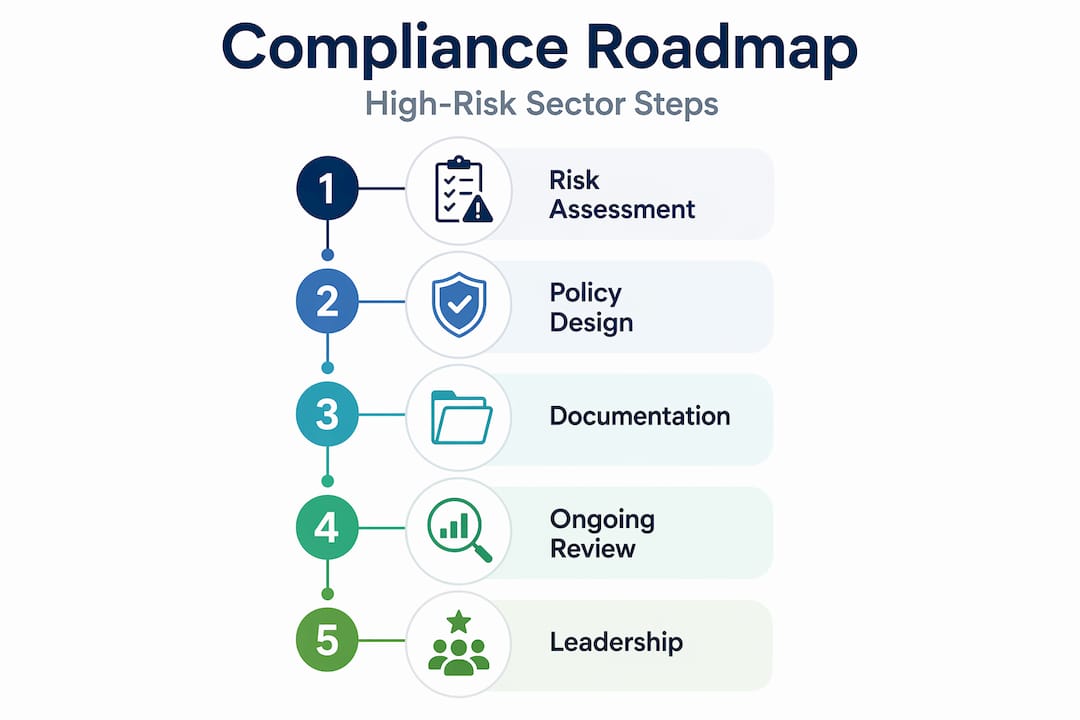
Effective compliance is judged not just by programme existence but by documented effectiveness and governance, including defensible risk assessments and rapid board escalation mechanisms. Enforcement bodies in 2026 are explicitly targeting individual executives, not just corporate entities, when programmes are found to be inadequate.
The governance obligations your leadership team must meet include:
- Written risk assessments that are specific to your business model, customer base, and product set, updated at least annually and whenever material changes occur
- Board-level compliance reporting at defined intervals, with clear metrics on screening performance, suspicious activity reports, and outstanding remediation items
- Escalation protocols that allow compliance officers to reach the board within hours when a high-risk event occurs, not days
- Personal accountability records documenting which executive is responsible for each area of the compliance programme
Regulators are explicit: “we had a compliance programme” is not a defence if you cannot demonstrate that the programme was effective, tested, and actively governed by leadership.
Your high-risk banking governance guide should make clear that the standard of proof required is documentary, not oral. Minutes of board compliance discussions, signed risk assessments, and dated control test results all form part of your evidentiary record. Learning from common high-risk banking mistakes often reveals that most enforcement actions stem not from catastrophic failures, but from gaps in documentation that make a functioning programme look absent.
Pro Tip: Schedule a quarterly thirty-minute board agenda item solely for compliance reporting. Have your compliance officer present three metrics: open issues, recent test results, and upcoming regulatory changes. Document the discussion in board minutes. This single habit creates a paper trail of active governance that is genuinely difficult for a regulator to challenge.
Why compliance investment is non-negotiable for high-risk sector leadership
Here is the uncomfortable truth that most compliance consultants will not say plainly: many high-risk business owners treat compliance as a minimum-viable exercise. Pay for the licence, file the annual report, run a basic screening system. That approach worked, partially, five years ago. It does not work now.
Regulatory modernisation does not reduce scrutiny. It focuses scrutiny more sharply on the highest-risk activities. Crypto, iGaming, forex, and adult entertainment sit at the top of every regulator’s priority list because the volumes, velocities, and jurisdictional complexity make them the most attractive vectors for financial crime. That is not going to change. If anything, enforcement budgets are increasing.
What this means practically is that the cost of under-investing in compliance is not a fine you pay once and move on from. It is the loss of your banking relationship, which in high-risk sectors can be existential. It is the revocation of your licence, which cannot be reinstated quickly. It is the reputational damage that follows an enforcement action, which affects your ability to attract institutional partners, investors, and legitimising counterparties for years.
The crypto business banking compliance reality in 2026 is that the businesses winning access to quality banking relationships and stable payment infrastructure are not the ones spending the least on compliance. They are the ones who have invested in documented, evidence-based programmes and can walk a bank’s correspondent team through them with confidence.
Compliance is not a cost of doing business in spite of your sector. It is the reason you get to keep doing business in your sector.
How BankMyCapital supports your compliance and banking needs
Navigating these challenges is significantly less daunting with the right specialist alongside you. BankMyCapital works exclusively with high-risk operators in crypto, iGaming, forex, and adult entertainment sectors, which means every solution is built around the specific regulatory and commercial realities you face. Our banking onboarding solutions are designed to cut through the friction that causes most high-risk applications to stall, connecting your business with pre-vetted banking partners who already understand your sector. For crypto operators specifically, our crypto banking solutions align with both EU and offshore compliance standards. And our guidance on payment processing best practices ensures your infrastructure meets evolving regulatory demands without sacrificing commercial performance. With an 87% approval rate and onboarding typically completed within two to three weeks, we remove the guesswork from a process that stalls most operators at the first hurdle.
Frequently asked questions
What triggers customer due diligence in high-risk sectors under EU regulations?
Customer due diligence is triggered by transactions exceeding specified cash or transfer amounts, suspicion of money laundering, doubts about customer identity, or linked transaction patterns. Under Regulation (EU) 2024/1624, this includes occasional transactions of at least EUR 10,000 and cash-related CDD for amounts of at least EUR 3,000.
Why are offshore virtual asset service providers considered high compliance risks?
Offshore VASPs frequently evade licensing and oversight by fragmenting operations across multiple entities and nesting customer accounts within other institutions’ structures. FATF’s 2026 findings highlight this regulatory arbitrage and supervision avoidance as a primary driver of money laundering and sanction evasion exposure.
What are the new EU expectations for sanctions screening in high-risk financial sectors?
Sanctions screening systems must undergo formal annual reviews with documented evidence of testing, tuning, and remediation. EBA Guidelines require this as a minimum, with calibration and governance records forming the evidentiary basis for any supervisory examination.
How important is executive involvement in compliance for high-risk businesses?
It is essential and increasingly personal. Enforcement in 2026 targets individual executives when governance and documentation are found inadequate, meaning documented risk assessments, clear escalation processes, and board-level oversight are no longer optional for any owner or director.
