
TL;DR:
- Many high-risk businesses treat compliance as a hurdle, increasing rejection risks with banks.
- Sector-specific frameworks like AML, KYC, and licensing are essential for EU banking approval.
- Proactive compliance practices build stronger banking relationships and reduce rejection rates.
Most high-risk finance businesses treat compliance as a hurdle rather than a tool. That mindset costs them banking relationships, operational stability, and real revenue. Whether you operate in crypto, iGaming, adult entertainment, or forex, the EU banking landscape in 2026 is less forgiving than ever towards businesses that approach regulation reactively. The businesses that thrive are those that understand compliance is not a one-time exercise but a living strategy. This article breaks down why compliance matters, what frameworks apply to your sector, and how you can use it to build stronger banking relationships and reduce rejection risk.
Key Takeaways
| Point | Details |
|---|---|
| Compliance enables banking access | Strategic compliance is fundamental for high-risk businesses to secure banking relationships in the EU. |
| Sector-specific frameworks matter | Each high-risk sector requires tailored compliance strategies for regulatory approval. |
| Proactive risk management | Continuous monitoring and adaptation of compliance processes help prevent banking rejection and operational disruptions. |
| Documentation is essential | Well-organised compliance documentation directly improves approval rates and credibility with banks. |
| Expert support accelerates success | Specialised guidance and tools simplify the complexity of compliance for high-risk finance sectors. |
Why compliance is vital in high-risk finance
High-risk businesses face a structural disadvantage when approaching EU banks. Conventional financial institutions are built around predictable, low-volatility clients. When a crypto exchange or an adult entertainment platform walks through the door, the bank’s risk team sees chargeback exposure, regulatory uncertainty, and reputational risk all at once. The result is rejection, often without explanation.
What many operators do not realise is that banking rejection rates drop significantly when businesses demonstrate genuine regulatory compliance. This is not about appearing compliant. It is about building systems that a bank’s compliance officer can actually audit and feel confident about.
The most common misconceptions we see include:
- Compliance is only necessary after you are rejected by a bank
- A single licence is sufficient to satisfy all EU banking requirements
- Compliance is a legal team’s problem, not an operational one
- Smaller high-risk businesses are exempt from stricter AML obligations
Every one of these beliefs creates risk. Banks do not just check whether you hold a licence. They assess your transaction monitoring systems, your customer due diligence processes, your source of funds documentation, and the quality of your internal controls. Passing bank compliance requires you to speak the bank’s language before you even submit an application.
“Compliance is not the ceiling of what you can do. It is the floor you need to stand on before any serious bank will work with you.”
The sectors most affected by poor compliance preparation are forex and iGaming. Both operate across multiple jurisdictions, which multiplies the regulatory obligations. Adult entertainment businesses, meanwhile, often underestimate the reputational scrutiny banks apply beyond pure legal requirements. Following compliance best practices specific to your sector is not optional. It is the difference between a live account and a rejection letter.
Understanding EU banking regulations as they apply to high-risk sectors is the starting point. From there, the work becomes sector-specific.
Compliance frameworks and sector-specific requirements
Compliance in high-risk finance is not a single standard. It is a layered set of obligations that vary by sector, jurisdiction, and the type of financial activity you conduct. The two foundational pillars across all sectors are Anti-Money Laundering (AML) and Know Your Customer (KYC) requirements. These are non-negotiable for any business seeking an EU bank account.
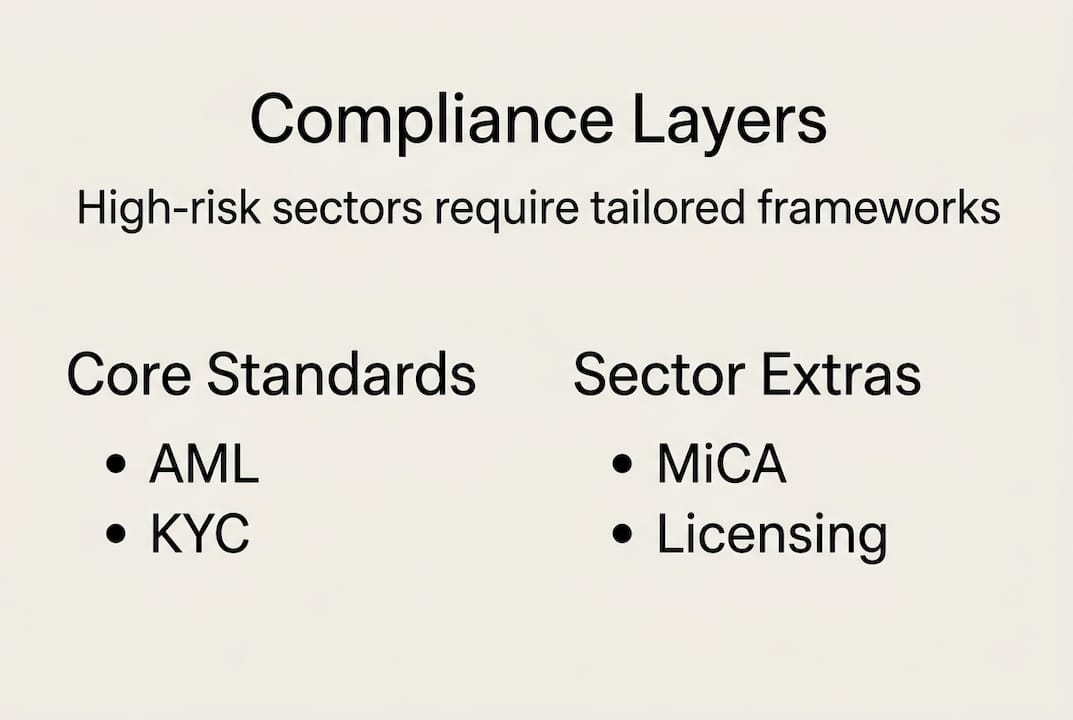
Beyond AML and KYC, each sector carries its own regulatory weight. High-risk sectors require distinct compliance strategies tailored to industry standards, and what works for a crypto exchange will not satisfy a forex broker’s obligations.
Here is a comparison of key compliance requirements across the four major high-risk sectors:
| Sector | Core frameworks | Key EU regulation | Licence required |
|---|---|---|---|
| Crypto | AML, KYC, VASP registration | MiCA (Markets in Crypto-Assets) | VASP or EMI licence |
| iGaming | AML, KYC, responsible gambling | EU Gambling Directive | National gambling licence |
| Adult entertainment | AML, KYC, age verification | DSA (Digital Services Act) | Content platform registration |
| Forex | AML, KYC, MiFID II | MiFID II, EMIR | CIF or investment firm licence |
The practical steps for achieving initial compliance readiness are consistent across sectors, even if the specifics differ:
- Identify the primary jurisdiction where you will be licensed and operate
- Register with the relevant national competent authority for AML purposes
- Implement a documented KYC process with identity verification technology
- Appoint a qualified Money Laundering Reporting Officer (MLRO)
- Draft and maintain an AML policy, risk assessment, and transaction monitoring procedure
- Obtain the sector-specific licence required for your activity
For crypto businesses, the crypto compliance checklist now includes MiCA obligations that came into full force in 2026, covering asset classification, whitepaper requirements, and reserve transparency. These are areas where many crypto operators are still catching up.
Our financial solutions for high-risk businesses are built around these exact frameworks, ensuring that by the time you approach a banking partner, your compliance architecture is already in place. Security and compliance go hand in hand when building a credible banking application.
Building successful banking relationships through compliance
Knowing the frameworks is one thing. Using compliance actively to build banking relationships is where most high-risk businesses fall short. Banks are not just checking boxes. They are assessing whether your business is a long-term, manageable risk. Your compliance posture signals that directly.

Strategic compliance leads to 87% approval rates for high-risk businesses working with the right banking partners in the EU. That figure is not accidental. It reflects what happens when businesses present complete, well-structured compliance documentation before the bank even asks for it.
Here is what proactive compliance looks like in practice:
| Reactive approach | Proactive approach | Outcome difference |
|---|---|---|
| Submit application, wait for queries | Pre-submit compliance pack with AML policy | 60% faster processing |
| Provide documents only when requested | Maintain live document repository | Fewer follow-up requests |
| Address issues after rejection | Conduct pre-application compliance audit | Higher first-attempt approval |
| Annual compliance review | Quarterly monitoring and reporting | Sustained banking access |
The pitfalls most high-risk businesses miss are not dramatic. They are mundane. Outdated beneficial ownership declarations. Transaction monitoring logs that exist but are never reviewed. KYC records that cover new clients but ignore legacy accounts. These gaps are exactly what a bank’s compliance team will find.
Pro Tip: Before submitting any banking application, commission an internal mock audit. Have someone outside your compliance team review your documentation as if they were a bank’s risk officer. You will find gaps you did not know existed.
For businesses seeking SEPA accounts for high-risk operations, the documentation bar is particularly high. SEPA access requires not just compliance documentation but evidence of ongoing monitoring, which means your systems need to be operational, not just described in a policy document.
Understanding banking rejection risks before you apply is the single most effective way to avoid them.
Practical compliance strategies and ongoing risk management
Securing a bank account is not the finish line. The real challenge is maintaining your compliance posture as your business grows, regulations evolve, and transaction volumes increase. Continuous compliance monitoring is essential for high-risk sectors to maintain operational longevity.
Here is a practical framework for ongoing compliance management:
- Conduct quarterly AML risk assessments covering new products, new markets, and changes in customer profile
- Review and update your KYC records on a risk-tiered basis, with high-risk clients reviewed at least annually
- Monitor regulatory updates from the European Banking Authority (EBA) and your sector’s national regulator monthly
- Test your transaction monitoring system with scenario-based exercises at least twice per year
- Maintain an audit trail of all compliance decisions, including why certain transactions were cleared or flagged
- Train all client-facing staff on AML red flags and escalation procedures every six months
The critical risk indicators to watch include sudden spikes in transaction volume, new geographies in your customer base, and changes in the nature of transactions. These are the signals that trigger enhanced due diligence obligations and, if missed, can result in banking partners terminating your account without warning.
Pro Tip: Set a calendar reminder for the first week of each quarter to review your compliance documentation. Treat it like a financial audit. The businesses that maintain EU approval success are those that make compliance a scheduled operational activity, not a crisis response.
Adapting to evolving EU regulation requires you to track MiCA updates for crypto, DSA obligations for adult platforms, and MiFID II amendments for forex. Following crypto compliance strategies specific to 2026 requirements is essential given how rapidly the regulatory landscape has shifted. Reviewing payment processing best practices also helps you stay ahead of the operational compliance requirements that banks monitor post-onboarding.
What most high-risk finance professionals miss about compliance
Here is the uncomfortable truth: most high-risk businesses treat compliance as a cost centre. They hire the minimum required staff, buy the cheapest KYC tool available, and update their AML policy only when a regulator or bank forces them to. That approach does not just create risk. It actively destroys value.
The businesses we see maintaining long-term banking relationships are those that have embedded compliance into their product and operational decisions from day one. When a new payment corridor is opened, compliance is consulted first. When a new customer segment is targeted, the KYC implications are mapped before marketing begins. This is what a proactive compliance culture actually looks like in practice, and it beats reactive box-ticking every time.
The contrarian insight here is that compliance, done well, is a competitive advantage. Businesses that can demonstrate institutional-grade compliance attract better banking partners, negotiate lower fees, and access products that competitors cannot. Your business banking checklist is not just a regulatory requirement. It is a marketing document to the banks you want to work with.
Your next step: expert-backed high-risk banking support
If you have read this far, you already understand that compliance is not a formality. It is the foundation of every successful banking relationship in high-risk finance. At BankMyCapital, we work directly with crypto, iGaming, adult entertainment, and forex businesses to build compliance architectures that banks trust. Our network of over 50 pre-vetted banking partners means we know exactly what each institution needs to see. Whether you are managing banking rejection risks, exploring options for securing high-risk accounts, or ready to follow a proven bank compliance guide, we can help you move from rejection to approval in as little as two to three weeks.
Frequently asked questions
How can high-risk businesses demonstrate compliance to EU banks?
Comprehensive compliance documentation including transparent transaction history and regular audits significantly increases approval rates for high-risk accounts. Presenting this proactively, before the bank requests it, is what separates successful applications from rejected ones.
What are the top compliance frameworks for high-risk financial sectors?
AML and KYC are foundational for all high-risk sectors, with sector-specific licensing requirements layered on top. Crypto businesses must also address MiCA obligations, whilst forex operators require MiFID II compliance.
What mistakes should high-risk finance businesses avoid in compliance?
The most damaging errors are insufficient documentation, outdated KYC records, and failing to monitor regulatory changes. Missing compliance documentation is the single most common reason high-risk applications are rejected by EU banks.
How often should high-risk finance businesses review compliance processes?
Quarterly compliance reviews are considered best practice for high-risk finance, ensuring your processes remain aligned with evolving EU regulations and minimising the risk of unexpected account termination.
