
High-risk businesses in crypto, iGaming, adult entertainment, and forex face mounting challenges securing traditional banking relationships. Restrictive compliance measures and heightened scrutiny from conventional financial institutions create barriers that delay operations and limit growth. Offshore banking provides faster onboarding and flexible options specifically designed for sectors struggling with mainstream bank rejections. This comprehensive guide explains how to navigate offshore banking successfully, from selecting appropriate jurisdictions to managing compliance requirements, ensuring your business maintains the financial infrastructure needed to operate globally.
Key Takeaways
| Point | Details |
|---|---|
| Jurisdiction selection speed | Choosing offshore jurisdictions with an appropriate risk appetite can shorten onboarding and improve approval rates. |
| Due diligence mandatory | Onboarding requires comprehensive documentation and enhanced due diligence including UBO verification and source of funds. |
| Multijurisdictional strategies | Hybrid and multijurisdictional banking reduces operational risk by distributing activity across jurisdictions that understand high risk sectors. |
| Avoid high risk jurisdictions | Avoiding blacklisted or high risk jurisdictions prevents enhanced scrutiny and potential account rejections. |
| Introducers boost approvals | Introducers streamline pre assessment and can substantially increase onboarding success for high risk businesses. |
Understanding high-risk sectors and their banking challenges
Businesses operating in crypto, iGaming, adult entertainment, and forex trading face classification as high-risk sectors by traditional financial institutions. This designation stems from regulatory complexity, reputational concerns, and perceived exposure to financial crime risks. Banks apply stringent compliance frameworks to these industries, creating substantial barriers to account opening and maintenance.
Traditional banking relationships present multiple obstacles for high-risk businesses. Lengthy onboarding processes stretching beyond six months are common, with rejection rates exceeding 60% for first-time applicants. Account closures occur without warning or explanation, disrupting payment processing and client relationships. Banks demand extensive documentation yet provide minimal transparency about decision-making criteria, leaving businesses uncertain about approval prospects.
Offshore banking for high-risk businesses involves selecting jurisdictions with high risk appetite like Malta, Seychelles, St. Lucia, St. Vincent, Curaçao, Belize. These locations maintain regulatory frameworks specifically designed to accommodate sectors facing mainstream banking challenges. Financial institutions in these jurisdictions understand the operational requirements of crypto exchanges, online gaming platforms, and forex brokers, applying proportionate risk assessment rather than blanket rejections.
Key advantages of offshore banking include:
- Multi-currency account capabilities supporting global transaction flows
- Onboarding timelines reduced to 2-3 weeks versus months with traditional banks
- Higher transaction limits accommodating business volumes
- Dedicated relationship managers familiar with sector-specific compliance needs
- Reduced risk of arbitrary account closures due to industry specialisation
Pro Tip: Before approaching offshore banks, research which specific sectors each jurisdiction prioritises. Malta excels for iGaming, whilst Seychelles offers stronger frameworks for crypto businesses. Matching your sector to jurisdictional expertise improves approval odds significantly.
Understanding why offshore banking matters requires recognising that these jurisdictions actively compete for high-risk business by developing sophisticated regulatory environments. They balance compliance requirements with commercial pragmatism, creating sustainable banking relationships rather than imposing prohibitive restrictions.
Preparing for offshore banking: compliance and documentation essentials
Securing offshore bank accounts demands meticulous preparation and comprehensive documentation. Onboarding requires enhanced due diligence including UBO verification, source of funds, business plans, and business licences. Banks scrutinise every aspect of your business structure, ownership, and transaction flows to assess risk profiles accurately.
Essential documentation includes:
- Certificate of Good Standing issued within the past three months
- Detailed business model explanations covering revenue streams and operational processes
- Transaction flow diagrams illustrating fund movements and customer interactions
- Complete AML and KYC policies demonstrating compliance frameworks
- Relevant licences such as MGA authorisation for iGaming or regulatory approvals for forex operations
- Ultimate beneficial owner verification with passport copies and proof of address
- Source of funds documentation tracing capital origins through bank statements and tax records
- Three-year business plans projecting growth and transaction volumes
Ultimate beneficial owner verification extends beyond simple identification. Banks require detailed explanations of how UBOs acquired their wealth, particularly when ownership structures involve multiple entities or jurisdictions. Documentation must trace funds through legitimate business activities, investments, or inheritance, providing clear audit trails that satisfy anti-money laundering requirements.
Business substance matters enormously in offshore banking applications. Banks assess whether your company maintains genuine operational presence rather than serving as a shell entity. Evidence of substance includes local office leases, employment contracts for resident staff, utility bills, and operational expenses demonstrating active business conduct within the jurisdiction.

Hybrid banking structures combining EMIs and traditional offshore accounts provide enhanced resilience against de-risking trends. Electronic money institutions offer faster onboarding and lower initial barriers, whilst offshore banks provide stability for larger transactions and reserve holdings. This dual approach ensures continuity if one provider implements policy changes affecting your sector.
Pro Tip: Engage introducers early in your preparation process. These specialists review documentation before submission, identifying gaps or weaknesses that trigger rejections. Their pre-assessment saves months of delays and substantially increases approval chances by ensuring applications meet bank expectations from initial submission.
Understanding bank compliance for high-risk accounts requires recognising that documentation quality matters more than quantity. Banks value clear, concise explanations over voluminous submissions lacking coherent narratives about your business operations and risk management approaches.
Selecting the right offshore jurisdictions and banking structures
Jurisdiction selection fundamentally determines offshore banking success for high-risk businesses. Each location offers distinct advantages regarding regulatory frameworks, risk appetite, and sector specialisation. Malta maintains robust iGaming infrastructure with MGA licensing attracting gaming operators. Seychelles provides crypto-friendly environments with streamlined incorporation and banking processes. St. Lucia and St. Vincent offer balanced approaches for forex and investment businesses seeking offshore advantages without excessive scrutiny.
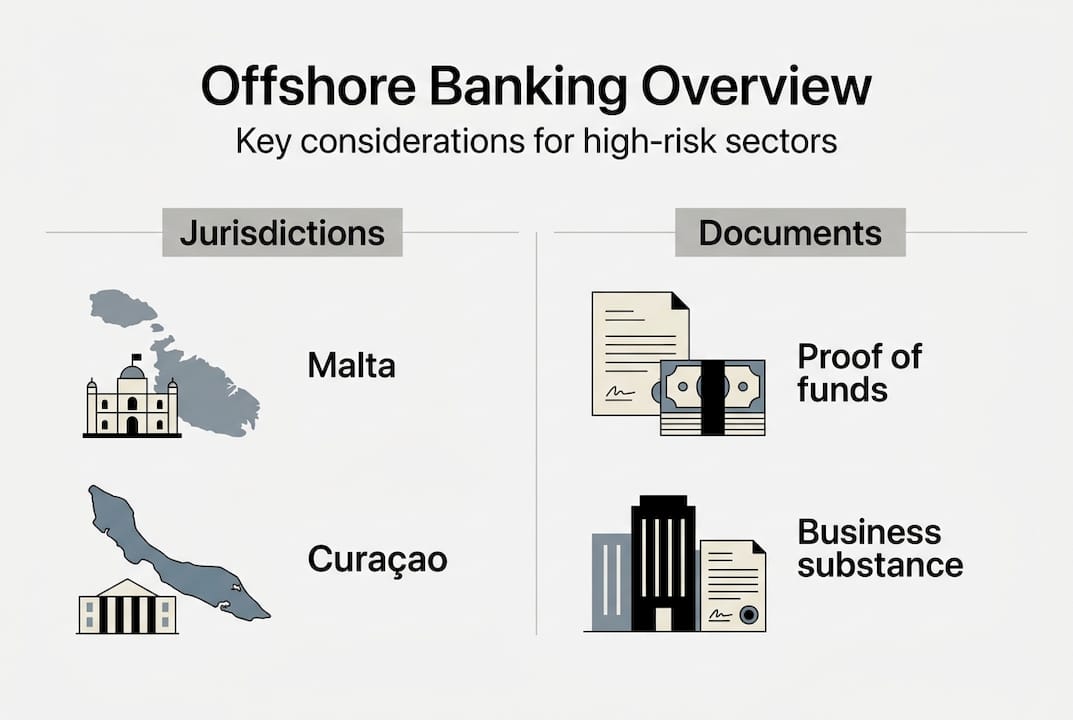
Curaçao attracts online gaming and entertainment sectors through established licensing frameworks and banking relationships. Belize provides cost-effective solutions for businesses prioritising affordability alongside offshore benefits. Each jurisdiction maintains different Basel AML Index scores reflecting their regulatory environments and international perceptions.
| Jurisdiction | Primary sectors | Basel AML risk score | Key advantages |
|---|---|---|---|
| Malta | iGaming, payments | 3.54 (low risk) | EU jurisdiction, MGA licensing, established banking network |
| Seychelles | Crypto, forex | 5.23 (medium risk) | Fast incorporation, crypto-friendly banks, confidentiality |
| St. Lucia | Forex, investment | 5.89 (medium risk) | Stable regulation, reasonable costs, diverse banking options |
| Curaçao | iGaming, adult | 4.67 (medium risk) | Gaming licence recognition, multi-currency support |
| Belize | General high-risk | 6.12 (medium-high risk) | Low costs, straightforward compliance, quick setup |
Avoid EU and FATF high-risk jurisdictions and consider Basel AML Index risk scores when evaluating offshore banking options. Territories appearing on grey or blacklists trigger enhanced due diligence from correspondent banks, creating transaction delays and higher fees. Some banks refuse relationships entirely with businesses incorporated in sanctioned jurisdictions, regardless of operational legitimacy.
Multi-jurisdictional banking strategies optimise operational stability and compliance positioning. Maintaining EU bank accounts for customer-facing transactions provides credibility and facilitates payment processing within European markets. Offshore accounts handle back-office operations, reserve holdings, and transactions requiring greater flexibility. This structure distributes risk whilst maintaining access to diverse banking services.
Hybrid solutions combining EMIs with traditional offshore banks create additional resilience layers:
- EMIs process daily transactions with faster onboarding and lower barriers
- Offshore banks hold reserves and manage larger transfers requiring traditional banking infrastructure
- Multiple providers prevent single points of failure if one relationship terminates
- Diversified jurisdictions reduce exposure to regulatory changes in any single location
Common pitfalls undermining offshore banking applications include vague source of funds explanations lacking documentary support. Banks reject applications when ownership structures appear unnecessarily complex or designed primarily for opacity rather than legitimate business purposes. Artificial arrangements without genuine substance trigger suspicion, whilst outdated or incomplete licensing documentation suggests operational irregularities.
Pro Tip: Research correspondent banking relationships before selecting offshore banks. Some institutions maintain limited correspondent networks, restricting your ability to process international payments efficiently. Banks with established relationships to major financial centres provide superior transaction capabilities.
Exploring choosing offshore banks requires evaluating not just jurisdiction characteristics but specific institutional capabilities, sector experience, and relationship management quality that determine long-term banking success.
Executing the offshore banking application and troubleshooting common issues
Successful offshore banking applications follow structured processes maximising approval prospects whilst minimising delays. Understanding each stage and anticipating potential obstacles enables proactive problem-solving that keeps applications progressing smoothly.
Application process steps:
- Initial assessment evaluating business model, jurisdiction suitability, and documentation readiness
- Provider selection matching your sector requirements with bank capabilities and risk appetite
- Document compilation gathering all required materials in formats meeting bank specifications
- Application submission through introducers who pre-validate materials and facilitate bank communication
- Enhanced due diligence completion responding promptly to bank queries and information requests
- Compliance review addressing any concerns raised during assessment processes
- Account activation finalising agreements, depositing initial funds, and establishing operational procedures
Success hinges on bank pre-approval via introducers, clear narratives and compliance to avoid rejections and delays. Introducers maintain relationships with multiple institutions, understanding specific approval criteria and risk tolerances. They position your application optimally, highlighting strengths whilst addressing potential concerns proactively before banks identify them as problems.
Common application issues include:
- Unclear source of funds documentation lacking transaction trails or supporting evidence
- Unsupported jurisdictions triggering automatic rejections due to bank policy restrictions
- Ambiguous ownership structures suggesting attempts to obscure beneficial ownership
- Artificial corporate arrangements without genuine business substance or operational necessity
- Incomplete licensing documentation or expired authorisations raising compliance concerns
- Inconsistent information across documents creating doubt about application accuracy
Mitigating these risks requires maintaining genuine substance through local agents, physical offices, and resident directors demonstrating operational presence. Transparent explanations connecting business activities to transaction patterns help banks understand your operations rather than relying on assumptions. Updated licences and regulatory approvals signal ongoing compliance commitment and operational legitimacy.
Responding rapidly to bank queries prevents applications stalling in review queues. Banks often request additional information or clarification during due diligence. Delays in responding suggest disorganisation or potential problems, whilst prompt, comprehensive responses demonstrate professionalism and transparency. Prepare supplementary documentation anticipating likely questions about transaction volumes, customer demographics, or risk management procedures.
Managing fees and reserve requirements strategically improves cash flow during onboarding. Some banks require substantial initial deposits or maintain minimum balance requirements affecting working capital. Understanding fee structures including transaction costs, monthly maintenance charges, and compliance review fees enables accurate budgeting. Negotiating terms through introducers often secures more favourable arrangements than direct applications.
Pro Tip: Maintain detailed records of all communications with banks during applications. Document every query, response, and timeline commitment. This creates accountability whilst providing reference materials if applications require escalation or if you need to demonstrate good faith efforts during disputes.
Understanding reasons for bank rejections enables proactive application strengthening, addressing common weaknesses before they derail your offshore banking efforts and cause costly delays.
Explore banking solutions tailored for high-risk businesses
Navigating offshore banking complexities demands specialised expertise and established relationships that high-risk businesses rarely possess internally. Professional services provide critical support throughout jurisdiction selection, documentation preparation, and application management, transforming challenging processes into streamlined operations. Tailored solutions address sector-specific compliance requirements whilst leveraging multi-jurisdictional strategies that optimise operational stability and regulatory positioning.
Expert introducers facilitate bank pre-approval, substantially improving success rates through relationships built over years of sector specialisation. Their structured approaches achieve 87% approval rates by matching business requirements with appropriate banking partners and jurisdictions. Discover comprehensive resources explaining high risk banking overview fundamentals that inform strategic decisions about offshore banking structures.
Actionable tools including detailed banking checklist for high-risk businesses ensure your documentation meets institutional requirements before submission. Step-by-step guidance through the offshore banking setup guide provides frameworks for executing applications efficiently whilst avoiding common pitfalls that delay approvals or trigger rejections.
Frequently asked questions
What is a high-risk business in banking terms?
Businesses involving crypto, iGaming, adult entertainment, and forex are typically classified as high risk due to regulatory complexity, reputational concerns, and perceived exposure to financial crime. Banks apply stricter compliance and enhanced due diligence for these sectors, increasing account opening challenges and rejection rates. This classification stems from both regulatory frameworks and internal risk management policies that banks implement to protect their correspondent banking relationships and regulatory standing.
Why is enhanced due diligence essential for offshore banking?
Enhanced due diligence ensures the legitimacy of business operations and origin of funds, reducing financial crime risks that offshore banks must manage carefully. Documentation such as UBO verification, source of funds, and licences are critical to meet compliance standards imposed by both local regulators and correspondent banking partners. Without thorough due diligence, banks face regulatory penalties and potential loss of correspondent relationships that enable international transaction processing.
How can introducers improve offshore bank account approval rates?
Introducers facilitate pre-approval review and communicate applicant backgrounds clearly to banks, positioning applications optimally from initial submission. They help navigate compliance requirements and recommend suitable jurisdictions based on sector-specific expertise, boosting approval rates up to 87%. Their established relationships enable frank discussions about application strengths and weaknesses before formal submission, allowing applicants to address concerns proactively rather than facing rejections.
What are the risks of choosing blacklisted or high-risk offshore jurisdictions?
Banks impose enhanced due diligence or outright rejections on accounts linked to jurisdictions appearing on FATF grey lists or other sanction frameworks. This leads to delays, higher fees, and potential loss of banking relationships as correspondent banks refuse to process transactions from these territories. Businesses incorporated in blacklisted jurisdictions face ongoing operational challenges even after securing initial banking relationships, as periodic compliance reviews may trigger account closures when policies change.
