
TL;DR:
- True transparency in banking involves documenting, tracing, and explaining every decision made about an account, from onboarding to transaction alerts.
- It relies on measurable frameworks, auditable records, and explainable AI tools to satisfy regulators and maintain high-risk business relationships effectively.
Most operators in crypto, iGaming, or forex think transparency in banking simply means sharing paperwork. It is far more demanding than that. True transparency means every decision your bank makes about your account, from the first identity check to your hundredth transaction alert, is documented, traceable, and explainable to a regulator at any moment. For high-risk businesses, this distinction is not academic. It determines whether you pass compliance, retain your account, and avoid costly delays during investigations. This article breaks down exactly what transparent banking processes involve, the frameworks that make them operational, and the real evidence regulators want to see.
Key Takeaways
| Point | Details |
|---|---|
| Defining transparency | A transparent banking process is evidence-based, documented, and can be audited at every step. |
| Digital onboarding advantage | Using eIDAS-compliant identity solutions boosts auditable remote onboarding for EU and offshore banks. |
| Explainable AI matters | Banks want consistent, explainable decisioning—random explanations aren’t enough for regulators. |
| False positives challenge | Transparently monitored processes can create more false positives and evidence workload unless rules are optimised. |
| Practical evidence wins | Regulators value rapid retrieval and clarity of compliance evidence over superficial documentation. |
What makes a banking process transparent?
Transparency in banking is not a vague virtue. It is a precise operational standard that regulators in the EU and offshore jurisdictions can measure and audit. When a bank’s process is genuinely transparent, every step in onboarding, customer due diligence (CDD), and ongoing monitoring is recorded and retrievable. Decisions are based on documented evidence, not informal judgement.
Transparent banking processes mean evidence-based decisions with auditable documentation and traceable rationales in onboarding, CDD, and ongoing monitoring. That definition matters enormously for high-risk operators because any gap in the chain gives a compliance officer a reason to reject or suspend your account.
The contrast between opaque and transparent processes is stark in practice. An opaque process might flag a transaction as suspicious with no documented rationale. A transparent process records the specific rule that triggered the alert, the analyst who reviewed it, the evidence gathered, and the final decision taken. One survives regulatory scrutiny; the other does not.
Under the EU’s Anti-Money Laundering Regulation (AMLR), transparency means documented identity verification for customers and beneficial owners, with risk-based checks per AMLR Article 22. For high-risk sector operators this is not optional compliance hygiene. It is a prerequisite for maintaining any banking relationship at all.
The key areas where transparent processes are applied include:
- Onboarding: Every document collected, every identity verified, every beneficial owner traced, all recorded with timestamps and analyst notes
- CDD: Risk scores assigned with defined criteria, enhanced due diligence triggered by documented thresholds
- Ongoing monitoring: Transaction rules written down, alerts reviewed on record, escalation pathways followed consistently
- Decision audit trails: Approvals, rejections, and account reviews all supported by written rationale
Operators who engage with high-risk sector compliance early in their banking search avoid the most common trap: presenting themselves to banks without the documented evidence trails that make transparent processing possible in the first place. The banking solutions for high-risk businesses that work long-term are built on this foundation.
“Transparent banking processes are not about volume of paperwork—they are about the quality and retrievability of documented decisions at every stage of the compliance lifecycle.”
Frameworks and tools for transparency: digital identity, risk assessment, and monitoring
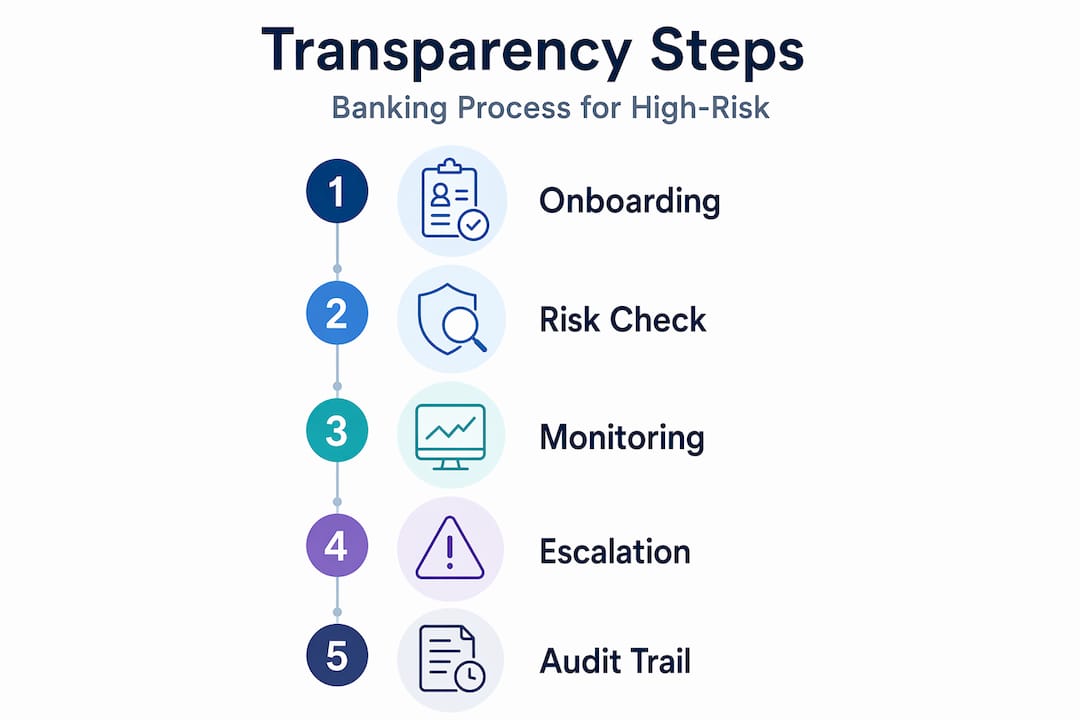
Understanding what transparency means is useful. Knowing the frameworks and tools that make it operational is essential. For EU-regulated and offshore banking relationships, the transparency chain moves through four distinct stages.
- Identity verification: Collect and verify identity documents for all customers and beneficial owners, using approved methods that create a retrievable audit trail
- Risk assessment: Apply a documented risk-scoring model, capturing why each customer is classified low, medium, or high risk
- Transaction monitoring: Set automated rules in writing, ensure every alert generates a case record, and route cases through defined escalation paths
- Record retention: Retain all identity documents, risk assessments, alert cases, and decisions for the period required by applicable regulations (typically five years under EU AML rules)
Digital onboarding has transformed how the first stage works. eIDAS-compliant digital identity supports auditable remote verification, and banks must integrate this with AML and GDPR processes to make it count. This matters most for iGaming, forex, and crypto operators who onboard customers remotely at scale. A manual, face-to-face process is simply not viable.
| Feature | Face-to-face onboarding | Digital/eIDAS onboarding |
|---|---|---|
| Audit trail | Paper-based, variable quality | Automated, timestamped |
| Identity verification speed | Days | Minutes |
| Beneficial owner tracing | Manual documentation | Digital extraction, linked records |
| GDPR compliance | Depends on process | Built-in with compliant platforms |
| Regulator retrievability | Often slow | Immediate digital retrieval |
| Scalability | Low | High |

Transparent processes rely on documented financial-crime risk assessments, monitoring, escalation pathways, and retrievable records. That is the standard against which your bank’s processes will be judged, whether you are applying in the EU or an offshore jurisdiction.
Pro Tip: When assessing a bank or EMI partner, ask specifically how they document escalation decisions during transaction monitoring. If they cannot show you a sample case record, that is a warning sign. A genuinely transparent institution will share its process without hesitation.
For banking onboarding for high-risk businesses, the digital framework matters enormously. Manual processes introduce inconsistency and gaps that regulators notice. Operators who understand passing bank compliance requirements early build their documentation habits before they apply, not after a rejection.
Operationalising transparency: explainable AI, decision documentation and audit trails
With basic frameworks in place, the real challenge in 2026 is ensuring processes are transparent as AI and automation become central to compliance operations. Most banks and larger EMIs now use machine learning models for transaction monitoring and risk scoring. The question for regulators, and therefore for your account relationship, is whether those models are explainable.
Transparency is operationalised through explainability and auditability of automated decisions in banking. Tools like SHAP (SHapley Additive exPlanations) and LIME (Local Interpretable Model-Agnostic Explanations) provide post-hoc explanations of why a model flagged a transaction or scored a customer as high risk. Consistent, regulator-friendly outputs from these tools are essential for regulatory acceptance.
| Tool | Type | Output | Regulator readability |
|---|---|---|---|
| SHAP | Post-hoc explainability | Feature importance scores | High |
| LIME | Post-hoc explainability | Local approximation of model | Medium |
| Decision trees | Inherent interpretability | Rule-based paths | Very high |
| Logistic regression | Inherent interpretability | Coefficient weights | High |
| Neural networks | Black box | Requires post-hoc tools | Low without SHAP/LIME |
What does this mean in practice for high-risk operators? It means your banking partner’s monitoring system should be able to tell you, in plain language, why a specific transaction triggered an alert. If it cannot, a regulator will have the same problem during an investigation. That is a transparency failure.
The evidence trail regulators expect includes:
- Model governance records: Documentation of which model version was in production at the time of a decision
- Alert rationale: For each alert, the specific rule or model output that triggered it
- Review records: Which analyst reviewed the alert, what information they considered, and what decision they made
- Escalation log: Whether the alert was escalated and why
- Outcome records: Whether the case was filed as a suspicious activity report or closed
Pro Tip: If you are negotiating with a banking partner, request evidence that their monitoring platform produces exportable compliance reports. This is a practical test of whether their transparency is real or cosmetic.
Operators who approach compliance unlock banking as a strategic investment, rather than a box-ticking exercise, find that their accounts attract far less friction during routine reviews. Explainability is not just a regulatory requirement. It is a business protection mechanism.
Transparency, cross-border transactions and the evidence burden
Transparency is not only about what happens inside your bank’s systems. It also shapes the quality and speed of cross-border payment processing, which is critical for crypto exchanges, iGaming platforms, and forex brokers operating across multiple jurisdictions.
The SWIFT payment framework improves clarity of fees and tracing for cross-border payments, reducing friction during onboarding and investigations. Clearer tracing means that when a regulator or correspondent bank queries a payment, the information needed to resolve that query is available quickly. For high-risk operators, speed of resolution directly affects account standing.
The practical benefits of transparent cross-border processes include:
- Faster investigations: Regulators can retrieve payment records, counterparty information, and routing history quickly
- Reduced correspondent bank friction: Correspondent banks are more comfortable handling payments when the originating bank’s transparency standards are demonstrable
- Clearer fee structures: Operators know what they are paying for each transaction, reducing disputes and compliance queries
- Stronger onboarding cases: When you can show a bank that your payment flows are traceable and documented, their risk appetite towards your account increases
There is, however, a real operational downside to greater transparency. Transparency may increase false-positive alert volumes, creating an evidence burden. AML false positive rates reportedly range from 85% to 95%, meaning the vast majority of alerts generated by monitoring systems do not represent genuine suspicious activity.
“Better monitoring transparency means more documented alerts. Without careful rule calibration, your compliance team could spend more time closing false positives than investigating real risk.”
For high-risk businesses this is a concrete operational challenge. More transparency means more cases to review, more evidence to gather and file, and more time spent on compliance. The answer is not to reduce transparency but to invest in well-tuned monitoring rules and trained analysts.
Robust banking security and compliance infrastructure must balance comprehensive alerting with realistic workloads. Operators who understand this tension plan for it. Those who do not often find themselves overwhelmed when a new banking relationship triggers far more monitoring activity than their previous, less rigorous arrangement.
Not just transparency for show: what EU banks and regulators really look for
Here is a candid reality that many operators only discover after a rejection or an audit. Regulators are not primarily impressed by the volume of your compliance documentation. They are looking for evidence that your controls actually work, that people follow defined processes, and that when something goes wrong, there is a record of what happened and why.
Regulators may judge transparency based on evidence of risk controls, monitoring escalation, and recorded outcomes. Not formal statements. The difference between a business that passes a regulatory inspection and one that does not is almost never the length of their compliance policy. It is whether they can produce the records that prove their policy was followed.
We have seen high-risk operators present immaculate policy documents during bank onboarding, only to be rejected because they could not demonstrate how those policies were applied to a specific customer or transaction. The bank’s compliance team was not sceptical of the policy. They were sceptical of the operator’s ability to prove it was real.
The practical lesson is straightforward but often missed: show your process, do not just claim you have one. This means sample audit trails from your own monitoring, example escalation records, and documented decisions with rationale attached. When you present these to a banking partner during the high-risk onboarding perspective stage, you are doing something most applicants never do. You are making the bank’s compliance team’s job easier.
The businesses that secure and retain banking relationships in high-risk sectors are not necessarily the most compliant on paper. They are the ones whose compliance is most rapidly retrievable and clearly evidenced in practice. Speed of retrieval is a proxy for quality of control. A well-organised evidence base signals a well-run business.
Get transparent, compliant banking solutions for high-risk businesses
Moving from understanding transparent banking processes to implementing them is where most high-risk operators struggle most. The frameworks are clear, but the execution requires the right banking partners, the right onboarding infrastructure, and compliance support that understands your specific industry’s risk profile. BankMyCapital works directly with crypto, iGaming, forex, and adult entertainment businesses to build exactly this kind of transparent, auditable banking foundation. Whether you need to open a bank account without a local entity, structure your high-risk onboarding process to meet EU AML requirements, or implement end-to-end high-risk payment processing with traceable cross-border flows, the network and expertise are ready. Transparent banking is achievable. The right partner makes the process far faster.
Frequently asked questions
What does ‘transparent banking process’ actually mean for my business?
It means every decision in onboarding, due diligence, and monitoring is documented, traceable, and auditable, so you can prove compliance to any regulator at any time. Transparent banking processes are built on evidence-based decisions with auditable documentation and traceable rationales throughout the compliance lifecycle.
How do I ensure my digital onboarding process is treated as transparent by EU banks?
Using eIDAS-compliant digital identity methods, integrated with AML systems and structured record-keeping, satisfies EU bank transparency requirements for remote onboarding. The key is ensuring your digital trail is as retrievable as any paper-based record would be.
What compliance tools help maintain transparency in bank monitoring?
AI-powered monitoring with explainable outputs, robust audit trails, and documented escalation paths enhances transparency considerably for high-risk sectors. Transparency is operationalised through explainability and auditability of automated decisions, with tools like SHAP producing regulator-ready output.
Are transparent processes more likely to generate false positives in AML monitoring?
Yes, better monitoring transparency often means more documented alerts, which increases false positive volumes unless rules are carefully calibrated. AML false positive rates range from 85% to 95%, making well-tuned monitoring rules a critical investment alongside transparency infrastructure.
How does transparent banking speed up compliance for cross-border payments?
Transparent processes provide clearer fee and tracing information for cross-border payments, reducing friction during both onboarding reviews and live regulatory investigations. The SWIFT payment framework demonstrates how standardised tracing directly accelerates resolution times for high-risk operators.
