
High-risk businesses in crypto, iGaming, adult entertainment, and forex are being pushed out of mainstream banking at an alarming rate. A 44% surge in UK account closures in 2024 alone tells you everything about how traditional banks view these sectors. The consequences are severe: frozen funds, broken payment chains, and operational paralysis that can destroy years of work overnight. Offshore jurisdictions have emerged as a legal, structured, and increasingly popular alternative, offering speed, sector expertise, and genuine compliance frameworks that onshore banks simply refuse to provide. This guide walks you through every dimension of that choice.
Key Takeaways
| Point | Details |
|---|---|
| Offshore solves exclusion | High-risk businesses gain vital access to banking and payment services outside restricted domestic systems. |
| Tax and setup advantages | Top jurisdictions offer low tax, fast account opening, and sector-specific licensing for crypto, gaming, and more. |
| Compliance is essential | Offshore today rewards transparency and legitimate operations but punishes evasion with heavy scrutiny. |
| Choose wisely | Matching your sector profile and risk appetite to the right jurisdiction ensures long-term successful operations. |
The compliance and access crisis for high-risk sectors
Traditional banks are not built for your business. Their risk models flag crypto wallets, gaming revenues, adult content payments, and forex margin accounts as liabilities, not opportunities. The result is a pattern of sudden account closures, frozen transactions, and blanket rejections that leave operators scrambling for alternatives.
Understanding why offshore banking matters starts with recognising what makes onshore relationships so fragile. Banks face regulatory pressure from domestic financial authorities, reputational risk from association with certain sectors, and internal compliance teams that default to rejection when in doubt. For your business, that means instability is baked into every onshore banking relationship.
The numbers are stark. Chargebacks run 2 to 5 times higher in adult and gaming sectors compared to standard retail, which triggers automatic red flags in bank risk systems. The sectors most affected share common pain points:
- Crypto businesses: flagged for AML exposure and volatile transaction patterns
- iGaming operators: high chargeback ratios and complex licensing requirements
- Adult entertainment: reputational risk and payment processor reluctance
- Forex brokers: leverage concerns and cross-border regulatory complexity
“Financial exclusion is not a theoretical risk for high-risk operators. It is an operational reality that strikes without warning and without recourse.”
Comparing offshore vs onshore accounts reveals a structural mismatch: onshore banks are designed for low-risk, domestic, predictable businesses. Yours is none of those things, and no amount of compliance documentation will change that fundamental tension.
What makes offshore jurisdictions attractive?
Offshore jurisdictions are not a loophole. They are purpose-built financial environments that recognise high-risk sectors as legitimate, revenue-generating industries deserving proper banking infrastructure. The advantages are concrete and measurable.

Tax efficiency is the headline benefit. Cayman Islands offers 0% corporate tax, Curacao sits at 2 to 3%, and Seychelles charges no tax on foreign-sourced income. For businesses operating across multiple jurisdictions, these rates represent significant retained capital that can be reinvested into growth.
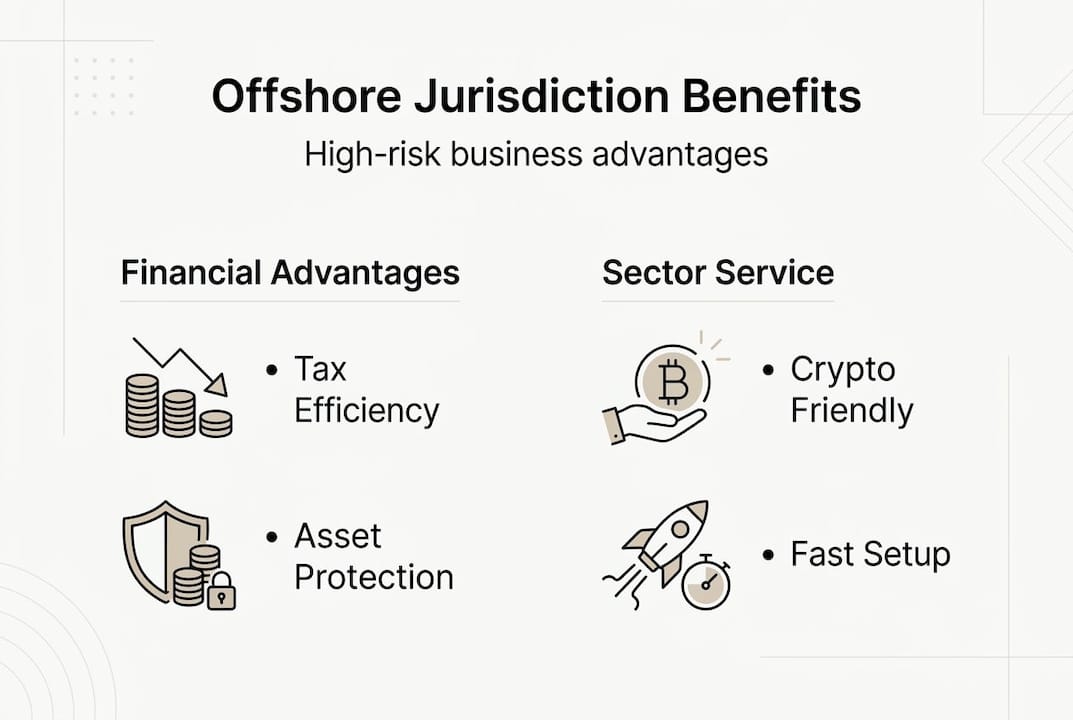
Asset protection is equally important. Offshore structures create legal separation between your operating entity and your personal assets, shielding you from political instability, domestic litigation, and economic volatility in your home country. Privacy layers, while not absolute, add a meaningful buffer.
The offshore banking guide outlines the full range of financial services available, including crypto custody accounts, multi-currency wallets, dedicated high-risk merchant processing, and sector-specific onboarding teams who actually understand your business model.
| Jurisdiction | Corporate tax | Sector strength | Setup time |
|---|---|---|---|
| Cayman Islands | 0% | Crypto, forex | 4 to 6 weeks |
| Curacao | 2 to 3% | iGaming, crypto | 3 to 5 weeks |
| Seychelles | 0% foreign income | All high-risk | 2 to 4 weeks |
| Belize | 0% foreign income | IBCs, forex | 2 to 3 weeks |
| St Vincent | 0% | Forex, crypto | 2 to 3 weeks |
Pro Tip: Do not choose a jurisdiction based on tax rate alone. Sector-specific licensing regimes matter far more for long-term banking stability. Curacao’s gaming licence, for example, carries genuine international recognition that opens doors with payment processors.
The best offshore banks for your sector will vary depending on whether you need crypto custody, multi-currency settlement, or high-volume merchant processing. Matching the jurisdiction to your actual operational needs is the critical first step.
Comparing key offshore jurisdictions for high-risk businesses
Choosing a jurisdiction without a side-by-side comparison is like picking a payment processor without checking their chargeback thresholds. The differences between popular offshore jurisdictions are significant and directly affect your approval odds, licensing costs, and long-term banking relationships.
Cayman Islands suits crypto funds and forex operations that need maximum credibility with institutional counterparties. The regulatory environment is sophisticated, costs are higher, but the reputational weight is considerable. Curacao remains the go-to for iGaming operators, with a well-established licensing framework and banks experienced in gaming revenue flows.
Seychelles and Belize are strong choices for International Business Companies (IBCs) seeking low-cost, fast-setup structures with broad sector acceptance. St Vincent and the Grenadines has become a preferred base for forex brokers, with a 2 to 3 week setup timeline and minimal licensing friction.
For iGaming offshore banks, Curacao consistently outperforms other jurisdictions on both licensing speed and banking access. For adult industry operators, the adult industry benefits of Seychelles and Belize structures are particularly strong, given their broad acceptance of content-related revenue streams.
Key factors to weigh when comparing jurisdictions:
- Regulatory reputation: Does the jurisdiction appear on FATF grey or blacklists?
- Sector licensing: Is there a formal licence available for your specific business type?
- Banking access: Do local banks actively serve your sector, or merely tolerate it?
- Cost structure: What are the annual maintenance, compliance, and renewal fees?
- Exit flexibility: Can you migrate to another jurisdiction if regulations shift?
Onboarding, compliance, and long-term operability in offshore banking
The myth that offshore banking means no scrutiny is dangerously outdated. Modern offshore banks operate under robust KYC and AML frameworks, and they expect compliant operators. What they offer that onshore banks do not is genuine sector understanding and a willingness to work with your business model rather than against it.
The 87% approval rate achieved through vetted offshore banking partners stands in sharp contrast to the single-digit approval rates many high-risk operators experience onshore. Speed is equally impressive: onboarding takes 1 to 3 weeks offshore versus 6 to 10 weeks for the rare onshore approvals that do come through.
A typical offshore onboarding process looks like this:
- Initial assessment: Define your sector, transaction volumes, and jurisdictional requirements
- Document preparation: Corporate structure, beneficial ownership, source of funds, and compliance history
- Bank matching: Align your profile with the most suitable banking partner from a pre-vetted network
- Compliance call: A structured interview with the bank’s compliance team to verify your business model
- Account activation: Final KYC sign-off and account credentials issued
“After recent reforms, offshore banks emphasise transparency. Compliant operators thrive; those attempting to evade AML obligations fall foul of increasingly sophisticated crackdowns.”
Pro Tip: Prepare your compliance documentation before you begin the application process. Incomplete or inconsistent source-of-funds documentation is the single most common reason for delays, even with high-approval-rate partners. Use the offshore setup guide to build a complete documentation pack before you approach any bank.
Long-term operability requires ongoing KYC refreshes, transaction monitoring cooperation, and proactive communication with your banking partner. The offshore banking explained resource covers what to expect at each stage of the relationship lifecycle.
Risks and reputational trade-offs in offshore banking
Offshore banking is not risk-free, and any adviser who tells you otherwise is not being straight with you. The landscape has changed dramatically since the 2009 CFATF reforms, which reshaped how offshore jurisdictions handle AML obligations. Post-reform analysis found that crackdowns displaced some activity into domestic cash sectors, creating approximately 47,000 additional US firms in cash-intensive industries with an estimated value of around £14 billion. The lesson: regulatory pressure does not eliminate risk, it redirects it.
For legitimate operators, the risks are manageable but real:
- Blacklisting exposure: Operating in a jurisdiction that lands on an FATF grey list can trigger correspondent banking restrictions
- Reputational perception: Some investors, partners, and customers view offshore structures with scepticism, regardless of legality
- Sudden regulatory shifts: Jurisdictions can change their licensing frameworks with limited notice
- AML investigation risk: Even compliant operators can face scrutiny if their transaction patterns resemble those of bad actors
“The question is not whether offshore banking carries risk. The question is whether that risk is lower and more manageable than the near-certain exclusion you face onshore.”
Understanding why offshore jurisdictions matter means accepting that the choice involves trade-offs. The onshore versus offshore risks comparison consistently shows that for compliant high-risk operators, offshore structures carry lower operational risk than the constant threat of onshore account closure.
How to decide: framework for choosing the right offshore jurisdiction
A structured decision process removes emotion from what is ultimately a strategic business choice. Each jurisdiction offers unique value based on your sector and compliance profile, so matching those variables systematically is essential.
Follow this framework:
- Define your risk profile: What is your primary sector, average transaction size, and chargeback history?
- Identify required services: Do you need crypto custody, multi-currency accounts, or high-volume merchant processing?
- Assess licensing needs: Does your sector require a formal licence in the chosen jurisdiction?
- Calculate total cost: Include setup fees, annual maintenance, compliance costs, and banking fees
- Evaluate reputational impact: How will your investors, partners, and customers perceive the chosen jurisdiction?
- Engage a specialist intermediary: Work with a consultancy that has pre-vetted relationships with banks in your target jurisdiction
Use the sector banking guide to map your specific requirements against available jurisdictions before committing to any structure.
Pro Tip: Prioritise transparency and thorough documentation from day one. Banks that understand your sector will reward clean, well-organised compliance files with faster approvals and more stable long-term relationships. Cutting corners on documentation is the fastest route to account closure, even offshore.
Secure the offshore banking advantage for your high-risk business
Moving from understanding to action is where most high-risk operators stall. The research is done, the jurisdiction shortlist is ready, but the actual process of securing a compliant offshore account feels opaque. That is precisely where specialist guidance makes the difference between a 2-week approval and a 6-month delay. At BankMyCapital, we work with a network of over 50 pre-vetted banking partners and EMIs, achieving an 87% approval rate for high-risk applications across crypto, iGaming, adult, and forex sectors. Understanding your banking rejection risks before you apply is the first step. From there, our offshore banking solutions and detailed offshore banking guide give you the tools to move quickly, compliantly, and with confidence.
Frequently asked questions
Are offshore jurisdictions legal for high-risk businesses?
Yes, offshore jurisdictions are fully legal for compliant high-risk businesses in crypto, iGaming, adult, and forex, provided all relevant domestic and international laws are respected. Offshore structures serve legitimate needs when built on proper compliance foundations.
How long does offshore account setup typically take?
Opening an offshore account usually takes 2 to 6 weeks depending on the jurisdiction and the quality of your documentation. St Vincent setups complete in 2 to 3 weeks, while more complex jurisdictions like Cayman may take slightly longer.
What sectors benefit most from offshore jurisdictions?
Crypto, iGaming, adult entertainment, and forex businesses benefit most because offshore banks offer specialised onboarding and compliance frameworks that domestic banks refuse to provide. These sectors are actively excluded by most onshore institutions.
Do offshore banks now enforce strict compliance?
Modern offshore banks require robust KYC, AML monitoring, and ongoing compliance cooperation, fully aligned with international standards following post-CRS reforms. The difference is that they understand your sector and apply those standards with context rather than blanket rejection.
